

Did you know that 94% of UK solar installations now include battery storage? In Staffordshire, homeowners are no longer just looking at panels; they're investing in solar battery installation Staffordshire residents trust to make every ray of sunshine count. It's frustrating to watch your solar energy drift back to the grid for pennies while your evening electricity bills remain stubbornly high. You want the security of knowing your home stays lit during a power cut and the confidence that you're not overpaying for tech you don't understand.
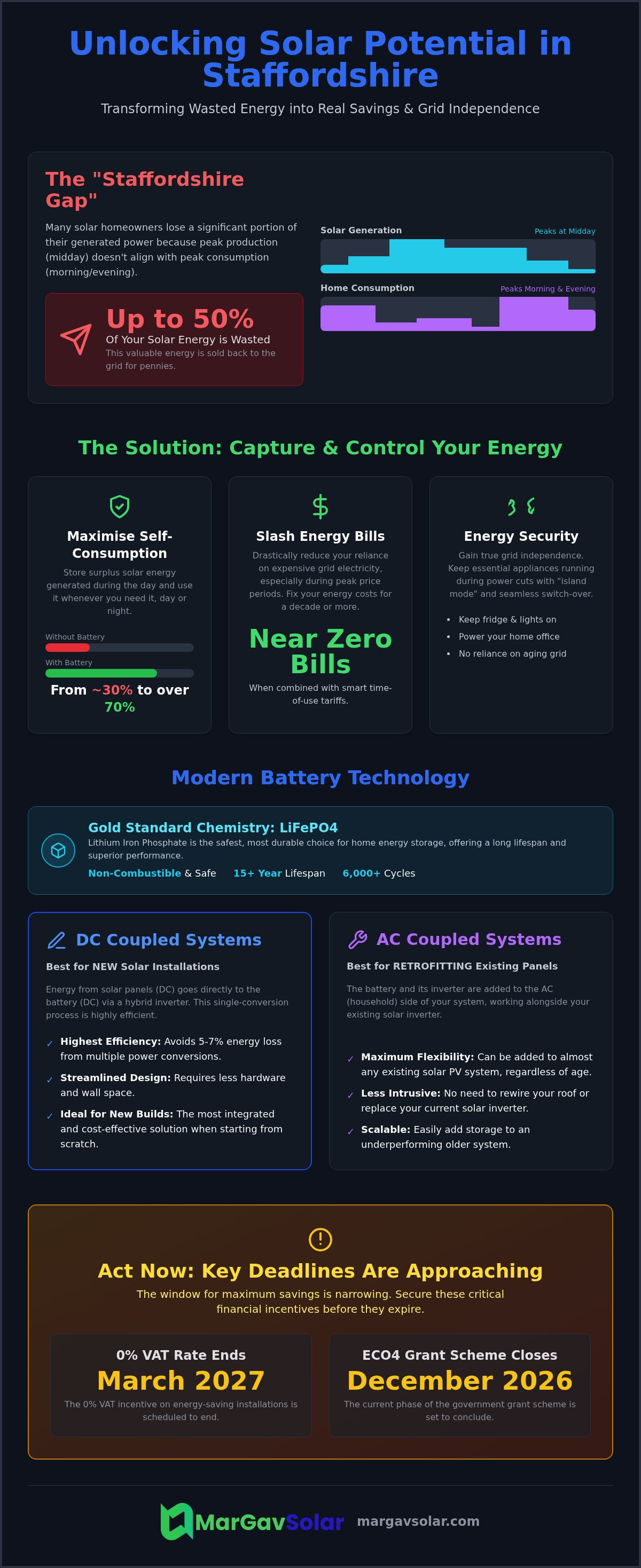
This guide will show you how to transform your energy profile, slashing bills and providing true grid independence. With the 0% VAT rate set to end in March 2027 and the ECO4 grant scheme closing in December 2026, the window for maximum savings is narrowing. We'll explore the latest 2026 battery technologies, local grant eligibility for Staffordshire homes, and how to integrate smart tariffs to ensure your system pays for itself as quickly as possible.
Key Takeaways
- Understand why Staffordshire solar owners often lose 50% of their generated power and how storage fixes this "energy gap."
- Learn how professional solar battery installation Staffordshire services guide you through choosing the right AC or DC coupled technology.
- Discover the secret to sizing your system correctly to avoid paying for capacity you won't use or running out when you need it most.
- Find out how to combine smart time-of-use tariffs with professional monitoring to slash your electricity bills to near zero.
- Identify the critical 2026 deadlines for grants and tax incentives that make this the most cost-effective year to upgrade.
Why Battery Storage is Essential for Staffordshire Solar Systems in 2026
Solar panels alone are a passive technology. They generate electricity when the sun is out, but if you're not home to use it, that power flows back to the grid. In 2026, we see many local homeowners struggling with the "Staffordshire Gap." This is a phenomenon where homes without storage lose up to 50% of their generated energy because their peak production doesn't align with their peak consumption. Professional solar battery installation Staffordshire wide is the solution that shifts your home from passive generation to active energy management, starting with Understanding Modern Battery Technology and how it stores surplus power.
By integrating a storage system, you capture that midday surplus. Instead of selling it back for a few pence, you use it at 7:00 PM when grid prices are highest. This transition is vital as UK energy costs continue to fluctuate. A battery effectively fixes your energy costs for the next decade or more, shielding you from the volatility of the national market. It also reduces your carbon footprint by ensuring you use your own green energy rather than drawing from the grid during peak times when fossil fuel plants are often fired up to meet demand.
The Financial Case for Battery Storage
The math for storage has changed significantly. Most Staffordshire homes reach "solar noon" when occupancy is lowest. Without a battery, your self-consumption rate might be as low as 20% or 30%. Adding storage can push this above 70%, drastically reducing what you buy from suppliers. Beyond daily savings, there's a clear impact on property value. Buyers in Stafford and surrounding areas now look for "future-proofed" homes. A high-spec battery system is a tangible asset that makes a property more attractive in a competitive market. Keep in mind that the 0% VAT incentive on these installations is scheduled to end in March 2027, making 2026 the peak year for return on investment.
Energy Security and Power Cut Protection
Modern battery systems offer more than just savings; they provide peace of mind through "island mode." If the grid goes down in Cannock or Lichfield, a standard solar system will shut off for safety. However, with the right solar battery installation Staffordshire experts provide, your system can decouple from the grid. This allows for:
- Essential Loads: You can prioritise keeping the fridge, LED lights, and home office running.
- Seamless Transition: High-end inverters offer a switch-over so fast you might not even notice the power went out.
- Grid Independence: You're no longer fully reliant on aging infrastructure during winter storms or local maintenance.
Understanding Modern Battery Technology: AC vs DC Coupled Systems
Choosing the right hardware for a solar battery installation Staffordshire project involves cutting through a lot of marketing noise. You'll likely hear terms like "coupling" and "chemistry" thrown around. In 2026, the gold standard for home storage is Lithium Iron Phosphate (LiFePO4). Unlike older lithium-ion batteries found in laptops, LiFePO4 is non-combustible and doesn't suffer from thermal runaway. It's incredibly durable, often maintaining 80% of its capacity after 6,000 cycles. This means your battery could easily last 15 years while providing daily support to your household.
DC Coupled Systems: Best for New Builds
DC coupled systems are generally the most efficient choice for new solar PV systems. Solar panels generate direct current (DC) electricity, and batteries store energy in the same format. By using a hybrid inverter, the energy stays as DC from the roof to the battery. This avoids the "conversion tax" where energy is turned into AC and back again, which typically wastes about 5% to 7% of your power. These systems are streamlined and require less wall space, making them ideal for modern homes in Stafford or Lichfield where utility room space is at a premium.
AC Coupled Systems: Retrofitting Your Current Panels
If you already have solar panels installed, AC coupling is usually the best way to go. This technology allows the battery to sit on the "home side" of your existing inverter. It's the least intrusive method for a solar battery installation Staffordshire homeowners choose for their existing arrays because you don't need to rewire your entire roof. While slightly less efficient than DC setups due to multiple conversions, it offers incredible flexibility. You can add an AC-coupled battery to almost any existing system, regardless of its age. If you're finding your current setup isn't meeting your needs, you might consider inverter upgrades in Staffordshire to improve overall performance.
Impartial guidance from the Energy Saving Trust regarding Smart Tariffs and GivEnergy Integration suggests that the way your battery communicates with the grid is just as important as how it connects to your panels. Our specialists can help you weigh these technical trade-offs; why not explore our battery storage solutions to see which fits your home?
Sizing Your System: How Much Storage Does Your Staffordshire Home Need?
Sizing isn't a one-size-fits-all approach. For a successful solar battery installation Staffordshire project, we start by analyzing your annual kilowatt-hour (kWh) usage. It's not just about what you use, but when you use it. If you generate 15kWh on a sunny July day but only use 4kWh in the evening, a massive 15kWh battery might be overkill. Conversely, you don't want to undersize and find yourself buying expensive peak power by 8:00 PM. We also account for Staffordshire's specific light levels. In winter, your panels might only produce 15% of their summer peak. This means your battery needs to be sized to catch every scrap of available light during those shorter days.
Beware the "Usable Capacity" trap. A battery marketed as 10kWh might only have 9kWh of usable energy. This is due to the Depth of Discharge (DoD) limits. While modern LiFePO4 batteries have high DoD, older or lower-quality alternatives might require leaving 20% of the charge untouched to prevent damage. Understanding the technical nuances between AC vs DC Coupled Systems also plays a role here; efficiency losses during conversion can slightly reduce the total energy available for your appliances.
The Small to Medium Household (3kWh - 5kWh)
This range is perfect for smaller properties in Lichfield or Tamworth. If your home primarily uses electricity for lighting, the TV, and a fridge-freezer during the evening, a 3kWh to 5kWh unit is often sufficient. These systems typically offer the fastest ROI because they are fully cycled almost every day. When planning a solar battery installation Staffordshire homeowners often find this entry-level capacity provides the most immediate impact on their utility bills by wiping out their "baseload" costs.
The Large Family Home (10kWh - 15kWh+)
Larger detached homes with high demand need more "muscle." If you're running multiple loads like dishwashers and ovens simultaneously, you need a higher discharge rate and more storage. This is also where future-proofing becomes critical. If you plan to install an EV charger or a heat pump in the next few years, your demand will spike. Investing in larger solar battery storage in Staffordshire now prevents expensive retrofitting later. A 10kWh+ system ensures you have enough buffer to handle heavy appliances without instantly draining your reserves, making it a smarter long-term investment for growing families.
The Professional Installation Process: What to Expect from MarGav Solar
We don't believe in generic estimates. Every solar battery installation Staffordshire project begins with a detailed on-site survey and energy audit. Our engineers, drawing on 20+ years of expertise, evaluate your existing solar array and your home’s electrical infrastructure. We don't just look at your roof; we look at your fuse board, your cable runs, and your consumption habits. As specialists in GivEnergy systems, we ensure the hardware is perfectly matched to your property's specific requirements. This thoroughness allows us to provide a fixed-price installation contract, ensuring you never face unexpected costs once work begins.
Once the design is finalised, our NICEIC-certified engineers handle the physical integration. This involves mounting the battery units, installing the hybrid inverter, and configuring the smart sensors that monitor your energy flow. We pride ourselves on clean, efficient workmanship that respects your home and minimises disruption to your daily routine.
Why NICEIC Certification Matters for Your Warranty
High-voltage battery systems carry significant electrical risks if handled by uncertified installers. Professional certification is your primary safeguard. It ensures that the installation complies with current UK building regulations and manufacturer warranty requirements. Without this, you might find your equipment warranty void or your home insurance invalid in the event of a fault. We provide all necessary compliance certificates upon completion, giving you total peace of mind. You can learn more in our NICEIC certification guide.
Local Knowledge: Dealing with Western Power Distribution (WPD)
Navigating grid permissions is often the most confusing part of the process for Staffordshire residents. Your District Network Operator (DNO), usually Western Power Distribution (WPD), must be notified of any battery storage addition. We take this burden off your shoulders. We determine whether your system fits under G98 "fit and inform" rules or requires a prior G99 application for larger systems. Our team handles all the technical dialogue with WPD, including managing export limitations and ensuring your smart meter is correctly configured for your new setup.
After the hardware is live, we perform a comprehensive handover. We'll set up your monitoring app on your phone, show you how to track your savings in real-time, and explain how to prioritise essential loads during a power cut. If you're ready to secure your energy future, book your Staffordshire on-site survey today.
Maximising Your ROI with Smart Tariffs and GivEnergy Integration
Energy independence isn't just about making power; it's about when you use it. In 2026, the real financial gains from a solar battery installation Staffordshire homeowners invest in come from Time-of-Use (ToU) tariffs. Tariffs like those from So Energy or Ecotricity offer Smart Export Guarantee (SEG) rates up to 20p/kWh, but the real magic is "arbitrage." This involves charging your battery from the grid during the night when prices are at their lowest and using that stored energy during the expensive 4:00 PM to 7:00 PM peak. By shifting your load, you're not just saving pennies; you're effectively decoupling your lifestyle from the most expensive hours of the day.
Control is central to this strategy. Systems like the GivEnergy Cloud allow you to manage these cycles directly from your smartphone. You can set your battery to charge only when rates drop or hold its charge if a storm is forecast and you want backup security. Our GivEnergy Cloud guide for Staffordshire explains how to automate these settings so your system works for you without constant manual input. This level of active management ensures you get the most out of every kilowatt-hour stored.
Integrating with EV Charging
If you drive an electric vehicle, your battery storage becomes even more valuable. High-speed chargers can put a massive strain on your home's supply. By using your battery as a buffer, you can charge your car using stored solar energy or cheap overnight electricity without tripping your main breaker or drawing from the grid at peak prices. Coordinating your solar, battery, and EV charging points in Staffordshire creates a closed-loop energy system. This can reduce your total reliance on the National Grid by an average of 73% compared to traditional homes, making your transport costs almost negligible.
Long-Term Maintenance and Support
A solar battery installation Staffordshire project is a 15 to 20-year commitment. While the hardware is robust, professional monitoring ensures your system doesn't lose efficiency over time. MarGav Solar provides end-to-end aftercare, drawing on over 20 years of local experience to keep your system performing at its peak. Regular checks prevent minor software glitches from becoming major downtime. For more on keeping your hardware in top shape, see our guide on solar panel maintenance in Staffordshire. Our fixed-price contracts and local presence mean we're here for the lifetime of your system, ensuring your investment remains protected long after the initial installation.
Secure Your Staffordshire Energy Future Today
The shift from passive solar generation to active energy management is the most significant change homeowners can make in 2026. By choosing the right battery technology and sizing it to your specific household needs, you're not just protecting yourself from grid volatility; you're taking control of your financial future. With critical deadlines for VAT incentives and grant schemes approaching fast, now is the ideal time to act. Professional solar battery installation Staffordshire residents rely on ensures your system is safe, efficient, and fully integrated with the latest smart tariffs.
At MarGav Solar, we bring 20+ years of Staffordshire expertise and NICEIC certified installers to every project. We understand the local landscape and the specific requirements of the regional power grid. Our fixed-price installation guarantee means you can invest with confidence, knowing exactly what to expect from the first survey to the final handover. It's time to stop exporting your valuable energy and start using it where it matters most: in your own home.
Get Your Free, Fixed-Price Solar Battery Quote in Staffordshire and take the first step toward true energy independence today.
Frequently Asked Questions
How much does solar battery installation cost in Staffordshire?
Industry averages for 2026 suggest that a 5kWh system typically costs between £3,000 and £5,000, while larger 10kWh units range from £4,000 to £6,000. These figures usually include the inverter and professional labour. Retrofitting a battery to an existing array often carries a slightly higher price point due to additional wiring requirements. Because every home is unique, we provide fixed-price contracts based on a specific on-site energy audit.
Can I add a battery to my existing solar panel system?
Yes, most existing solar arrays are compatible with modern storage through AC coupling. This method allows the battery to work alongside your current inverter without needing to replace your roof panels. It's a popular choice for a solar battery installation Staffordshire homeowners use to upgrade older systems. We assess your current setup to ensure the new battery integrates seamlessly with your existing generation capacity and household wiring.
How long do solar batteries typically last in the UK climate?
Modern Lithium Iron Phosphate (LiFePO4) batteries generally last between 10 and 15 years. Their lifespan is measured in cycles, with many units rated for 6,000 cycles before they reach 80% of their original capacity. The UK’s temperate climate is actually beneficial for battery health, as extreme heat can degrade cells faster. Installing the unit in a cool, dry space like a utility room or garage further protects the technology’s longevity.
Do I need planning permission for a solar battery in Staffordshire?
In most cases, planning permission isn't required as battery storage falls under permitted development. However, if your home is a listed building or located in a conservation area, such as parts of Lichfield or Stafford, you should check with your local council first. The installation is typically internal or involves a small external cabinet, making it unobtrusive. We always recommend verifying local restrictions if your property has specific heritage protections.
Will a solar battery charge on cloudy days in Staffordshire?
Yes, solar panels generate electricity from diffuse light even when it's overcast. While generation is lower than on a bright summer day, your system will still capture energy to trickle-charge the battery. In 2026, many residents also use smart tariffs to top up their batteries from the grid during cheap overnight hours. This ensures you have a full store of power ready for the morning, regardless of the previous day's weather.
What happens to my solar battery during a power cut?
Standard systems usually shut down during a power cut for safety. However, if your solar battery installation Staffordshire project includes an emergency backup or island mode function, your home can remain powered. You can choose to support your entire house or just essential circuits like lighting and the fridge. This provides vital security during local grid outages, keeping your most important appliances running until the main power returns.
Is a 5kWh battery enough for a 3-bedroom house in Stafford?
A 5kWh battery is often sufficient for covering the evening baseload of a standard 3-bedroom home, including lights, electronics, and refrigeration. However, it may struggle if you run high-demand appliances like a tumble dryer or electric oven simultaneously. For families with higher evening consumption or those planning to add an EV charger, a 10kWh system usually provides better long-term value and greater grid independence for a larger household.
How much can I save on my energy bills with a solar battery?
Combining solar panels with a battery can reduce your reliance on the National Grid by an average of 73%. Your actual savings depend on your tariff and consumption habits. By using stored energy during peak evening hours instead of buying from the grid, many Staffordshire households see a significant drop in their monthly outgoings. When paired with smart, time-of-use tariffs, the potential for annual savings increases even further.


