

Exporting every spare unit isn’t necessarily the best way to get value from solar. For the UK in 2026, Smart Export Guarantee (SEG) eligibility for micro-CHP systems allows a capacity of up to 50 kW, opening up new opportunities for homeowners. Here at MarGav Solar, we help you understand that you’re paid specifically for the electricity you send to the grid, not the electricity you use at home.
It’s natural to focus on the export rate, but how much electricity you export matters just as much. Using more of your solar power at home can reduce what you buy from the grid. A battery can store surplus electricity for later use, changing how much you export.
This guide explains what affects SEG payments, which renewable systems may qualify and how to apply. It also covers how self-use and battery storage affect exports, helping you understand the trade-offs behind potential earnings.
Key Takeaways
- Eligible renewable installations can have a capacity of up to 5 MW, and according to Ofgem, the FIT scheme closed to new applicants from 1 April 2019.
- Certification evidence, an export-capable smart meter, your MPAN and installation details are key parts of an SEG application.
- You need to apply directly to an SEG supplier; export payments don’t start automatically.
- Using solar electricity at home or storing it in a battery changes how much is left to export, so weigh export income against the value of using less grid electricity.
Capacity limits for eligible renewable installations
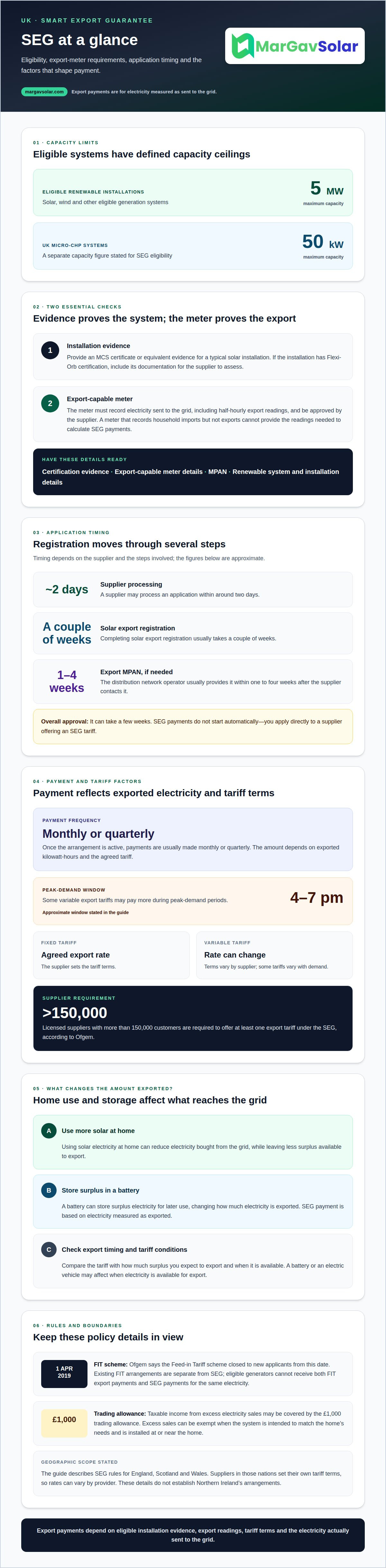
The Smart Export Guarantee (SEG) pays eligible generators for renewable electricity exported to the grid. Solar panels, wind turbines and micro combined heat and power systems may qualify. According to Ofgem, eligible installations can have a capacity of up to 5 MW. UK micro-CHP systems can have a capacity of up to 50 kW for SEG eligibility.
For a typical domestic solar installation, eligibility generally depends on MCS certification or equivalent evidence. Ofgem says the Feed-in Tariff (FIT) scheme closed to new applicants from 1 April 2019. Existing FIT arrangements are separate from SEG: eligible generators cannot receive both FIT export payments and SEG payments for the same electricity.
Fixed tariffs pay an agreed export rate, while variable tariffs can change; suppliers set their terms. Time-of-use tariffs can pay more during peak-demand windows, roughly from 4pm to 7pm, so payment depends on when surplus electricity is exported.
Solar panels need eligible certification, and applicants typically provide an MCS certificate or equivalent proof of installation. An export-capable smart meter records electricity sent to the grid. You’ll also need your MPAN and installation details. A battery can store surplus power, but export payments are based on electricity measured as exported.
Export earnings depend on the tariff and the volume of electricity recorded, while system and metering arrangements affect practical readiness. For tax, excess electricity sales can be exempt when the system is intended to match the home’s needs and is installed at or near the home. Taxable income may be covered by the £1,000 trading allowance.
The SEG rules described here cover England, Scotland and Wales. Suppliers in those nations set their own tariff terms, so rates can vary by provider. These details do not establish Northern Ireland’s arrangements.
A government grant for a solar installation does not, by itself, prevent SEG payments. The system still needs to meet the relevant SEG requirements. Keep proof of installation, such as an MCS certificate or equivalent, ready for your application.
Smart meters and MCS or Flexi-Orb certification
An SEG application needs evidence that the generating system meets certification requirements. For a typical solar installation, this means an MCS certificate or evidence of equivalent certification. If your installation has Flexi-Orb certification, include its documentation for the supplier to assess. Certification helps establish what equipment was installed and supports your application for export tariffs.
The meter must measure exported electricity separately from electricity imported for household use. A smart meter used for SEG export payments must record half-hourly export readings and be approved by the supplier. A smart or bidirectional meter can measure electricity flowing both ways, but it is suitable only if it records the required export data.
Before applying, gather your certification evidence, MPAN and solar installation details. The supplier uses these alongside meter readings to set up export payments. If your meter records imports but not exports, the supplier won’t have the readings needed to calculate SEG payments. Meter capability is essential because it links generation records to the electricity eligible for payment.
Certification and metering serve different purposes. MCS or equivalent certification documents the installation, while the meter records electricity sent to the grid. A battery or electric vehicle may affect when electricity is available to export, but neither replaces the need for export readings. A supplier may pay for electricity exported from a household battery or an electric vehicle that can import and export electricity.
For households planning an EV charging point alongside solar, consider how charging affects the electricity left for export. A suitable EV charging point installation can form part of that wider energy plan. Keep your certification and meter details together, so the supplier can assess the installation and register its export measurements.
Applying for SEG payments
SEG payments don’t start automatically when your renewable system begins generating. Apply directly to an electricity supplier offering an SEG tariff, then provide the information needed to register your exports. The supplier paying for your exports does not have to be the company supplying electricity to your home.
Prepare the key details before submitting an application. Suppliers commonly request:
- Proof of MCS certification or equivalent evidence for the installation.
- Your export-capable meter details and MPAN.
- Information about the renewable system, including its installation.
These records help the supplier assess eligibility and link measured exports to your account. Your meter must record electricity sent to the grid, not just household consumption. Without export readings, the supplier can’t calculate payments.
Timing depends on the steps involved. A supplier may process an application within around two days, while completing solar export registration usually takes a couple of weeks. Overall approval can take a few weeks. If you need an export MPAN, the distribution network operator usually provides it within one to four weeks after the supplier contacts it.
Once the arrangement is active, payments are usually made monthly or quarterly. The amount depends on exported kilowatt-hours and the agreed tariff. SEG rates vary between suppliers and may change yearly, so compare the tariff terms, including whether the rate is fixed or variable. Some variable export tariffs pay more during peak demand windows, roughly from 4pm to 7pm.
Licensed suppliers with more than 150,000 customers are required to offer at least one export tariff under the SEG, according to Ofgem. That doesn’t mean every tariff suits every household. Consider how much surplus you expect to export, when it’s available, and any tariff conditions. Keep the application details and payment records together; they make it easier to follow registration progress and understand each payment.
Self-consumption and battery storage
The best return from solar panels isn’t always the highest SEG rate. Using a unit of self-generated electricity avoids buying that unit from the grid. At an import price of around 24p/kWh in the UK in 2026, each self-used unit saves around 24p, while an export earns the tariff rate. Self-consumption can therefore deliver roughly two to six times more value per unit than exporting.
Timing helps households use more of their generation directly. Shifting flexible electricity use to peak solar hours, roughly 10am to 4pm, can reduce imports while panels are producing. Running suitable appliances or charging an electric vehicle during this period uses available solar power rather than sending that surplus to the grid.
A battery changes when you use solar electricity. It stores excess daytime generation for later, such as after sunset, reducing immediate exports and potentially lowering evening imports. The benefit depends on household consumption, solar output, battery capacity and the SEG rate. A battery makes less difference if you already use most of your solar generation as it is produced.
For context, a UK household with a 4.6kWp solar system, a 5.2kWh battery and annual electricity use of 3,400kWh is estimated to export around 65% of its solar generation. Without a battery, around half of generated electricity may be exported. These examples show why export totals vary with system size, usage patterns and storage, rather than tariff alone.
A battery can also affect export timing. Some energy suppliers offer variable tariffs that pay more during peak-demand windows, roughly from 4pm to 7pm. Stored energy may be available then, but exporting it means it isn’t available for household use. Compare the value of the SEG rate with the import cost you avoid, and choose how to use stored power around your priorities.
To plan a system around household use and exports, explore solar and battery storage options.
MarGav Solar
MarGav Solar helps households plan and install renewable energy systems around their electricity use and potential exports. Its residential solar PV systems and battery storage solutions can be planned together, bringing generation, self-consumption and surplus exports into one practical plan.
If you already have panels, MarGav Solar provides solar panel maintenance and cleaning to support their ongoing operation. It also installs EV charging points, which can be included in household energy planning when charging may use electricity generated at home. The right combination depends on your property, energy use and priorities, including how much power you want to use rather than export.
For help planning a solar or battery system around your household’s needs, contact MarGav Solar.
Make your next energy decision count
Before changing your setup, decide what you want your electricity to do: support everyday home use, charge an electric vehicle, or earn export payments from surplus generation. That priority can guide how you think about future energy needs, not just today’s export income. Planning for selling electricity back to the grid in the UK in 2026 works best when export potential is considered alongside household consumption and the way you may use electricity later.
MarGav Solar offers residential solar PV systems, battery storage solutions and EV charging points. Together, these options can support a joined-up plan for generating, storing and using electricity at home. The right mix depends on your property and priorities. Discuss what you want your energy system to achieve with MarGav Solar.
Contact MarGav Solar today to talk through your plans and move forward with confidence.
Frequently Asked Questions
How Much for Selling Electricity Back to the Grid?
For selling electricity back to the grid in the UK in 2026, typical SEG rates range from 3p to 15p per kWh, and many households earn around £50 to £300 annually. Your total depends on exported units and your tariff. For example, exporting 1,500 kWh at 10p per kWh earns £150 before any other household energy costs are considered.
How do you sell power back to the grid?
Generate electricity with an eligible renewable system, then arrange an export tariff with an SEG supplier. Your meter must record electricity flowing to the grid so the supplier can calculate payments from export readings. For example, a home using solar power during the day exports only the surplus it doesn’t consume or store. Exporting electricity alone won’t start SEG payments; you also need to register.
How do you apply for a SEG tariff?
Apply directly to an electricity supplier that offers a Smart Export Guarantee tariff. The supplier will ask for details to assess your installation and set up export payments. Have your installation evidence, MPAN and export-meter information ready. You can choose a different supplier for your SEG tariff and imported electricity, although tariff terms and rates vary between suppliers.
How is SEG income paid?
SEG income is usually paid monthly or quarterly, based on the electricity your meter records as exported. The calculation is your eligible exported kilowatt-hours multiplied by the tariff rate for those units. For example, exporting more during a sunny period can increase your measured exports and payment, while electricity used at home isn’t counted as exported.
What happens to unused solar electricity?
Surplus solar electricity can flow to the grid when your home isn’t using it, provided your system is connected for export. With an active SEG arrangement, eligible exported units can earn payment. Without one, surplus electricity may still be exported, but it won’t earn SEG income. Using more generation at home can also reduce the electricity you need to import.
Can I use SEG if I have a solar battery?
A solar battery doesn’t automatically prevent SEG payments. It stores surplus generation for later use, which can reduce immediate exports. A supplier may also pay for electricity exported from a household battery, provided the arrangement supports it and the export is measured. The practical trade-off is whether stored electricity is more useful at home or under your export tariff.


