

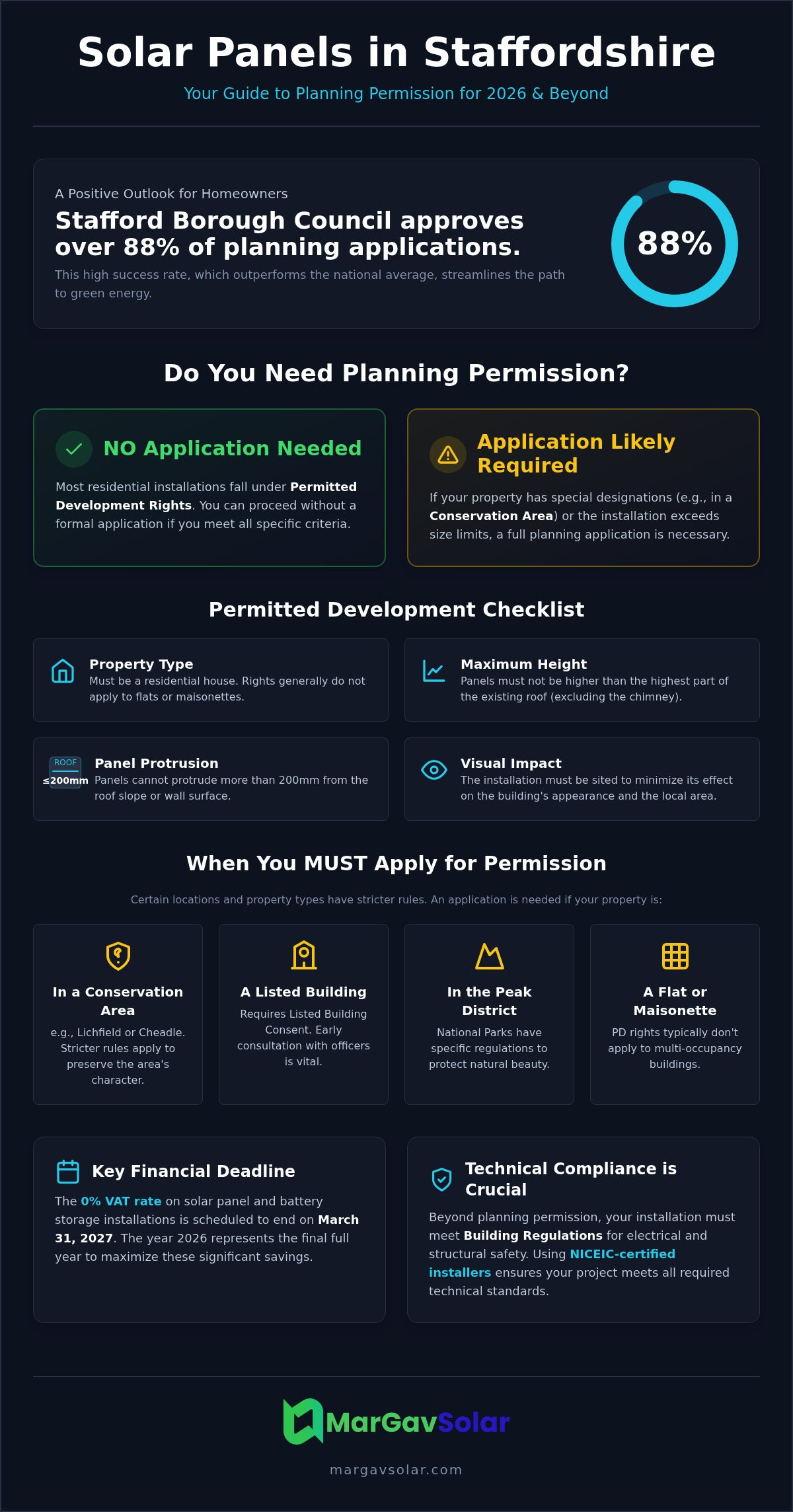
Did you know that Stafford Borough Council recently approved over 88% of planning applications, outperforming the national average? Despite this high success rate, many homeowners still hesitate to go green because they fear a complex legal battle with local authorities. It's natural to feel anxious about potential council fines or the hidden costs of a rejected application, especially when rules regarding planning permission for solar panels Staffordshire can feel like a moving target.
We understand that you want a clear path to energy independence without the headache of red tape. This guide helps you navigate the local landscape with confidence, ensuring you understand exactly where your project stands under the latest August 2026 regulations. You'll learn if your home qualifies for Permitted Development or if its location in a Conservation Area or the Peak District requires a specific application. We'll also break down the current fee structures and show you how MarGav Solar's twenty years of local expertise simplifies the technical certifications councils demand. By the end, you'll have a certain "Yes or No" on your permission needs and a streamlined route to your new installation.
Key Takeaways
- Identify the specific height and protrusion limits that allow your installation to qualify as Permitted Development under the updated August 2026 rules.
- Understand how living in a Conservation Area like Lichfield or Cheadle changes the requirements for planning permission for solar panels Staffordshire.
- Discover the essential steps for securing Listed Building Consent and why early consultation with conservation officers is vital for historic properties.
- Get a step-by-step breakdown of the planning application process, from gathering manufacturer data to navigating 2026 council fee structures.
- Learn how partnering with NICEIC-certified installers ensures your project meets all technical certifications and building control standards required by local councils.
Planning Permission for Solar Panels in Staffordshire: The 2026 Basics
The most common question we hear from residents in Stafford, Lichfield, and the Moorlands is whether they need to ask the council for the green light before going solar. For the vast majority of homeowners, the answer is a relieving "no." Most rooftop installations fall under what is known as Permitted Development. This means you can bypass the lengthy and often expensive formal application process that typically accompanies home extensions or new builds. However, planning permission for solar panels Staffordshire isn't a one-size-fits-all rule, especially given the county's diverse mix of historic towns and protected landscapes.
2026 has become a pivotal year for local renewable energy. Following various climate declarations across the West Midlands, local authorities are under pressure to streamline the transition to green power. This shift was bolstered by the national update on August 27, 2026, which further relaxed restrictions on wall-mounted and balcony solar equipment. While these changes make it easier than ever to install Solar power in the United Kingdom, you must still distinguish between planning permission and building regulations. Planning permission deals with the appearance and impact of the project on the local area, while building regulations ensure the installation is structurally safe and electrically sound.
What are Permitted Development Rights?
Permitted Development is a statutory right for minor home improvements without council applications. These rights are granted by the General Permitted Development Order (GPDO), which effectively gives a blanket "yes" to certain types of work. For solar panels, this usually covers roof-mounted systems on residential houses, provided they don't protrude too far or exceed the highest part of the roof. It's vital to recognize that these rights often don't apply to flats or maisonettes. If you live in a multi-occupancy building in Stoke-on-Trent or Stafford, you'll likely need to submit a formal application to ensure your project doesn't negatively impact your neighbours or the building's structural integrity.
Why Staffordshire Homeowners are Choosing Solar in 2026
Staffordshire residents are moving toward solar at a record pace this year. With the 0% VAT rate on solar installations and battery storage scheduled to end on March 31, 2027, 2026 is the final chance to maximize financial savings. Beyond the tax benefits, many are looking to pair their panels with solar battery storage in Staffordshire to gain independence from the grid. In rural communities across the Staffordshire Moorlands, where energy prices can be volatile, the ability to store and use your own generated power provides long-term financial security that traditional energy suppliers simply can't match. This drive for energy autonomy is transforming the county's rooftops into a critical part of the local power infrastructure.
When Do You Qualify for Permitted Development in Staffordshire?
To qualify for Permitted Development (PD) rights, your project must meet specific criteria outlined in the General Permitted Development Order 2015. These national standards apply across the county, but local variations in Stafford or the Moorlands can sometimes complicate matters. Generally, you won't need to apply for planning permission for solar panels Staffordshire if your installation adheres to strict physical limits. One of the most important rules is the "Effect on Appearance" clause. This requires homeowners to install panels in a way that minimizes the visual impact on the local streetscape and the external appearance of the building.
Roof-Mounted Solar Criteria
For most pitched roofs, the panels must not protrude more than 200mm from the roof slope. This ensures the array remains relatively flush with the existing structure. Crucially, the panels must not exceed the highest part of the roof, excluding the chimney. If you're considering a flat roof installation, the rules are slightly different as the panels often need angled mounting frames to maximize efficiency. Even then, the 200mm protrusion limit remains a key threshold for PD eligibility. If your design requires the panels to sit higher to catch more sunlight, you'll likely cross the line into requiring a formal application. This applies to outbuildings and garages too; as long as they are within your domestic curtilage, the same height and protrusion rules apply.
Ground-Mounted Solar Rules
If your roof isn't suitable, a standalone array in the garden is a popular alternative. However, ground-mounted systems face stricter scrutiny when determining if you need planning permission for solar panels Staffordshire. The total surface area of the panels cannot exceed 9 square metres. Additionally, the entire structure must be at least 5 metres away from the boundary of your property. In rural areas like the Staffordshire Moorlands, where gardens are larger, it's easy to meet the 5-metre rule, but you must also ensure the array is no taller than 4 metres. Only one ground-mounted system is allowed per property under PD rights. If you need a larger array to power a farm or a large estate, you'll likely need to consult with your local planning officer.
Ensuring your project fits these technical boxes is the first step toward a hassle-free installation. If you aren't sure how these measurements apply to your specific roofline, speaking with an experienced local installer can help clarify your options before you commit to a design. This proactive approach saves time and prevents potential disputes with the council later on.
Conservation Areas, Listed Buildings, and the Peak District
While most homeowners enjoy a straightforward path to green energy, Staffordshire's rich history means many properties are subject to stricter oversight. If you live in a historic town centre or a protected landscape, the standard Permitted Development for Solar Panels may not apply. In these instances, securing planning permission for solar panels Staffordshire is a vital step to avoid legal complications and potential restoration orders from the council.
Installing Solar in Staffordshire Conservation Areas
Conservation Areas in places like Lichfield, Stafford, and Cheadle exist to protect the unique character of our streetscapes. Consequently, councils often reject applications for panels on roof slopes that face a public highway. If your property's front elevation is the only one with good sun exposure, you might face a challenge. However, this doesn't mean solar is impossible. Local heritage officers in Newcastle-under-Lyme and Stafford are often supportive of installations on rear-facing roofs or hidden internal valley gutters where they aren't visible from the street. It's always best to seek pre-application advice to see which "hidden" elevations might be acceptable for your specific house type.
The Peak District and AONB Restrictions
For residents in the north of the county, the Peak District National Park Authority acts as the planning body rather than the local district council. They hold a high bar for visual impact, especially regarding the reflection and glare from traditional panels. Similarly, the Cannock Chase Area of Outstanding Natural Beauty (AONB) requires installations to be particularly sensitive to the surrounding landscape. If your home is a designated heritage asset, remember that Listed Building Consent is a separate legal requirement from standard planning permission. You must obtain this consent even if the planning department says the work is "permitted," as it focuses specifically on protecting the historical fabric of the building itself.
Finally, keep an eye out for Article 4 Directions. Local councils can use these to "turn off" your usual development rights in specific streets or neighbourhoods to preserve a very specific architectural look. While rare, they can appear in parts of Stoke-on-Trent or historic village centres. Checking your local council's interactive planning map is the quickest way to see if your street is affected by these extra layers of protection. This proactive check ensures you don't accidentally breach local rules during your transition to renewable energy.
The Staffordshire Planning Application Process: A Step-by-Step
If your project falls outside the scope of Permitted Development, you'll need to submit a formal application to your local district or borough council. The process for securing planning permission for solar panels Staffordshire follows a national framework, but local nuances can influence your timeline and success rate. Following these five steps ensures your application is robust and ready for review.
- Step 1: Determine if PD applies: Start by seeking pre-application advice. Most Staffordshire councils offer this service to help you confirm whether a full application is even necessary.
- Step 2: Preparing documents: You'll need high-quality site plans, elevations showing the proposed panels, and manufacturer datasheets.
- Step 3: Submitting via the National Planning Portal: This is the standard route for all Staffordshire councils. You'll upload your documents and pay the required fee here.
- Step 4: The consultation period: Once validated, your application enters an 8-week period where neighbours can comment and statutory consultees are notified.
- Step 5: Discharging conditions: After approval, you must meet any specific requirements, such as using specific mounting brackets, before beginning your solar panel installation.
Local Council Variations: Stafford vs. Moorlands
While the steps are similar, the experience can vary between East Staffordshire, the Moorlands, and Stafford Borough. Pre-application fees aren't uniform; they are set locally and can range from a small admin fee to over £100 depending on the depth of advice requested. As of April 1, 2026, fees for domestic solar applications in Staffordshire typically range between £200 and £500. Most minor residential applications are handled via "delegated decisions," meaning a planning officer makes the call rather than a full committee, which usually speeds up the process. However, if you live in villages like Brewood or Tutbury, you must check the "Neighbourhood Plan." these local documents often contain specific aesthetic preferences that the council must consider when reviewing your planning permission for solar panels Staffordshire.
Document Checklist for a Successful Application
A rejected application is often the result of missing or vague documentation. Your submission must include a block plan, which is a detailed map showing the exact location of the array within your property boundaries. You should also provide technical datasheets that prove the efficiency and safety of your chosen panels. In more sensitive locations, such as those near the edge of the Peak District, a visual impact assessment might be required. This document uses photos or renders to demonstrate that the panels won't create an eyesore for the surrounding area. Since MarGav Solar handles the technical certifications required by councils, we often help homeowners gather the precise data needed for these submissions.
If the paperwork feels overwhelming, contact our local team for guidance on meeting council requirements and ensuring your application is professional from day one.
Expert Solar Installation and Compliance with MarGav Solar
Securing planning permission for solar panels Staffordshire is a significant milestone, but it's only the first step in a successful home energy transition. Once the council gives the go-ahead, the focus shifts toward technical compliance and long-term reliability. MarGav Solar leverages over twenty years of experience in the West Midlands to bridge the gap between planning approval and a fully operational system. Our team understands that homeowners in Stafford and the Moorlands value certainty, which is why we offer fixed-price installation contracts. This approach protects you from the budget creep that often happens when unexpected planning conditions or structural requirements arise during the build phase.
Our expertise extends to helping you integrate multiple green technologies at once. Many residents choose to pair their new solar array with EV charging points to maximize the use of their self-generated power. By planning these systems together, you ensure that the entire electrical setup meets the rigorous standards required by both local building control and the National Grid. We handle the heavy lifting regarding technical certifications, so you don't have to worry about the administrative burden that follows a planning decision.
Beyond Planning: Building Regulations and MCS
While planning permission for solar panels Staffordshire deals with the visual and environmental impact, Building Regulations focus on safety and structural integrity. Every installation must be registered with the local authority's Building Control department. This confirms the electrical work is safe and that your roof can structuraly handle the additional weight of the panels. A structural roof survey is a non-negotiable part of our process; we won't install on a surface that isn't up to the task. Because we are NICEIC certification holders, we handle all the necessary electrical notifications and paperwork on your behalf. This certification is a key indicator of quality that local councils and insurers look for when verifying the legitimacy of your home improvements.
Long-term Maintenance for Staffordshire Solar Systems
A solar installation is a thirty-year investment. To keep it performing at peak efficiency, regular check-ups are essential. Proper solar panel maintenance in Staffordshire involves more than just cleaning the glass. It includes checking inverter health, inspecting mounting brackets for wear, and ensuring the battery storage system is cycling correctly. Our Staffordshire-based team provides ongoing warranty support and maintenance services to ensure your system remains as compliant and productive as the day it was installed. Staying proactive with maintenance not only protects your energy yields but also ensures you continue to meet the safety standards set during the initial building control sign-off.
Ready to Power Your Staffordshire Home with Solar?
Navigating the rules for planning permission for solar panels Staffordshire doesn't have to be a barrier to your green energy goals. Whether your property falls under standard Permitted Development or requires a specific application due to its location in a Conservation Area, the path to energy independence is clearer than ever in 2026. By understanding the local nuances of Stafford, Stoke, and the Moorlands, you can avoid common pitfalls and ensure your project meets all necessary legal standards from the start.
MarGav Solar is here to simplify the process. With 20+ years of local expertise and a team of NICEIC certified installers, we handle the technical certifications that councils require. We provide comprehensive fixed-price quotes so you won't face unexpected costs during your installation. Our deep knowledge of the West Midlands planning landscape means we can guide you through every hurdle with confidence.
Book Your Free Staffordshire Solar Consultation with MarGav Solar
Your transition to sustainable power is an investment in both your home's value and the environment. Take the first step toward lower energy bills and a smaller carbon footprint today.
Frequently Asked Questions
Do I need planning permission for solar panels on a flat roof in Staffordshire?
You usually need planning permission for solar panels on a flat roof because the mounting frames typically elevate the panels more than 200mm above the roof surface. While Permitted Development covers roof-mounted systems, the 200mm protrusion limit is strict. On a flat roof, panels need an incline to generate power efficiently, which almost always exceeds this threshold. It's best to check with your local planning officer in Stafford or Stoke before proceeding with the project.
How long does it take to get solar planning permission from Staffordshire Moorlands District Council?
Staffordshire Moorlands District Council generally aims to decide on minor residential planning applications within an eight-week window from the date of validation. This timeline includes a statutory consultation period where neighbours and local bodies can comment. While the process is standardized, ensuring your site plans and technical datasheets are accurate from day one prevents delays. Most applications in the region are handled through delegated decisions, which helps keep the process moving toward that eight-week target.
Can I install solar panels in a Conservation Area like Lichfield?
Yes, you can install solar panels in a Conservation Area like Lichfield, but you'll likely need planning permission for solar panels Staffordshire if the array is visible from the public highway. Councils prioritize preserving the historic streetscape. To increase your chances of approval, consider placing panels on a rear-facing roof slope or a hidden valley. Heritage officers often look more favourably on designs that minimize the visual impact on the area's unique architectural character.
Are there specific rules for ground-mounted solar panels in Staffordshire gardens?
For garden installations, you must follow strict Permitted Development criteria to avoid a full application. Your standalone array cannot exceed 9 square metres in total area and must be at least 5 metres from your property boundary. Additionally, the system's height shouldn't exceed 4 metres. Only one ground-mounted system is allowed per house. If your project in the Staffordshire countryside requires a larger footprint, you'll need to submit a formal planning application for a full review.
What happens if I install solar panels without planning permission?
Installing panels without required consent can lead to an enforcement notice from the council, requiring you to remove the equipment at your own expense. While you can apply for retrospective planning permission, there's no guarantee of approval. If the council rejects the retrospective application, you'll face the cost of removal and potential legal fees. It's always safer and more cost-effective to verify your Permitted Development rights or secure the necessary permissions before the installation begins at your property.
Does a listed building in Staffordshire always get rejected for solar?
A listed building designation doesn't mean an automatic rejection. Many historic properties in Staffordshire successfully integrate solar power by using non-invasive mounting techniques and placing panels in discrete locations. You must apply for Listed Building Consent, which is separate from standard planning permission. The council will assess whether the installation harms the building's historical fabric. Historic England provides guidance on how to balance renewable energy needs with the preservation of heritage assets during the formal application process.
Is planning permission required for solar battery storage units?
Planning permission isn't typically required for indoor solar battery storage units as they are considered internal works. However, if you're installing a large outdoor battery enclosure or if your property is a listed building, you should check with your local authority. Most residential battery systems are small enough to fall under Permitted Development. If the unit requires a separate external structure or significantly changes the appearance of a protected building, a formal application might be necessary for approval.
Do I need to inform my neighbours before installing solar panels?
If your project qualifies as Permitted Development, you aren't legally required to inform your neighbours, though it's often helpful for maintaining good relationships. However, if you apply for planning permission for solar panels Staffordshire, the council will formally notify your immediate neighbours as part of the public consultation process. They'll have 21 days to submit comments or objections. While the council considers these views, they primarily base their final decision on established planning policies and technical guidelines.


