
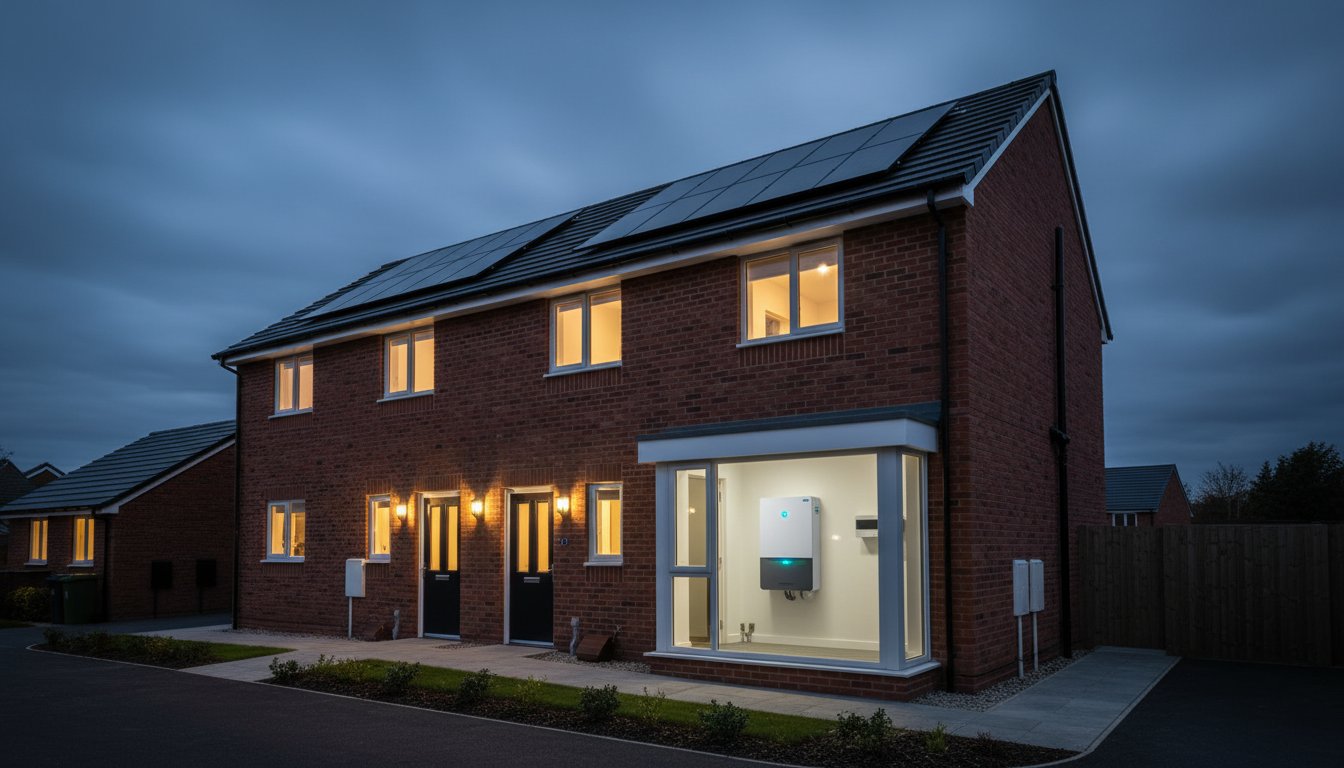
Imagine it's a rainy Tuesday evening in Stafford. While your neighbours are paying the 2026 peak rate of 29p per kWh to run their ovens, your home is silently powered by free electricity you captured at noon. It's a frustrating reality that 80% of UK solar owners without solar battery storage still rely on the grid once the sun sets. You've likely noticed your hard-earned energy being exported for as little as 5p per unit, only for you to buy it back at five times that price just hours later.
You deserve a system that works for your wallet, not the energy companies. This guide will show you exactly how to transform your Staffordshire home into a self-sufficient powerhouse while slashing your monthly utility bills. We'll break down the latest 2026 battery technology, explain how to master smart tariffs like Octopus Flux, and provide a clear roadmap to total energy independence.
Key Takeaways
- Learn why solar battery storage is the key to overcoming the "Staffordshire Gap" by keeping your generated power at home rather than exporting it for low returns.
- Discover how to accurately calculate your home’s "Baseload" to determine if a 5kWh or 10kWh system best suits your family’s energy needs and ROI goals.
- Explore the 2026 industry standard of LiFePO4 technology, offering Staffordshire homeowners superior safety and long-term battery life.
- Find out how AI-powered smart tariffs and GivEnergy systems work together to automatically optimize your energy usage and slash monthly bills.
- Master the professional installation process, including how a custom site survey and energy audit ensure your system is perfectly tuned to your property.
What is Solar Battery Storage and Why Does it Matter in Staffordshire?
Solar battery storage acts as a dedicated energy reservoir for your home. It captures the surplus electricity generated by your solar panels during the day, which would otherwise be sent back to the National Grid. Instead of losing that power, you store it in home energy storage systems to use during the evening or on cloudy days. Solar battery storage is the bridge between generation and consumption.
In 2026, the financial logic for Staffordshire homeowners has shifted. Most local households now aim for 70-80% energy independence. This target is achievable because modern lithium-ion and salt-water batteries have become more efficient at holding charge for longer periods. By keeping your power local, you insulate your household from the volatility of the UK energy market and the 2026 price cap adjustments that continue to penalize heavy peak-time users.
The Shift from Exporting to Storing Energy
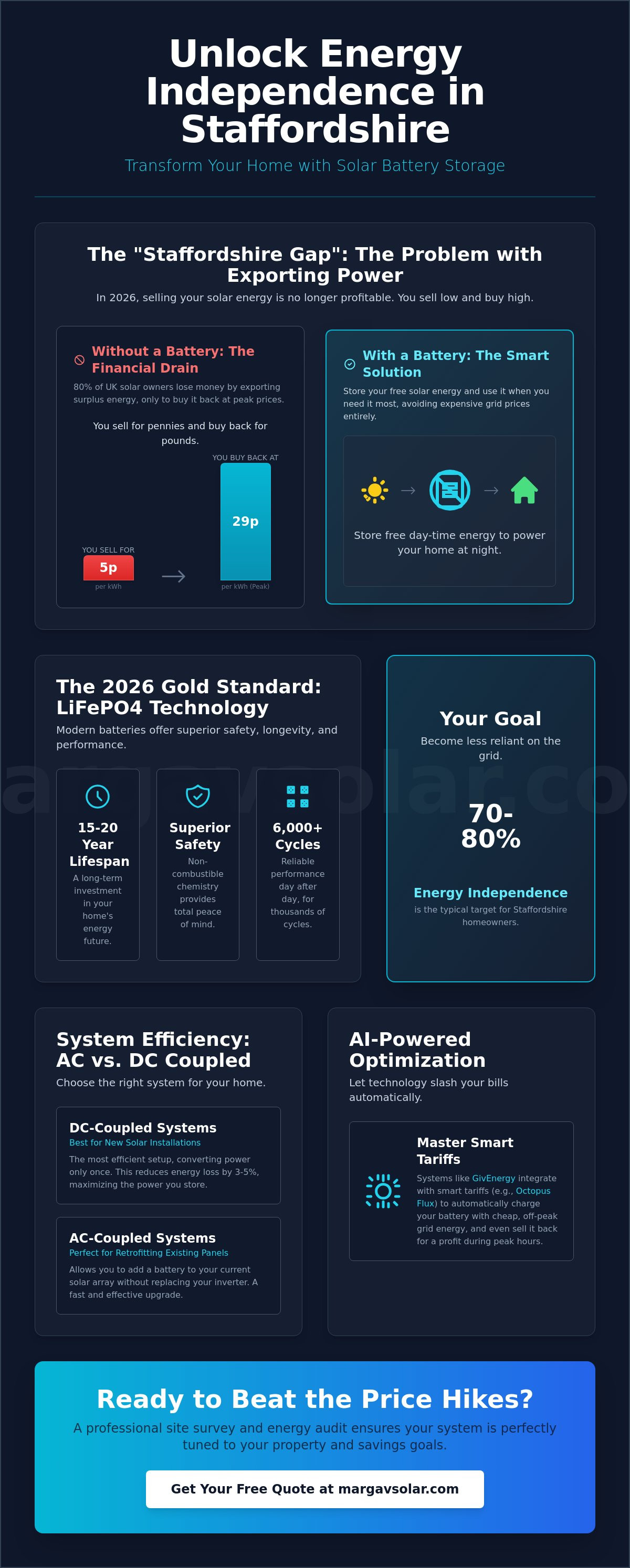
The "Staffordshire Gap" refers to the growing price difference between what you earn by selling power and what you pay to buy it. Under the Smart Export Guarantee (SEG), energy companies often pay as little as £0.05 to £0.15 per kWh. However, buying that same electricity back during the 4pm to 7pm peak window can cost upwards of £0.28 per unit. Storing your own "free" solar power allows you to bypass these expensive grid units entirely. It's no longer profitable to be a mini-power station for the grid; it's far better to be a self-sufficient home.
Staffordshire’s Energy Landscape in 2026
Local grid constraints in areas like Stafford, Cannock, and the Potteries make "peak shaving" a necessity. This process involves using your stored battery power to reduce your demand on the local substation during high-traffic hours. The UK Warm Homes Plan, active throughout 2026, has accelerated local adoption by providing clearer frameworks for battery integration in residential areas.
MarGav Solar focuses on the specific property types found across the county. Whether it's a Victorian terrace in Stoke-on-Trent with limited roof space or a detached new-build in Lichfield, the energy needs differ. We prioritize systems that handle the specific weather patterns of the West Midlands, ensuring your solar battery storage setup provides maximum reliability when the Staffordshire winter sets in. By 2026 standards, a home without storage is essentially leaving money on the table every time the sun shines.
How Solar Battery Storage Works: A Deep Dive for Homeowners
Understanding solar battery storage starts with the journey of a single photon. When sunlight hits your panels, it creates Direct Current (DC) electricity. If your home doesn't need that power immediately, the system redirects it into your battery. Later, when you flick the switch on your kettle for a cup of tea, the stored energy flows back out, converted into Alternating Current (AC) for your appliances. This process ensures you use every bit of free energy generated on your roof rather than sending it back to the grid for a minimal export payment.
By 2026, Lithium Iron Phosphate (LiFePO4) has become the gold standard for UK homes. Unlike older lithium-ion chemistries, LiFePO4 batteries are non-combustible and offer a lifespan often exceeding 6,000 cycles. This means your investment could reliably power your home for 15 to 20 years. For a detailed look at the starting point of this energy cycle, see our guide on Solar Panel Installation in Staffordshire.
Modern systems rely on real-time data apps to give you total control. You can track your self-sufficiency percentage and see exactly how much solar battery storage is saving you on your monthly energy bill. This Energy Saving Trust guide to solar batteries highlights how monitoring helps you shift heavy appliance use to peak generation hours, maximizing your ROI.
AC vs. DC Coupled Systems: Which is Right for You?
DC-coupled systems are the most efficient choice for new installations because they only convert power once before storing it. This reduces energy loss by approximately 3% to 5% compared to other setups. If you already have a Staffordshire solar array, AC-coupling is the standard retrofit solution. It allows you to add a battery without replacing your existing equipment. While AC-coupling is slightly less efficient, it's often faster to install, typically taking less than a day to commission by a qualified team.
The Role of the Hybrid Inverter
The hybrid inverter acts as the central brain of your setup. It decides in milliseconds whether to send power to your lights, your battery, or the grid. You can find more technical specifications in our article on Inverter Upgrades in Staffordshire. When choosing a system, check the C-rating. A 0.5C rating means a 10kWh battery discharges at 5kW, taking two hours to empty. A higher C-rating allows you to run high-drain appliances like ovens and power showers simultaneously without pulling from the grid. If you're ready to optimize your home's efficiency, request a bespoke system design from our local experts.
Sizing and ROI: Is a Battery Worth the Investment?
Calculating the return on investment for solar battery storage depends on matching the system size to your household's "baseload" consumption. This is the amount of electricity your home uses consistently throughout the night for appliances like fridges, routers, and standby devices. If you install a battery that's too small, you'll still rely on expensive grid power after sunset. If it's too large, you'll pay for capacity you never use, which extends your payback period unnecessarily.
Determining Your Ideal Battery Capacity
Staffordshire homeowners should start by analyzing smart meter data via their energy provider's app. Look specifically at your usage between 6 PM and 7 AM. A typical family in a four-bedroom house in Stafford usually finds that a 10kWh battery covers their evening needs, including running appliances and lighting. Smaller households or couples might find a 5kWh unit more cost-effective. Over-sizing is a common mistake; it's better to have a battery that reaches 100% charge and 10% discharge daily to maximize the value of every pound spent. Usable capacity refers to the actual amount of energy you can discharge, whereas total capacity includes a reserve that the system keeps to protect the battery's internal chemistry.
Financial Benefits and Incentives
The financial case for solar battery storage has strengthened as we head into 2026. UK homeowners benefit from a 0% VAT rate on battery installations when paired with a new solar array. This tax incentive can save you over £1,000 on a standard installation. Most Staffordshire properties see a payback period of 7 to 9 years, depending on how aggressively they use time-of-use tariffs to charge from the grid during cheap off-peak hours.
- Resale Value: Modern storage systems increase a home's attractiveness to buyers by improving the EPC rating, often adding 2% to 5% to the property value.
- Warranty Security: Most lithium-ion batteries now come with 10-year warranties that guarantee at least 70% of the original capacity remains, protecting your long-term investment.
- Operational Costs: Maintenance is minimal, though you should factor in periodic checks as detailed in this guide on Solar Panel Maintenance in Staffordshire.
By 2026, electricity prices remain volatile. A battery acts as a hedge against these fluctuations. Even as the battery slowly degrades over a decade, the cumulative savings on your monthly bills usually outweigh the initial capital outlay well before the warranty expires. It's a strategic move for any homeowner looking to lock in lower energy costs for the next fifteen years.
Smart Tariffs and GivEnergy: The 2026 Optimization Secret
By 2026, the real value of solar battery storage isn't just found in the hardware on your wall, but in the software managing it. Staffordshire homeowners are moving away from passive systems toward AI-driven "Smart Charging." This technology allows your home to communicate with the National Grid in real-time, making decisions based on weather forecasts and live energy pricing. It transforms your home from a simple consumer into an active participant in the energy market.
GivEnergy has emerged as the frontrunner for local installations because of its seamless integration with the UK's most innovative energy providers. One of the most powerful features is the ability to "Force Charge." During periods of low demand or high renewable generation, grid prices can drop to as little as 1p per kWh or even turn negative. Your GivEnergy system recognizes these windows, automatically pulling cheap energy from the grid to ensure you never pay peak rates during the evening rush. It's a level of automation that ensures your solar battery storage pays for itself years faster than older, "dumb" systems.
Octopus Agile and Flux Integration
Smart tariffs like Octopus Agile change price every 30 minutes based on wholesale costs. In 2026, savvy users are using their batteries to buy energy at 5p per kWh during the night and avoiding the 35p per kWh peak rates. This "Winter Strategy" is essential when solar generation is lower. By automating your battery to sync with the UK day-ahead market, you can ensure your home runs on the cheapest possible electrons 24 hours a day. Systems now use predictive algorithms to calculate exactly how much grid energy you need to buy to bridge the gap until the next sunrise.
GivEnergy Cloud and App Control
Managing your energy shouldn't be a full-time job. The GivEnergy app provides Staffordshire users with a clear, visual breakdown of their home's performance. You can toggle between "Eco Modes" to prioritize solar self-consumption or "Timed Discharge" to sell energy back to the grid when export rates are highest. For a deeper dive into these features, read our GivEnergy Cloud: The Ultimate Guide. MarGav Solar also uses this platform to provide remote firmware updates and performance tracking. This ensures your system operates at peak efficiency without you ever needing to pick up a screwdriver or check a manual.
Professional Installation and Next Steps in Staffordshire
The transition to solar battery storage involves a precise technical process to ensure your home captures every available kilowatt of energy. In Staffordshire, this journey follows four distinct stages designed to maximize your return on investment and ensure full compliance with UK electrical standards.
- Step 1: Site Survey. A MarGav engineer visits your property to evaluate your current energy load. We analyze your electricity bills from the last 12 months to determine the ideal battery capacity for your specific needs.
- Step 2: Custom System Design. We don't believe in one-size-fits-all solutions. Our team designs a configuration based on your roof orientation and daily consumption patterns, ensuring the inverter and battery placement optimizes performance.
- Step 3: Professional Installation. Our team handles the physical setup. It's vital to use installers who follow this NICEIC Certification Guide to guarantee the safety and longevity of your home's electrical system.
- Step 4: Grid Connection and MCS. We manage the G98 or G99 applications with the National Grid. Once the solar battery storage system is live, we provide MCS certification, which is essential if you plan to earn money through the Smart Export Guarantee (SEG).
Why Local Expertise Matters
Staffordshire features a diverse range of architecture, from modern developments in Stafford to protected heritage properties in Lichfield or the Peak District fringes. Navigating local planning permissions for Grade II listed buildings or conservation areas requires specific regional knowledge. We understand which local authorities require full applications and which fall under permitted development.
Because your system has a 20 year lifespan, having a local partner is a practical necessity. MarGav Solar draws on 20 years of experience in the region to provide a "Fixed-Price" guarantee. This means the quote you receive after your survey is the final price you pay, with no hidden costs added during the installation process.
Getting Started with Your Free Consultation
Your first call with a MarGav consultant is more than a sales pitch; it's a technical assessment. To make the most of this session, have your annual electricity statement and any details regarding future energy changes ready. If you're planning to switch to electric transport, we can demonstrate how to integrate your battery with EV Charging Points to charge your vehicle using stored sunshine.
Taking control of your energy future starts with accurate data. Contact our Staffordshire team today to book your personalized energy assessment and discover exactly how much you can save on your monthly utility bills.
Future-Proof Your Staffordshire Home Today
Achieving energy independence in Staffordshire has never been more accessible. By installing solar battery storage, you effectively decouple your home from rising grid costs and maximize the 100% renewable energy your roof produces. Modern LiFePO4 systems now offer superior cycle life, meaning your investment stays protected for over a decade. When you pair this hardware with smart export tariffs like Octopus Flux, you can automate your savings by selling power back to the grid during peak evening windows.
Margav Solar provides the local technical expertise needed to navigate these complex setups. Our NICEIC Certified Installers bring over 20 years of renewable energy expertise to your doorstep, specializing in GivEnergy integrations that optimize every kilowatt-hour. We focus on precision sizing so you don't overspend on capacity you won't use. It's time to stop wasting your surplus solar energy and start powering your home on your own terms.
Request your free, fixed-price solar battery quote in Staffordshire today. We're excited to help you transition to a smarter, cheaper, and greener way of living.
Frequently Asked Questions
How long does a solar battery typically last in a UK climate?
Most solar battery storage systems in Staffordshire last between 10 and 15 years. Modern lithium-ion units handle the UK's temperate climate effectively without significant degradation. You'll likely receive a performance guarantee for 10 years or 6,000 charge cycles from major manufacturers. After this period, the battery continues to function but usually holds about 70% of its original capacity.
Can I install a solar battery if I already have solar panels?
You can definitely add a battery to an existing solar array through a process called AC-coupling. This setup requires a separate battery inverter to sit alongside your current solar inverter. Roughly 40% of UK installations are now retrofits rather than new builds. It's a straightforward technical process that doesn't require you to replace your current panels or their mounting hardware.
Will a solar battery provide power during a grid-wide power cut?
A standard solar battery storage setup won't provide power during a grid outage unless you request an Emergency Power Supply (EPS) function. Without this specific gateway, the system shuts down to protect utility workers from "islanding" risks. Adding a dedicated backup circuit allows you to power essential loads like lights and refrigerators. About 15% of Staffordshire homeowners currently opt for this full backup capability.
How much space do I need for a 10kWh battery system?
A 10kWh battery system usually occupies a space similar to a wall-mounted gas boiler. Most modern units measure approximately 800mm in height and 600mm in width. You'll need an extra 100mm of clearance on all sides to ensure proper ventilation. These systems are often installed in garages, utility rooms, or on reinforced external walls to keep them out of living areas.
Is it possible to charge my solar battery from the grid at night?
You can charge your battery using cheap off-peak electricity from the grid. This strategy works best with dynamic time-of-use tariffs like Octopus Flux or Agile. During winter months, you might pull 100% of your battery's capacity from the grid at 7p per kWh. You then use that stored energy during the evening peak when prices often exceed 30p per kWh, maximizing your savings.
Do I need planning permission for battery storage in Staffordshire?
Most battery installations in Staffordshire fall under Permitted Development rights. You won't need a formal application unless your home is a Grade I or II listed building. If you live in one of the 20 conservation areas managed by Stafford Borough Council, check with the local planning department first. Always ensure your installer notifies the District Network Operator (DNO) after the work is finished.
What is the difference between Lead-Acid and Lithium-Ion solar batteries?
Lithium-ion batteries are the dominant choice for UK homes because they offer a 95% depth of discharge. Lead-acid batteries are cheaper upfront but only allow you to use 50% of their capacity safely. A lithium unit typically lasts 10 years, whereas lead-acid often requires replacement after 3 or 4 years. Lithium systems are also 60% smaller and much lighter, making them easier to wall-mount.
How much can I expect to save on my annual bill with a 5kWh battery?
A 5kWh battery can save a typical Staffordshire household between £250 and £450 on annual electricity bills. These figures depend on your specific solar generation and how much energy you use during peak evening hours. According to Energy Saving Trust data, pairing a battery with solar can increase your self-consumption from 30% to over 70%. This reduces your reliance on expensive grid power significantly.


