
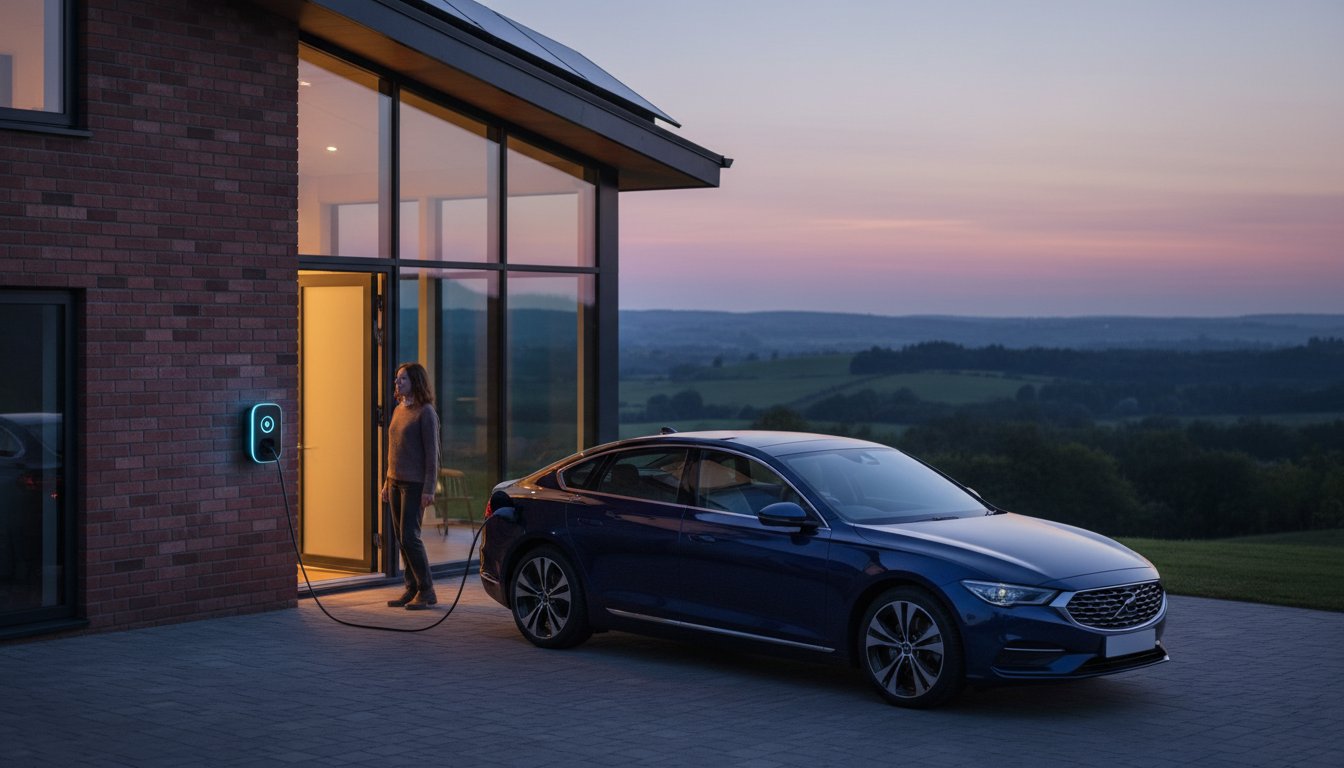
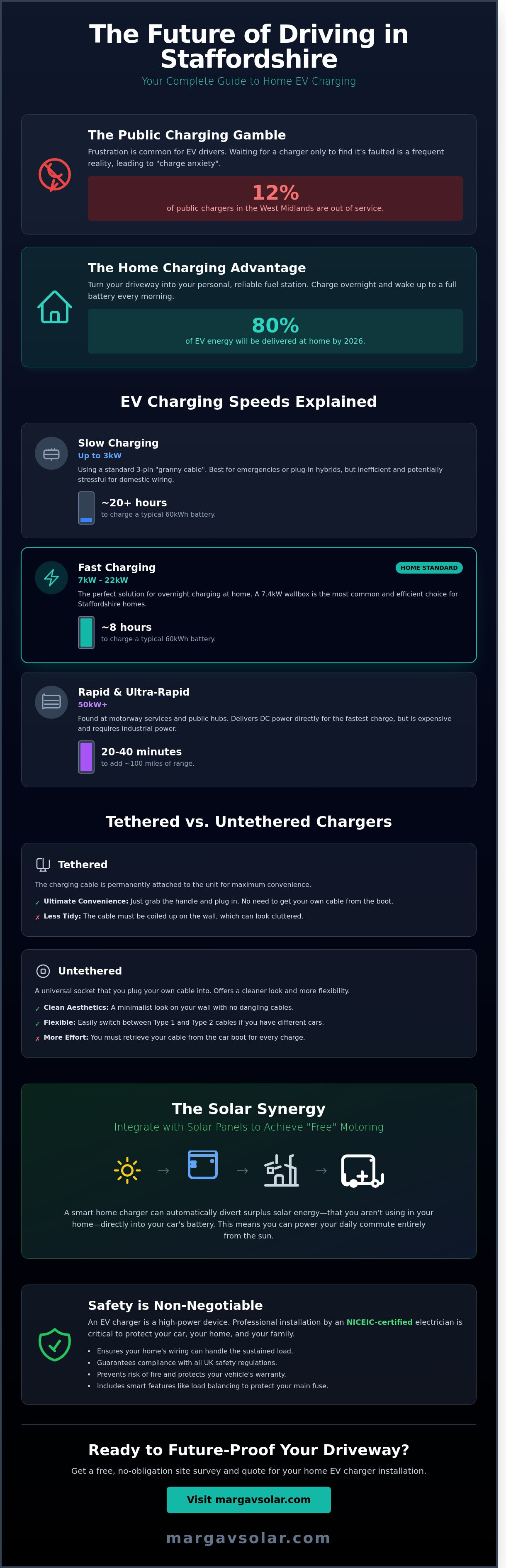
Last Tuesday, a homeowner in Lichfield spent forty minutes waiting for a public plug-in only to find the unit was faulted, a common frustration as 2025 data shows that nearly 12% of public chargers in the West Midlands remain out of service at any given time. You've likely felt that same sting of "charge anxiety" or stared at your electricity bill wondering how to keep costs down while powering your vehicle. Finding reliable EV charging points across Staffordshire shouldn't feel like a part-time job, especially when your home could be your own personal fuel station.
We agree that the current mix of Type 1 and Type 2 cables is confusing, and the rising cost of energy in the UK makes a smart strategy essential. This guide promises to clear the fog, showing you exactly how to build a future-proof home setup that cuts your long-term expenses. You'll learn the difference between various charging speeds, how to integrate your car with existing solar panels, and what the 2026 regulations mean for your driveway installation.
Key Takeaways
- Learn why modern EV charging points are sophisticated safety devices and why home charging is set to become the primary fuel source for Staffordshire drivers by 2026.
- Compare the public infrastructure across Stafford and Stoke-on-Trent against the cost-saving "convenience gap" of private home installations.
- Master the technical essentials of smart charging and Type 2 connectors to ensure your vehicle remains compatible and your energy bills stay low.
- Discover how to achieve "free" motoring by integrating your charger with solar panels to capture and use surplus green energy.
- Understand the critical importance of NICEIC-certified installations and how a professional site survey ensures your home’s electrical system is ready.
Understanding EV Charging Points: More Than Just a Socket
Many people mistake a home charger for a simple outdoor power outlet. In reality, a modern electric vehicle charging station is a sophisticated safety and communication hub. These devices do not just deliver power; they "talk" to your car to determine the maximum safe current and monitor temperature levels throughout the session. This prevents overheating and protects your home's electrical circuit from the sustained high loads that EV batteries demand.
The UK is approaching a significant transition in 2026. Industry forecasts suggest that home charging will account for roughly 80% of all energy delivered to electric cars by this date. This shift means your driveway will replace the local petrol station as your primary fuel source. For this reason, installing dedicated EV charging points is no longer a luxury but a fundamental home utility upgrade.
Staffordshire homeowners are rapidly moving away from the "granny cable," which uses a standard 3-pin domestic plug. These cables are limited to 2.3kW and aren't designed for the 10 to 12 hours of continuous high-intensity use required to fill a modern battery. Relying on them is inefficient and can put unnecessary stress on domestic wiring. Switching to a dedicated wallbox reduces charging times by over 60% and provides a much safer, permanent solution.
Home units primarily use Alternating Current (AC). Your car has an onboard converter that turns this into Direct Current (DC) for the battery. Public rapid chargers skip this step by delivering DC directly to the vehicle, which is why they are significantly faster but also much more expensive to use than a home unit.
The Three Levels of Charging Speed
Understanding delivery speeds helps you choose the right hardware for your daily mileage. Most UK homes have a single-phase supply, which dictates your maximum charging potential.
- Slow charging (3kW): Usually delivered via a 3-pin plug. It's best for plug-in hybrids with small batteries or emergency top-ups when no other option exists.
- Fast charging (7kW - 22kW): The 7.4kW wallbox is the standard for Staffordshire residential installations. It can fully charge a 60kWh battery in approximately 8 hours, making it perfect for overnight use.
- Rapid and Ultra-Rapid (50kW+): These units are strictly for public motorway hubs. They can add 100 miles of range in under 30 minutes but require industrial-grade power supplies not found in residential streets.
Tethered vs. Untethered Charging Points
Choosing between a tethered or untethered unit often comes down to a balance of convenience and aesthetics. It's a decision that affects how you interact with your car every single day.
- Tethered: These units have a cable permanently attached. You don't have to dig your own cable out of the boot every time you arrive home. It's the most convenient option for daily drivers.
- Untethered: This is a simple socket on the wall. It offers more flexibility if you have multiple EV brands in the household with different plug types. It also looks much tidier on a Staffordshire driveway because there is no cable coiled around the unit.
- Aesthetics: Untethered points are often preferred by homeowners who want a minimalist look, as the cable can be stored out of sight in the garage or boot when not in use.
EV Charging in Staffordshire: Public vs. Private Infrastructure
Staffordshire’s public charging landscape is a patchwork of rapid hubs and slower kerbside units. While Stoke-on-Trent and Stafford have seen a 35% increase in charger density since 2022, the "convenience gap" remains a hurdle for many. Relying on public EV charging points often means planning your day around a 45-minute wait at a retail park or service station. Home charging eliminates this by turning your driveway into a private fuel station that works while you sleep.
Local grid capacity is another factor to consider. In older residential areas of Cannock or rural Staffordshire villages, the local network may have limitations. Modern EV charging points solve this through smart load balancing. This technology monitors your home's total power usage and automatically adjusts the charger's draw to ensure you don't exceed the capacity of your main fuse. Staffordshire councils are currently utilizing government support for EV charging to bridge the gap between urban and rural access, but for most, a domestic unit is the only way to guarantee a full battery every morning.
The Reality of Public Charging in the West Midlands
Public charging costs have climbed significantly, with some rapid units exceeding 80p per kWh in 2024. Compare this to domestic Staffordshire electricity tariffs, where off-peak EV rates can drop as low as 7p or 9p per kWh. Reliability is also a persistent issue. A broken unit in a rural village can leave a commuter stranded, making a dedicated home point essential for peace of mind. If you're ready to stop queuing at public hubs, you can explore professional home installation options to secure your own reliable energy source.
Planning Permission and Legalities
Most residential installations fall under "permitted development" rights. This means you won't need to apply for formal planning permission as long as the charger meets size limits and isn't installed near a highway. However, if you live in one of Staffordshire’s many conservation areas or a listed building in Lichfield, you'll need to check with the local planning office first.
- DNO Notification: Your installer must notify the Distribution Network Operator (National Grid Electricity Distribution in this region) within 28 days of installation.
- Off-Street Requirement: To qualify for most grants and permitted development, you must have dedicated off-street parking.
- Smart Compliance: All new points must meet the Electric Vehicles (Smart Charge Points) Regulations 2021 to ensure grid stability.
The DNO process is vital because it helps the network manage the cumulative load of multiple EVs on a single street. Professional installers handle this paperwork for you, ensuring your transition to electric driving is both legal and safe for the local Staffordshire grid.
Technical Essentials: Sockets, Cables, and Smart Features
Understanding the hardware behind EV charging points ensures you don't end up with incompatible kit. The Type 2 socket has been the European standard since 2014. By 2026, every new electric vehicle sold in the UK will utilize this 7-pin configuration, making it the undisputed standard for home installations. These connectors support both single-phase and three-phase charging, providing the flexibility needed for future battery technology improvements.
Safety is a major factor in modern design. Built-in PEN fault protection is now a standard feature in high-quality units. This technology detects a potential loss of the protective earth neutral (PEN) conductor in the grid. Without this internal safety measure, an electrician would need to install an external earth rod, often involving digging up garden paths or driveways. Verifying that your installer has NICEIC certification ensures the installation meets the BS 7671 wiring regulations, keeping your household safe from electrical surges.
The Electric Vehicles (Smart Charge Points) Regulations 2021 mandate that all new home chargers have smart functionality. This includes "scheduled charging" by default. This feature is designed to protect the National Grid and save you money. By automatically setting your car to charge during off-peak hours, you can take advantage of cheaper energy rates. Some EV-specific tariffs offer prices as low as 7p per kWh compared to standard daytime rates of 25p or 30p. To manage this, your charger needs a reliable connection via Wi-Fi or 4G to receive software updates and communicate with your energy provider's app.
Type 1 vs. Type 2: Clearing the Confusion
Most modern UK EVs use Type 2 connectors, but you might find a Type 1 port on older Japanese or American imports like the early Nissan Leaf. The Type 2 socket has been the European standard since 2014. If you own an older vehicle with a Type 1 port, you don't need to replace your whole charger. You can simply use a Type 1 to Type 2 adapter cable to ensure compatibility with modern EV charging points.
Smart Features You Actually Need
- App-based monitoring: This lets you track your charging history and see exactly how many kilograms of CO2 you've saved each month.
- Solar matching: If you have solar panels, this feature detects when you're generating excess power and diverts it into your car's battery rather than selling it back to the grid for a lower rate.
- Load balancing: This safety feature protects your home's main fuse. If you turn on the oven, washing machine, and a power shower at the same time, the charger reduces its power draw to prevent an electrical overload.
The Solar Synergy: Charging Your EV for Free in Staffordshire
The true power of home charging isn't just about plugging into the wall; it's about generating your own fuel. By combining a solar panel installation with modern EV charging points, you effectively create a private petrol station on your driveway. Smart chargers like the Myenergi Zappi lead this transition. These devices monitor your home's energy flow in real time. If your solar panels produce more electricity than your house needs, the Zappi diverts that surplus into your car's battery. Without this, you would export that energy back to the grid for roughly 5p to 15p per unit, only to buy it back later at 25p or more.
Staffordshire homeowners often ask if this setup works during overcast weather. It really does. Modern photovoltaic cells don't need direct, scorching sunlight to function; they operate on daylight. While peak output happens on clear days, a well-optimised system provides a steady trickle of "free" miles even under typical British clouds. By 2026, the "Solar-to-EV" ecosystem will be the standard for energy-conscious homes across the county, as energy prices and vehicle range requirements continue to shift.
Battery Storage and Overnight Charging
To truly maximise your ROI, you need to bridge the gap between when the sun shines and when you actually drive. Using the GivEnergy Cloud allows you to manage your energy with precision. You can store solar power during the day to charge your EV at night, or use the system to "top up" from the grid during cheap overnight tariffs. Many UK providers now offer EV-specific rates as low as 7p per kWh between 12 am and 5 am. Combining solar PV, a home battery, and smart EV charging points ensures you never pay peak prices for your commute.
V2H and V2G: The Future of Your Charging Point
The next evolution of home energy is Vehicle-to-Home (V2H) technology. This allows your car to act as a giant backup battery for your house. If there is a local blackout in Staffordshire, a V2H-compatible charger pulls power from your car to keep your lights and fridge running. The UK is also preparing for wider Vehicle-to-Grid (V2G) trials in 2026, which could allow you to sell your car's battery power back to the National Grid during peak demand. Choosing a future-proof, bi-directional charger now prevents expensive hardware upgrades in just a few years.
Ready to turn your roof into a fuel source? Contact MarGav Solar for a custom EV and solar integration quote.
Professional Installation: Why NICEIC Certification Matters
MarGav Solar brings 20 years of electrical expertise to Staffordshire homes. Installing EV charging points isn't a simple weekend DIY task. It involves high-voltage equipment that pulls a significant amount of power for extended periods. Our team ensures your home’s electrical system can handle this demand without compromising safety.
Our professional approach follows a structured four-step process. First, we conduct a free technical site survey. This isn't just a quick glance at your driveway. We inspect your consumer unit, check existing fuse ratings, and plan the most efficient cable run. This prevents unexpected power trips or overloaded circuits once you start charging.
Second, we handle custom design and hardware selection. We don't believe in one-size-fits-all solutions. We help you choose between premium brands like GivEnergy, Zappi, or Ohme based on your specific habits. If you have solar panels, we'll recommend a Zappi unit to divert excess green energy directly into your vehicle. Third, our certified experts manage the physical installation and the mandatory Distribution Network Operator (DNO) registration. This legal requirement ensures the local power grid is aware of the new high-load device at your property.
Finally, we provide a full handover and app setup. We'll show you how to use the software to schedule charging during off-peak hours. This ensures you're charging efficiently from day one and saving money on every mile.
The Dangers of Non-Certified "DIY" Installations
Attempting to install EV charging points without professional certification is a major safety risk. Improper wiring can lead to thermal runaway, which significantly increases the risk of electrical fires. Most UK insurance providers will immediately invalidate a policy if they discover that EV equipment was installed by an uncertified individual. It's a risk that simply isn't worth taking for your home or your family.
- NICEIC Certification: This is the gold standard for electrical safety in the UK. It proves an installer is regularly assessed for technical competence.
- EICR Requirements: Every professional installation includes an Electrical Installation Condition Report (EICR). This document proves the circuit meets BS 7671 safety standards.
- Compliance: Professional installers ensure all work meets Part P building regulations, which is essential when you eventually sell your home.
Start Your Staffordshire EV Journey
Getting your home ready for an electric vehicle shouldn't be stressful. We provide a fixed-price quote after your initial survey so there are no hidden costs or surprise fees. Because we're a local Staffordshire team, we don't just disappear after the job is done. We offer ongoing maintenance and technical support to keep your charger running at peak performance year after year.
Don't settle for a generic installation that might not meet the latest safety codes. Choose a team with two decades of local experience to power your transition to green energy. You can Contact MarGav Solar for your Staffordshire EV charging consultation today to secure your quote and schedule your technical survey.
Future-Proof Your Staffordshire Home for the Electric Revolution
Transitioning to an electric vehicle is no longer a distant prospect; it's a practical reality for 2026. By installing private EV charging points, you bypass the rising costs of public networks and gain total control over your energy usage. Pairing your charger with a solar array allows you to harness the 1,000 plus hours of annual sunshine recorded in the West Midlands, potentially reducing your daily fuel costs to zero. Safety remains the priority. Professional installation ensures your home's electrical system handles the increased load without risk. With over 20 years of industry experience, our team provides the technical expertise required for a seamless transition. We're NICEIC Certified Installers, meaning every project meets the highest UK safety standards. Choosing a local Staffordshire partner ensures you get rapid support and advice tailored to our region's specific infrastructure. Don't leave your home's readiness to chance while the UK moves toward the 2035 petrol and diesel phase-out. Take the first step toward energy independence and lower motoring costs right now.
Book your free Staffordshire EV charging site survey today
Our experts are ready to help you navigate the latest smart features and solar integration options available for your property.
Frequently Asked Questions
Is it cheaper to charge an EV at home than at a public charging point?
Home charging is significantly cheaper than using public networks. You'll typically pay between 7p and 9p per kWh on a dedicated EV off-peak tariff. Public rapid chargers often charge 75p per kWh or more. This means filling a 60kWh battery at home costs about £5.40, while the same charge at a motorway station could exceed £45.00.
Can I install an EV charging point myself to save money?
You can't legally install a charger yourself because it requires a certified electrician. UK law requires all EV charging points to be installed by a competent person under Part P of the Building Regulations. A professional ensures the unit's safely earthed and provides the necessary Electrical Installation Certificate for your home insurance and manufacturer warranty.
How long does it take to install a home EV charging point in Staffordshire?
A standard installation usually takes 3 to 4 hours to complete. If your driveway's far from your consumer unit or requires extensive cabling through walls, the process might take up to 6 hours. Most installers in Staffordshire can book your appointment within 10 working days once they've reviewed your home's electrical setup and photos.
Do I need to upgrade my home’s electrical fuse box for an EV charger?
You might need an upgrade if your current consumer unit's full or outdated. Most 7kW chargers need a dedicated 40-amp breaker. If your property has a 60-amp main fuse, your installer will notify the Distribution Network Operator to see if an upgrade to 100 amps is necessary. This ensures your shower, oven, and car can all run at once.
What happens if I have solar panels-can I charge my car with them?
You can definitely use solar panels to charge your electric vehicle. By choosing a smart charger with solar integration, you can capture free energy that's usually exported to the grid. If you have a 4kW solar array, you could generate enough power on a clear day to add 15 to 20 miles of range without spending a penny.
Can I charge my EV from a standard 3-pin UK plug socket?
It's possible to use a 3-pin plug, but it's incredibly slow and less safe. These sockets only provide 2.3kW of power, taking roughly 24 to 30 hours to charge a modern long-range battery. Most manufacturers recommend using dedicated EV charging points for daily use to avoid overheating standard domestic wiring during the long charging cycles.
Is there still a government grant for home EV charging points in 2026?
The OZEV EV Chargepoint Grant currently offers £350 toward installation costs for specific groups. While the 2026 budget hasn't been fully confirmed, the scheme currently supports renters, flat owners, and landlords. You should check the official GOV.UK portal for the most recent updates, as the government frequently adjusts these incentives to meet net-zero targets.
How much does it cost to charge a typical EV for 100 miles of range?
Charging for 100 miles costs about £2.33 on a standard off-peak rate of 7p per kWh. This calculation assumes your car achieves 3 miles per kWh of energy. Compared to a petrol car averaging 40mpg, which costs around £15.00 for 100 miles at current pump prices, you'll save over £12.00 every time you cover that distance.


