
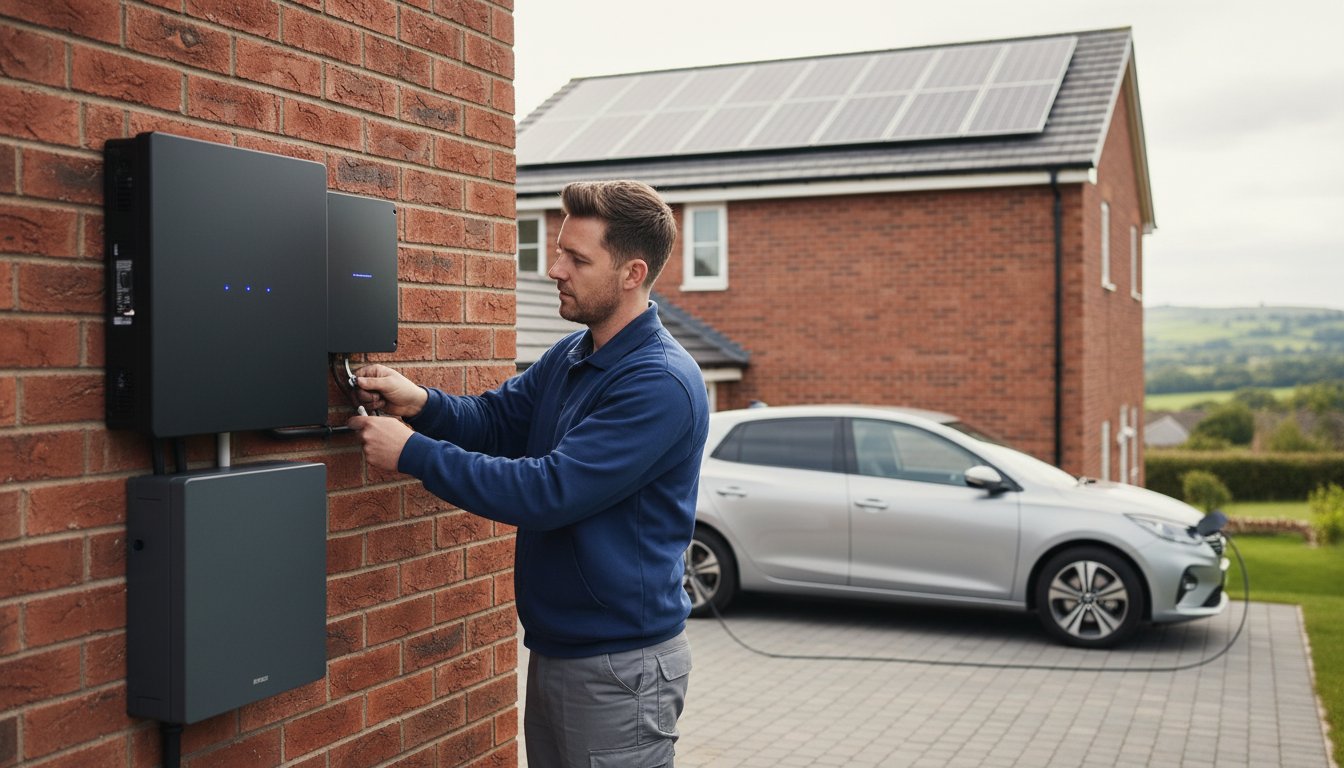
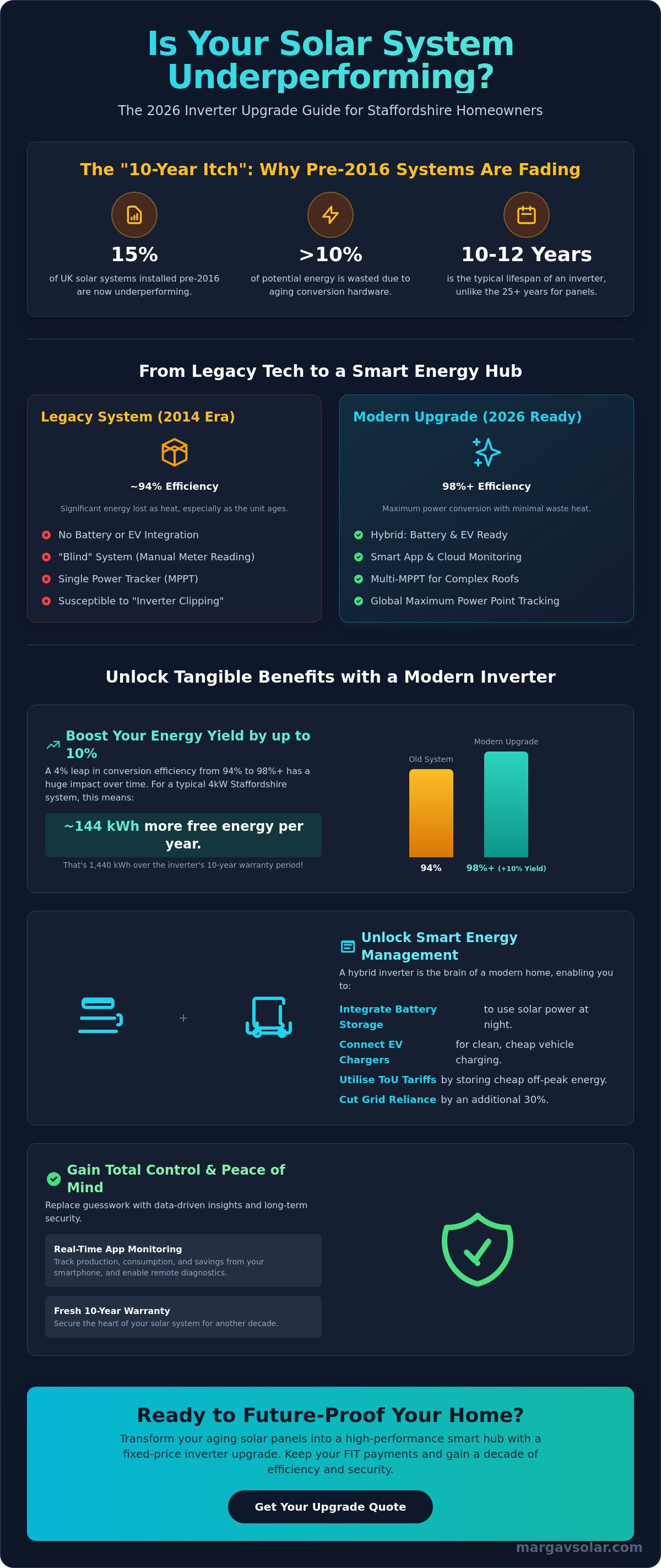
15% of solar systems installed across the UK before 2016 are currently wasting over 10% of their potential energy because of aging conversion hardware. If you've watched your generation numbers slowly decline, you aren't alone. Many Staffordshire homeowners feel stuck with legacy systems that can't integrate with modern battery storage, which is why inverter upgrades are now the most effective way to restore performance. It’s frustrating to see energy prices fluctuate while your roof isn't working as hard as it should.
We agree that your solar investment should grow with you, not become a relic of the past. By modernising your hardware, you can increase your energy yield by up to 10% and finally unlock the door to seamless battery integration. This guide explores how to future-proof your Staffordshire home for 2026, ensuring you keep your Feed-in Tariff payments intact while gaining the security of a fresh 10-year warranty. We will show you exactly how to transform your aging panels into a high-performance smart hub.
Key Takeaways
- Learn how jumping from 2014 to 2026 efficiency standards can significantly increase your annual energy yield and long-term savings.
- Discover why modern inverter upgrades are the vital foundation for Staffordshire homeowners wanting to add battery storage or EV charging stations.
- Identify the signs of the "10-year itch" and why solar systems installed during the FIT boom are now prime for a high-performance hardware refresh.
- Understand the essential UK grid regulations and DNO requirements necessary for safely and legally increasing your system’s capacity.
- Explore the benefits of a fixed-price installation model to ensure your system transition is completed without hidden costs or technical delays.
Why Consider Inverter Upgrades for Your Staffordshire Home in 2026?
Inverter upgrades involve replacing your existing, likely aging, string inverter with a modern high-efficiency or hybrid unit. For many Staffordshire homeowners, this isn't just a maintenance task; it's a strategic performance boost. Most systems installed during the Feed-in Tariff (FIT) peak between 2011 and 2016 now face the 10-year itch. While your panels might still have 15 years of life left, the original technology powering them is likely falling behind. Modern 2026 standards have shifted the focus from simple energy generation to active home automation and intelligent energy management. Upgrading bridges the technical gap between your 2014-era panels and 2026 storage solutions like high-voltage lithium batteries.
The Natural Lifespan of Solar Inverters
A Solar inverter acts as the hardworking heart of your system, converting DC electricity into usable AC power. While solar panels often boast 25 year warranties, electronic inverters typically require professional attention every 10 to 12 years. In Staffordshire, many units are tucked away in lofts where summer temperatures can exceed 40 degrees Celsius. This thermal stress, combined with constant electrical switching, eventually wears down internal capacitors and reduces efficiency by up to 15% over a decade. Inverter clipping happens when your panels produce more energy than your inverter can process, causing the system to cap output and waste potential generation during peak summer hours.
Staffordshire Energy Trends in 2026
The energy market in 2026 demands more than just fitting and forgetting. With UK electricity prices remaining volatile, Staffordshire residents are increasingly turning to Time of Use (ToU) tariffs to lower bills. These tariffs require smart inverter control to charge batteries when rates are low and discharge when they peak. If you are just starting your solar journey, you can read about Solar Panel Installation in Staffordshire to understand the basics. However, for existing owners, inverter upgrades are the only way to access these advanced grid-balancing features.
Local demand for self-sufficiency has risen by 40% since 2023, driven by the desire to decouple from grid instability. Older units lack the communication protocols needed to talk to modern smart meters or EV chargers, leaving you stuck with 2015 efficiency in a 2026 world. By switching to a hybrid model, you transform a passive array into a responsive energy hub that can cut annual grid reliance by an additional 30% compared to legacy string setups.
The Technical Edge: Efficiency Gains and Smart Features
Solar technology has moved fast since the early 2010s. If your system was installed around 2014, your inverter likely operates at roughly 94% efficiency. Modern 2026 standards have pushed this figure to 98% or higher. This 4% increase in conversion efficiency might seem minor, but the cumulative effect is substantial. For a typical 4kW Staffordshire home generating 3,600 kWh annually, an upgrade captures an extra 144 kWh every year. Over a decade, that's 1,440 kWh of electricity that would have been lost as waste heat in an older unit.
Modern inverter upgrades also solve the "weakest link" problem through Multi-MPPT (Maximum Power Point Tracking). Many Staffordshire homes feature complex rooflines with gables or dormers that create uneven sunlight. While older inverters often treat the entire solar array as a single block, 2026 models use multiple trackers to harvest maximum power from different roof sections independently. This is bolstered by "Global Maximum Power Point" technology. It allows the system to sweep the entire power curve to find the true peak during partial shading, rather than getting stuck on a "false peak" caused by a stray shadow from a chimney or tree.
From Blind Systems to App-Based Monitoring
Older installations usually rely on a simple generation meter tucked away in a cupboard. You only know there's a problem when you check the dial. Modern inverter upgrades replace this "blind" approach with WiFi-enabled cloud monitoring. You can see exactly how much power you're producing every minute via a smartphone app. This real-time data helps you time your energy-heavy chores, like running the washing machine or dishwasher, to coincide with peak sunshine. MarGav Solar uses these digital links for remote diagnostics, often identifying and fixing software glitches before you even notice a drop in performance. If you're curious about your system's health, MarGav Solar's free health checks can identify if your current hardware is underperforming.
Safety Standards and Rapid Shutdown
Safety regulations have tightened significantly since the first wave of UK solar adoptions. 2026 models include Arc Fault Circuit Interruption (AFCI) as standard. This technology detects abnormal electric arcs and shuts the system down in milliseconds to prevent fire risks. Early 2010s systems lacked these sophisticated sensors. Upgrading to a modern unit doesn't just improve your ROI; it brings your home up to current fire safety codes. Many UK insurers now look more favourably on properties with updated renewable infrastructure, potentially lowering your long-term risk profile and protecting your property value.
Hybrid Inverters: The Key to Adding Battery Storage and EV Charging
A hybrid inverter acts as the central brain of a modern energy system. Unlike traditional models that only convert solar energy for immediate use, a hybrid unit is a two-in-one solution that manages power from your solar panels and your battery storage simultaneously. Choosing a standard string replacement during your next round of inverter upgrades is often a missed opportunity. You're essentially buying yesterday's technology for tomorrow's energy needs. By 2026, the ability to store and redirect energy will be the primary driver of solar profitability in the UK.
Homeowners in Staffordshire often face the choice between AC-coupled and DC-coupled systems. While AC-coupling is a common way to retrofit batteries to older systems, a hybrid upgrade allows for a DC-coupled configuration. This setup is more efficient because energy only converts once from the panels to the battery. It eliminates the 1% to 3% energy loss typically seen in AC-to-DC conversions. Staying compliant with the latest UK government solar regulations is vital when changing your system architecture. These rules ensure your equipment meets the updated G98 or G99 distribution codes required for a safe grid connection.
Unlocking GivEnergy and Battery Storage
A hybrid upgrade allows for the seamless addition of GivEnergy batteries, which are a top choice for local reliability. These systems feature an "EPS" (Emergency Power Supply) function. This keeps your lights on and your fridge running during local grid outages, which is a significant advantage for rural Staffordshire properties. Modern hybrid units achieve round-trip efficiencies of over 94% by keeping energy in the DC domain for storage. You'll capture more of the power you generate instead of losing it to heat during conversion.
Integrating EV Charging Points
If you're planning to buy an electric vehicle, a hybrid inverter is your first essential step. Smart inverter upgrades allow your system to communicate directly with EV charging points to ensure you're using 100% green energy. This process, known as "Solar Diversion," monitors your generation in real-time. Instead of exporting excess power to the grid for a low feed-in rate, the system redirects that energy into your car's battery. This logic can save a typical household hundreds of pounds annually by avoiding expensive peak-rate grid charging. It turns your driveway into a private, zero-cost petrol station.
Navigating the Upgrade Process: Local Regulations and Grid Requirements
Upgrading your solar system involves more than just physical installation. In Staffordshire, the National Grid (formerly Western Power Distribution) manages the electrical infrastructure. They act as the Distribution Network Operator (DNO). They ensure that the local grid in towns like Cannock or Leek can handle the power your system generates. If your inverter upgrades involve increasing the system's capacity beyond 3.68kW on a single-phase supply, you must follow the G99 application process. This requires formal permission before any work begins. For smaller systems, a G98 notification is usually sufficient, which allows for notification within 28 days of commissioning.
MarGav Solar manages these technical submissions for you, ensuring compliance with local grid constraints. In areas where the grid is congested, we often implement smart export limiting to bypass strict capacity caps. This technology ensures you don't backfeed more than the local substation can handle, while still allowing you to use 100% of the generated power within your home.
DNO Applications in Staffordshire
The distinction between G98 and G99 is vital for legal compliance. G98 is a "fit and inform" process for small systems under 16 Amps per phase. However, most modern inverter upgrades that include battery storage or higher-yield panels require G99 permission. National Grid requires a detailed technical assessment to prevent local voltage spikes. MarGav Solar handles the complex paperwork and liaison with the National Grid, which is essential in Leek and surrounding rural areas where grid capacity is often limited.
Maintaining Your FIT and SEG Status
A common concern for homeowners who installed solar between 2010 and 2019 is the Feed-in-Tariff (FIT). Many people believe that changing hardware will stop their payments. This is a myth. You can perform an inverter replacement without losing your subsidy, provided the total AC capacity remains within the limits of your original agreement. If you significantly increase the AC output, your energy supplier might view it as a new system, which could impact your legacy rates. To protect your payments, follow this checklist:
- Keep original documents: Always have your original MCS commissioning certificate and FIT registration letter available.
- Use MCS certified installers: Any replacement work must be carried out by an MCS-accredited professional to remain valid for SEG or FIT schemes.
- Notify your supplier: You must inform your FIT or SEG licensee of the change within 28 days. Provide the new inverter model name and serial number.
- Verify AC capacity: Ensure the new inverter's rated output doesn't exceed the capacity stated on your original FIT contract.
It's vital to remember that the MCS certification is the "gold standard" for UK solar. Without it, you'll struggle to sell your home or claim export payments. Every upgrade we perform includes a full suite of updated certification and DNO completion notices, keeping your investment safe and your payments flowing.
Ready to ensure your system is fully compliant and performing at its peak? Contact MarGav Solar for a professional assessment today.
Choosing MarGav Solar for Your Professional Inverter Replacement
Selecting the right partner for your solar maintenance is a decision that impacts your home's energy security for the next decade. MarGav Solar brings over 20 years of hands-on experience to the Staffordshire renewable sector. We've helped thousands of homeowners transition from early feed-in tariff systems to the high-efficiency hybrid setups common in 2026. Our reputation is built on technical precision and a deep understanding of the local climate's impact on hardware longevity.
Our approach centres on a Fixed-Price Installation model. We believe transparency is vital for long-term trust, so the quote you receive covers every aspect of the project. This includes:
- The physical inverter unit and all mounting hardware.
- All necessary AC and DC wiring adjustments.
- Full NICEIC and MCS-compliant certifications.
- All required DNO (Distribution Network Operator) notifications and paperwork.
You won't face hidden surcharges for minor component replacements or administrative fees during the install process. Every one of our inverter upgrades also includes a comprehensive system health check. We inspect your existing mounting brackets and DC isolators to ensure the entire array is safe and performing at its peak. This holistic view prevents future call-outs and protects your investment.
The MarGav Consultation Process
Every project begins with a detailed technical audit of your current setup. We don't just swap boxes; our engineers assess your existing panel strings to ensure the new unit's Maximum Power Point Tracking (MPPT) voltage range matches your roof's output perfectly. This ensures you don't lose energy during low-light winter mornings.
As NICEIC-certified electrical contractors, we guarantee that every connection meets the latest BS 7671 wiring regulations. Being based locally in Staffordshire allows us to provide rapid aftercare that national companies struggle to match. If you have a question about your new monitoring app or need a quick check-up, our team is usually on-site within 48 hours.
Next Steps: Future-Proof Your Energy
Modernising your system is about more than just replacing a failed part. It's about regaining control over your energy bills. A professional performance audit can reveal if your old hardware has been clipping your energy production by 10% or more during peak summer months. By choosing MarGav for your inverter upgrades, you're investing in a warrantied energy hub that integrates seamlessly with modern battery storage and smart home tech.
Don't let an ageing inverter hold back your solar potential. Our team is ready to help you quantify the gains of a modern system and provide a clear, fixed-price path to improved efficiency. We'll handle the technical complexities so you can enjoy the peace of mind that comes with a high-performance energy system.
Contact MarGav Solar for your Staffordshire inverter upgrade quote today and secure your energy future.
Secure Your Solar Savings for the Next Decade
Your solar array is only as effective as the technology converting the power. Upgrading to a modern hybrid system in 2026 allows you to capture up to 98% of generated energy, a significant jump from the 90% efficiency typical of systems installed before 2015. These inverter upgrades act as the gateway to energy self-sufficiency. They provide the vital infrastructure needed to integrate battery storage or high-speed EV charging as UK grid demands evolve over the next few years.
MarGav Solar brings 20 years of local Staffordshire expertise to every project. Our NICEIC and MCS Certified Installers ensure your system meets all current G98 and G99 grid regulations. You'll benefit from fixed-price installation contracts, so there are no hidden fees or unexpected costs during the process. It's time to stop letting potential savings slip through outdated hardware. Taking this step ensures your home remains resilient against rising energy prices while maximizing the lifetime value of your original solar investment.
Book Your Staffordshire Inverter Health Check Today
Your path to a more efficient, lower-carbon home starts with a simple professional assessment.
Frequently Asked Questions
How much does a typical inverter upgrade cost in Staffordshire?
A standard string inverter replacement typically costs between £500 and £1,500 including VAT and labour. If you opt for a hybrid model ready for battery storage, prices usually range from £1,000 to £2,500. These figures depend on the system capacity, with 3.6kW models being cheaper than 5kW units. Labour costs in Staffordshire currently average £300 to £500 for a half-day installation.
Will upgrading my inverter affect my Feed-in-Tariff (FIT) payments?
Upgrading your inverter won't stop your FIT payments as long as the total installed capacity remains the same. You must notify your FIT licensee about the equipment change to keep records accurate. If you increase the generation capacity beyond the original MCS certificate, you might lose the FIT eligibility for the entire system. Most homeowners keep the same kilowatt peak (kWp) to avoid this.
Can I upgrade to a hybrid inverter if I don’t want a battery yet?
Yes, you can install a hybrid inverter now and add a battery later. This approach is a popular strategy for inverter upgrades because it future-proofs your home without the immediate £4,000 cost of a lithium-ion battery. The inverter functions exactly like a standard string model until you connect a storage unit. It's a smart way to spread the investment costs over 12 to 24 months.
How long does the actual physical installation of a new inverter take?
A typical physical installation takes between 2 and 4 hours to complete. This timeframe includes mounting the new unit, rewiring the DC strings, and configuring the AC connections. If your system requires a firmware update or a complex WiFi setup for monitoring, it might take slightly longer. Most Staffordshire installers finish the work within a single morning or afternoon session.
What is the difference between a string inverter and microinverters for an upgrade?
String inverters manage all panels as a single group, while microinverters sit behind each individual panel. String units are generally 20% to 30% cheaper to install and easier to access for maintenance. Microinverters are better if your roof has shading issues, as they allow each panel to operate independently. For most Staffordshire homes with clear roof lines, a high-efficiency string inverter offers the best return on investment.
Do I need planning permission to upgrade my solar inverter in the UK?
No, you don't need planning permission for inverter upgrades in the UK. These works fall under Permitted Development rights because the inverter is located inside the property or in a garage. You only need to ensure the new equipment complies with G98 or G99 grid connection regulations. Your installer will handle the DNO (Distribution Network Operator) notification process after the installation is finished.
What happens if my old inverter is still under warranty but I want to upgrade?
If your inverter is under warranty, the manufacturer might cover the cost of a like-for-like replacement part. However, they won't pay for an upgrade to a newer or more efficient model. You'll usually have to forfeit the remaining years of the old warranty to install a 2026 model. Most new inverters come with a fresh 10 year warranty, which often provides better protection than an aging original policy.
Is it better to repair an old inverter or replace it with a 2026 model?
Replacing is almost always better than repairing an inverter older than 8 years. A repair often costs £300 to £600 and only carries a 12 month warranty on the specific part fixed. A new 2026 model offers 98% efficiency and a decade of coverage. Since the average lifespan of a string inverter is 10 to 12 years, investing in a replacement avoids multiple repair bills.


