

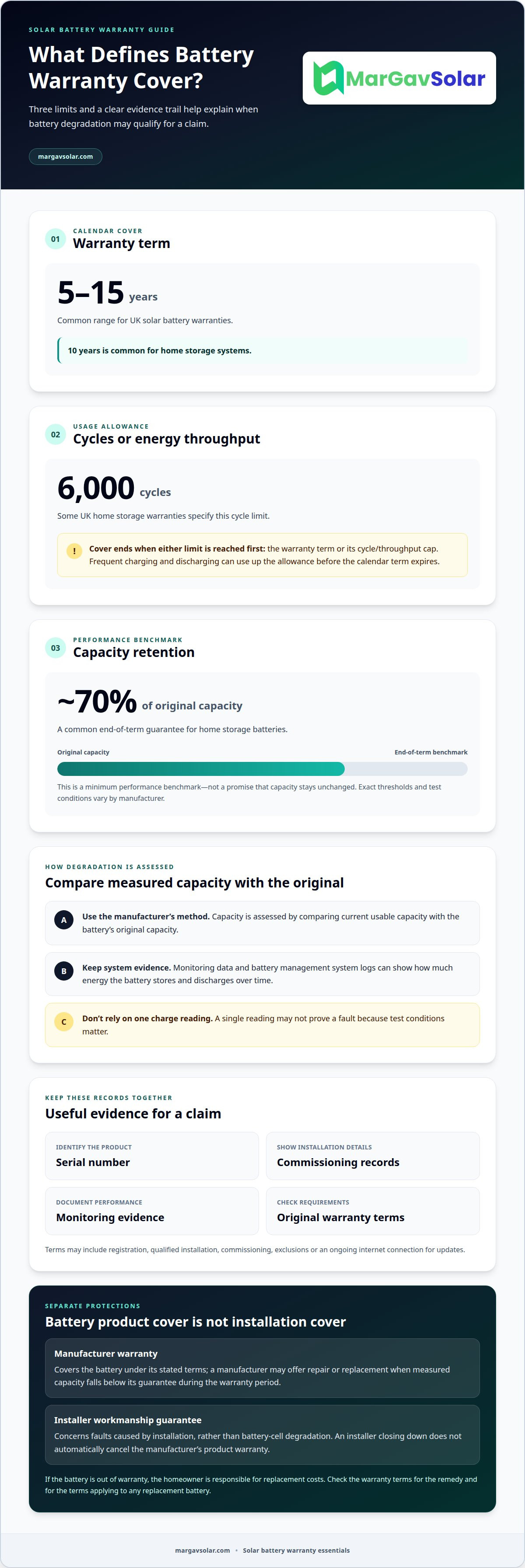
A solar battery warranty doesn’t always last as long as the date on its paperwork suggests. In the UK, cover commonly lasts between 5 and 15 years, and a solar battery degradation warranty claim may depend on the battery reaching a stated capacity threshold before the time limit expires. If the warranty also sets a cycle or throughput cap, cover ends when either limit is reached first. Many home storage warranties last 10 years and commonly guarantee around 70 per cent of the battery’s original capacity by the end of the term.
It’s reasonable to expect the warranty to protect you if capacity falls faster than promised, but a product warranty, an installer’s workmanship cover and your rights against the seller are separate protections. This guide explains how long battery degradation cover lasts, what its capacity and usage limits mean, and what routes may remain if the installer or manufacturer stops trading. You’ll also learn what information can support a claim and how to understand which party is responsible, so you can distinguish a battery fault from an installation issue.
Key Takeaways
- Read the warranty’s energy-throughput limit and capacity-retention terms alongside its time limit to understand what degradation may qualify for a claim.
- If your installer stops trading, workmanship cover and the battery’s manufacturer warranty are separate; another installer may be able to handle a manufacturer claim.
- When a manufacturer is insolvent, the claim route may run through the installer or distributor, with serial numbers and battery monitoring data helping document the issue.
- According to the UK Government, the Consumer Rights Act 2015 places responsibilities for refunds, repairs and fit-for-purpose goods on the seller, independently of the manufacturer’s warranty.
How long is a solar battery warranty?
UK solar battery warranties commonly last between 5 and 15 years, with 10 years common for home storage systems. The warranty may also have energy-throughput or cycle limits, so the calendar term isn’t the only measure of cover.
Warranty Term and Energy Throughput
A warranty can set a time limit alongside a maximum throughput or cycle count. Cover ends when either limit is reached first, meaning frequent charging and discharging can use up the allowance before the term expires. Some UK home storage warranties specify 6,000 cycles. For a solar battery degradation warranty claim in the UK, the applicable limit helps establish whether cover remains active.
Capacity Retention Thresholds
Capacity retention compares the energy a battery can store with its original capacity. UK warranties commonly guarantee around 70 per cent of original capacity by the end of the warranty term, though the exact threshold and test conditions vary by manufacturer. This is a minimum performance benchmark, not a promise that capacity stays unchanged. It helps define when degradation may qualify for a claim.
Measuring Battery Degradation
Degradation is assessed by comparing current usable capacity with the battery’s original capacity, using the manufacturer’s warranty method. Monitoring data and battery management system logs can show how much energy the battery stores and discharges over time. A single charge reading may not prove a fault because test conditions matter. For a solar battery degradation warranty claim in the UK, keep the serial number and system records to identify the product and document its performance.
Replacement and Warranty Coverage
A manufacturer may offer repair or replacement if measured capacity falls below its guarantee during the warranty period. An accepted claim may cover the remedy specified in the warranty terms. If the battery is out of warranty, the homeowner is responsible for replacement costs. There is no single UK replacement price: costs vary with factors such as battery capacity and brand. Check whether a replacement battery receives a new warranty period and what terms apply.
What happens to the warranty if my installer goes bust?
An installer closing down does not automatically cancel the battery’s manufacturer warranty. Product cover is separate from the installer’s workmanship guarantee, which concerns faults caused by installation rather than battery-cell degradation. If the installer stops trading, another installer can usually help handle a manufacturer warranty claim. The manufacturer’s terms determine whether the fault qualifies.
Solar panels also have different types of cover. Product warranties address manufacturing defects and generally last 10 to 15 years; performance warranties cover excessive output degradation and usually last around 25 years. Installation warranties vary from 2 to 10 years. These terms cover different risks, so a panel output problem and faulty installation aren’t the same claim.
For workmanship protection, an MCS-certified installer typically provides a guarantee of at least 2 years. An insurance-backed warranty remains valid for its full warranty period even if the installer ceases trading. Keep its documentation with the installation records: it can show which protection applies when the original business is no longer available. An insurance-backed workmanship warranty doesn’t replace the battery manufacturer’s product warranty.
Battery cover may depend on installation by a competent, certified installer and commissioning according to the manufacturer’s process. A claim may require evidence of qualified installation and compliance with the warranty conditions. Some manufacturers also require the battery to remain connected to the internet for updates. A disconnection or missing commissioning record could complicate a claim, even if the installer has closed.
If the manufacturer remains in business, a replacement installer can usually help progress the product claim using the battery’s serial number, commissioning records and monitoring evidence. If the manufacturer itself becomes insolvent, that is a separate problem from installer closure and may affect who can honour its warranty. For a new system after cover ends, explore residential battery storage options.
Manufacturer insolvency and battery warranty claims
If a battery manufacturer becomes insolvent, its warranty may be harder to enforce because the company responsible for honouring it may no longer operate. The available claim route will depend on the warranty wording and any role played by the retailer or distributor.
Manufacturer Warranty Terms
A manufacturer’s warranty sets out the battery’s cover, including its term and the conditions owners must meet. Read the original terms for capacity guarantees, registration requirements and exclusions, which vary by manufacturer. For example, a warranty may require registration after commissioning or an ongoing internet connection for updates. A minimum capacity guarantee applies only if the claim meets the stated test and conditions.
Separate components have separate warranty terms. A battery defect is not automatically an inverter fault, and an inverter warranty does not replace battery cover. If the manufacturer is still operating, the installer or distributor can usually help submit the claim and evidence. If the manufacturer is no longer available, the route for pursuing a warranty claim may be less clear. Keep the documents showing the original commitment and claim requirements.
Making a Manufacturer Claim
Battery claims are usually handled through the installer or distributor, rather than directly with the manufacturer. They can help identify the fault and assemble evidence, such as the battery serial number and monitoring data. Keep purchase and commissioning records with the warranty terms. These details help distinguish abnormal degradation from normal operation and show whether installation conditions were followed.
If the manufacturer is insolvent, start with the seller, installer or distributor named in your purchase records to establish the available claim route. A reseller may help forward documents to the manufacturer or its appointed claims handler, depending on the arrangements and warranty terms. Keep written responses and evidence of the fault together. If the installer has also closed, another installer can usually handle a manufacturer claim while the manufacturer remains able to process it.
Seller responsibilities under UK consumer law
A manufacturer’s warranty isn’t the only route for a faulty battery. The seller may have separate responsibilities under UK consumer law.
Consumer Rights Against the Seller
The seller is the first point of contact for a claim about a faulty or malfunctioning product. This matters if the battery’s actual capacity falls short of what you were told or it fails to store energy as expected. Your purchase documents identify the seller and the goods supplied. Raise the issue with the seller rather than assuming the manufacturer’s warranty is your only option.
According to the UK Government, the Consumer Rights Act 2015 places legal responsibilities on the seller for refunds, repairs and goods being fit for purpose, independently of the manufacturer's warranty. A manufacturer may assess a capacity claim against its original-capacity guarantee; the seller’s legal responsibilities are a separate route. Keep the contract, receipt and monitoring evidence together to explain the fault and its effect.
Consumer Rights Act Protections
The Consumer Rights Act 2015 concerns the relationship between the consumer and seller, not just the manufacturer’s warranty terms. A claim may relate to goods being faulty or not fit for purpose, and the appropriate remedy depends on the circumstances. In England and Wales, a claim may be possible within a reasonable time, generally up to six years; in Scotland, generally up to five years.
That period does not guarantee an automatic repair or refund. The nature of the fault, purchase date and evidence all matter. A degradation guarantee measures capacity against the warranty terms, while a seller claim concerns the goods supplied. These are different tests, even when both relate to reduced battery output.
According to the Financial Ombudsman Service, a credit card payment of at least £100 can qualify for Section 75 protection even if only the deposit was paid by card. The MCS Consumer Code also requires member installers to provide written warranty terms before signing, plus deposit and workmanship protection. If a failed battery prompts plans for a new system, explore solar battery options.
MarGav Solar: Battery Storage Solutions
MarGav Solar provides Battery Storage Solutions for homeowners planning a new system or considering battery storage as part of their property’s energy setup. If a battery has reached the end of its warranty, or you’re weighing replacement against a new installation, professional advice can help you assess how storage fits your household’s needs.
MarGav Solar also installs Residential Solar PV Systems and EV Charging Points, and provides Solar Panel Maintenance & Cleaning. These services may suit a broader home energy upgrade, rather than a manufacturer warranty claim for an existing battery. The right next step depends on whether you need a new system, battery storage or panel maintenance.
For advice on battery storage or a wider solar project in Staffordshire, contact MarGav Solar.
Plan your next step with confidence
A warranty issue can also prompt a closer look at how your home uses and stores energy. If you’re considering a replacement or planning future improvements, consider your household’s energy needs rather than the battery in isolation. A solar battery degradation warranty claim in the UK may be one part of that decision, alongside plans for solar generation or home charging.
MarGav Solar offers Battery Storage Solutions, Residential Solar PV Systems and EV Charging Points. These options can support homeowners considering a new energy setup or changes to an existing one. You can discuss what suits your property and priorities without assuming that every warranty concern requires a new system.
Contact MarGav Solar for advice about your next step. With a clearer plan, you can move forward with confidence.
Frequently Asked Questions
What’s Covered and What’s Not?
A battery warranty generally covers specified product defects and performance below its capacity guarantee, subject to its terms. It does not automatically cover installation workmanship, accidental damage or every drop in stored energy. For example, a battery that falls below its stated capacity threshold may qualify for assessment, while damage from vandalism or an unauthorised system change may be excluded. External damage may instead be an insurance matter.
How long do home solar battery warranties last in the UK?
Home solar battery warranties commonly last between 5 and 15 years, with 10 years common for UK home storage systems. The warranty’s start date and any registration requirement can affect how the period is recorded. Some manufacturers require registration after commissioning, so keep the commissioning paperwork with your purchase documents. For Staffordshire homeowners, these records can help identify which warranty terms apply to an installed system.
What cycle or throughput limits apply to UK solar battery warranties?
Limits depend on the battery and its manufacturer’s warranty. Some UK home storage warranties specify 6,000 cycles, while others use an energy-throughput cap. If both a time limit and a cycle or throughput limit apply, cover ends when the first limit is reached. A household that charges and discharges its battery frequently may reach a usage cap before the warranty’s calendar period ends.
What evidence and documents are needed to claim for solar battery degradation in the UK?
Useful evidence includes the warranty terms, proof of purchase, the battery’s serial number and monitoring data showing its performance. Keep commissioning or installation records too, as a claim may require evidence of qualified installation and compliance with warranty conditions. Battery management system logs can help document use. Together, these records help the installer or distributor assess the reported capacity problem.
How do I make a solar battery warranty claim with the manufacturer or installer in the UK?
Start by reporting the fault through the installer or distributor, which usually handles the manufacturer claim and helps diagnose the battery. Describe the performance change and provide the serial number, purchase and commissioning documents, and any available monitoring records. Keep copies of your submission and the response. If the installer has stopped trading, another installer can usually handle a manufacturer claim while the manufacturer remains able to process it.
What exclusions can invalidate a UK solar battery warranty claim?
Warranty terms may exclude damage caused by severe weather, vandalism, poor maintenance or unauthorised system modifications. A claim may also be affected if installation or commissioning did not follow the manufacturer’s requirements, or if a required internet connection for updates was interrupted. For example, changing system settings outside the permitted process could complicate a degradation claim. The battery’s warranty documents set out the specific exclusions and conditions.


