

Did you know that 94% of UK homeowners installing solar panels over the last year chose to include battery storage? It's a staggering figure that proves the era of simply exporting your clean energy back to the grid for pennies is over. However, learning how to choose a solar battery UK residents can actually rely on is often easier said than done. You might feel overwhelmed by technical jargon like kWh versus kW, or confused about whether an AC or DC coupled system fits your existing setup. High upfront costs are a valid concern, even with the current 0% VAT incentive available until March 2027.
We understand that you want a clear path to energy independence without the technical headache. This guide provides a masterclass in selecting the right storage, helping you balance capacity with your actual household loads. As Staffordshire specialists with over 20 years of experience, we've seen which systems truly deliver. You'll learn a foolproof framework for sizing your battery, discover which brands offer the best longevity, and see how to integrate smart monitoring like GivEnergy Cloud with time-of-use tariffs to maximize your savings. Let's turn that technical confusion into a practical plan for your home.
Key Takeaways
- Differentiate between storage capacity (kWh) and power delivery (kW) so you can power high-demand appliances during peak times.
- Use your smart meter data to accurately size your battery, balancing your average daily solar yield with your home's actual energy needs.
- Determine if AC or DC coupling is right for your property based on whether you're starting from scratch or upgrading an existing solar array.
- Follow our practical framework on how to choose a solar battery UK residents can trust to increase self-consumption and lower energy bills.
- Learn why professional NICEIC certification and local Staffordshire expertise are vital for a safe, high-performance battery installation.
Why Battery Storage is Essential for UK Homes in 2026
Solar battery storage serves as the essential bridge between energy generation and household consumption. Without a way to capture surplus power, your solar PV system sends excess energy back to the grid during the day, only for you to buy it back at a premium once the sun goes down. In 2026, the primary goal for any homeowner should be total self-consumption. Learning how to choose a solar battery UK families can rely on means looking at how to decouple your home from the National Grid's price volatility and aging infrastructure.
By utilizing high-efficiency rechargeable battery technology, you significantly reduce your reliance on fossil fuel "peaker" plants. These plants often fire up during evening spikes to meet national demand. When you power your kettle or TV with stored sunlight instead of grid power at 7 PM, you're making a direct, positive impact on the environment while keeping your money in your pocket.
The Shift from Exporting to Storing
Selling energy back through the Smart Export Guarantee (SEG) is a useful secondary income stream, but it's no longer the most profitable strategy. In 2026, top export rates range from 16p to 20p per kWh. While these figures are competitive, they still pale in comparison to the cost of importing electricity during peak hours. Storing your own "free" solar energy for evening use is far more valuable than selling it for a few pence and buying it back later for three times the price.
Smart time-of-use tariffs have also transformed the ROI of battery storage. Many homeowners now use their systems to "load shift." This involves automatically charging the battery with cheap off-peak grid electricity during the night. You can then use that stored power during expensive peak windows, which effectively slashes your average unit price for electricity across the entire day.
Key Benefits Beyond Financial Savings
Financial returns are a major driver, but batteries offer practical security that solar panels alone cannot provide. Many modern systems include an Emergency Power Supply (EPS) function. This acts as a dedicated backup during grid outages, keeping your essential lights, fridge, and Wi-Fi running when the rest of the street goes dark. It's a level of energy independence that provides genuine peace of mind.
A high-quality battery installation also improves your property's Energy Performance Certificate (EPC) rating. As energy efficiency becomes a top priority for UK homebuyers, a property that can power itself through the night is a much more attractive and valuable asset. It's a way to future-proof your lifestyle while making a tangible commitment to a net-zero future.
Understanding Technical Specifications: Capacity vs. Power
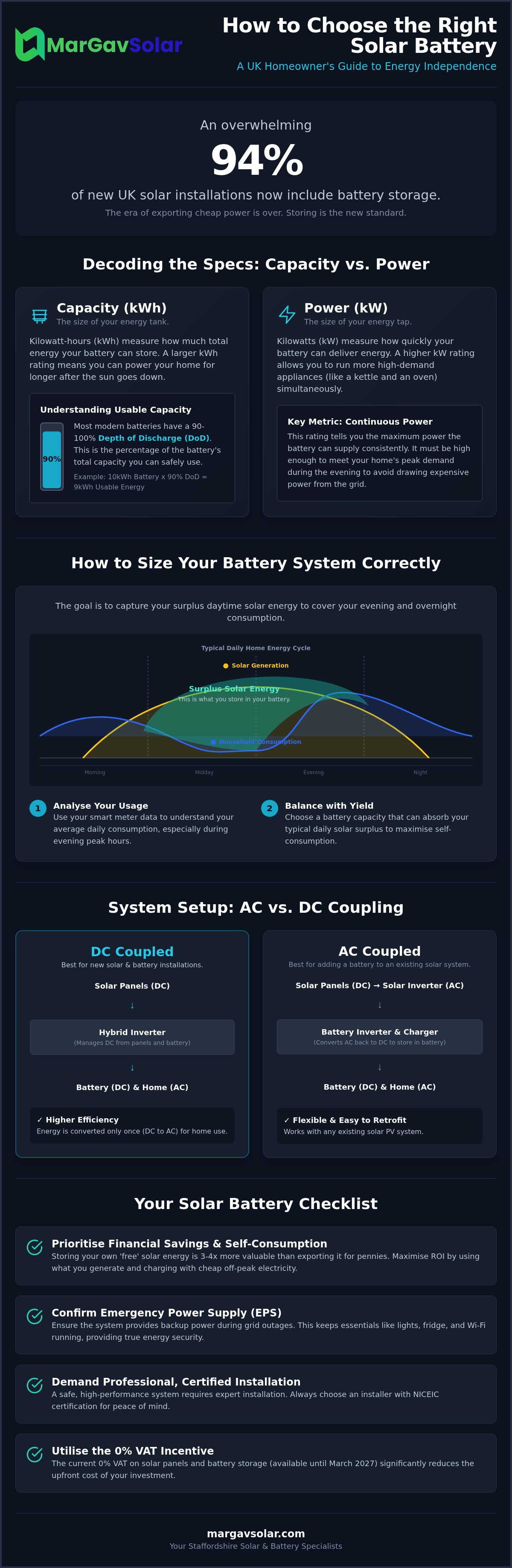
Confusion often arises between kilowatt-hours (kWh) and kilowatts (kW) when homeowners look at spec sheets. It's helpful to think of your battery system as a water tank. The kWh represents the size of the tank (how much energy it holds), while the kW is the size of the tap (how fast that energy can flow out). If you want to know how to choose a solar battery UK homeowners can rely on for high-drain appliances, you must look at both figures. A large tank with a tiny tap won't help you much when you're trying to run multiple appliances at once.
Usable Capacity vs. Total Capacity
Total capacity is the absolute limit of the battery cells, but you can't drain every drop without risking long-term damage. Manufacturers set a limit to protect the hardware, which is where Depth of Discharge (DoD) comes in. Depth of Discharge is the percentage of the battery that can be safely used without causing damage. Most modern Lithium Iron Phosphate (LiFePO4) batteries offer a 90% to 100% DoD. If a battery has a 10kWh total capacity but a 90% DoD, your usable capacity is actually 9kWh. As noted in the Energy Saving Trust guide to solar panels, understanding your storage needs is the first step toward true home efficiency.
Charge and Discharge Rates (kW)
A massive 15kWh battery won't help if its discharge rate is only 2kW. If you turn on a 3kW kettle while the dishwasher is running, a low-power battery simply can't keep up. You'll end up pulling the difference from the grid despite having a full battery sitting in your garage. Look for "continuous power" ratings that match your peak household demand. While "peak power" offers a short burst for starting heavy motors, continuous power is what keeps your home running during the evening rush. If these specs feel complex, our team at MarGav Solar can analyze your usage data to find the right technical fit for your home.
You should also consider the cycle life and round-trip efficiency. Every time a battery charges and discharges, it completes a "cycle." High-quality systems are often rated for 6,000 to 10,000 cycles, providing a lifespan of 15 to 25 years. Round-trip efficiency tells you how much energy is lost during the storage process. Most lithium systems hit around 90% to 95% efficiency. If this number is lower, you're losing "free" solar power as heat every time the battery works, which extends your payback period over time.
Sizing Your System: How Much Storage Do You Actually Need?
Determining the right capacity for your home is a strictly data-driven process. To understand how to choose a solar battery UK homeowners should first consult their smart meter data. This reveals your 'baseload' usage during the night and your 'peak' usage during the evening. Once you know how many units (kWh) you typically consume after sunset, you can compare this against your solar array's average daily yield. If your panels only generate 6kWh on a cloudy day, buying a 15kWh battery might be overkill unless you plan to charge from the grid during off-peak hours.
The "Goldilocks" Zone of Battery Sizing
Finding the 'Goldilocks' zone means avoiding the common trap of oversizing. While a massive battery sounds great, it may never reach a full charge during the UK's low-light winter months. This drags down your return on investment because expensive hardware sits half-empty for months on end. Sizing for your 'evening peak' rather than trying to cover a full 24-hour cycle is often the most cost-effective approach. Using modular GivEnergy batteries allows you to start with a smaller capacity and add more storage later if your needs change. This flexibility is vital for future-proofing your home for EV chargers or air-source heat pumps, which can significantly increase your daily demand.
Smart Monitoring and Cloud Integration
The Energy Saving Trust guide to battery storage highlights how monitoring helps you track energy flow in real-time. Modern storage systems act as smart energy managers rather than just simple tanks. By using GivEnergy Cloud, you can identify 'energy leaks' and optimize your charge cycles based on weather forecasts or tariff prices. Remote firmware updates also ensure your system stays efficient as software improves over time.
Smart monitoring also helps you decide when to discharge your battery. If you know a storm is coming and solar generation will be low, you can tell the system to hold its charge for emergency backup. This proactive management is what separates a standard installation from a high-performance energy hub. By following this data-led approach, you'll feel confident in how to choose a solar battery UK homes can actually benefit from for the next decade.
AC vs. DC Coupling: Choosing the Right Setup
One of the most technical decisions in learning how to choose a solar battery UK homeowners face is the choice between AC and DC coupling. This refers to how your battery storage system connects to your solar panels and your home's electrical circuit. The right choice depends almost entirely on whether you're installing a brand-new system or adding storage to an existing array. Getting this wrong can lead to unnecessary conversion losses and higher installation costs.
DC-Coupled Systems: Efficiency for New Builds
For a completely new solar installation, DC coupling is usually the gold standard. In this setup, a single hybrid inverter manages both your solar panels and your battery storage. Because solar panels and batteries both operate on Direct Current (DC), the electricity flows directly from the panels into the battery without needing to be converted. This reduces conversion losses significantly. You'll only convert that power to Alternating Current (AC) once when you actually use it in your home. While highly efficient, DC systems can be harder to expand later if the original hybrid inverter isn't compatible with newer battery models.
AC-Coupled Systems: The Retrofit King
If you already have solar panels installed, AC coupling is often the most practical and cost-effective route. This setup allows the battery to sit alongside your existing system without needing to replace your current solar inverter. AC-coupled batteries are connected to your home’s AC wiring via a dedicated battery inverter. This independence is a huge advantage. It doesn't matter how old your solar panels are or what brand of inverter you currently use; an AC-coupled battery will work perfectly alongside them. It also provides a great opportunity for inverter upgrades if your original hardware is nearing the end of its lifespan.
The choice of inverter is the single most important factor for long-term reliability. It's the "brain" of your energy system, managing the complex task of charging, discharging, and grid interaction. A low-quality inverter can fail years before the battery cells do, leading to expensive repairs. At MarGav Solar, we focus on matching the coupling type to your specific property needs to ensure you get the highest possible return on your investment. Whether you're starting fresh with a hybrid DC system or retrofitting an AC unit to a Staffordshire home, we'll help you navigate the technical specifications to find the perfect fit.
Installation and Costs: Finding an Expert in Staffordshire
While technical specs are vital, the financial reality is often the deciding factor in how to choose a solar battery UK homeowners can afford. In 2026, the 0% VAT rate continues to provide a significant incentive, applying to both standalone and integrated battery installations until March 2027. Typically, you can expect an installed cost ranging from £3,000 to £10,500. For a standard 3 to 4 bedroom home requiring an 8 to 10 kWh capacity, the average investment sits between £4,500 and £7,000. It's vital to recognize that retrofitting a battery to an existing system is usually more expensive than a combined install, often costing between £4,500 and £6,500 due to the additional labour and technical integration required.
When you evaluate a quote, look beyond the bottom line. A transparent proposal should break down the hardware costs, labour, and the administrative fees for certifications and grid notifications. Don't be tempted by low-cost "hardware-only" deals from non-specialist firms. The value of a local Staffordshire installer lies in their ability to provide long-term maintenance and rapid warranty support. If a component fails in five years, you want a team that can be on-site within hours, not a national call centre that might take weeks to respond.
Why Certification Matters for Your Warranty
Electrical safety isn't just about functionality; it's about protecting your long-term investment. This is why NICEIC certification is non-negotiable. High-voltage DC work carries significant risks if handled by non-specialists. Using a certified expert ensures your installation meets strict UK building regulations. Many manufacturers will only honour their 10 year or 15 year warranties if the system was installed by a qualified professional. Ongoing solar panel maintenance also plays a role here, as keeping the entire system in peak condition prevents the battery from working harder than necessary. With 20 years of experience in Staffordshire, MarGav Solar provides the local accountability and technical expertise needed for these complex setups.
Next Steps for Staffordshire Homeowners
Once you've narrowed down your choices, the next step is a comprehensive technical survey. A local expert can assess your property's suitability, looking at everything from your fuse board capacity to the best physical location for the battery. Many residents are now opting to integrate their storage with EV charging points to maximize their self-consumption of clean energy. Before signing a contract, go through this final checklist:
- Confirm the usable capacity and Depth of Discharge (DoD) matches your evening peak.
- Verify the cycle life and manufacturer warranty terms (aim for 6,000+ cycles).
- Ensure the system is compatible with smart "time-of-use" tariffs to speed up your ROI.
- Check for MCS and NICEIC credentials to guarantee eligibility for export payments.
Take Charge of Your Home Energy Future
Choosing the right storage system is the final piece of the puzzle for energy independence. You now understand that balancing usable capacity with discharge power is just as important as picking the right brand. Whether you're opting for a DC-coupled hybrid system for a new build or retrofitting an AC-coupled unit to an existing array, the goal remains the same: maximizing self-consumption. Learning how to choose a solar battery UK residents can rely on doesn't have to be a technical struggle when you focus on smart monitoring and professional installation.
Ready to stop exporting your clean energy and start using it? Our NICEIC-certified team brings over 20 years of expertise in Staffordshire to every project. As GivEnergy Advanced Partners, we'll help you navigate the technical specs to find a solution that fits your home perfectly. Get a Fixed-Price Solar Battery Quote from MarGav Solar and take the first step toward a more efficient, lower-carbon home. It's time to make your solar panels work harder for you.
Frequently Asked Questions
Is a solar battery worth it in the UK in 2026?
Solar batteries are highly worth it in 2026 because they increase your self-consumption from roughly 50% to around 85%. With the 0% VAT rate still active, the upfront investment is lower than in previous years. When you combine storage with a smart tariff, the payback period can be significantly shorter than the standard ten years. It's the most effective way to protect your home from grid price spikes while maximizing your clean energy.
Can I add a battery to my existing solar panel system?
You can certainly add a battery to an existing system. This is known as a retrofit and typically uses an AC-coupled setup. This means the battery has its own inverter and works alongside your current solar panels regardless of their age or brand. While retrofitting is slightly more expensive than a combined installation, it's a popular choice for Staffordshire homeowners looking to upgrade their energy independence and stop wasting surplus generation.
How long do solar batteries typically last?
Most modern lithium-ion batteries are designed to last between 10 and 15 years. This is usually measured in cycles, with high-quality units offering 6,000 to 10,000 cycles before their capacity drops significantly. Choosing a system with a long warranty and a high cycle life ensures your investment pays for itself several times over. Regular maintenance and keeping the battery in a temperature-controlled environment can also help extend its total functional life.
Do I need planning permission for a solar battery in Staffordshire?
In most cases, you don't need planning permission for a solar battery in Staffordshire as it falls under Permitted Development. However, there are exceptions if your property is a Listed Building or located within a Conservation Area. It's always best to check with your local council or a certified installer before starting. Our team can help verify these requirements during a technical home survey to ensure your installation is fully compliant with local regulations.
What is the best solar battery brand for UK homes?
While several brands exist, we recommend GivEnergy for UK homes due to their excellent smart monitoring and UK-based technical support. Their systems integrate seamlessly with smart tariffs and offer modular designs that allow you to expand your storage later. When researching how to choose a solar battery UK homeowners should prioritize brands with a proven track record for longevity and software reliability rather than just looking at the lowest possible price point.
Can I charge my solar battery from the grid at night?
Yes, charging from the grid is one of the most effective ways to increase your savings. By using a smart time-of-use tariff, you can program your battery to charge during off-peak hours when electricity is cheapest. You then use that stored power during expensive peak periods. This strategy is particularly useful during the winter months when solar generation is lower but your household energy demand typically increases for heating and lighting.
Is there still 0% VAT on solar batteries in the UK?
Yes, a 0% VAT rate currently applies to the supply and installation of solar batteries in the UK. This incentive was introduced to encourage green energy adoption and is set to remain in place until March 31, 2027. After this date, the rate is expected to revert to 5%. This makes 2026 an ideal time to invest, as you can save significantly on the total cost of both standalone and integrated battery systems.
What happens to my solar battery during a power cut?
During a power cut, most standard solar batteries will shut down for safety unless they have an Emergency Power Supply (EPS) feature. If your system includes EPS, it can automatically switch to island mode to power essential circuits like lighting and your fridge. When learning how to choose a solar battery UK residents should specify if they require backup power, as this often involves additional wiring and a dedicated consumer unit for those circuits.


