

What happens to your 25 year performance guarantee if the company that installed your panels disappears next Tuesday? It's a valid fear that keeps many Staffordshire homeowners awake at night, especially when faced with a mountain of confusing "Product" versus "Performance" labels. You want the peace of mind that your investment is actually protected, not just covered on paper. Having the solar panel warranty explained UK style is essential to ensure you don't get stuck with hidden shipping fees or "orphaned" hardware if a claim arises.
You're right to be cautious, as a warranty is only as strong as the company standing behind it. This guide will help you master the complexities of solar warranties so you can protect your investment and ensure your home generates clean energy for decades. We'll break down the three pillars of coverage, explain how to keep your protection valid through proper maintenance, and show you why choosing a stable, MCS certified local installer is your best defense against future costs in 2026.
Key Takeaways
- Learn the critical differences between manufacturer and installer coverage with our solar panel warranty explained UK guide to avoid unexpected repair bills.
- Discover why a long performance guarantee doesn't always cover the costs of labour, shipping, or scaffolding during a hardware claim.
- Understand how Insurance-Backed Guarantees protect your investment even if your original installation company ceases trading.
- Identify the specific maintenance requirements and unauthorized actions that can instantly void your system's protection.
- Find out how choosing a local Staffordshire specialist with a long trading history provides the ultimate security for your home's energy future.
The Three Pillars of Solar Panel Warranties in the UK
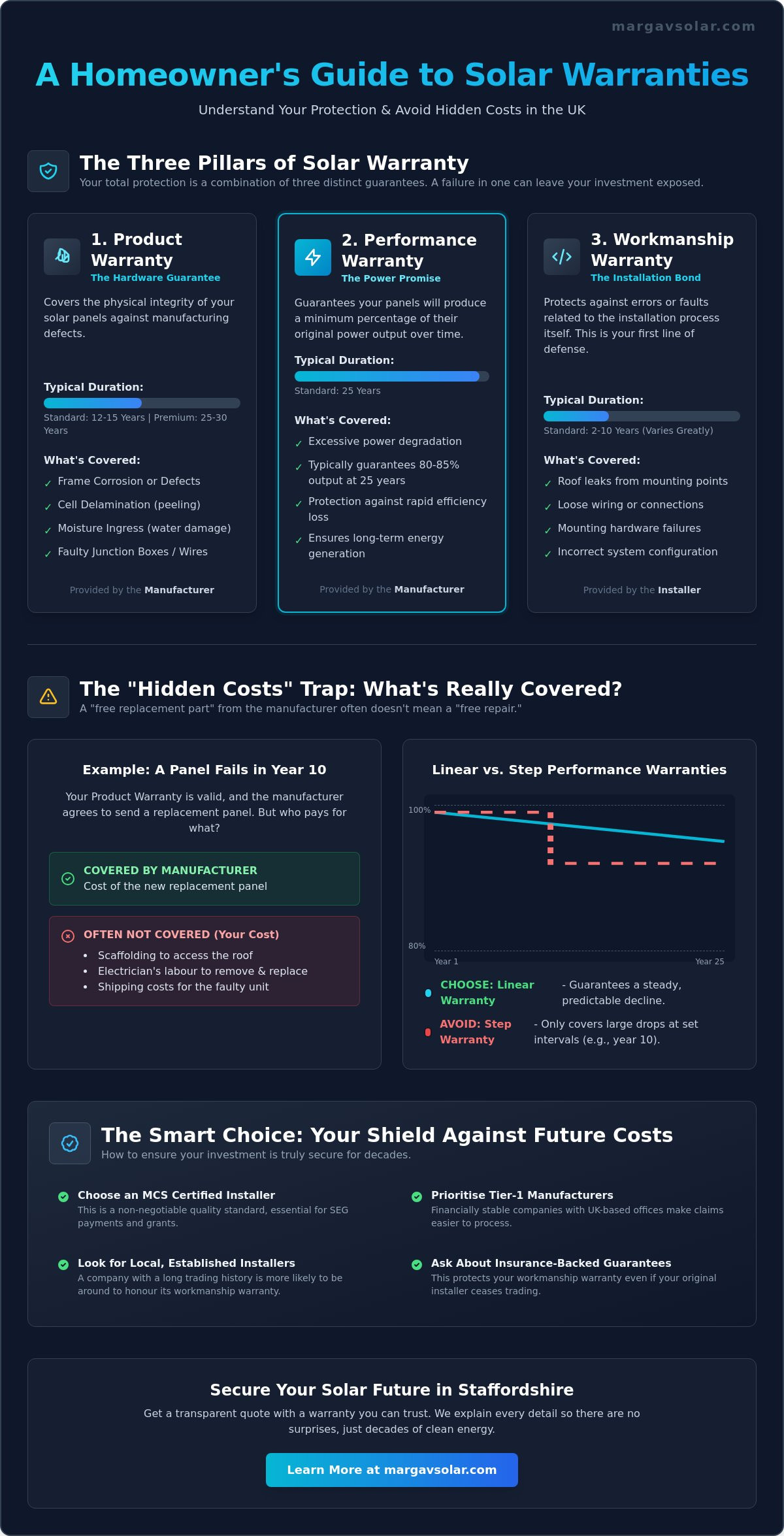
Don't be fooled by the "25-year warranty" stickers often found on marketing brochures. While it sounds simple, a solar system is a complex assembly of glass, silicon, electronics, and mounting hardware. Having the solar panel warranty explained UK style means looking at three distinct layers of protection that work together. If one pillar fails, your investment could be at risk. A solar installation is not a single product; it's a long-term energy solution where different components carry different levels of protection.
The Microgeneration Certification Scheme (MCS) acts as the foundation for these pillars. It's a government-backed quality standard that ensures both the products and the installers meet strict criteria. Without an MCS-certified installation, you'll likely find yourself ineligible for the Smart Export Guarantee (SEG) payments or government grants available in 2026. These three pillars provide a safety net that covers everything from a faulty internal wire to the gradual decline in energy production over several decades.
Manufacturer Product Warranty: The Hardware Guarantee
This covers the physical Solar panel itself. It protects you against manufacturing defects like frame corrosion, cell delamination, or moisture ingress. In 2026, standard Tier-1 panels usually offer 12 to 15 years of product cover. Premium, high-efficiency panels often extend this to 25 or even 30 years. It's essentially the "hardware insurance" that ensures the materials used to build your panels are fit for purpose and won't fail prematurely due to poor factory standards.
Manufacturer Performance Warranty: The Power Promise
This is the "Power Promise" that guarantees a specific electricity output over a 25-year period. Solar panels naturally lose a tiny bit of efficiency every year. A performance warranty ensures they don't degrade too quickly. Most manufacturers guarantee that after 25 years, the panels will still produce at least 80% to 85% of their original rated power. You should look for "linear" warranties. These guarantee a small, steady decline each year, which is much better than "step" warranties that only offer protection at specific 10 or 25-year intervals.
Workmanship Warranty: The Installation Bond
While the manufacturer covers the parts, the installer covers the labor. This pillar protects you against issues like roof leaks, loose wiring, or mounting failures. It's the most frequently used warranty type during the first five years of a system's life. Choosing an NICEIC-certified installer is vital because it confirms the electrical work meets the highest safety standards in the UK. This bond ensures that if a component is fitted incorrectly, the installer is responsible for fixing it without charging you for the visit.
Product vs. Performance: Understanding the Manufacturer’s Promise
Many homeowners assume a 25-year warranty means they won't pay a penny if something breaks. This is rarely the case. When you have the solar panel warranty explained UK homeowners often discover a massive gap between a "free replacement part" and a "free repair." Most manufacturer product warranties only cover the cost of the hardware itself. If a panel fails in year ten, the manufacturer might ship a new one to your door, but you are often responsible for the cost of the scaffolding, the labour for the electrician, and even the shipping costs for the faulty unit.
This "hidden cost" trap is why reading the fine print is vital. For more context on consumer protections and industry standards, you can refer to this UK Parliament Q&A on solar panels. It highlights how regulations are evolving to protect consumers from these exact scenarios. To mitigate these risks, it's best to choose Tier 1 manufacturers. These companies are financially stable and maintain UK-based claims offices, making it much easier to process a claim than dealing with a remote factory overseas. If you're concerned about your current system's health, booking a professional solar panel maintenance check can help identify issues before they void your coverage.
What is a Linear Performance Guarantee?
A linear performance guarantee is a year-on-year output commitment that ensures your panels don't lose power too quickly. While all panels degrade, a standard Tier 1 panel shouldn't lose more than 0.5% to 0.7% of its efficiency annually. If you notice your generation dropping significantly faster, you may have a valid performance claim. Unlike "step" warranties that only check power at year 10 or 25, a linear guarantee protects you every single year of the system's life. This ensures your Staffordshire home continues to hit its energy targets throughout the decades.
Inverter Warranties: The System’s Weakest Link?
While panels sit quietly on the roof, the inverter is the "brain" that works hard every second the sun is shining. Because they handle high-voltage electricity and heat, inverters typically have shorter lifespans and warranties, usually ranging from 5 to 12 years. If your system is approaching its first decade, considering inverter upgrades with extended cover can save you from a total system shutdown later. Battery storage warranties are also distinct, often measured in "cycles" or years, reflecting how often the battery is charged and discharged. You should always check if your battery warranty is tied to a specific number of discharges or a flat time period.
Workmanship Warranties: Why Your Installer’s Reputation Is Vital
A manufacturer's promise is only half the battle. If your installer goes out of business, you might find yourself with an "orphaned system." This is a common issue for homeowners who chose national "fly-by-night" firms that vanished during market shifts. Having the solar panel warranty explained UK homeowners often realize that the workmanship warranty is actually their most valuable asset. It covers the physical integrity of the install, ensuring your roof remains weatherproof and your wiring stays safe. If a leak occurs three years after installation, it's this guarantee that saves you from a massive repair bill.
To avoid the "labour cost" trap, you need an Insurance-Backed Guarantee (IBG). While a manufacturer might replace a faulty component for free, they won't pay for the technician's time or the scaffolding. An IBG ensures that even if your original installer ceases trading, another company will be paid by the insurer to fix the issue. You can find more detail on these specific protections at The Renewable Energy Hub, which outlines how these guarantees function as a final safety net. In 2026, a 10-year insurance-backed workmanship warranty has become the industry standard for high-quality installations.
Choosing a firm with over 20 years of local expertise in Staffordshire provides a level of security that new startups can't match. You aren't just buying panels; you're buying a relationship with a company that will still be here when you need a claim processed. Local stability is the ultimate warranty feature.
The Role of NICEIC and MCS Accreditations
These bodies vet installers to ensure every solar panel warranty explained UK guide is backed by high-quality work. MCS certification is essential for accessing the Smart Export Guarantee (SEG). It also confirms that your solar panel installation meets strict UK standards. NICEIC accreditation further guarantees the electrical safety of the system. Keeping this documentation safe is key for future house sales, as buyers will want proof that the warranties are valid and transferable.
Consumer Protection Schemes (HIES/RECC)
Schemes like HIES or RECC provide codes of conduct that protect your deposit and your long-term warranty. They offer free mediation services if a dispute arises between you and your installer. You should always verify an installer’s standing with these bodies before signing any contract. MarGav Solar maintains a commitment to transparent, long-term support, ensuring our Staffordshire customers are never left in the dark. We focus on building systems that last, backed by the certifications that give you total peace of mind.
How to Avoid Voiding Your Solar Warranty: Maintenance & Protection
Owning a solar system is a long-term commitment that requires more than just an initial installation. Even the most comprehensive solar panel warranty explained UK guide won’t help you if a manufacturer finds evidence of neglect or unauthorized modifications. Most warranties include strict "duty of care" clauses. If a fault occurs because you haven't looked after the system, the manufacturer or installer can legally reject your claim. This is especially true for unauthorized modifications; adding components or attempting to move panels yourself will immediately kill your cover.
Staffordshire’s specific climate presents its own challenges for warranty preservation. High winds and heavy winter frost in the West Midlands can put immense pressure on mounting hardware and cabling. While "Acts of God" like extreme storms or lightning strikes are typically excluded from manufacturer warranties, they are often covered by your home buildings insurance. However, if a panel becomes loose because you failed to have it inspected after a period of high winds, the resulting damage might be classed as "preventable neglect," leaving you with a rejected claim.
The "Professional Only" rule is perhaps the most critical factor to remember. Manufacturers require that any work, from simple repairs to solar panel maintenance, is carried out by an MCS-certified professional. If a manufacturer sees evidence of DIY tinkering or non-certified tool marks on the hardware, your product and performance guarantees are likely void. If you’re concerned about your system’s condition, you can arrange a professional solar panel maintenance check to keep your warranties intact.
Why Professional Cleaning and Maintenance Matter
Dirt, bird droppings, and lichen build-up do more than just reduce your energy yield. They can lead to "hotspots," where certain cells overheat because they are shaded while others are active. These hotspots can cause permanent damage to the panel's internal structure. Consistent professional cleaning prevents permanent cell degradation by removing debris that creates these localized heat zones. Investing in regular solar panel maintenance in Staffordshire ensures your system remains within the manufacturer’s operating guidelines, making a future performance claim much easier to prove.
Bird Proofing: Preventing Physical Damage
Pigeons are a significant threat to solar warranties in the UK. They love the warm, sheltered space beneath the panels, but their nesting materials and acidic droppings can destroy wiring and underside components. Most manufacturer warranties specifically list "pest damage" as a standard exclusion. This means if a bird pecks through your DC cabling, you’ll be paying for the repair out of your own pocket. Protecting your system with professional bird proofing solutions is a proactive way to safeguard the physical integrity of your install and avoid expensive, non-warranty repairs.
Securing Your Solar Future in Staffordshire with MarGav Solar
A warranty is only as strong as the company standing behind it. While we've had the solar panel warranty explained UK style throughout this guide, the most important factor remains the stability of your installer. MarGav Solar’s 20-year history in the industry provides a level of workmanship security that national "fly-by-night" firms simply cannot match. We've seen technologies evolve and companies come and go, but our commitment to Staffordshire homeowners has remained constant. Choosing a local expert means you aren't just a number in a national database; you're a neighbour who can reach us directly if you ever need to make a claim.
One of the biggest headaches for homeowners is the "blame game" that happens when components from different installers don't work together. We solve this by offering a unified approach. Whether we are installing residential solar PV, solar battery storage, or EV charging points, we bring everything under one professional umbrella. This integration simplifies your energy future and ensures that every part of your system is covered by a cohesive set of warranties and our expert local support.
The MarGav Maintenance Programme
As we discussed in the previous section, neglecting your system is the fastest way to void your manufacturer guarantees. Our recurring maintenance programme is designed to satisfy the strict "duty of care" requirements set by Tier 1 manufacturers. We provide professional cleaning and system health checks that prevent hotspots and cell degradation before they become a problem. You won't have to deal with national call centres or automated bots. Our Staffordshire-based team provides end-to-end consultancy and hands-on care to keep your system performing at its peak for the full 25-year duration of your performance promise.
Contact Us for a Warranty Review
Is your current system underperforming? If your energy bills are rising or your generation figures have dropped unexpectedly, you might be eligible for a warranty claim without even knowing it. We can help identify if your hardware is failing or if an older inverter is simply reaching the end of its natural life. Our team provides expert advice on inverter upgrades and system optimisations that can restore your ROI while maintaining your existing cover. Don't leave your investment to chance; ensure your home is protected by the most reliable name in local solar. Book your Staffordshire solar consultation today to secure your clean energy future.
Protect Your Investment for the Long Term
Mastering your solar warranty is the final step in turning a smart purchase into a lifelong asset. You now understand that a "25 year promise" is actually a combination of hardware durability, performance consistency, and expert installation quality. By keeping your system clean and choosing accredited professionals for any repairs, you ensure those protections remain active until long after your system has paid for itself. Having the solar panel warranty explained UK homeowners can move forward with total confidence in their renewable energy transition.
The most reliable warranty isn't just a piece of paper; it's the reputation of the people who stand behind the work. With over 20 years of renewable energy expertise and a team of NICEIC and MCS certified installers, we provide the local support Staffordshire families need to keep their systems running perfectly. Don't leave your long-term savings to chance. Secure your home's energy future with a MarGav Solar installation and enjoy peace of mind for decades to come. Your journey toward energy independence starts with a system you can trust.
Frequently Asked Questions
What is the difference between a solar product warranty and a performance warranty?
A product warranty covers the physical integrity of the hardware, while a performance warranty guarantees the amount of electricity the panels produce over time. Having the solar panel warranty explained UK homeowners should know that the product cover protects against manufacturing flaws like frame corrosion. The performance guarantee ensures the panels still produce at least 80% to 85% of their original capacity after 25 years.
Does my solar panel warranty cover the cost of scaffolding and labour for repairs?
Most manufacturer warranties only cover the cost of the replacement component, not the labour or scaffolding required to install it. If a panel fails, you might receive a free replacement part from the factory, but you'll likely pay for the technician's time and the equipment needed to reach your roof. You should check your workmanship warranty or insurance-backed guarantee to see if labour costs are included for installation errors.
What happens to my solar warranty if my installation company goes out of business?
Your workmanship warranty is protected by an Insurance-Backed Guarantee (IBG) if your installer was properly accredited. This safety net ensures that another certified company can be paid by the insurer to fix issues if your original firm stops trading. Manufacturer warranties for the panels and inverters remain valid regardless of the installer's status, as these are held directly with the hardware brand.
Will bird damage or nesting pigeons void my solar panel warranty?
Damage caused by nesting birds or rodents is almost always excluded from standard manufacturer warranties. Pigeons can damage wiring and components on the underside of the panels, which is classed as an external factor rather than a manufacturing defect. It's best to install professional bird proofing during your initial setup to prevent these non-covered repair costs from arising.
Is a solar panel warranty transferable if I sell my Staffordshire home?
Yes, solar warranties are typically transferable to the new owner when you sell your property. Having a solar panel warranty explained UK buyers will see this as a significant benefit that adds value to your home. You'll need to hand over all original documentation, including the MCS certificate and warranty registration details, to the new owner during the conveyancing process.
Does the UK weather, like heavy snow or high winds, affect my warranty coverage?
Standard warranties cover defects that cause failure during normal weather, but they don't usually cover "Acts of God" like extreme storm damage. If high winds or heavy snow physically break a panel, this is typically a matter for your home buildings insurance rather than the manufacturer. However, the workmanship warranty should cover any mounting failures caused by standard UK weather patterns if the installation was performed correctly.
How often do I need to service my solar panels to keep the warranty valid?
Most manufacturers recommend a professional inspection and cleaning every one to two years to keep your warranty valid. Neglecting maintenance can lead to dirt build-up or hotspots that might void your coverage under "neglect" clauses. Regular servicing provides documented proof that you've fulfilled your duty of care, making it much easier to process a successful claim if a hardware fault occurs.
What should I do if I think my solar panels are underperforming?
You should first check for obvious issues like shading from new tree growth or heavy dirt on the panel surface. If the system is clear, contact your original installer or a maintenance specialist to perform a diagnostic output test. They can determine if the generation drop is within the expected annual degradation rate or if it has fallen below the threshold for a performance warranty claim.


