
Why is the cheapest solar quote often the most expensive mistake a UK homeowner can make? With the 0% VAT relief on installations set to end in March 2027, many residents are rushing to secure their energy independence. However, a low price tag often hides cut corners that lead to roof leaks or underperforming systems. Learning exactly what to ask a solar panel company is the only way to separate professional engineers from "solar cowboys" who disappear the moment the last bolt is tightened.
It's natural to feel overwhelmed by differing yield estimates and the technical jargon surrounding battery storage or inverter upgrades. You want more than just panels on a roof; you want a smart energy microgrid that actually pays for itself through competitive Smart Export Guarantee rates. This guide provides a clear framework to rank installers based on structural safety and long term performance. We'll walk through the red flags to watch for, the essential certifications you need for SEG eligibility, and how to ensure your warranty actually protects your investment for the next 25 years.
Key Takeaways
- Identify high-pressure sales tactics early by using the "Red Flag" test to ensure your installer has the longevity to support a 25-year system.
- Discover exactly what to ask a solar panel company about MCS certification and DNO applications to secure your eligibility for Smart Export Guarantee payments.
- Learn how to evaluate technical components like inverters and battery storage to ensure your system manages shading and high energy demands effectively.
- Distinguish between workmanship and manufacturer warranties to protect your home from unexpected repair costs and structural issues.
- Understand the value of fixed-price contracts and local Staffordshire expertise in avoiding hidden "on-the-day" installation surprises.
Why Vetting Your Solar Installer Matters: The "Red Flag" Test
A solar installation isn't just another home improvement project; it's a 25-year commitment to your property's energy infrastructure. Because high-quality panels are designed to retain over 80% of their output after two and a half decades, your installer needs to have the stability to outlast the system they install. Many homeowners fall into the trap of choosing the first company that appears in a social media ad, but knowing what to ask a solar panel company during the initial pitch is vital for avoiding long-term headaches.
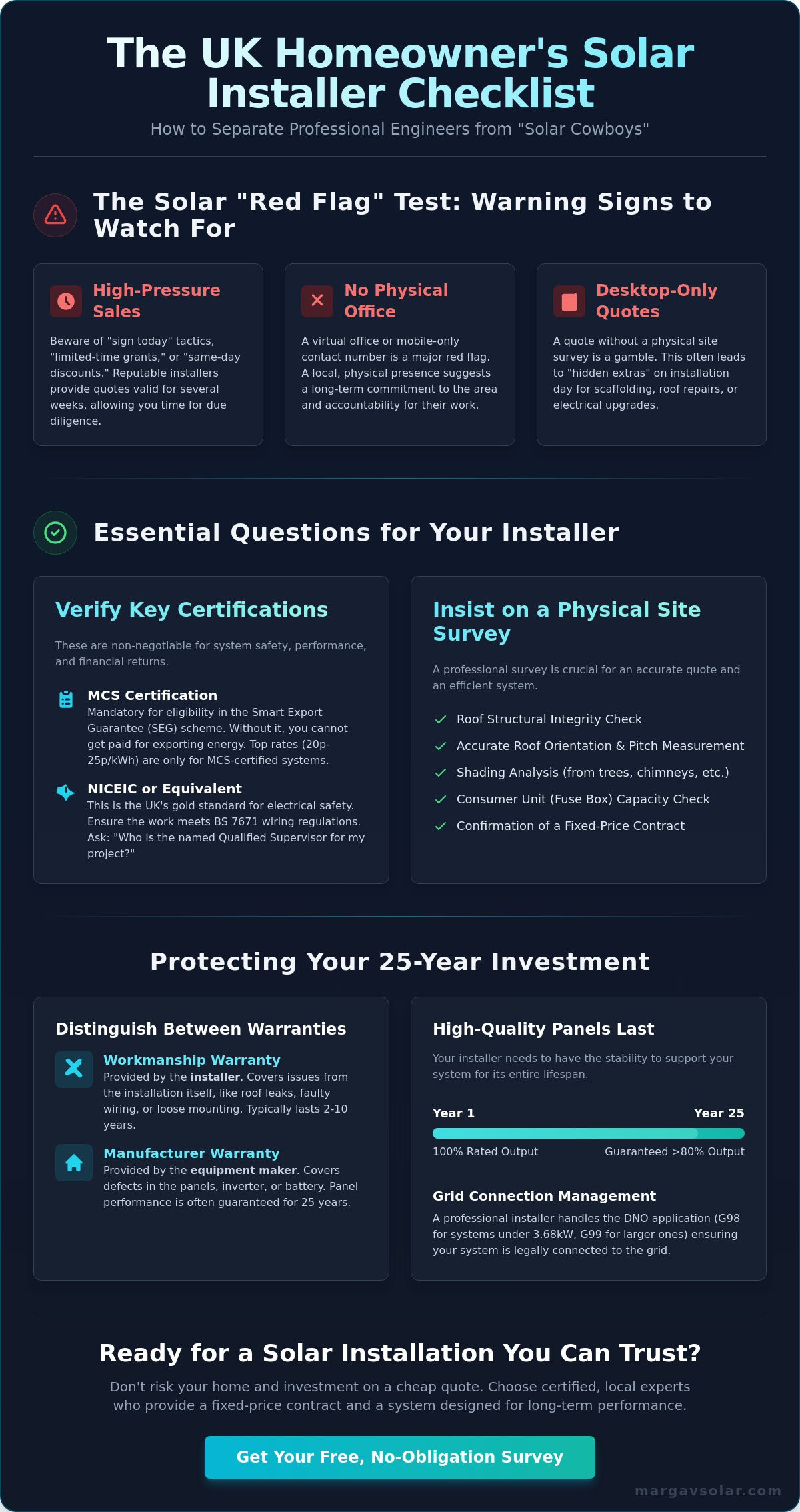
The most common red flag in the UK market is the high-pressure "sign today" tactic. If a representative claims a "limited-time government grant" or a "same-day discount" is only available if you buy immediately, walk away. These companies are typically sales-led organisations that prioritise commission over technical accuracy. They often provide unrealistic generation estimates that ignore specific Staffordshire weather patterns, such as local cloud cover and seasonal daylight variations, leading to a system that doesn't meet its promised ROI.
The Danger of "Solar Cowboys" in the UK Market
Poorly installed systems are more than just an eyesore; they're a significant safety risk. "Solar cowboys" frequently cut costs by using uncertified components or rushing the electrical work, which can lead to fire hazards and premature inverter failure. A properly installed rooftop solar power system requires precision mounting and high-grade wiring to withstand British weather. Always check if a company has a physical local office. A virtual office or a mobile-only contact number often suggests the firm won't be around when you need maintenance or a warranty claim in five years.
Desktop Quotes vs. Physical Site Surveys
While software can provide a rough estimate, a company must visit your home before providing a final, fixed-price contract. A desktop-only quote is a major warning sign. During a physical site survey, a qualified surveyor should inspect your roof's structural integrity, measure the exact orientation, and check your consumer unit capacity. They need to identify potential shading from chimneys or nearby trees that software might miss. Without this visit, you're at risk of "hidden extras" on installation day, such as unexpected costs for scaffolding or required electrical upgrades that weren't in the original price.
Essential Questions About Certifications and Local Reputation
Before you sign a contract, you must verify that the installer's credentials match the technical demands of your home. You aren't just buying hardware; you're buying a 25-year relationship with the UK's electrical grid. Understanding what to ask a solar panel company regarding their accreditation is the only way to ensure you can actually get paid for the energy you generate. A company without the right paperwork can leave you with a functional system that is legally ineligible for financial incentives.
Understanding MCS and NICEIC Requirements
The first question should always be about MCS (Microgeneration Certification Scheme) accreditation. This isn't just a badge of quality; it's a requirement for the Smart Export Guarantee (SEG). As of May 2026, top export rates like the 25p/kWh from Good Energy or 20p/kWh from OVO Energy are only accessible if your system is MCS certified. While some guides, like the Homeowner's Guide to Going Solar, offer broad advice on system potential, the UK market specifically demands MCS for grid payments.
You should also verify their electrical credentials. An NICEIC certification is the gold standard for electrical safety in the UK. Don't be afraid to ask, "Who is the named Qualified Supervisor for my project?" This individual is responsible for ensuring the entire installation meets BS 7671 wiring regulations. If a company can't name their supervisor or lacks these specific badges, they likely outsource to sub-contractors who may not maintain the same safety standards.
Local Grid Connection and Planning
Local knowledge is vital when dealing with the National Grid (formerly Western Power Distribution) in Staffordshire. Ask the company if they manage the G98 or G99 application process. A G98 application is typically for smaller systems under 3.68kW, while larger systems with battery storage often require a G99 application. If the installer expects you to handle this paperwork, it's a sign they lack the technical administrative support you need.
Staffordshire also has specific planning constraints, especially in conservation areas like those in Lichfield or Stafford. A reputable local firm will know if your project falls under "permitted development" or if it requires a full planning application due to roof protrusion limits. Before committing, it's worth speaking with a local Staffordshire solar expert who understands these regional grid and planning nuances. Ensure they can show you recently completed projects in towns like Rugeley or Cannock to prove their local track record.
Technical Design: Asking About Efficiency, Shading, and Integration
When determining what to ask a solar panel company, the conversation should shift from paperwork to the physical components that will sit on your roof for decades. A system is only as strong as its weakest link. While general consumer advice on solar often focuses on contracts, the technical design of your system determines your actual savings. You need to know which brands are being quoted and why they were chosen for your specific roof orientation.
Shading is a common performance killer in Staffordshire, where chimneys and gables can cast long shadows during winter months. Ask your installer what software they use for performance modelling. Professional firms use advanced tools like PVSyst or OpenSolar to provide a detailed shading analysis. If your roof suffers from partial obstruction, ask about optimisers or micro-inverters that allow panels to operate independently, preventing one shaded panel from dragging down the entire string's output.
Maximising Yield with Advanced Components
Modern homeowners should prioritise N-Type solar cells over older P-Type technology. N-Type panels offer better low-light performance and lower degradation rates, often retaining over 80% of their output after 25 years. If you already have an older system, it is worth asking about inverter upgrades to improve efficiency. During the design phase, ensure your installer explains "clipping." Clipping occurs when your solar panels generate more power than your inverter can process, causing the excess energy to be lost; proper sizing ensures your inverter matches your peak panel output without wasting potential generation.
Smart Home Integration: Batteries and EV Charging
Your solar system shouldn't exist in a vacuum. It needs to work with your wider home ecosystem. Ask your installer, "How will this system integrate with my EV charging points?" A well-designed system allows you to divert excess solar energy directly into your car battery rather than sending it to the grid for a lower rate.
Effective monitoring is the key to mastering your energy usage. Platforms like the GivEnergy Cloud provide real-time data on energy flow, allowing you to prioritise charging your home battery over exporting to the grid. This level of control is essential for maximising self-consumption. Ensure you ask if the system is "battery-ready" so you can add storage later without needing a completely new inverter.
Warranties and Maintenance: Protecting Your Investment
Securing your energy future doesn't end when the last panel is bolted to the roof. Solar hardware is durable, but it isn't invincible. When deciding what to ask a solar panel company, your focus must shift from the "how" of installation to the "who" of long-term support. You need to know exactly who is responsible if a component fails in five, ten, or twenty years. A 25-year performance guarantee sounds impressive, but it's worthless if you can't find anyone to honour it when your yield drops.
One of the most critical questions involves the Insurance-Backed Warranty (IBW). In the UK, this is your ultimate safety net. If your installer ceases trading, the IBW ensures that another firm will step in to handle repairs covered under your workmanship agreement. Without this, a ten-year workmanship warranty is only as strong as the company's balance sheet. Always verify that the company has a dedicated after-sales team rather than just a sales office that disappears once the commission is paid.
Decoding the Three Types of Solar Warranties
Homeowners often confuse different types of coverage, which leads to frustration during a claim. Ensure you understand these three distinct layers:
- Product Warranty: This covers physical defects in the panels or inverters. For premium panels, this is typically 25 years, while standard inverters might only carry a 5 to 10-year guarantee.
- Performance Warranty: This is a manufacturer's promise that the panels will produce a specific percentage of their original power (often 80% to 85%) after 25 years of use.
- Workmanship Warranty: This is provided by the installer. It covers issues like roof leaks, loose mounting, or faulty electrical connections. It's the most common type of claim and the one most dependent on the installer's reputation.
Long-term Support and Monitoring
Modern solar systems are "set and forget" to an extent, but regular health checks are vital for maintaining your ROI. Ask if the company provides remote monitoring through apps. This allows them to see if your system is underperforming before you even notice your electricity bill rising. Atmospheric pollutants and debris can reduce efficiency over time, making a professional solar panel maintenance plan a smart investment. These visits should include an electrical safety check and a visual inspection of the mounting system to ensure everything remains secure against Staffordshire's winds.
If you want to ensure your system continues to deliver maximum savings for decades, consider booking professional solar maintenance and support with a local expert who understands the technical nuances of your specific setup.
Why MarGav Solar is the Right Choice for Staffordshire
Once you understand what to ask a solar panel company, the next step is finding an installer that meets every technical and ethical benchmark. Many national firms operate on a "fit and forget" basis, using sub-contracted labour to hit high-volume targets. MarGav Solar takes a different approach. As a local Staffordshire business with over 20 years of expertise in high-efficiency solar panel installation, we treat your home as a long-term partnership rather than a one-off transaction. We provide fixed-price contracts that eliminate hidden "on-the-day" surprises, ensuring the quote you receive is the price you actually pay.
Our team specialises in more than just mounting panels. We are experts in premium solar battery storage and smart energy integration. Whether you need an EV charging point or a complete inverter upgrade, we design systems that work together to maximise your ROI. We remain committed to the Staffordshire community, providing local maintenance and repair services to keep your system performing at its peak for its entire 25-year lifespan.
The MarGav Consultation Process
Our end-to-end support starts with a detailed physical site survey. We don't believe in "one-size-fits-all" kits that ignore the unique shading or structural needs of your roof. Every project is overseen by NICEIC-certified installers who use only Tier 1 hardware, ensuring your system meets the highest safety standards in the UK. We handle the technical administrative work, including DNO applications and MCS certification, so you can focus on enjoying lower energy bills and high SEG export rates.
Ready to Transform Your Energy Future?
Choosing the right partner means finding someone who understands the local landscape. With over two decades of local reputation across the Midlands, we have helped hundreds of homeowners navigate the transition to renewable energy. Our deep expertise in GivEnergy systems and advanced battery solutions allows us to build microgrids that offer true energy independence. Don't leave your investment to chance by wondering what to ask a solar panel company during a high-pressure sales pitch.
Take the first step toward a high-performing, warrantied solar system today. Book your expert solar consultation with MarGav Solar today and let our Staffordshire-based team design a bespoke energy solution for your home.
Secure Your Energy Future with Confidence
Choosing the right installer is the single most important step in securing a high-performing system. By focusing on technical accuracy and ensuring your provider handles the complex DNO and MCS paperwork, you protect your home from unreliable contractors and underperforming hardware. Now that you know exactly what to ask a solar panel company, you can approach your project with the certainty that your investment will yield real savings for the next 25 years.
MarGav Solar brings over 20 years of renewable energy expertise directly to your home. Our NICEIC and MCS accredited installers specialise in bespoke designs that integrate solar PV with battery storage and EV charging points. We provide the dedicated, Staffordshire-based local support you need to ensure your system remains a high-yielding asset for decades.
Get a Fixed-Price Solar Quote from MarGav Solar
You're ready to make a choice that powers your home and protects your wallet. Taking control of your energy future starts with a single, informed conversation.
Frequently Asked Questions
What is the single most important certification for a UK solar installer?
The Microgeneration Certification Scheme (MCS) is the most critical accreditation for any UK installer. Without an MCS certificate, you're ineligible for Smart Export Guarantee (SEG) payments to sell excess energy back to the grid. It also serves as an independent mark of quality, ensuring that both the equipment and the installation meet rigorous national safety and performance standards.
How do I know if a solar company is giving me an honest quote?
An honest quote is always based on a physical site survey rather than a rough "desktop" estimate. If a company offers a massive discount that is only valid if you sign immediately, it's a major red flag. Transparent quotes should include a fixed price with no hidden extras for scaffolding, consumer unit upgrades, or regional grid application fees.
Should I ask about the structural integrity of my roof before installation?
Yes, you must ensure the installer performs a structural assessment of your roof rafters and covering. Solar panels add significant weight and change how wind load affects your property. A professional surveyor will check for rot or existing damage to ensure your roof can safely support the system for its 25-year lifespan without causing structural issues.
What happens to my warranty if the solar company goes out of business?
Your workmanship warranty should be insurance-backed (IBW) to protect you if the company stops trading. This policy ensures another firm will honour the installation guarantee if leaks or electrical faults occur. Always verify the details of the IBW provider before signing, as this is your primary protection against the installer's potential long-term business risks.
Is it worth asking for a breakdown of labour vs. component costs?
Requesting a breakdown helps you understand what to ask a solar panel company regarding the quality of the hardware they use. It allows you to see if they're using premium N-Type panels or cheaper, less efficient alternatives. A detailed quote prevents installers from hiding high margins behind a single lump sum and ensures you're paying a fair rate for expertise.
How can I verify a company’s claims about being a "local" installer?
Check for a physical office address in Staffordshire rather than just a virtual office or a national 0800 number. Ask for specific examples of recent installations in nearby towns like Stafford, Cannock, or Rugeley. Local firms rely on their regional reputation and are significantly more likely to provide prompt maintenance and after-sales support compared to national "fit and forget" companies.
What technical jargon should I listen for during a site survey?
Listen for mentions of "N-Type cells," which offer better efficiency and lower degradation than older P-Type panels. A good surveyor will also discuss "clipping" and whether your inverter is properly sized for your array's peak output. Knowing what to ask a solar panel company about G98 or G99 grid applications shows you understand the technical requirements for a safe, legal connection.
Do I need to ask about planning permission for solar panels in Staffordshire?
Most roof-mounted installations in Staffordshire fall under "permitted development" and don't require planning permission. However, restrictions apply if you live in a conservation area or a listed building. Your installer should be familiar with local council guidelines to ensure your system doesn't protrude more than 200mm from the roof surface or sit above the highest part of the ridge line.


