

Did you know that 94% of new solar installations in Britain now include storage, yet the most common question remains whether the investment will actually break even? You've probably heard conflicting stories about the solar battery storage payback period UK residents can expect, especially with energy price caps shifting to 26.32p per kWh this October. It's natural to feel overwhelmed by fluctuating SEG rates and the technical jargon of smart tariffs. You want to ensure your home isn't just greener, but that your bank balance reflects the change before the hardware reaches its sunset years.
We understand that the fear of battery degradation and complex grid regulations can make you hesitate. This guide promises to clear the fog, showing you how the 2026 market allows savvy homeowners to pay off their systems in as little as six to seven years. As Staffordshire's local experts with 20 years of experience, we'll preview how tariff arbitrage and new 0% VAT rules on domestic electricity are fast-tracking ROI. You'll discover how to turn your battery into a profit-generating asset that adds genuine value to your property while securing your energy independence.
Key Takeaways
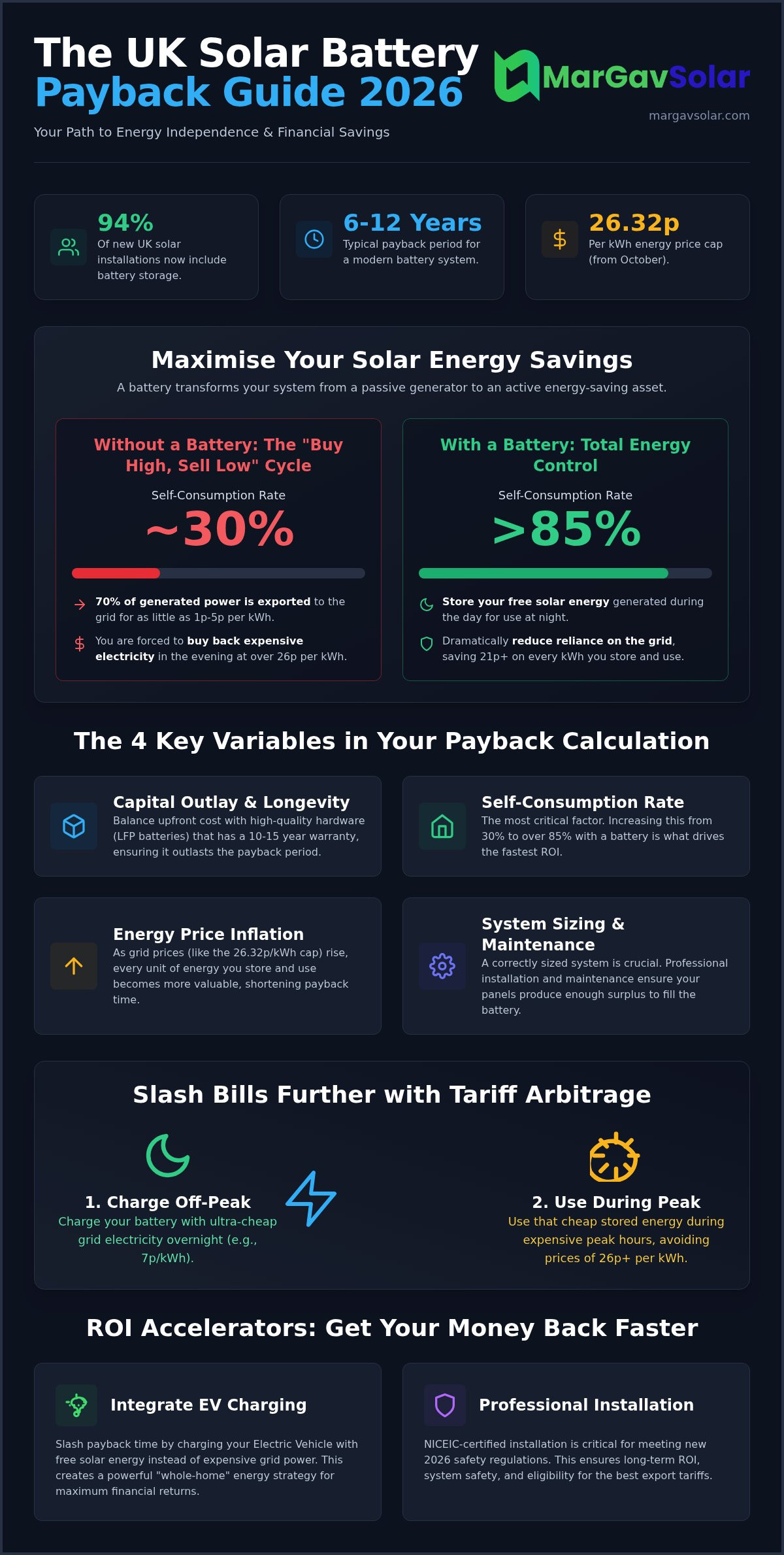
- Learn why the typical solar battery storage payback period UK homeowners experience is now between 6 and 12 years, depending on your specific energy profile.
- Discover how "tariff arbitrage" allows you to charge your battery with cheap off-peak electricity to slash your bills during expensive peak hours.
- Understand how a correctly sized battery system can increase your solar self-consumption from a mere 30% to over 85%.
- See why professional NICEIC-certified installation in Staffordshire is critical for meeting new 2026 safety regulations and ensuring long-term ROI.
- Explore how integrating battery storage with EV charging points creates a "whole-home" energy strategy that accelerates your financial returns.
The 2026 Outlook: Why Solar Battery Payback is Changing
In 2026, the financial logic behind home energy has undergone a radical transformation. We've moved past the era where solar panels were a "fit and forget" addition to the roof. Today, the solar battery storage payback period UK homeowners calculate is no longer just about catching midday sun; it's about active grid participation. With the average electricity unit rate hitting 26.32p per kWh this October, the volatility of the UK energy market has turned storage from a luxury into a strategic necessity. Understanding the principles of energy storage is now essential for any household looking to hedge against rising costs.
In the simplest terms, the payback period is the number of years it takes for your monthly utility savings to cover the total cost of your installation. While historical data suggested a decade or more, the convergence of high grid prices and smarter technology has significantly compressed this timeline. It's a calculation that balances your upfront investment against the avoided cost of buying power from the grid.
The End of Passive Solar
Relying solely on solar panels often leaves households frustrated. Without a battery, you'll likely export 70% of your generated energy to the grid for as little as 1p to 5p per kWh under some Smart Export Guarantee (SEG) schemes. Meanwhile, you're buying that same power back at over 26p in the evening. A battery is the intelligent brain of your solar system that stops this "buy high, sell low" cycle by ensuring your home uses its own green energy first. In the 2026 market, the best SEG rates of 15p to 25p are often reserved for those with integrated storage systems, making the hardware even more vital for your return on investment.
Battery Lifespan vs. Payback Time
Modern lithium-iron phosphate (LFP) batteries have changed the ROI math for UK residents. Most units now come with 10 to 15-year warranties, which comfortably outlasts the typical 6 to 12-year solar battery storage payback period UK households typically see. To protect this investment, we focus on the Depth of Discharge (DoD). High-quality systems allow you to use almost 100% of the stored energy without damaging the cells, ensuring the hardware remains efficient long after it's paid for itself. At MarGav Solar, our 20 years of expertise in Staffordshire helps us size these systems so the hardware lifespan always exceeds the payback date.
Calculating the Payback Period: The 4 Key Variables
Calculating your solar battery storage payback period UK requires looking beyond the price tag of the unit. While the initial investment is the most visible hurdle, the long-term ROI hinges on how much grid power you actually displace. High-quality hardware ensures efficiency doesn't drop off after a few years, but four main variables will dictate your break-even point. First, your capital outlay must be balanced against hardware longevity; cheap units often fail before they pay for themselves. Second, your self-consumption rate determines how much free energy stays in your home. Third, energy price inflation plays a massive role. With the October 2026 price cap setting electricity at 26.32p per kWh, every unit you store becomes more valuable as grid costs rise. Finally, regular solar panel maintenance and cleaning ensure your system produces enough surplus to fill the battery in the first place.
The Energy Saving Trust guide to battery storage highlights that sizing is the most critical factor in these calculations. An oversized battery stays half-empty, while an undersized one leaves you buying expensive peak power. If you're unsure which size fits your home, our Staffordshire-based team can provide a bespoke solar assessment to clarify your potential savings.
The Math of Self-Consumption
The financial "sweet spot" for storage is moving from a 30% self-consumption rate to over 85%. Without a battery, you're forced to export your excess energy for SEG rates that can be as low as 1p per kWh. By storing that energy, you calculate your "avoided cost". Instead of earning 5p by exporting, you're saving 26.32p by not buying from the grid. This 21p+ difference on every single kilowatt-hour is what aggressively drives down your payback time. Over a year, a typical household can save between £300 and £1,000 just by shifting when they use their own power.
Impact of EV Charging on ROI
For many of our customers, the solar battery storage payback period UK timeline is slashed by the addition of electric vehicles. When you integrate EV charging points in Staffordshire homes, the battery's utility doubles. Instead of just powering your kettle or TV, the battery acts as a fuel tank for your car. By charging your EV with solar-stored power during peak times, or using a smart tariff to fill both the battery and car during cheap off-peak windows, you're displacing expensive petrol or high-rate grid charging. This increased "throughput" means the battery works harder every day, paying for itself much faster than in a home without an EV.
Shortening Payback with Smart Tariffs and Arbitrage
In the 2026 energy market, the most significant shift in the solar battery storage payback period UK homeowners see comes from smart tariffs. We've moved beyond simple solar storage. Today, "Time-of-Use" (ToU) tariffs like Octopus Flux or similar agile offerings allow your battery to become a trading tool. This strategy, known as tariff arbitrage, involves charging your battery from the grid during the middle of the night when prices might drop to 7p per kWh, then using that stored power during the 4pm to 7pm peak when rates can soar to 35p or more.
This approach solves the traditional "winter problem" of solar. Even on a dark, rainy Tuesday in January when your panels are dormant, your battery is still earning its keep. By cycling cheap grid power, the system continues to generate savings every single day of the year. This constant throughput ensures the hardware is always working toward its break-even point, regardless of the weather in Staffordshire. It's a fundamental change that makes storage viable for almost any household, not just those with huge solar arrays. If you are looking to secure the best utility rates or need guidance on switching contracts to complement your setup, learn more about Easy2switch UK Ltd to explore expert energy consultancy options.
GivEnergy and Smart Energy Management
Managing these price fluctuations manually would be a full-time job. That's where automated systems like GivEnergy Cloud prove their value. The software monitors grid prices and weather forecasts to decide exactly when to charge or discharge. In our experience at MarGav Solar, using smart automation can shave two to three years off a standard payback timeline by ensuring you never buy a single kilowatt-hour at peak prices. The system learns your habits and optimises your solar battery storage payback period UK without you ever having to check an app.
The 'Export Bonus' Strategy
The final piece of the ROI puzzle is the Smart Export Guarantee (SEG) scheme. While standard SEG rates offer a flat return, 2026 has seen the rise of "Dynamic Export" rates. These allow you to sell your stored energy back to the grid when demand is highest. Instead of a flat 5p, you might receive 20p or 25p per kWh for helping the grid balance its load. By strategically exporting during these windows, you're not just saving money; you're actively generating a profit that accelerates your return on investment.
The Staffordshire Context: Local Factors Affecting ROI
Staffordshire's geography plays a bigger role in your financial returns than you might think. While the county doesn't see the same peak irradiance as the South Coast, its consistent light levels are ideal for maintaining steady battery throughput. For a typical detached home in Stafford or a semi-detached property in Cannock, the solar battery storage payback period UK homeowners calculate must account for these local conditions. Larger properties often have the roof space for more panels, which fills batteries faster, while terraced homes require more precise sizing to ensure the battery isn't sitting idle. Every kilowatt-hour you fail to capture is a missed opportunity to offset grid costs.
Protecting this ROI requires more than just sunshine. Dirt and debris from local agricultural or industrial activity can reduce panel efficiency by up to 25% over time. Following a rigorous schedule for solar panel maintenance in Staffordshire is essential to ensure your battery actually receives the surplus energy it needs to cycle. Without clean panels, your battery throughput drops, and your payback timeline stretches out. We've seen local systems regain significant performance simply by clearing away the Midlands' environmental film.
Grid Constraints in the Midlands
Navigating the local grid is where many national installers stumble. In Staffordshire, the Distribution Network Operator (DNO) has specific requirements for G98 and G99 applications. If your system is sized incorrectly for the local infrastructure, you might be barred from exporting energy or limited in how much your battery can pull from the grid during cheap windows. As local consultants with 20 years of experience, we understand these grid pockets. We handle the complex paperwork to ensure your system size is legally optimised for the fastest possible return without running into regulatory roadblocks.
Professional Installation vs. ROI
A cheap installation is often the most expensive mistake a homeowner can make. Poorly configured inverters or low-quality cabling lead to significant efficiency losses, directly attacking your ROI. Ensuring your installer has NICEIC certification is a non-negotiable financial safeguard. It guarantees that the work meets the latest 2026 safety standards, protecting your home insurance and hardware warranties. When components are fitted correctly, they operate at peak efficiency for longer, ensuring the hardware doesn't fail before it has paid for itself. If you want to ensure your system is designed for the specific needs of the Midlands, book a local site survey with MarGav Solar today.
Maximising Your ROI: MarGav Solar’s Expert Approach
MarGav Solar’s 20 years of expertise allows us to look beyond the general 6 to 12-year window. We focus on the precision of the build. A system that is slightly misaligned with your household’s peak demand can add years to your break-even point. We specialise in GivEnergy systems because their modular nature allows for exact capacity matching. This consultancy-first approach ensures you aren’t paying for storage you’ll never fill, or missing out on savings by choosing a unit that’s too small. It’s about making the solar battery storage payback period UK homeowners face as short as possible through intelligent design and local insight.
Maintaining your system’s health is just as important as the initial setup. As technology moves forward, inverter upgrades can breathe new life into older solar arrays, allowing them to communicate more effectively with modern battery storage. This ensures every watt generated is either used or stored at the highest possible efficiency. Our NICEIC-certified installers ensure that every upgrade and maintenance check protects your long-term financial interests. We believe that a battery shouldn't just be an add-on; it should be a perfectly integrated part of a whole-home energy strategy that includes your solar panels and EV charging points.
Bespoke System Design
Generic calculators often fail to account for how a family actually lives. Do you work from home? Do you charge an EV overnight? We use your historical usage data to build a predictive model of your solar battery storage payback period UK. By matching battery discharge rates to your specific high-load appliances, we ensure the hardware works at its maximum financial potential from day one. This level of detail is what separates a standard installation from a high-performance energy asset. We take the time to understand your Staffordshire home's specific grid connection and orientation to ensure our forecasts are grounded in reality.
Your Path to Energy Independence
The benefits of storage extend into property valuation and long-term security. Homes with integrated, professionally installed energy systems are increasingly attractive to buyers in the 2026 market. Beyond the ROI math, there’s the intangible value of knowing your home is shielded from the next shift in grid pricing. For a deeper look at the technology, you can request our solar battery storage guide which is tailored specifically for Staffordshire homeowners. Our team is ready to help you map out a bespoke financial plan for your home’s energy future. Taking the first step towards energy independence starts with a conversation about your specific goals and usage patterns.
Secure Your Energy Independence in Staffordshire
The energy landscape of 2026 offers more control than ever before. As we've explored, the solar battery storage payback period UK homeowners face is no longer a decade-long wait. By leveraging smart tariffs, tariff arbitrage, and high-efficiency hardware, you can turn a passive solar setup into a proactive financial asset. It's about more than just storing sunlight; it's about protecting your household from price volatility and increasing your property's value through intelligent, integrated technology.
Success depends on choosing the right partner to navigate local grid constraints and technical requirements. With over 20 years of renewable energy expertise, MarGav Solar is proud to be Staffordshire's leading GivEnergy specialist. Our NICEIC certified installers ensure every system is sized perfectly for your specific needs, from EV charging integration to long-term maintenance. You don't have to leave your ROI to chance with a one-size-fits-all approach.
Get a bespoke ROI calculation for your Staffordshire home from MarGav Solar and start your journey toward a greener, more cost-effective future today.
Frequently Asked Questions
What is the average solar battery payback period in the UK for 2026?
The typical solar battery storage payback period UK homeowners see in 2026 is between 6 and 12 years. This range depends on your household energy usage and whether you use smart tariffs to cycle grid power. In Staffordshire, our clients often see these timelines compressed to seven years when integrating storage with high-efficiency GivEnergy systems. This is because storing your own solar energy is far more profitable than buying grid power at the current 26.32p rate.
Will a solar battery increase the value of my UK home?
Yes, installing a solar battery significantly boosts the appeal and value of your property. In the 2026 UK housing market, buyers prioritise homes with lower running costs and energy independence. A professionally installed system with NICEIC certification provides a tangible asset that justifies a higher asking price. It transforms your house from a standard building into a modern, self-sustaining home that is future-proofed against volatile energy price caps.
Can I add a battery to my existing solar panel system?
You can definitely add a battery to an existing solar PV system. This process often involves an AC-coupled battery or an inverter upgrade to manage the new storage component. At MarGav Solar, we specialise in retrofitting storage solutions for Staffordshire residents who already have panels but want to stop exporting their surplus for low rates. Upgrading your inverter ensures your older panels can communicate effectively with modern lithium-iron phosphate battery technology.
Is the Smart Export Guarantee (SEG) enough to pay for a battery?
The Smart Export Guarantee (SEG) is a helpful bonus, but it rarely covers the battery cost on its own. While some 2026 suppliers offer up to 25p per kWh for exports, the real financial gain comes from avoided costs. Every unit of energy you store and use saves you roughly 26.32p, which is much higher than most export rates. We design systems to maximise self-consumption rather than relying solely on export payments.
How long do solar batteries actually last in the UK climate?
Modern solar batteries are designed to last between 10 and 15 years in the UK climate. Most high-quality units, such as those from GivEnergy, come with warranties that cover this entire period. The UK's temperate weather is actually quite favourable for battery health, as extreme heat is a bigger threat than our typical winters. Integrated battery management systems (BMS) ensure the cells stay within safe operating temperatures to protect your long-term ROI.
Does a solar battery require regular maintenance to keep its ROI?
Regular maintenance is essential to ensure you meet your projected ROI targets. While the battery units themselves are low-maintenance, the solar panels feeding them must stay clean to ensure a full charge. In Staffordshire, local dust and environmental film can reduce yield by up to 25%. We provide professional solar panel maintenance and cleaning services to ensure your battery throughput remains high and your payback period stays on track.
What happens to the payback period if I install an EV charger?
Installing an EV charger typically shortens your solar battery storage payback period UK significantly. By using your battery to store solar energy for your car, or charging both during cheap off-peak windows, you increase the "throughput" of the battery. This means the hardware works harder and pays for itself faster by displacing expensive petrol or peak grid charging. It turns your home energy system into a complete fuel station for your vehicle.
Are there any UK government grants for solar batteries in 2026?
There are no direct cash grants for batteries in 2026, but the UK government provides significant support through tax relief. A 0% VAT rate applies to all solar and battery installations until March 31, 2027. Additionally, the government has reduced VAT on domestic electricity to 0% as of October 2026. These measures, combined with the Smart Export Guarantee, provide the primary financial framework for subsidising your transition to renewable energy storage.


