

What if the real test of going solar isn’t how much electricity you make in July, but whether you can keep the lights on through a grey January? If you’re asking, “can I go completely off-grid with solar in the UK?”, the answer depends on more than the number of panels on your roof. Short winter days and cloudy weather can leave a home generating far less power just when heating, lighting and appliances are in use.
It’s understandable to want energy independence without risking unreliable electricity. But a fully off-grid home is different from one that uses solar panels and a battery while staying connected to the grid. The right choice depends on your household’s electricity use, the space and conditions at your property, and how you would manage periods when generation is low.
This guide explains what year-round off-grid living involves, why winter is the biggest hurdle, and what storage and backup plans need to account for. It also compares full disconnection with grid-connected solar, with or without a battery, and covers the property factors to assess before taking the next step.
Key Takeaways
- Going fully off-grid means no longer relying on a live electricity-grid connection. It’s a bigger commitment than simply cutting bills or importing less power.
- Use your electricity data to identify essential appliances and flexible loads before estimating the solar generation and storage your home may need.
- If you’re wondering “can I go completely off-grid with solar in the UK?”, assess winter performance and backup needs, not just summer output.
- Compare full disconnection with grid-connected solar, with or without a battery, to understand the differences in reliability and resilience.
- A property-specific site assessment can help you weigh the options before making decisions about equipment or your grid connection.
What Does Going Completely Off-Grid with Solar in the UK Actually Mean?
Going completely off-grid with solar means running your home without relying on a live electricity-grid connection. It’s a more demanding goal than lowering bills or using less electricity from your supplier: your own system must meet household needs when solar generation is low as well as when it’s plentiful. The broader idea of living independently from public utilities is outlined in Wikipedia’s overview of off-grid living. Here, the focus is household electricity, not complete self-sufficiency in hot water, heating or other services.
So, can I go completely off-grid with solar in the UK? It’s technically possible in some cases, but feasibility depends on the property, its energy demand and the household’s routines. A system that works for one home may not suit another, including homes in Staffordshire with different roof conditions and patterns of use.
What does off-grid solar need to do every day?
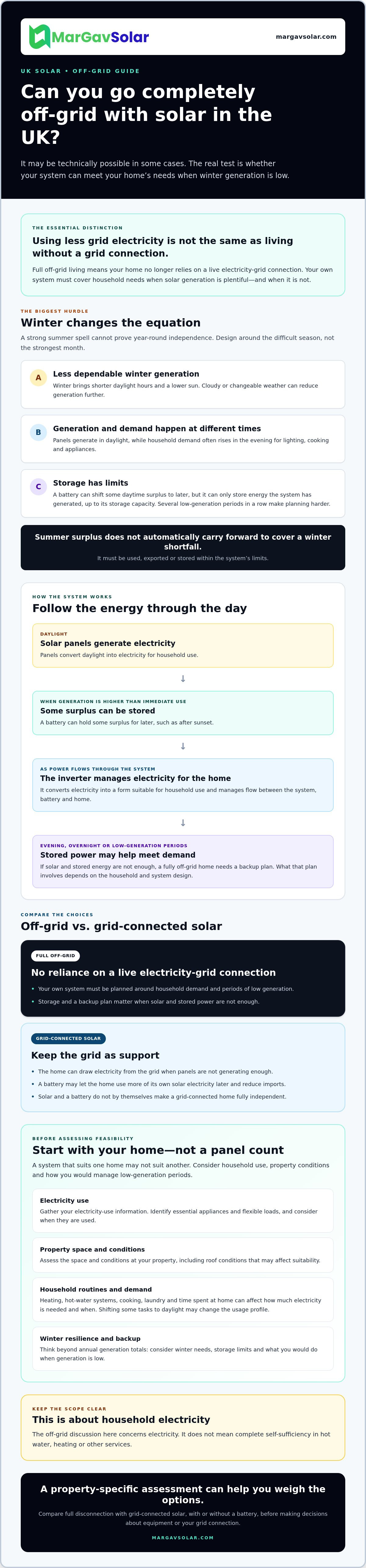
Solar panels convert daylight into electricity. When generation is higher than immediate use, a battery can store some of that surplus for later, such as after sunset. An inverter converts electricity into a form suitable for household use and manages the flow between the system, battery and home.
The challenge is matching supply with demand as both change. A home may use power in the evening, overnight or during periods of weak generation, so panel output and stored energy need to be considered alongside when appliances are used. A backup plan matters for times when solar and stored power aren’t enough. What that plan could involve depends on the household and system design. Don’t assume that solar and a battery alone will cover every situation.
How is off-grid different from grid-connected solar?
Off-grid living means operating without reliance on a live electricity-grid connection; lower grid reliance means staying connected while using less electricity imported from it.
A grid-connected home can draw electricity from the grid when its panels aren’t generating enough for the household. Adding a battery may let the home use more of its own solar electricity later, reducing imports, but it doesn’t by itself make the home fully independent. A grid connection can supply power when the household’s own generation and stored energy fall short. An off-grid system must instead be planned around that shortfall.
Before considering equipment or a change to your connection, gather your electricity-use information and identify which appliances are essential. A professional assessment of the property and household’s needs can help establish whether solar and storage are suitable. It won’t make a grid-connected system a substitute for full independence.
Why UK Winter Makes Year-Round Off-Grid Solar Challenging
Summer performance can make a solar system look comfortably self-sufficient. Winter is a different test: daylight hours are shorter, the sun is lower, and cloudy or changeable weather can reduce generation. The combination matters more than any single feature of a UK location, so assumptions based on a sunny spell or annual average can give an incomplete picture.
There’s also a timing mismatch. Solar panels generate during daylight, while household demand often rises in the evening, when people return home, switch on lights, cook and use appliances. A battery can shift some daytime surplus to later, but it can only store energy the system has generated, up to its storage capacity. Several low-generation periods in succession can make year-round independence harder to plan for.
Why summer generation cannot prove winter independence
Annual generation totals combine brighter and darker months. They don’t show whether enough electricity will be available on the particular winter days when a household needs it. Surplus produced in summer doesn’t automatically carry forward to cover a later winter shortfall. It must be used, exported or stored within the system’s limits. Off-grid solar must be designed around the weakest season, not the strongest month.
Household demand shapes the challenge, too. Electric heating or hot-water systems can add substantial loads; cooking, laundry and time spent at home also affect when electricity is needed. A household that can shift some tasks to daylight hours may have a different usage profile from one with fixed evening demand. Neither can be assessed reliably from panel count alone.
What happens when stored energy runs low?
With limited generation, households may need to prioritise essential loads and reduce or delay flexible uses. How much storage and backup to plan for depends partly on the level of autonomy expected. Tolerating occasional conservation is different from expecting every appliance to run as usual through prolonged low-generation weather.
Any alternative backup energy source is a separate design consideration, not something to assume solar panels and batteries provide. Its suitability, connection and safe operation need to be assessed for the specific property and system. A qualified designer can model seasonal generation against actual usage. For background, MCS provides information about standards for small-scale renewable-energy installations.
If you’re asking, “can I go completely off-grid with solar in the UK?”, start by gathering electricity-use data and noting which loads are essential. A property-specific review of residential solar and battery options can help clarify whether a grid-connected setup may better fit your needs. It should not be treated as a guarantee of off-grid independence.
Full Off-Grid Solar vs a Grid-Connected Solar and Battery System
These options serve different goals. A fully off-grid home has no live grid connection to fall back on. A grid-connected solar system can use imported electricity when on-site generation falls short, while a battery can store some solar power for later use. A battery may reduce grid imports, but it doesn’t guarantee enough stored energy for every season or make a connected home fully independent.
| Option | Reliability | Dependence on the grid | Resilience needs | Potential suitability |
|---|---|---|---|---|
| Full off-grid solar and storage | Depends on system design, generation, stored energy and household demand. | None for electricity if fully disconnected. | Requires a plan for low-generation periods and limited stored energy. | Could suit a property with appropriate space, manageable demand and a household prepared to adapt usage. |
| Grid-connected solar, no battery | The grid can supply electricity when solar output is insufficient. | Continues to import electricity when needed. | Less reliant on stored energy, since there is no battery in the setup. | Could suit households aiming to use solar while retaining grid supply. |
| Grid-connected solar with a battery | The grid remains available when generation and stored energy don’t meet demand. | Can reduce imports, but doesn’t remove grid reliance. | Storage can shift some solar use to later, though seasonal shortfalls still matter. | Could suit households seeking greater use of their own generation without disconnecting. |
Solar output varies by season, as explained in the Energy Saving Trust’s guidance on solar panels and UK generation. That’s one reason to judge a battery by the role it can realistically play, rather than treating it as a guarantee of year-round independence.
When could complete off-grid operation suit a household?
It may be worth investigating if a property has suitable space, electricity demand is manageable and the household has a clear resilience plan. Ask whether you could prioritise essential appliances or shift flexible tasks if generation or stored energy were limited. A professional, property-specific assessment must confirm whether the site, system design and intended operation are technically suitable.
When is a connected solar-and-battery system more practical?
Keeping the connection provides a fallback when on-site supply is insufficient. That can be a sensible way to reduce grid reliance without taking on the different challenge of complete disconnection. If you’re weighing up can I go completely off-grid with solar in the UK, first decide whether your aim is lower imports or true independence. For more on the connected option, see Solar Battery Storage in Staffordshire: The Complete 2026 Homeowner’s Guide.
Staying connected isn’t a failed attempt at sustainability. It may simply be the more practical match for a home’s needs, while still allowing solar generation and battery storage to contribute.
How to Assess Whether Your UK Home Could Go Off-Grid
There’s no single panel count or battery size that answers whether a home can operate independently. A useful assessment starts with the household, then tests how the property and system would perform across different seasons. Work through these steps before deciding whether full disconnection is realistic.
- Reduce demand first. Consider whether practical efficiency improvements or changes to how you use electricity could lower the amount your system needs to supply.
- Map your consumption. Review electricity bills or meter data across representative periods, including colder months if possible. Note high-demand appliances and when they’re used. Separate essential loads, such as refrigeration and lighting, from flexible uses that could be shifted or reduced.
- Assess the site. Check roof orientation, shading at different times of day, usable roof or ground space, and where a battery could be located. An installer should assess the actual property rather than assume a standard layout will work.
- Model seasonal supply. Ask for estimates that account for the site and changing conditions throughout the year, not only an annual generation total or summer performance.
- Review resilience and backup. Clarify what happens if generation and stored energy are insufficient, which circuits remain essential, and what backup arrangements are being considered.
Start with demand, efficiency, and essential loads
Consumption data helps turn a broad question into a household-specific one. A home with electric heating, frequent cooking and evening-heavy use will have a different demand profile from one that can shift some appliances into daylight hours. Identify which uses are non-negotiable and which can pause during a low-supply period. This information helps inform system modelling without assuming that every appliance must always run as usual.
Ask an installer to model seasonal supply and resilience
Ask the installer to explain the assumptions behind winter generation, expected household demand, storage and backup. Find out how the design responds to extended periods of low generation and how essential circuits would be supplied. For background on the installation process, see Solar Panel Installation in Staffordshire: A Comprehensive Guide, and consult NICEIC Certification: The Complete Guide for Staffordshire Homeowners when researching electrical work and installer credentials.
Staffordshire households should assess their own roof, shading, space and usage rather than rely on a single regional generation figure. A professional site assessment can help establish whether solar PV and battery storage suit a particular home, but it won’t guarantee off-grid independence. If you’re weighing up can I go completely off-grid with solar in the UK, discuss your home’s solar and battery needs as a property-specific starting point.
What to Do Next: Plan a Resilient Solar Setup for Your Home
A sensible next step is to be clear about what independence means to you. Is your priority to use more of your own electricity, reduce grid imports or operate without a live connection? Then consider winter demand, compare full off-grid operation with grid-connected solar and storage, and assess the space and conditions at your property. A design based on your actual household and site is more useful than choosing equipment based on a generic example.
Before changing a connection or committing to equipment, ask a qualified professional to assess technical feasibility and explain any relevant installation, certification and network requirements. If you’re still asking, “can I go completely off-grid with solar in the UK?”, request a clear explanation of what the proposed design can support and where its limits are.
Questions to ask before committing to a system
Use your electricity-use information to make the discussion specific. Ask how the design accounts for winter generation and changes in demand, and what happens during an extended period of low solar output. Clarify which household loads are supported, what backup arrangements the design assumes, and which limitations remain. Make sure the installer explains what is and isn’t included.
- How are expected generation and household demand modelled across the year?
- Which essential circuits can the proposed system support, and under what conditions?
- What backup is assumed, and what installation, certification or network requirements should be checked?
Choose the next step that matches your goal
If you mainly want to rely less on imported electricity, a grid-connected solar system with battery storage may be an option to assess. The connection can remain available when your on-site generation and stored energy don’t meet demand. If complete independence is essential, ask for a transparent resilience assessment that sets out the system’s assumptions, backup plan and expected limitations. Don’t treat a connected solar-and-battery setup as a guaranteed off-grid substitute.
MarGav Solar provides residential solar PV and battery storage, with support from consultation through installation and long-term maintenance. A property-specific discussion can help establish whether these options suit your home, without assuming that full off-grid operation is available or appropriate.
To discuss your options, explore residential solar options with MarGav Solar and ask about an assessment based on your household’s needs and property.
Make Your Next Solar Decision With Confidence
So, can I go completely off-grid with solar in the UK? It’s technically possible for some homes, but success depends on the property, household demand and a realistic plan for winter and backup. Full independence is a different goal from reducing grid reliance. For many households, assessing a grid-connected solar-and-battery system may be a more practical place to start, though it isn’t a guaranteed substitute for going off-grid.
Before making decisions about equipment or your grid connection, use your energy data and a property-specific assessment to understand what your home can support. MarGav Solar brings more than 20 years of industry experience, with end-to-end consultancy, installation and long-term maintenance support for residential solar and battery storage.
Discuss a solar assessment for your home with MarGav Solar. A clear assessment can help you choose a path that fits your priorities and move forward with confidence.
Frequently Asked Questions
Can I legally go completely off-grid with solar in the UK?
It may be possible, but the steps and requirements depend on your property, installation and connection arrangements. Don’t disconnect or alter equipment based on general advice alone. Before making changes, check with your electricity network operator, local planning authority if relevant, and a qualified professional who can confirm applicable safety, planning and network requirements. Ask what formal steps apply to ending or changing your connection, and get the implications explained for your specific home.
Can solar panels power a house all year in the UK without the grid?
They can in some circumstances, but solar alone shouldn’t be assumed to meet every home’s needs year-round. Winter brings shorter days and potentially lower generation, while household demand can remain high. Batteries can store surplus for later, but storage is limited and can’t compensate indefinitely for poor generation. Whether a system can support your home depends on site conditions, seasonal modelling, electricity use and a realistic plan for periods when supply is low.
How many solar panels and batteries would I need to go off-grid?
There’s no reliable standard number of panels or battery capacity for every home. The design depends on your electricity consumption, when you use power, roof orientation and shading, available space, seasonal generation and how much backup you expect. Gather meter readings or bills across representative periods, then ask for a property-specific assessment. Be cautious of estimates based only on household size or annual usage, since they may overlook winter demand and consecutive low-generation periods.
Is it better to stay connected to the grid with solar and a battery?
For households seeking to reduce grid imports without requiring complete independence, staying connected with solar and battery storage may be a practical option to assess. The connection can supply electricity when on-site generation and stored energy don’t meet demand. A battery may increase the amount of solar electricity you use later, but it doesn’t guarantee year-round independence. The better choice depends on your priorities, property and tolerance for managing limited supply.
What happens if an off-grid solar battery runs out in winter?
If the battery is depleted and solar generation can’t meet demand, the home may not have enough electricity for all its usual loads. The practical response depends on the system and its backup arrangements. A resilience plan should identify essential circuits, explain which flexible uses could be reduced or postponed, and set out any alternative backup source. Ask a qualified designer how the system is expected to operate during extended periods of low generation.
Can I use my existing solar panels to go completely off-grid?
Not necessarily. Existing panels may contribute to generation, but full off-grid operation also depends on the inverter, battery compatibility, system configuration, household demand and backup planning. Some grid-connected systems are not designed to power a home independently during a grid outage. Have a qualified installer assess the existing equipment and explain what changes, if any, would be needed. Don’t assume that adding a battery alone will make your home independent.
Is off-grid solar practical for a home in Staffordshire?
It could be practical for some properties, but Staffordshire location alone can’t determine whether a home will be self-sufficient. Roof orientation, shading, usable space, household consumption and winter performance all need to be assessed for the specific site. Don’t rely on one regional generation estimate as a guarantee. A property-specific review can compare full independence with grid-connected solar and storage, and clarify what resilience measures each option would require.


