

What if your commercial solar panels generated clean electricity but still failed to prove meaningful ESG progress? The ESG benefits of commercial solar can be real, but installing panels alone doesn’t show how much energy was generated, how much the business used onsite or what emissions impact followed.
Businesses need evidence to explain progress credibly, avoid overstating renewable energy claims and decide how solar compares with other ways to reduce energy use and emissions. The answer depends on the site, when electricity is used and the quality of the records behind each claim.
This guide explains the potential environmental, social and governance benefits, as well as their limits. It covers the data and documentation that can strengthen ESG reporting, then sets out practical criteria for assessing a project against your organisation’s energy needs, property and sustainability priorities. MarGav Solar brings over 20 years of industry experience to commercial consultation, professional installation and longer-term maintenance. For Staffordshire businesses, a site-specific assessment can help determine whether solar fits the property and energy profile.
Key Takeaways
- The ESG benefits of commercial solar depend on how a project supports your organisation’s priorities, not simply on having panels installed.
- Build a clearer evidence trail by recording site energy use, solar generation, onsite consumption and exported electricity.
- Describe solar’s contribution precisely, and compare it with efficiency measures, storage and offsite renewable electricity by purpose and evidence.
- Assess your site’s energy use, roof or land context and operating hours to understand whether generation aligns with demand.
- MarGav Solar’s commercial consultation, installation and longer-term support can help shape a project around your site and ESG aims.
What are the ESG benefits of commercial solar for UK businesses?
Environmental, social and governance (ESG) factors help businesses understand and explain their impacts, responsibilities and practices. The Environmental, Social, and Governance (ESG) framework groups these considerations, but an action that supports one area isn’t automatically evidence of progress across all three.
Commercial solar has its clearest direct connection to a business’s operational energy use. It can provide evidence for an ESG strategy, but it won’t automatically improve workforce wellbeing, benefit a community or demonstrate strong governance. Those outcomes depend on separate actions and evidence.
Commercial solar can support ESG progress by supplying measurable onsite electricity and improving visibility of energy use. Its wider impact depends on how the system is operated and reported.
Environmental benefits: renewable generation and operational emissions
Onsite solar generates electricity at the property. When the business uses that electricity, it can displace some electricity that would otherwise have been imported from the grid. The emissions effect depends on actual generation, how much is consumed onsite and the reporting boundary used to assess the organisation’s energy and emissions.
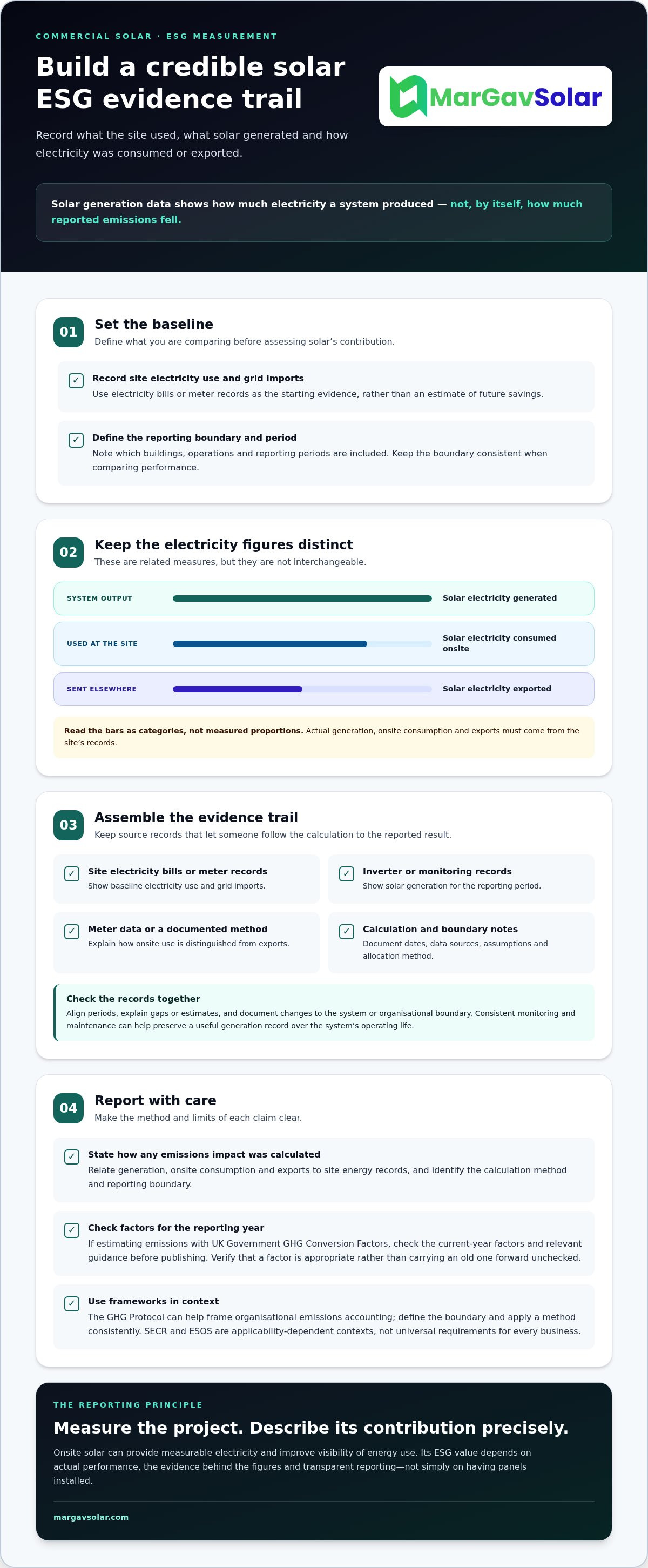
Keep the figures distinct: generated electricity, self-consumed electricity and exported electricity are not interchangeable. Generation records show system output, but they don’t by themselves prove an equivalent reduction in reported emissions. Any assessment should also recognise lifecycle considerations, including equipment manufacture, transport and eventual end-of-life treatment.
Social and governance benefits: opportunity, not automatic proof
Solar may create opportunities for local engagement or help employees understand how the workplace uses energy. Installation alone, however, doesn’t establish community benefit or workforce awareness. To support those claims, record what the business did, who was involved and what evidence exists, such as engagement records or staff communications.
Meter and inverter records can also help teams monitor generation and energy performance. Used consistently, they strengthen oversight and provide source data for internal reporting. They don’t replace wider governance practices. Workforce, community and governance claims need their own policies, responsibilities and supporting evidence.
The ESG benefits of commercial solar are strongest when a business connects a site-specific project to clear priorities, monitors its performance and describes its contribution without implying that one installation solves wider environmental or social challenges.
How can a business measure commercial solar’s ESG contribution?
Start with a baseline, not an estimate of future savings. Record site electricity use and grid imports over a defined period. Note which buildings, operations and reporting periods are included. Keep the boundary consistent when comparing performance: adding or excluding a site can change the reported picture even if the solar system hasn’t changed.
Solar generation data shows how much electricity a system produced, not by itself how much an organisation’s reported emissions fell. To explain the contribution, distinguish total generation from electricity consumed onsite and electricity exported. Relate each figure to the site’s energy records and state the method used to calculate any emissions impact.
Build an evidence trail from baseline to reported outcome
Bring together records that allow someone to follow the calculation from source data to reported figure. Useful evidence includes:
- Site electricity bills or meter records showing baseline use and imports.
- Inverter or monitoring records showing solar generation for the reporting period.
- Meter data or a documented method for distinguishing onsite use from exports.
- The dates, site boundary, data sources, assumptions and allocation method used.
Keep these records with the reported results. Check that the periods align, explain any gaps or estimates, and document changes to the system or organisational boundary. Consistent monitoring and maintenance can help preserve a useful generation record over the system’s operating life.
Use UK reporting frameworks carefully
The GHG Protocol can help frame organisational emissions accounting, but the business still needs to define its boundary and apply a method consistently. If using UK Government GHG Conversion Factors to estimate emissions, check the current-year factors and relevant guidance before publishing calculations. Don’t carry forward an old factor without verifying that it’s appropriate for the reporting year and calculation.
SECR and ESOS are applicability-dependent reporting and energy-management contexts, not universal requirements for every business. Check whether either applies to your organisation before describing a duty or presenting a disclosure as mandatory. The UK Solar Council provides useful context on UK solar deployment, but its existence doesn’t substantiate an individual company’s emissions claim.
For a site-specific view of generation potential and the records a project may produce, read about commercial solar consultation with MarGav Solar. Connecting system design and monitoring with the organisation’s reporting needs helps keep projected output distinct from an achieved ESG result.
Commercial solar ESG claims: benefits, trade-offs and alternatives
The ESG benefits of commercial solar are strongest when claims match what the system and its records can show. Installing panels doesn’t, by itself, prove that an organisation is sustainable or net zero. Solar can document onsite renewable electricity generation over a defined period, but it can’t establish performance across the whole value chain or every environmental, social and governance issue.
Be precise about electricity figures. Generated electricity is the system’s total output; self-consumed electricity is used at the site; exported electricity is sent elsewhere. These figures describe different outcomes and shouldn’t be treated as interchangeable. Avoid broad claims such as “zero emissions” unless a clearly defined, verified boundary supports them.
Compare approaches by purpose and evidence
Different measures address different needs. Onsite solar generates electricity at the property. Offsite renewable procurement can support renewable electricity purchasing without relying on a business’s own roof or land, while energy efficiency reduces demand. Battery storage doesn’t generate electricity, but it can change when solar-generated electricity is used. Each approach needs different supporting evidence.
| Approach | Control and site dependence | Useful evidence and reporting consideration |
|---|---|---|
| Onsite solar | Generation is tied to the site and system. | Use generation, import, self-consumption and export records; report the period and boundary. |
| Offsite renewable procurement | Less dependent on the business’s property; delivery and claims depend on the procurement arrangement. | Retain contract and supporting documentation, and explain the basis of any renewable electricity claim. |
| Energy efficiency | Can be applied to suitable equipment or operations, with no solar site required. | Compare energy use before and after, accounting for changes in activity and reporting boundaries. |
| Battery storage | Requires a suitable site and system configuration. | Track charging, discharging and energy flows to show how storage changes electricity use over time. |
Match the measure to the energy profile
A business that uses electricity during sunny operating hours may be able to use more solar output directly. If demand occurs at other times, storage may shift some generated electricity for later use. It doesn’t guarantee savings or remove the need to assess system performance. For a plain-language overview of storage concepts, see solar battery storage guidance.
Efficiency improvements may be a better first step where avoidable consumption is the main issue. Compare options against the organisation’s energy profile and ESG priorities, then report each measure’s contribution separately. This is more credible than presenting one intervention as proof of a net-zero outcome.
How should UK businesses assess a commercial solar project?
A useful assessment starts with the organisation’s needs, not a standard system size. Review site electricity use, operating hours, property constraints and ESG priorities together. A Staffordshire business with daytime operations, for example, may have a different fit for onsite generation than a site with most demand outside daylight hours. Local site conditions matter, so don’t assume one design suits every property.
Prepare a site and energy-use assessment
Gather electricity records, operating schedules and available site plans. These show when and where energy is used, helping determine whether expected generation is likely to align with demand. A site assessment can then consider roof condition, orientation, shading and electrical requirements before deciding whether a property is suitable.
Include battery storage or EV charging in the discussion only where they support a defined operational need. Storage may be relevant if the organisation wants to consider using solar electricity at a different time. EV charging should reflect actual or planned vehicle requirements. Include solar panel maintenance and cleaning in the project plan to account for ongoing system care and performance monitoring.
Set project measures and reporting responsibilities
Decide what success means before installation decisions are made. Measures might include actual generation, the proportion used onsite, imported electricity and documented assumptions for any emissions calculation. Choose indicators that connect to the organisation’s ESG priorities, and distinguish measured results from forecasts.
Assign responsibility for monitoring system data, keeping records and updating ESG reporting. Facilities staff might maintain generation records while a sustainability or finance team reviews how figures are used in disclosures. Agree on the reporting period and site boundary so comparisons remain consistent. If energy use, organisational boundaries or reporting guidance change, review the assumptions and update the method rather than carrying old calculations forward without checking.
The ESG benefits of commercial solar are easier to assess when a project’s aims, site conditions and reporting approach are considered together. MarGav Solar provides commercial consultation and professional installation, with project support shaped around the property and organisation. A commercial solar assessment can bring site needs and energy use into the project discussion.
How MarGav Solar can support a commercial solar ESG plan
A commercial solar project works best as a considered site decision, not a promise of a particular ESG result. MarGav Solar brings over 20 years of industry experience to consultation and professional installation for commercial properties. The assessment can help businesses consider how a system fits their property, energy use and priorities, including for sites in Staffordshire.
From initial consultation to an evidence-aware project
Consultation brings together practical site information and organisational aims. This can include electricity use, operating patterns, available roof or land context and the outcomes the business wants to track. Those details inform project design and help establish whether expected generation aligns with demand.
Before installation, agree how performance will be evaluated. Measures might include generation over a defined period and how much electricity is used onsite. If the organisation plans to report an emissions effect, its sustainability or reporting team should define the accounting boundary and calculation approach. The system can provide operational data, but the ESG claim should remain tied to recorded outcomes and clearly stated assumptions.
Installation is one point in the system’s operating life. Ongoing maintenance can support performance monitoring and help the business maintain a useful record of system operation over time. Maintenance itself doesn’t prove a specific emissions reduction or wider ESG impact; those claims depend on relevant performance data and the reporting method.
Turn the assessment into a practical next step
A focused discussion is easier to prepare for if your team brings together:
- Recent site electricity records and information about typical operating hours.
- Available site plans and details of the property or proposed installation area.
- The organisation’s ESG priorities, reporting boundary and intended measures.
- Any known plans for battery storage or EV charging, linked to operational needs.
It also helps to involve the people responsible for facilities, energy data and sustainability reporting. They can align project goals with how performance will be monitored and how evidence will be used, reducing the risk of treating forecasts as achieved results. MarGav Solar supports commercial projects from consultation through installation and longer-term maintenance, with the assessment shaped around the site and organisation.
If you’re weighing the ESG benefits of commercial solar, start with the property, energy records and outcomes your business wants to measure. Discuss a commercial solar project with MarGav Solar to explore a practical next step for your site.
Make your next solar decision evidence-led
The ESG benefits of commercial solar are most credible when a project fits the site’s energy needs and its contribution is measured clearly. Track generation and onsite use, keep reporting assumptions transparent, and avoid presenting solar as proof of wider sustainability or net-zero performance on its own.
Bring together your energy records, site details and sustainability priorities to give your team a stronger basis for assessing whether commercial solar aligns with your property and how you’ll monitor results over time.
MarGav Solar brings over 20 years of industry experience, providing consultancy and professional installation for commercial and residential properties. Support extends from initial consultation through installation and longer-term maintenance, helping businesses plan around their site and project objectives without promising a predetermined ESG outcome.
Discuss a commercial solar project with MarGav Solar to explore an evidence-led way forward for your business. Clear goals and a site-specific assessment can help turn a promising idea into a considered next step.
Frequently Asked Questions
What are the ESG benefits of commercial solar?
The main direct ESG contribution is environmental: onsite solar generates renewable electricity and may reduce the amount of grid electricity a business imports. The ESG benefits of commercial solar can also include better visibility of energy performance through generation records. Social or governance gains aren’t automatic. Staffordshire businesses should treat community engagement, employee awareness and oversight as separate outcomes, supported by their own actions and evidence.
Can commercial solar reduce a company’s reported emissions?
Yes, it may reduce reported operational emissions if solar electricity used onsite displaces imported electricity, but the effect depends on actual generation, consumption and the organisation’s accounting boundary. Keep exported electricity distinct from electricity consumed at the site. Any calculation should document its method and use appropriate, current-year UK emissions factors and reporting guidance. A system’s generation figure alone doesn’t establish the emissions reduction a business can report.
How does a business measure the ESG impact of solar panels?
Start with site electricity-use and import records for a defined baseline period. Then track actual solar generation and distinguish onsite use from exports, using meter and inverter records where available. Keep the site boundary, time period, data sources, assumptions and calculation method with the figures. Assign responsibility for reviewing and retaining this evidence so sustainability or finance teams can explain how reported results were calculated and update them when circumstances change.
Does installing commercial solar make a business net zero?
No. Installing solar can contribute to managing a business’s operational electricity emissions, but it doesn’t account for all emissions across its activities and value chain or address every ESG factor. A net-zero claim needs a clearly defined boundary and evidence for the organisation’s wider approach, not just a solar installation. Describe the system’s measured contribution precisely, and avoid broad claims such as “zero emissions” unless they’re supported by appropriate verification.
Is commercial solar better than buying renewable electricity?
Neither option is automatically better; they serve different purposes and depend on the site and business priorities. Onsite solar generates electricity at the property and can be measured through system and energy records. Renewable electricity procurement doesn’t depend on having a suitable roof or land, but its claim needs supporting documentation for the arrangement. Businesses can also consider energy efficiency to reduce demand. Compare each option by its evidence, boundaries and fit with operations.
Does battery storage improve the ESG benefits of commercial solar?
Battery storage can change when solar-generated electricity is used by storing some output for later, which may help align generation with a site’s demand. It doesn’t generate electricity or guarantee savings or emissions reductions. Assess the system’s role against operating patterns, then monitor charging, discharging and energy flows. This helps show whether storage changed onsite use and supports a more accurate account of the project’s environmental contribution.
Do UK businesses have to report commercial solar under SECR or ESOS?
Not all UK businesses have the same reporting obligations. Whether SECR or ESOS applies depends on the organisation and the relevant rules, so don’t assume either framework covers every business. Check current official guidance against your organisation’s circumstances before describing a duty. Where relevant, solar generation and energy records may inform reporting, but they don’t replace the need to follow applicable requirements or document the method used.


