

The lowest-upfront-cost option isn’t automatically the best way to finance a commercial solar project. A loan, lease, hire purchase agreement or power purchase agreement can affect cash flow, system ownership and control in different ways. The key is to compare the full commitment with the project’s likely performance, not just the first payment.
The right choice depends on how the system fits your energy use, what obligations the agreement creates and how current tax treatment or available support may apply to your business. These details are project-specific, so broad savings claims aren’t a substitute for a realistic assessment.
This guide compares the main commercial solar funding routes, explains who typically owns the system under each, and sets out the trade-offs in cash flow, risk, control and internal workload. It also gives you a practical process for gathering information and comparing options. A well-scoped, professionally designed system is the starting point. MarGav Solar provides commercial solar consultation and installation, connecting a property’s requirements and energy use with a practical project scope for businesses in Staffordshire.
Key Takeaways
- To decide how to finance a commercial solar project, match the funding route to your cash flow, ownership preferences and appetite for performance risk.
- Compare options using the same system scope, energy assumptions and time horizon, then examine payment timing and total contractual commitments.
- Gather electricity bills, half-hourly usage data where available, site plans and operating patterns to build a more realistic project assessment.
- Separate the cost of funding the solar system from the price paid for the electricity it generates. These are different financial arrangements.
- Use a project-specific assessment of site requirements and energy use to align the finance structure with a practical system design.
How commercial solar project economics shape the finance decision
Commercial solar project finance can mean funding the system itself or paying for the electricity it produces. These are related but different decisions: one concerns the equipment and installation, while the other concerns the cost and value of energy over time. A Feed-in Tariff (FIT) is an example of a policy mechanism that can influence renewable project economics, but it isn’t a funding structure.
Before deciding how to finance a commercial solar project, build a business case around realistic site and energy assumptions. A projected return is an estimate, not a guaranteed outcome. Generation and financial benefits can vary with system design, site conditions, energy use and the terms of the chosen arrangement.
What belongs in a commercial solar business case?
Start with the proposed system and full project scope. Include design and installation, maintenance assumptions and any proposed battery storage. Then compare expected generation with the business’s electricity demand throughout the day and across its operating schedule.
Daytime electricity use matters. When a site uses power while panels are generating, more of that electricity may be consumed on site. If demand and generation don’t line up, the financial case may differ. Forecasts should state their assumptions, including how operating hours and site conditions affect expected generation. Treat estimated bill reductions and export income as projections, not guaranteed returns.
Finance suitability depends on the assumptions behind the forecast, not on one headline figure.
Which business priorities should guide financing?
Set your priorities before comparing structures. Is preserving working capital more important, or does the business value owning the asset? Consider whether predictable payments matter more than flexibility, how much control you want over the system, and who is responsible for maintenance. Assess who carries the financial impact if actual performance differs from the forecast.
These priorities can point in different directions. A business seeking to retain capital may favour an arrangement with lower initial outlay. A business prioritising ownership may instead weigh the full cost and responsibilities of buying the asset. The right fit depends on the project and the organisation’s ability to manage its obligations.
For commercial properties in Staffordshire, site requirements and energy profiles need individual assessment. Roof or ground conditions, operating patterns and the proposed system scope can all affect the design and finance comparison. A project-specific consultation brings these details together before the system is specified.
Commercial solar finance options: how ownership and risk differ
Each funding route changes the balance between upfront cash, ownership and responsibility. To decide how to finance a commercial solar project, compare more than the payment amount. Establish who owns and controls the equipment, and how the agreement treats performance that differs from the forecast. Accounting and tax treatment can also vary by structure and business circumstances.
How loans and hire purchase differ from leasing
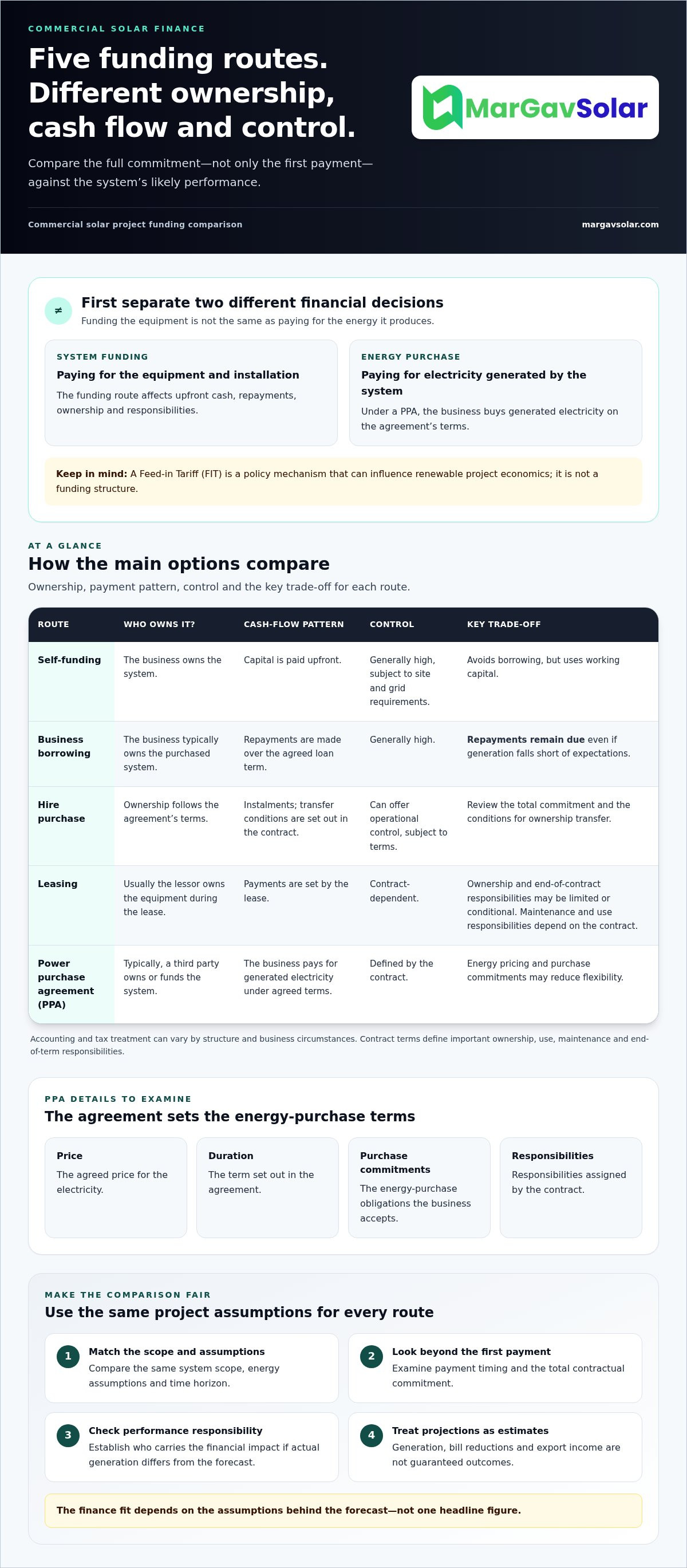
Self-funding uses the business’s available capital to pay for the system, avoiding finance repayments but tying up cash. A business loan can spread the cost while the business owns the asset, subject to the loan and purchase arrangements. Repayments remain due even if generation falls short of expectations. Hire purchase also spreads payments and is structured towards ownership, but the transfer point depends on the agreement. With a lease, the finance provider typically owns the equipment during the term. Maintenance, use and end-of-contract responsibilities depend on the contract.
| Option | Ownership | Cash-flow pattern | Control | Key trade-off |
|---|---|---|---|---|
| Self-funding | Business owns the system | Capital paid upfront | Generally high, subject to site and grid requirements | Avoids borrowing, but uses working capital |
| Business borrowing | Business typically owns the purchased system | Repayments over the agreed loan term | Generally high | Repayments continue regardless of actual generation |
| Hire purchase | Ownership follows the agreement’s terms | Instalments, with any transfer conditions set out in the contract | Can offer operational control, subject to terms | Review total commitment and ownership conditions |
| Leasing | Usually the lessor during the lease | Payments set by the lease | Contract-dependent | Ownership and end-of-term responsibilities may be limited or conditional |
| Power purchase agreement (PPA) | Typically a third party owns or funds the system | Business pays for generated electricity under agreed terms | Defined by the contract | Energy pricing and purchase commitments may reduce flexibility |
When a power purchase agreement may be considered
A PPA may suit a business that wants to avoid funding the equipment directly. A third party generally owns or funds the installation, and the business buys the electricity it generates. The agreement sets the price, duration, energy purchase commitments and responsibilities, so review these details closely. Consider how the arrangement fits future energy needs, site control and the business’s ability to meet its commitments. The Ofgem Feed-in Tariff scheme information explains the legacy scheme, which closed to new applicants in 2019. It shouldn’t be mistaken for a current funding route.
For a sound comparison, first establish a system scope based on the site and its energy use. Explore commercial solar project planning as part of shaping that assessment.
How to compare commercial solar finance options fairly
A fair comparison starts with a like-for-like project. If one proposal assumes a larger system, different operating hours or a battery while another doesn’t, their forecasts aren’t directly comparable. Set a shared system scope, energy-use profile and assessment period before weighing finance structures. This helps show whether differences come from the funding terms or from different project assumptions.
Projected savings are estimates, not guaranteed repayments or promises of project performance. Test whether an arrangement remains workable if generation, electricity use or other assumptions change.
Which financial and operational questions belong in the comparison?
Look beyond the headline payment. Compare any upfront capital requirement, payment timing and total, asset ownership, maintenance responsibilities, and the conditions for ending or changing the agreement. Consider the effect on internal approvals and accounting processes, as well as plans to sell, expand or alter the site. A lower initial commitment may come with obligations that continue if business needs change.
Run practical scenarios. What happens if operating hours fall, occupancy changes, the business uses less electricity during generation hours, or maintenance needs differ from the forecast? If the proposal includes battery storage, assess its role and cost within the same project assumptions rather than treating its benefits as automatic. Take accounting and tax questions to a qualified adviser, using current HMRC guidance for the business’s circumstances.
How do grants and tax relief fit into the analysis?
Treat grants and tax relief as possible inputs, not assured funding. Availability, eligibility, application timing and interaction with a finance arrangement can depend on the scheme and the business. Check current UK guidance before including support in a forecast, and compare the project with and without it. This shows whether the proposal works on its underlying economics or depends on an incentive being available.
Don’t assume different finance structures receive the same tax treatment. Ownership, contract terms and the business’s circumstances can matter. Have a qualified adviser review relevant current HMRC guidance before final approval.
A simple method for a fair comparison
- Standardise the proposal: use the same system scope, generation assumptions, energy profile and time horizon.
- Map the commitments: record upfront and scheduled payments, responsibilities and exit conditions.
- Stress-test the forecast: adjust electricity use, generation, occupancy and maintenance assumptions.
- Separate confirmed inputs from estimates: identify which figures are contractual, forecast or dependent on incentives.
This process gives decision-makers a clearer view of how to finance a commercial solar project without relying on one attractive forecast. If battery storage is included, assess its proposed function alongside the solar system and the site’s demand pattern.
How to prepare and progress commercial solar project finance
A finance decision is easier to assess when project details stay consistent from the first site review to the final agreement. Gather evidence about energy use and the property, define a realistic installation scope, then compare funding options against the same assumptions. This helps prevent a mismatch between what the finance documents fund and what the installation is designed to deliver.
What information should a business prepare?
Gather information that shows how the site uses energy and what the project may involve:
- Recent electricity bills and available consumption data, including half-hourly usage where available.
- Business operating hours, seasonal patterns and expected changes in occupancy or demand.
- Site plans and details about the roof or land, including planned building or site changes.
- Relevant electrical infrastructure information and any known site constraints.
- Business priorities: preferred ownership, cash-flow limits and intended project timing.
These details help shape the system scope and generation estimate. If the business is planning an expansion or expects its operating pattern to change, include that context rather than relying only on historic usage. For a commercial property in Staffordshire, a project-specific assessment can connect site conditions with the business’s actual energy profile.
What is the practical funding decision sequence?
- Define the project: Set out the intended system, installation scope and any proposed battery storage or related requirements.
- Assess the site: Consider property conditions, energy demand, operating patterns and relevant infrastructure before settling on a design.
- Prepare comparable assumptions: Use the same project scope, generation estimates and time horizon across funding comparisons.
- Test alternatives: Model how changes in energy use, generation or occupancy could affect the project and its commitments.
- Review before approval: Check that finance documents align with the intended system and installation plan. Discuss agreement terms and tax or accounting questions with appropriate legal, financial and accounting advisers.
Keep the project specification, generation estimates and finance documents aligned as plans develop. A change in system scope can alter the project assumptions, so revisit the comparison before committing if the design or installation plan changes. For background on planning and delivery, read the solar installation guide alongside this finance process.
MarGav Solar helps businesses connect site requirements and energy use with a realistic commercial solar scope. Discuss your commercial solar project as you prepare your assessment.
Turn the finance decision into a commercial solar project
A finance structure only makes sense when it matches the system the business needs. Before moving ahead, align the proposed equipment, installation scope and expected energy use with the payment arrangement and its responsibilities. If the design changes after approval, project assumptions may change too. Treat the system plan and finance documents as connected parts of the decision.
From project assessment to installation planning
Professional consultation helps clarify how the site and the business’s energy profile shape a practical project scope. Roof or land conditions, operating hours, electricity demand and relevant infrastructure all inform system design and generation estimates. For a Staffordshire business, planning should reflect the specific property rather than rely on a generic system size or forecast.
Battery storage may suit a business’s operating and energy objectives, but assess it as part of the overall design rather than assuming it improves every project. MarGav Solar provides commercial solar consultation and installation, with end-to-end support from initial consultation through installation and long-term maintenance. A Staffordshire solar installation guide can also provide useful context on planning and delivery as the project moves from assessment to installation.
What should happen before committing to a finance agreement?
Before signing, check that the written agreement reflects the project being planned. The system design, installation scope and finance assumptions should describe the same project, with responsibilities clearly set out. Review payment obligations, maintenance arrangements, ownership conditions and any terms that affect future changes to the site or system.
Make sure projected generation and financial outcomes are presented as estimates, with their assumptions disclosed. They aren’t guaranteed results and shouldn’t be treated as a promise that future performance will match the forecast. Resolve any gaps between the project specification and finance documents, and seek legal, financial or accounting advice where the agreement or its treatment needs specialist review.
Understanding how to finance a commercial solar project is one part of the decision. The next is turning the selected structure into a realistic, well-specified installation. MarGav Solar’s commercial project consultation connects site requirements and energy use with a practical project scope.
To explore a commercial solar project shaped around your site and business needs, Explore commercial solar solutions with MarGav Solar.
Make your next solar decision with confidence
Choosing how to finance a commercial solar project starts with the project itself: its energy profile, proposed system and installation scope. Then compare funding routes using consistent assumptions, weighing ownership, cash-flow commitments, control and responsibility for performance. Forecasts can inform the decision, but they’re estimates. Understand their assumptions before agreeing to contractual terms.
A well-designed system gives the business a firmer foundation for comparing finance options and planning installation. MarGav Solar brings over 20 years of industry experience, with support from consultation through installation and long-term maintenance. For Staffordshire businesses, a project-specific discussion connects site requirements and energy use with a realistic commercial solar scope.
Take the next step by exploring what a project could involve for your property. Explore commercial solar solutions with MarGav Solar and start shaping a plan around your business needs.
Frequently Asked Questions
What are the main ways to finance a commercial solar project in the UK?
The main routes are self-funding, business borrowing, hire purchase, leasing and a power purchase agreement (PPA). With self-funding or borrowing, the business typically owns the system, while hire purchase is structured towards ownership under the agreement’s terms. A lease or PPA generally involves a third party owning the equipment. To decide how to finance a commercial solar project, compare ownership, payment commitments, control and performance responsibilities with your business’s cash-flow priorities.
Is a commercial solar PPA better than buying a solar system?
Neither option is automatically better. The right choice depends on the business’s priorities and the agreement. Buying can give the business ownership and greater control, but requires capital or borrowing and leaves it exposed to system performance. Under a PPA, a third party typically owns or funds the system and sells the business its generated electricity under contract. Compare pricing, duration, purchase commitments, responsibilities and flexibility with the business’s long-term energy needs.
Can a business get a grant for a commercial solar project in the UK?
Some funding programmes may support particular projects or businesses, but a grant shouldn’t be treated as assured project funding. Availability, eligibility and application timing depend on the scheme and its current rules. Support for households may not apply to commercial premises. Check authoritative UK or relevant devolved-nation guidance before including a grant in the business case, and model the project without it too. Staffordshire businesses should assess schemes against their specific commercial project and eligibility.
How do I compare a solar loan, lease, and hire purchase agreement?
Compare who owns the equipment, when payments are due, the total contractual commitment, who handles maintenance and what happens at the end of the agreement. A loan can fund an asset owned by the business, while hire purchase is structured towards ownership subject to its terms. A lease generally leaves ownership with the lessor during the term. Check exit conditions and how each option responds if generation, business use or site plans change.
What information does a business need to apply for commercial solar finance?
Prepare recent electricity bills, available consumption data, half-hourly usage where available, and details of operating hours or seasonal demand. Include site plans, information about the roof or land, relevant electrical infrastructure and any planned property changes. Define the proposed system scope and project timing, then set out preferences for ownership and cash flow. This information helps align finance assumptions with the site and installation plan rather than relying on a generic forecast.
Do commercial solar panels qualify for UK tax relief?
Commercial solar equipment may qualify for tax relief where it meets the relevant rules, but the treatment depends on the asset, finance structure and business circumstances. Ownership can affect which party may claim an allowance, so don’t assume a lease, loan and purchase receive identical treatment. Check current HMRC guidance and discuss the proposed arrangement with a qualified tax or accounting adviser before including relief in your project forecast.
What happens if a business moves premises during a solar finance agreement?
The outcome depends on the contract and who owns the system. The agreement may set out whether it can transfer to a new owner or site, whether equipment can be removed, or whether early settlement or other costs apply. A PPA may also be tied to electricity use at the original property. Review these terms before signing, especially if relocation, a sale or major site changes are possible during the agreement.


