

With over 2 million electric vehicles now navigating UK roads as of late 2026, the transition to electric driving has moved from a niche choice to the national standard. However, actually determining the cost to install EV charger at home UK still feels like solving a puzzle with missing pieces. You likely feel the common frustration of spotting a low headline price, only to worry about hidden electrical upgrade fees or the confusion of choosing between tethered and untethered units.
It's understandable to want clarity before committing to a home improvement that affects your daily commute. This guide provides a transparent breakdown of what you will really pay this year, covering hardware, labour, and the impact of the latest 2026 OZEV grant updates. We'll show you how to build an accurate budget, explain why the 0% VAT on domestic electricity matters for your savings, and explore how integrating your charger with solar and battery storage creates a truly future-proof home energy ecosystem. Whether you are a tenant looking for grant support or a homeowner seeking a certified local installer, you'll find the answers you need to move forward with confidence.
Key Takeaways
- Estimate your total budget by understanding the current price ranges for hardware and labour, ensuring you know exactly what the cost to install EV charger at home UK entails in 2026.
- Check your eligibility for the updated OZEV grant, which now provides up to £500 for tenants and landlords to help offset installation expenses.
- Avoid surprise fees by identifying common hidden costs like consumer unit upgrades or complex cable routing before you request a quote.
- Maximise your return on investment by learning how to pair your EV charging point with solar panels and battery storage for significantly lower running costs.
- Learn why hiring a certified local Staffordshire installer is essential for meeting the latest electrical safety standards and ensuring long-term maintenance support.
How Much Does it Cost to Install an EV Charger at Home in the UK (2026)?
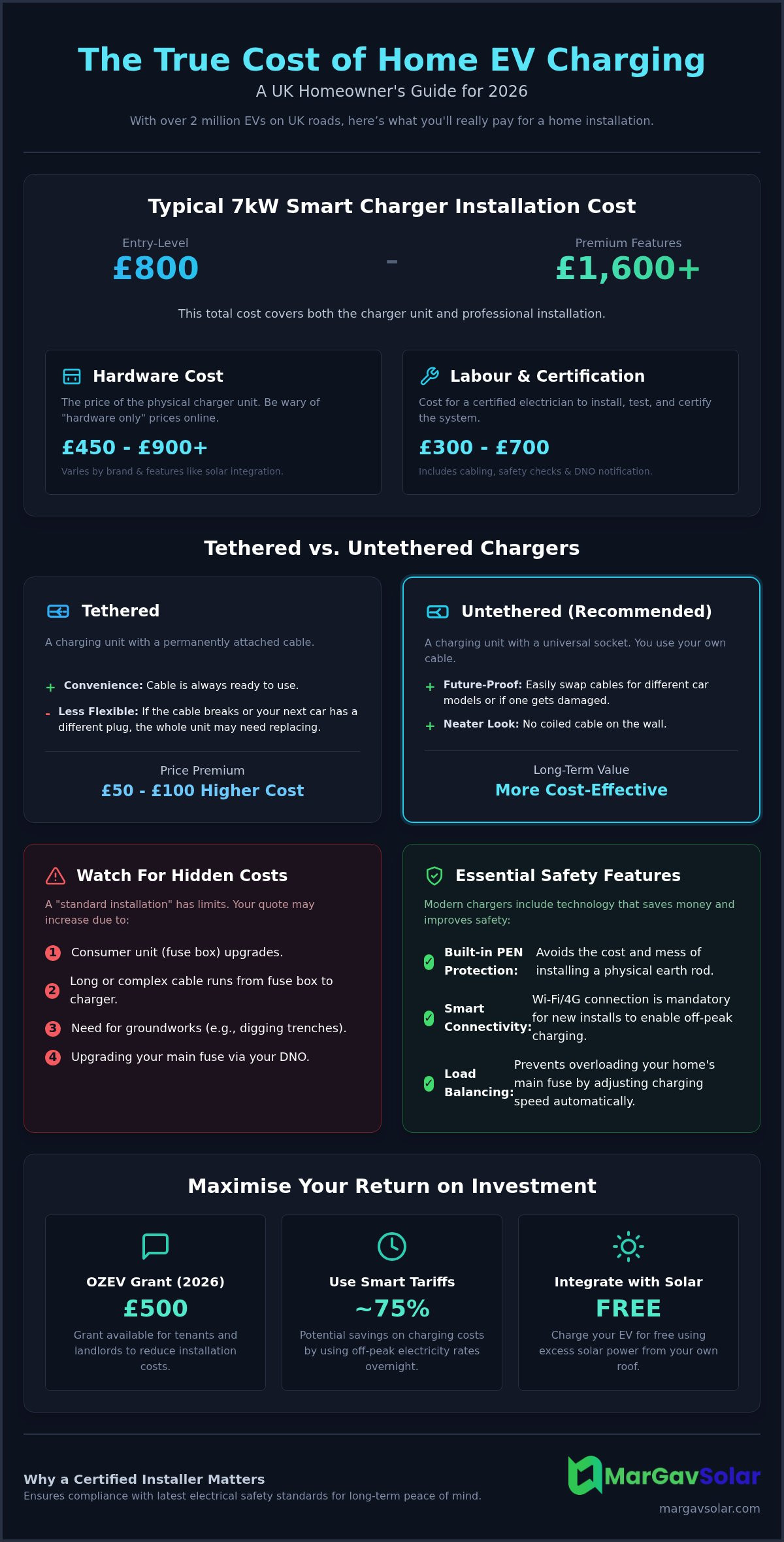
Determining the actual cost to install EV charger at home UK wide requires looking past simple hardware stickers. In 2026, the market has matured significantly. Most homeowners now opt for 7kW smart chargers as the standard for reliable overnight charging. While 22kW units are available, they require a three-phase power supply, which is rare in standard residential properties. For a typical UK semi-detached home, the total investment for a standard installation usually settles between £800 and £1,200.
The distinction between "hardware only" and "fully installed" quotes is where many homeowners get caught out. A charger might list for £450 online, but this doesn't account for the NICEIC-certified labour, cabling, or safety components required by current wiring regulations. In the 2026 market, professional labour typically ranges from £300 to £700 depending on the complexity of your home's electrical layout. This emphasis on expert integration is a global trend; for instance, in the United Arab Emirates, Copak Technical Services LLC provides similarly high standards for both residential and commercial EV charging solutions.
The Average Price Range for Home Charging
Entry-level smart chargers, which provide basic scheduling and app connectivity, usually fall into the £800 to £1,000 bracket for a full installation. If you're looking for premium features like seamless solar integration or advanced load balancing, expect to pay between £1,200 and £1,600 or more. This price gap often reflects the quality of internal components in an electric vehicle charging station and its ability to communicate with home battery systems. Hardware costs have stabilised recently as manufacturing scales up to meet the demand of the millions of EVs now on our roads.
Tethered vs. Untethered: Which Costs More?
Tethered chargers are units with a permanently attached cable. These often carry a slight price premium of £50 to £100 because the cable is included in the box. While they offer the convenience of not having to dig a cable out of your boot every evening, untethered units are often seen as a better long-term investment. Untethered chargers allow you to swap cables if you change cars with different socket types in the future. This flexibility can prevent you from needing to replace the entire unit just because your next vehicle uses a different connection standard.
For residents in Staffordshire, choosing a local expert with a 20-year track record is often more cost-effective than national firms. Specialist installers who understand solar and battery integration can help you avoid the "hardware only" trap. They ensure your quote includes the unit, labour, and the mandatory safety certifications required by the latest 2026 electrotechnical standards.
Breaking Down the Costs: Hardware, Labour, and Certification
Understanding the cost to install EV charger at home UK requires a look under the hood of your installation quote. You aren't just paying for a plastic box on the wall. You're investing in complex power electronics, heavy-duty copper cabling, and specialized safety components. Most modern installations include smart features that allow you to sync with off-peak tariffs. This connectivity is now a core part of the cost of installing a home EV charger because it ensures your unit meets the latest UK smart charging regulations.
Smart Charger Hardware Features
Modern smart chargers must include Wi-Fi or 4G connectivity to allow for app-based management. This hardware enables you to schedule charging when electricity is cheapest. Another significant feature in 2026 units is built-in PEN protection. This technology monitors the electrical supply and automatically disconnects the charger if a fault is detected. By choosing a unit with integrated PEN protection, you avoid the cost of installing a traditional earth rod, which requires more labour and can be unsightly. For a deeper look at specific models available for your property, see our EV Charging Points in Staffordshire: The 2026 Homeowner’s Guide.
The Value of Certified Professional Labour
Labour involves far more than bolting a unit to a brick wall. A professional installer evaluates your home's total electrical load to ensure your main fuse can handle the charger alongside your oven, shower, and heat pump. They also handle the mandatory Distribution Network Operator (DNO) notification. This administrative step informs the local grid of your new high-demand appliance. Choosing an installer with over 20 years of experience, like the team at MarGav Solar, ensures these technical and legal steps are completed without delay.
Certification is the final, crucial piece of the puzzle. An NICEIC certification proves the work meets BS 7671 standards. Without this document, your home insurance provider may refuse a claim in the event of an electrical fault. It's a vital safety net that protects your property value and your family's safety. If you're looking to maximize your savings, you might consider how EV charging points can be integrated with a wider solar and battery storage system.
Consumables also play a role in your final bill. The price of specialized EV Ultra cable, which carries both power and data, fluctuates with global copper markets. Additionally, if your existing fuse box is full, your installer will need to fit a dedicated mini-consumer unit to house the charger's circuit breaker. These parts are essential for a safe, compliant installation that stands the test of time.
Factors That Can Increase Your Installation Quote
While many national providers advertise a "standard" installation price, the reality for many UK properties is more complex. The final cost to install EV charger at home UK often hinges on the specific layout of your property and the age of your current electrical system. For those in Scotland, consulting an Electrician Dundee can help clarify these costs; if your driveway is on the opposite side of the house from your consumer unit, or if your home still relies on an outdated fuse box, your quote will naturally increase to reflect the extra time and materials required.
A standard installation typically covers up to 10 metres of cabling. If the distance from your fuse box to the charger is greater, you'll face additional costs for every extra metre. This isn't just about the wire itself; it's about the labour involved in securing it safely. For external runs across gardens or driveways, installers must use Steel Wire Armoured (SWA) cable to prevent accidental damage. Longer cable runs increase material and labour costs significantly. If the route requires lifting floorboards, navigating through lofts, or clipping cable high up on external walls, the complexity of the job rises alongside the price.
Electrical Infrastructure Upgrades
Your existing electrical setup might not be ready for the high demand of an EV charger. If your consumer unit is full or lacks modern safety features, you may need a dedicated "mini-board" or a full replacement. Modern standards require specific RCBOs (Residual Current Breaker with Overcurrent protection) and surge protection to prevent damage to your vehicle's sensitive electronics. If you're already considering solar energy, signs your old fuse box needs an inverter upgrade or replacement often appear during an EV site survey.
In older Staffordshire properties, we frequently find that the main incoming fuse is rated at only 60 Amps. To support a 7kW charger alongside other high-power appliances, you might need to request an amperage increase to 80 or 100 Amps from your Distribution Network Operator (DNO). While the DNO often performs this upgrade for free, it can delay the project. Fortunately, government grants for EV chargers can help offset some of these infrastructure costs for eligible residents, such as those living in flats or rented accommodation.
Groundworks and Structural Drilling
Groundworks represent the most significant potential cost increase. If your cable needs to go under a paved driveway or through a landscaped garden, trenching is required. This involves physical excavation and subsequent reinstatement of the surface to match its original state. Drilling through thick stone walls in period properties also adds significant time to the installation. By identifying these hurdles during an initial site visit, you can build a realistic budget and avoid surprise additions to your final bill.
Maximising ROI: Grants, Smart Tariffs, and Solar Integration
The upfront cost to install EV charger at home UK is an investment that starts paying dividends the moment you plug in. While the initial hardware and labour expenses are significant, the long-term savings on fuel often outweigh these costs within a few years. By moving away from standard variable tariffs and embracing smart energy management, you can transform your driveway into a high-efficiency refuelling station that operates at a fraction of the cost of public charging.
Smart energy tariffs are the most effective tool for rapid ROI. As of late 2026, dedicated EV tariffs offer off-peak rates around 8p per kWh, with some providers dropping as low as 6.99p. Compared to the standard price cap rate of 26.11p per kWh, charging a mid-size car overnight costs approximately £4.80 instead of £16. For a high-mileage driver, these savings can effectively pay back the installation cost in roughly 24 months. Additionally, the government's decision to reduce VAT on domestic electricity to 0% from October 1, 2026, further enhances these daily savings.
The Solar and Battery Synergy
To achieve the lowest possible "cost per mile", integrating your charger with a renewable energy system is essential. When you pair your charger with a residential solar PV system, you can divert excess generation directly into your vehicle battery. This creates a "zero-cost" mile where your car runs entirely on energy captured from your own roof. Implementing solar battery storage in Staffordshire allows you to store this clean energy during the day and discharge it into your EV at night, bypassing the grid entirely during peak hours.
Managing this ecosystem is simplified through advanced software. Using the GivEnergy Cloud platform, you can monitor exactly how much solar energy is going into your car versus your home appliances. This level of transparency helps you fine-tune your charging schedule to ensure you never draw expensive power from the grid when your battery has stored sunlight ready to use.
Grants and Tax Incentives
Financial support remains available for specific groups to help manage the cost to install EV charger at home UK wide. The EV Chargepoint Grant currently provides up to £500 for tenants and flat owners with dedicated off-street parking. This grant, which increased in April 2026, is also available to residential landlords at a rate of £500 per socket. If you run a business from home, you may also be eligible for the Workplace Charging Scheme (WCS), which supports up to 40 sockets for business-registered addresses.
If you want to see how these savings apply to your specific property, you can request a professional EV charging site survey to explore your integration options. Beyond national grants, some local Staffordshire initiatives occasionally offer energy efficiency rebates for homeowners who combine EV charging with solar and battery upgrades. Always check for these local incentives before finalising your project to ensure you aren't leaving money on the table.
Choosing the Right Installer in Staffordshire
Selecting the right professional is the final, most critical step in managing the cost to install EV charger at home UK. While national firms often dominate search results with generic promises, they frequently rely on a rotating network of subcontractors. This model can lead to inconsistent quality and a lack of accountability if issues arise with your warranty or electrical system. Choosing a local Staffordshire expert ensures you have a direct point of contact who understands the local grid and the specific housing stock in our area.
A 20-year track record in renewable energy is more than just a number. It represents a deep understanding of how electrical standards have evolved and how modern smart technology interacts with older wiring. For MarGav Solar, this experience means your installation isn't treated as an isolated task. It's handled by NICEIC-certified installers who look at your home's entire energy profile. When you're reviewing quotes, look for absolute transparency. A professional contract should be fixed-price, clearly detailing the hardware, labour, and any specific infrastructure upgrades discussed during your survey. This prevents the "hidden costs" that often plague generic estimates.
The Local Expert Advantage
MarGav Solar’s commitment to Staffordshire homeowners goes beyond the initial installation. National providers often struggle to provide repeat service once the van leaves your driveway. By staying local, we offer quick response times for future maintenance or even solar panel maintenance and cleaning. This end-to-end support means your warranty is backed by a team that's actually reachable. Whether you need a simple check-up or help integrating a new battery storage solution later, having an expert nearby provides long-term peace of mind that a national call-centre simply cannot match.
Next Steps: Getting an Accurate Quote
To ensure your final bill matches your initial estimate, preparation is key. Before your consultation, take clear photos of your main consumer unit and the proposed route from the house to your parking spot. While generic online calculators provide a rough idea, they can't account for the structural nuances of your home. A physical site survey is the only way to identify potential hurdles like thick stone walls or limited fuse capacity before work begins. If you're ready to move forward with a reliable, local team, you can request a professional EV charger consultation from MarGav Solar. Our experts will provide a detailed, transparent breakdown tailored to your property's specific needs and your long-term energy goals.
Future-Proof Your Home Energy Today
Transitioning to electric driving is a major step toward long-term energy independence. Understanding the total cost to install EV charger at home UK wide helps you avoid budget surprises while ensuring your property meets the latest 2026 safety regulations. By focusing on smart integration and professional certification, you're doing more than just buying a charger; you're building a reliable home refuelling station that works for you. It's about choosing quality over the lowest headline price to ensure your system remains efficient for years to come.
Choosing an installer with 20+ years of local Staffordshire expertise ensures your installation handles the demands of modern smart technology. We specialise in NICEIC-certified professional installations and are experts in GivEnergy and solar-integrated charging systems. This local approach guarantees you'll have long-term support and a system that grows with your home's energy needs. You don't have to navigate these technical choices alone.
Ready to secure your energy future? Get a fixed-price EV charger installation quote from MarGav Solar and take the first step toward cleaner, cheaper, and smarter home charging today.
Frequently Asked Questions
Is it cheaper to install an EV charger at the same time as solar panels?
Yes, combining these projects significantly reduces the overall cost to install EV charger at home UK properties. By having MarGav Solar install your charger alongside a residential solar PV system, you benefit from a single site visit and shared electrical labour. This synergy avoids the expense of paying for separate scaffolding or technical surveys twice. It also ensures your smart charger is perfectly configured to prioritise your home-grown solar energy from day one.
Can I get a grant for a home EV charger in the UK in 2026?
As of 2026, the OZEV EV Chargepoint Grant provides up to £500 for tenants and flat owners with dedicated off-street parking. Landlords can also claim £500 per socket for rental properties through the Residential Landlord Scheme. While the general homeowner grant has ended, these targeted incentives help many Staffordshire residents manage the cost to install EV charger at home UK wide. Always verify your eligibility with a certified installer before starting your application.
Does a home EV charger add value to my property in Staffordshire?
Installing a dedicated charging point is a significant asset for any Staffordshire property. With over 2 million electric vehicles now on UK roads, buyers increasingly prioritise homes with existing 7kW smart chargers. It signals that the property is future-proofed and ready for the modern market. When combined with solar panels and battery storage, the value increase is even more pronounced as it offers the next owner a sustainable refuelling station.
How much more does a 22kW charger cost compared to a 7kW unit?
A 22kW charger unit carries a slight hardware premium, but the primary expense lies in the electrical infrastructure. Most UK residential properties use a single-phase supply, which only supports up to 7kW. Upgrading to the three-phase supply required for 22kW charging can cost thousands of pounds in grid connection fees and groundwork. For most Staffordshire homeowners, a 7kW smart unit remains the most cost-effective and practical choice for reliable overnight charging.
What happens if my fuse box is too old for an EV charger?
If your consumer unit is outdated or full, a qualified installer will likely recommend an upgrade or a dedicated mini-board. Modern EV chargers require specific safety components like Type A RCBOs and surge protection that older fuse boxes often lack. MarGav Solar’s NICEIC-certified team assesses your board during the initial site survey. This ensures your installation remains compliant with BS 7671 standards and protects your home's electrical integrity without compromising your safety.
Are there hidden costs in "free" installation offers from energy companies?
Often yes. "Free" or ultra-low-cost offers usually only cover a "standard" installation, which typically includes less than 10 metres of cabling and no groundwork. If your charger needs to be further from your meter or requires drilling through thick stone walls common in Staffordshire, you'll face unexpected surcharges. Opting for a transparent, fixed-price contract ensures you know the total investment upfront, including all necessary hardware, labour, and specific electrical certifications for your property.
How much does it cost to maintain an EV charger annually?
Home EV chargers are relatively low-maintenance, but annual safety inspections are a wise investment to ensure long-term efficiency. These checks confirm that cable connections remain tight and the software is updated for the latest smart tariff optimisations. MarGav Solar provides technical inspections and cleaning services to keep your equipment running at peak performance. Regular maintenance helps prevent hardware failure and ensures your warranty remains valid, protecting your investment in sustainable transport for years to come.
Can I install my own EV charger to save on labour costs?
No, you shouldn't attempt a DIY installation. EV chargers handle high electrical loads and must comply with strict safety standards, including Building Regulations Part P and S. Attempting it yourself voids your home insurance, makes you ineligible for government grants, and poses a serious fire risk. From October 2026, installers must hold specific qualifications like City & Guilds 2921-34. Always use a certified professional to ensure your installation is safe, legal, and correctly certified.


