

Imagine the sinking feeling of discovering your home insurance is void because your new solar array doesn't meet the latest October 2026 electrical standards. For many families in Staffordshire, the excitement of switching to green energy is often clouded by the fear of faulty wiring or systems that fail prematurely. Understanding the various solar panel installer qualifications UK homeowners are told to check is a daunting task. You need to know that the person on your roof understands more than just brackets; they must master the complex electrical integration required for a safe home.
It's normal to feel overwhelmed by technical jargon and shifting industry requirements. You want a system that lowers your bills without compromising your family's safety. This guide explains why NICEIC certification remains the gold standard for UK solar installations, ensuring every connection complies with the mandatory BS 7671:2018+A4:2026 wiring regulations. We'll help you identify true expertise in an industry where shortcuts are costly.
We will explore how the NICEIC Platinum Promise provides up to £25,000 in protection and why combining this with MCS standards is the only way to guarantee a legal, high-performing system. From the 0% VAT relief available until March 2027 to the benefits of hiring local Staffordshire experts, you'll gain the clarity needed to protect your investment for the long term.
Key Takeaways
- Learn why NICEIC certification is the essential safety bridge for managing high voltage DC electricity and ensuring your solar array integrates safely with your home's earthing system.
- Understand the different solar panel installer qualifications UK residents need to verify to ensure their system meets both renewable performance and mandatory electrical safety standards.
- Discover how the NICEIC Platinum Promise provides a £25,000 guarantee for six years, protecting your financial investment if a contractor's work is found to be non-compliant.
- See how local Staffordshire expertise ensures your installation complies with the latest 2026 wiring regulations and specific regional grid requirements.
- Find out why choosing an installer with over 20 years of industry experience is the most reliable way to secure end-to-end support for your solar and battery storage systems.
What is NICEIC and Why Does It Matter for Solar PV?
Choosing an installer involves more than just comparing quotes. You're effectively inviting a professional to modify your home's core electrical heartbeat. The National Inspection Council for Electrical Installation Contracting (NICEIC) provides the framework that ensures this work doesn't put your property at risk. While many certifications focus on the panels themselves, NICEIC focuses on the person behind the tools. It's the industry benchmark for electrical competence and safety.
In 2026, the landscape of solar panel installer qualifications UK homeowners must navigate has become stricter. Installers must now adhere to the BS 7671:2018+A4:2026 wiring regulations. This amendment became the mandatory standard on October 15, 2026, introducing tighter requirements for safety and documentation. NICEIC ensures its registered contractors aren't just aware of these changes but are actively implementing them in every Staffordshire home.
The History and Authority of NICEIC
Since its inception in 1956, NICEIC has functioned as the UK's most recognised regulatory body for electrical contractors. Registration isn't a one-time event. It involves regular, rigorous assessments of an installer's work, equipment, and documentation. For a company like MarGav Solar, this accreditation has been the foundation of a 20-year reputation for excellence. It acts as a proxy for technical mastery, proving that an installer can handle the complex integration of renewable tech into a standard domestic grid.
NICEIC’s Evolution into Renewable Energy
The council has adapted significantly as the UK moves toward a greener grid. Modern solar installations are rarely standalone systems. They often involve solar battery storage and EV charging points, which require a sophisticated understanding of Direct Current (DC) safety and earthing systems. NICEIC competence ensures your installer can navigate Part P of the Building Regulations, which covers electrical safety in dwellings.
Solar PV systems generate DC electricity, which behaves differently than the Alternating Current (AC) in your wall sockets. If a system is poorly integrated into your consumer unit, the risk of electrical fire increases. An NICEIC-certified professional is trained to manage these specific dangers, ensuring your transition to renewable energy is both legal and safe.
Why NICEIC Accreditation is Non-Negotiable for Solar Safety
While many homeowners focus on the efficiency of their panels, the real danger lies in the high-voltage Direct Current (DC) flowing beneath them. Unlike the Alternating Current (AC) found in your standard home circuits, DC electricity doesn't have a zero point where the current stops. This makes electrical arcs far more persistent and difficult to extinguish. Without the right solar panel installer qualifications UK standards demand, a simple loose connection can quickly escalate into a persistent fire hazard.
NICEIC assessments are designed to catch these specific risks. Inspectors look for rigorous cable management and correct sizing of DC isolators. They also verify that your home’s earthing system is robust enough to handle the additional load. Substandard work often skips these invisible safety layers. By choosing an accredited expert, you ensure that every component, from the panels to your consumer unit, is integrated safely. The UK government's Warm Homes Skills Programme highlights the importance of this specialised training, funding initiatives to ensure installers have the technical depth required for modern renewables.
The Complexity of Solar Inverters and Batteries
Modern systems are becoming increasingly sophisticated. If you are considering inverter upgrades to boost your system's ROI, you need a technician who understands circuit design inside out. High-efficiency panels in 2026 produce significant voltage that requires precise management. This is especially true when installing GivEnergy battery systems. These units require specific safety protocols to manage the charge and discharge cycles without straining your home’s existing electrical infrastructure.
Insurance and Legal Compliance
Safety isn't the only concern; your financial security is also at stake. Most UK home insurance providers explicitly state that any major electrical work must be carried out by a competent person. If a fire occurs and you cannot produce a Building Regulations Compliance Certificate from a certified installer, your policy might be void. NICEIC contractors handle this administrative burden for you, self-certifying their work and notifying local authorities automatically. If you want to ensure your home remains fully protected, consider speaking with the experts at MarGav Solar about their end-to-end certification process.
By hiring a certified professional in Staffordshire, you're not just buying hardware. You are investing in a system that meets the 2026 legal requirements for safety and performance. This peace of mind is essential when dealing with technology that will sit on your roof for the next twenty five years.
NICEIC vs. MCS: Understanding the UK Solar Certification Landscape
Navigating the sea of acronyms in the renewable sector can be frustrating. While NICEIC and the Microgeneration Certification Scheme (MCS) often appear side-by-side, they serve distinct purposes. NICEIC is a regulatory body that assesses the overall electrical competence of a business. It ensures that the wiring, earthing, and consumer unit connections meet the latest BS 7671 standards. In contrast, MCS is a quality assurance scheme that focuses specifically on the performance and installation standards of the solar hardware itself.
For a truly safe and efficient solar panel installer qualifications UK search, you should look for a contractor who holds both. This dual-layered approach protects you from two different angles. NICEIC ensures your house won't catch fire due to poor wiring, while MCS ensures your panels will actually produce the energy promised by the manufacturer. It's a system of checks and balances that keeps the industry honest and your home protected.
Which Certification Do You Actually Need?
You don't have to choose between them; you need both. A high-quality solar panel installation requires an electrician who understands the broader electrical grid and the specific nuances of photovoltaic technology. Look for the NICEIC 'Approved Contractor' logo alongside the MCS mark on an installer's website. This combination proves the business is part of the Competent Persons Scheme, allowing them to self-certify that their work meets Building Regulations without requiring a separate inspection from the local council. It streamlines the project and ensures your legal paperwork is filed correctly from day one.
The Smart Export Guarantee (SEG) Requirements
Financial returns are a major motivator for going solar, but those returns depend on your paperwork. To sell your excess electricity back to the grid through the Smart Export Guarantee, your energy supplier will demand proof of an MCS-certified installation. SEG payments are often tied to proof of certified installation. Without this certificate, you could lose out on hundreds of pounds in annual income over the life of your system.
In Staffordshire, the local Distribution Network Operator (DNO), National Grid, also requires formal notification of any new system. A qualified installer handles this DNO application as part of their service. They ensure the grid can handle your system's output and that all safety protocols are logged. By choosing an installer with the right credentials, you're securing your right to earn from the energy you generate while keeping your local network stable.
The NICEIC Platinum Promise: Protecting Your Solar Investment
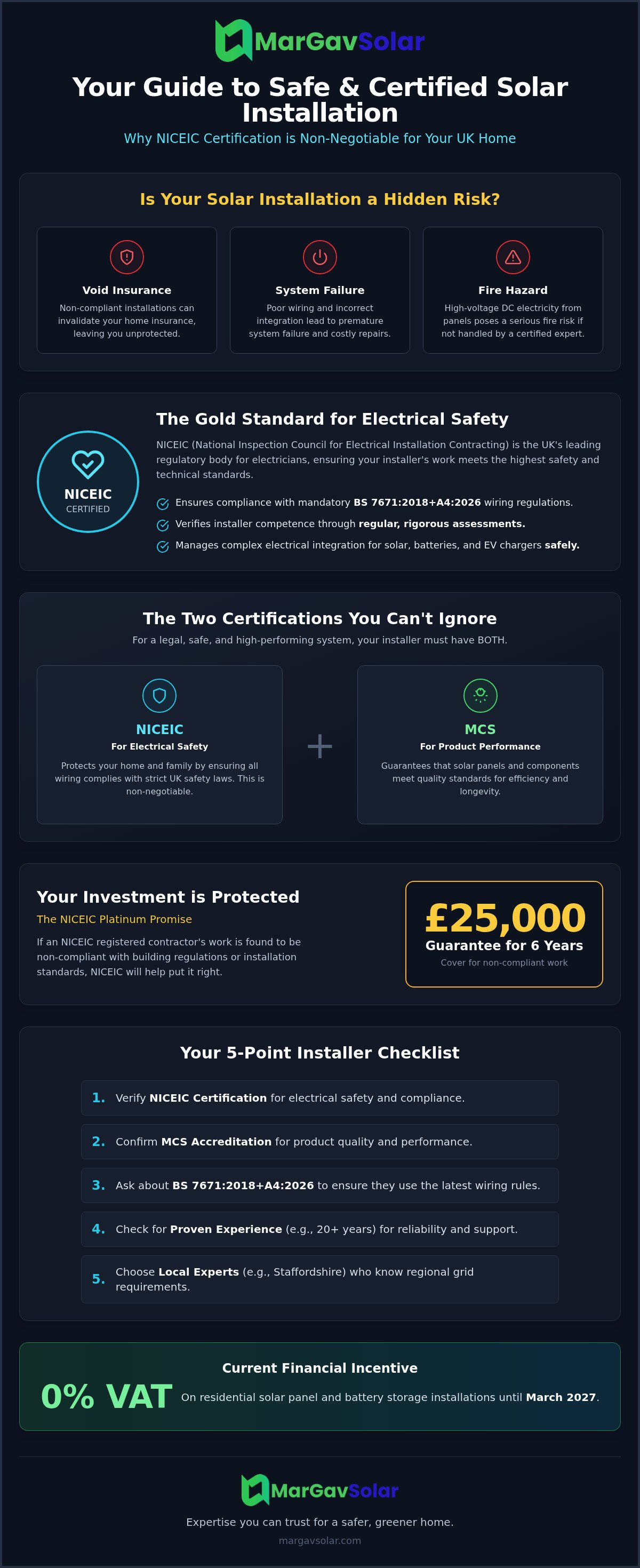
The Platinum Promise isn't just a marketing slogan; it's a legally binding safety net. If an NICEIC-registered contractor carries out work that falls short of the BS 7671:2018+A4:2026 standards, the council ensures it's put right. This guarantee covers up to £25,000 per installation. This is a critical factor when evaluating solar panel installer qualifications UK homeowners should prioritize. If your installer ceases trading, you aren't left with a faulty system and no recourse. NICEIC will find another registered contractor to fix the non-compliant work at no extra cost to you.
This protection lasts for six years from the date the work is completed. For solar systems designed to last 25 years or more, having a guaranteed safety net for the first six years provides essential stability during the system's most critical early phase. It protects your deposit and ensures that if the business fails before finishing the job, the council steps in to help resolve the situation. This is why the scheme is often referred to as the "ultimate consumer protection" in the electrical industry.
Financial Peace of Mind for Homeowners
Standard manufacturer warranties often only cover the hardware itself. The Platinum Promise bridges the gap by covering the installation labour. This is vital because even the best panels can fail if the wiring is shoddy. This level of protection also makes ongoing solar panel maintenance much simpler. You know the foundation of your system was installed to a verifiable standard, reducing the likelihood of expensive remedial repairs later. It offers a psychological layer of security that a simple handshake or an uncertified contractor can never provide.
Vetting the Experts: The NICEIC Assessment Process
Becoming an NICEIC Approved Contractor isn't a "set and forget" process. Installers undergo rigorous on-site technical assessments every year. An assessor visits a live job site to check that the contractor is using the correct testing equipment for solar strings and verifying DC voltages correctly. They audit the company's insurance, tools, and previous work records. This constant scrutiny ensures that when you choose a long-standing expert like MarGav Solar, you are hiring a team that has passed hundreds of these technical hurdles over their 20-year history. It guarantees that the person on your roof is current with every 2026 safety regulation.
Choosing an NICEIC-Certified Installer in Staffordshire
Finding the right solar panel installer qualifications UK residents need is especially important when dealing with local grid constraints. In Staffordshire, the transition to renewable energy requires more than just technical skill; it requires a deep understanding of how our local infrastructure handles new loads. Whether you're in the heart of Stoke-on-Trent or the historic streets of Lichfield, your installer must navigate specific regional requirements that uncertified or out-of-area contractors might overlook.
Local expertise matters because every house has a different relationship with the grid. A qualified professional doesn't just bolt panels to a roof; they evaluate your existing electrical capacity to ensure your new system won't cause issues for you or your neighbours. This is particularly relevant as more households move towards total electrification.
Staffordshire DNO Notifications (National Grid)
Every solar installation must be notified to the Distribution Network Operator (DNO). In our region, this is National Grid. For systems under 3.68kW per phase, a G98 notification is usually sufficient, but larger systems or those with significant battery storage often require a G99 application. NICEIC contractors are trusted by National Grid because they provide the certified documentation needed to prove the system won't destabilise the local network. This process is technical, but a qualified local team handles the paperwork to ensure your connection is fully legal and your export payments are secured.
Many Staffordshire homeowners are now looking to combine solar with EV charging points. This adds significant demand to your home’s electrical system. An NICEIC-certified installer ensures your consumer unit can handle these simultaneous loads safely. When your surveyor arrives, ask them: "Are you an NICEIC Approved Contractor?" and "Will you handle the G98/G99 notification for me?". You can always verify an installer's credentials directly on the NICEIC website to ensure their registration is active and covers the specific work you need.
The MarGav Solar Difference
With over 20 years of industry experience, MarGav Solar treats NICEIC accreditation as the foundation of our reputation. We handle all labour and hardware certifications as part of our fixed-price contracts, removing the stress of administrative hurdles for you. We also help homeowners integrate their safety-first installations with smart technology like GivEnergy Cloud for real-time monitoring. Choosing an expert with two decades of local history ensures you're not just getting a system that works today, but one that remains compliant and efficient for years to come.
Secure Your Home's Energy Future with Certified Expertise
Choosing the right solar system is a significant decision that impacts your home's safety and your family's finances for decades. We've explored how NICEIC accreditation serves as the essential safeguard against the unique electrical risks of high-voltage DC power. By prioritizing the correct solar panel installer qualifications UK homeowners can ensure their system complies with the 2026 BS 7671 wiring regulations while securing the £25,000 Platinum Promise protection. This dual-layered approach, combining electrical mastery with MCS performance standards, is the only way to guarantee a legal and efficient installation.
Don't leave your investment to chance with uncertified work that could void your insurance or fail your local DNO requirements. With over 20 years of Staffordshire expertise, MarGav Solar provides the technical depth and end-to-end support your project deserves. Our team handles every certification, from initial design to final grid notification, so you can focus on the benefits of lower bills and a smaller carbon footprint. It's time to build a sustainable future with absolute peace of mind.
Book a free, certified solar consultation with MarGav Solar today and take the first step toward a safer, greener home with an NICEIC Approved Contractor you can trust.
Frequently Asked Questions
Is NICEIC certification mandatory for solar panel installation?
NICEIC certification isn't strictly mandatory for a business to operate, but it's essential for self-certifying work under UK Building Regulations. Without an accredited installer, you'd have to pay for separate local authority inspections to prove your system is safe. Most reputable companies in Staffordshire use NICEIC to guarantee compliance with the latest 2026 wiring standards. It's the most reliable way to ensure your installation meets the high safety levels required for high-voltage DC systems.
What is the difference between NICEIC and MCS for solar?
NICEIC and MCS serve different but equally vital roles. NICEIC focuses on the electrical competence of the contractor, ensuring your home's wiring and grid connection are safe. MCS (Microgeneration Certification Scheme) specifically audits the quality and performance of the renewable energy hardware. For the best solar panel installer qualifications UK homeowners can find, look for a firm that holds both. This ensures your system is electrically sound and eligible for financial incentives.
How do I check if my solar installer is actually NICEIC registered?
You can verify any contractor's status by visiting the official NICEIC website and using their "Find a Contractor" search tool. Simply enter the company's name or their location in Staffordshire to see their current registration level. It's vital to check that they're listed as an "Approved Contractor" rather than just a "Domestic Installer" for complex renewable projects. Always ask for their registration number during your initial consultation to be certain of their credentials.
Will an NICEIC installer help with my Smart Export Guarantee (SEG) application?
Yes, a qualified installer provides the essential documentation needed for your SEG application. While NICEIC proves electrical safety, your energy supplier will specifically ask for an MCS certificate to prove the system's performance. MarGav Solar handles all necessary electrical certifications as part of their fixed-price contracts. This paperwork is the key to selling your excess energy back to the grid, so having a certified professional manage these notifications is a significant advantage.
Does the NICEIC Platinum Promise cover solar panel battery storage?
The NICEIC Platinum Promise covers all domestic electrical work carried out by a registered contractor, including the installation of battery storage solutions. If your battery system is found to be non-compliant with 2026 safety standards, the promise provides up to £25,000 to correct the work. This protection is valid for six years. It gives Staffordshire families peace of mind that their battery units are backed by a robust financial guarantee from a leading regulatory body.
What happens if my solar installer goes out of business but was NICEIC registered?
If your installer ceases trading, the NICEIC Platinum Promise acts as your safety net. This scheme protects consumers for up to six years after the work is completed. If you discover a fault that doesn't meet the BS 7671 electrical standards, NICEIC will commission and pay for another registered contractor to fix the issue. This protection is a primary reason to verify solar panel installer qualifications UK before signing any contract, as it prevents you from being left with a broken system.
Do I need a new electrical certificate if I upgrade my solar inverter?
Yes, an inverter upgrade is a significant modification to your electrical system and requires a new Electrical Installation Certificate. This ensures the new hardware integrates safely with your existing consumer unit and meets the mandatory 2026 regulations. In Staffordshire, MarGav Solar includes all necessary testing and certification as part of their inverter replacement services. This documentation is essential for maintaining your home insurance validity and ensuring your system continues to operate at peak efficiency.
Is NICEIC registration required for installing an EV charger with my solar?
While not the only scheme available, NICEIC registration is the industry standard for installing EV charging points. Charging an electric vehicle places a high, sustained load on your home's electrical supply, so the installation must be perfectly executed to avoid overheating. An NICEIC-certified professional will ensure your solar PV system and EV charger work together without overloading your consumer unit. They'll also handle the mandatory notifications to the local Distribution Network Operator for your Staffordshire property.


