

With commercial electricity rates in 2026 sitting roughly 70% higher than pre-2020 levels, your Staffordshire business is likely feeling the constant strain of volatile energy tariffs. It's frustrating to watch operational overheads climb while facing pressure to meet carbon reduction mandates. You've probably wondered if a commercial solar panel installation Staffordshire project is truly a viable financial move or just another source of installation downtime. The reality is that solar has evolved. It's now a critical financial asset, often offering annual ROIs as high as 45% for energy-intensive companies.
You'll discover how local firms are securing energy independence and 5-year paybacks through professional installations. We'll walk you through the 2026 tax landscape, including current Capital Allowance rates and the latest National Energy System Operator grid connection rules. This guide also explains how to maximize 25-year price security by pairing PV with battery storage and maintenance plans. By the end, you'll have a clear roadmap to lowering your overheads and enhancing your brand's reputation for sustainability without the guesswork.
Key Takeaways
- Learn how to leverage the "Full Expensing" Capital Allowance to deduct 100% of your solar investment costs from taxable profits.
- Understand the technical requirements for a commercial solar panel installation Staffordshire, including structural roof assessments and National Grid connection protocols.
- Discover how drone surveys and half-hourly energy data analysis ensure your system is perfectly sized for your business's specific load profile.
- Explore how fixed-price contracts and NICEIC-certified expertise protect your budget from hidden costs during the transition to renewable energy.
- See how your business can generate secondary revenue streams by selling surplus energy back to the grid through the Smart Export Guarantee.
The Strategic Case for Commercial Solar in Staffordshire
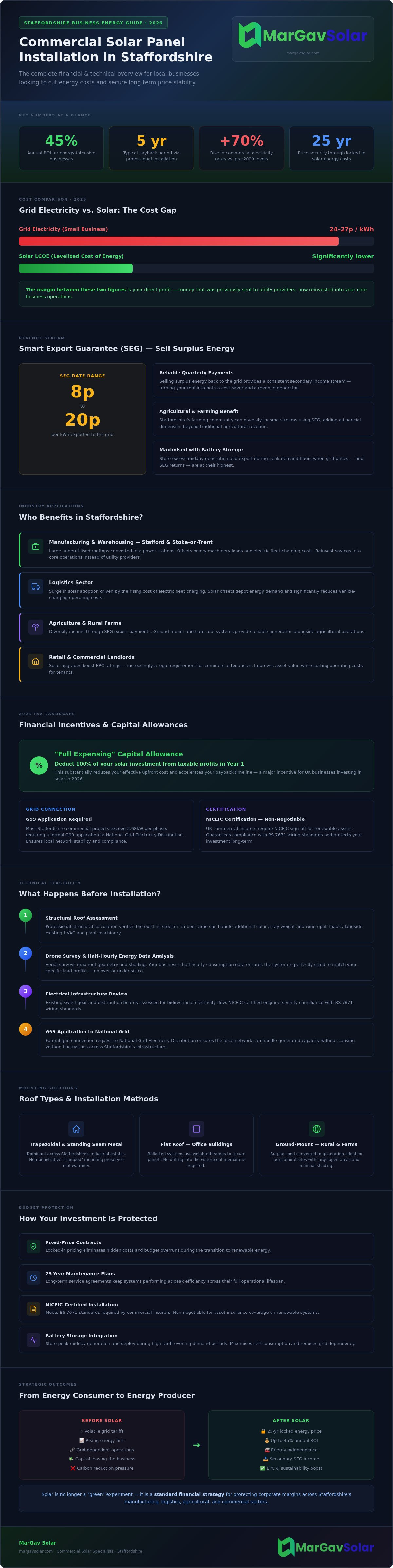
Commercial solar PV refers to high-capacity photovoltaic systems specifically designed to match the heavy daytime load profiles of businesses. Unlike residential setups, these installations are engineered to handle the intensive demands of machinery, server rooms, and climate control systems. As we move through 2026, the case for commercial solar panel installation Staffordshire has reached a financial tipping point. While grid electricity for small businesses remains high at roughly 24-27p per kWh, the levelized cost of solar energy (LCOE) has dropped significantly. This creates a massive margin for savings that directly impacts your bottom line.
The growth of Solar power in the United Kingdom has demonstrated that large-scale adoption is no longer a "green" experiment; it's a standard financial strategy for protecting corporate margins. For Staffordshire's manufacturing and logistics hubs, this shift empowers local firms to reinvest energy savings back into their core operations rather than sending it to utility providers. It's a move from being an energy consumer to becoming an energy producer.
Sector-Specific Benefits for Local Industries
Manufacturing and warehousing hubs in Stafford and Stoke-on-Trent are sitting on massive, underutilised assets: their roofs. Converting these into power stations turns a maintenance cost into a revenue generator. Staffordshire's logistics sector is seeing a surge in commercial solar panel installation Staffordshire projects as firms look to offset the rising costs of electric fleet charging. For the local farming community, solar provides a way to diversify income. With Smart Export Guarantee (SEG) rates currently between 8p and 20p per kWh, selling surplus energy back to the grid provides a reliable quarterly check. Additionally, retail and office landlords are using solar to boost EPC ratings, which is becoming a legal necessity for commercial tenancies.
Energy Security and Price Hedging
Energy security is about more than just bills; it's about price hedging. By locking in your energy costs for 25 years or more, you remove the risk of future global price spikes. Adding battery storage solutions allows your business to store excess midday generation and use it during peak Staffordshire demand hours when grid prices are at their highest. This move toward energy independence ensures that your operations aren't at the mercy of a volatile National Grid. It's a proactive way to stabilize your long-term financial forecasts and protect your business against the unpredictability of the energy market.
Technical Feasibility and Staffordshire Grid Constraints
Before a single panel is bolted down, your commercial premises must undergo a rigorous structural assessment. Commercial roofs carry significant dead loads from HVAC units and plant machinery; adding a solar array requires a professional calculation to ensure the existing steel or timber frame can handle the additional weight and wind uplift. For many businesses, commercial solar panel installation Staffordshire compliance also hinges on your electrical infrastructure. Your existing switchgear and distribution boards must be capable of handling the bidirectional flow of electricity. This is where NICEIC certification becomes non-negotiable. Most commercial insurers in the UK will not provide cover for renewable assets unless the installation is signed off by a certified professional, as this guarantees the work meets BS 7671 wiring standards.
Understanding the difference between G98 and G99 applications is equally vital. G98 is reserved for micro-generation systems under 3.68kW per phase, which rarely applies to business operations. Most Staffordshire commercial projects require a G99 application, which involves a formal request to National Grid Electricity Distribution to connect a larger system. This process ensures the local network can handle the capacity you intend to generate without causing voltage fluctuations.
Roof Types and Mounting Solutions
Staffordshire's industrial landscape is dominated by trapezoidal and standing seam metal roofs. These are ideal for solar because they allow for non-penetrative or "clamped" mounting systems that preserve the roof's weather-tight warranty. If your business operates out of a modern office building with a flat roof, ballasted systems are the standard choice. These use heavy weights to secure the panels in place, avoiding any drilling into the waterproof membrane. For rural businesses or farms with surplus land, ground-mount systems can be an effective alternative if roof space is limited or structurally unsuitable.
The Grid Connection Process
The grid connection process in Staffordshire is currently undergoing a significant shift. As of 2026, the National Energy System Operator (NESO) has moved away from a "first-come, first-served" model. The new framework prioritizes projects that are "ready to build," which helps bypass the long queues that previously stalled many commercial solar panel installation Staffordshire projects. Navigating these DNO (Distribution Network Operator) applications requires precise technical data, including your site's peak demand and expected export values. Managing these complexities is a core part of the consultancy service provided by MarGav Solar, ensuring that technical hurdles don't delay your ROI. We handle the liaison with the grid operators to secure your connection offer as efficiently as possible under the new 2026 guidelines.
Financial Incentives and ROI Analysis for 2026
The 2026 tax landscape has made the financial case for a commercial solar panel installation Staffordshire stronger than ever. Under the current Annual Investment Allowance (AIA) rules, businesses can deduct 100% of the cost of their solar installation, up to a £1,000,000 limit, from their taxable profits in the year of purchase. For a company paying the 25% corporation tax rate, this effectively reduces the net cost of a £100,000 system to £75,000. It's a powerful upfront incentive that turns a capital-heavy project into an immediate tax-saving strategy. These rules are currently verified through March 31, 2026, making this a critical window for procurement.
Tax Efficiency and Capital Allowances
HMRC continues to support renewable transitions by offering specific exemptions that protect your bottom line. Beyond the AIA, the UK government provides a business rates exemption for solar panels installed on non-domestic buildings. This ensures that your green investment doesn't lead to an unwelcome hike in annual property taxes. In 2026, the "Full Expensing" capital allowance acts as the permanent successor to the Super Deduction, allowing businesses to offset the total cost of solar PV equipment against their taxable profits without a cap. This level of tax efficiency is designed to move solar from a CSR goal to a core financial priority.
Projected Savings and Cash Flow Impact
The immediate impact on cash flow is driven by the widening gap between grid prices and the cost of self-generation. With small businesses in Staffordshire paying roughly 24-27p per kWh for grid electricity, every unit of solar power consumed on-site represents a significant saving. If your system produces more than you need, the Smart Export Guarantee (SEG) allows you to sell that surplus back to the grid. Typical 2026 SEG rates range from 8p to 20p per kWh, depending on your energy supplier. This creates a secondary revenue stream that shortens your payback period.
Most commercial systems in the region now see a payback period of 4 to 8 years. For energy-intensive industries like manufacturing, this can drop as low as 3 years. To maintain these returns over a 25-year lifespan, planning for inverter upgrades between years 10 and 15 is essential. This proactive maintenance ensures the system continues to convert DC power at peak efficiency. If your business prefers to preserve capital, options like Asset Finance or Power Purchase Agreements (PPAs) allow for installation with minimal upfront costs, often resulting in immediate monthly savings that outweigh the finance repayments.
The transition to renewable energy shouldn't grind your operations to a halt. A professional commercial solar panel installation Staffordshire project begins with a non-intrusive site audit. We use drone surveys and thermal imaging to map your roof's condition and shading patterns without requiring staff to work at height during the initial phase. This data, combined with your site's half-hourly (HH) energy consumption figures, allows for a custom system design that matches your generation peak with your highest demand periods. It ensures your system isn't just large, but correctly sized for your specific load profile.
Project management is where business continuity is won or lost. Our teams coordinate directly with your facility managers to schedule heavy lifting or electrical work during off-peak hours or planned maintenance windows. This precise coordination ensures that while your infrastructure is being upgraded, your production lines and office functions remain active. Once the physical install is complete, we move to commissioning. This involves rigorous final testing and the issuance of MCS and NICEIC certification, which are vital for your insurance and grid connection compliance. It's the final step in turning a construction site back into a high-performing power plant.
Health, Safety, and Compliance
Industrial environments demand a higher standard of safety. We develop site-specific Risk Assessments and Method Statements (RAMS) that account for your unique operational hazards, such as moving machinery or chemical storage. Whether it's managing scaffolding in busy loading bays or installing edge protection on high-reach warehouses, safety is integrated into every workflow. After the panels are live, we set up a digital energy management dashboard. This tool allows you to track real-time generation and savings, giving your finance team immediate visibility into the system's performance and impact on overheads.
Long-Term Performance and Care
Securing a 5-year ROI depends on the system performing at its nameplate capacity year after year. Environmental factors in Staffordshire, such as agricultural dust or bird nesting in rural areas, can significantly degrade output if left unmanaged. Investing in professional solar maintenance ensures that debris and technical faults are caught before they impact your yield. Annual electrical inspections are also a requirement for maintaining equipment warranties and ensuring the long-term safety of the installation. Regular care is the simplest way to protect the 25-year lifespan of your investment.
Ready to see how solar fits into your facility? Contact MarGav Solar for a detailed site assessment and start your journey toward energy independence today.
Why Staffordshire Businesses Choose MarGav Solar
Selecting the right partner for your commercial solar panel installation Staffordshire project is about more than just finding a contractor; it's about establishing a 25-year partnership. MarGav Solar brings over 20 years of industry expertise to every project, providing a deep understanding of local Staffordshire solar installation requirements. We don't just install hardware. We act as a consultancy partner, ensuring your system is designed to meet the specific energy demands and structural constraints of your commercial premises.
One of the primary concerns for finance departments is budget creep. We address this directly through fixed-price installation contracts. Once we've completed your site audit and design, the price we quote is the price you pay, with no hidden costs or surprise variations. This transparency is backed by our NICEIC-certified excellence. Every electrical component is installed to the highest commercial safety standards, ensuring full compliance with your business insurance and building regulations. Our support is truly end-to-end, managing everything from the initial DNO grid applications to long-term maintenance and repair services.
Our Local Commitment to Staffordshire
We're proud to support the business community across the region, from the manufacturing hubs in Stoke and Stafford to the commercial centres of Cannock and the rural Moorlands. Being local isn't just a badge; it's a practical advantage for our clients. It means we can offer quick response times for maintenance calls and annual inspections, ensuring your system's downtime is kept to an absolute minimum. We're invested in helping Staffordshire's logistics, agricultural, and retail sectors transition to Net Zero, strengthening the local economy through sustainable energy practices.
Ready to Future-Proof Your Business?
The transition to renewable energy begins with a clear understanding of your current consumption. Our team can conduct a comprehensive commercial energy audit to identify exactly where solar can provide the most value. For many firms, integrating solar battery storage is the final piece of the puzzle, allowing you to capture midday generation for use during expensive peak hours. This holistic approach ensures you aren't just generating power, but managing it for maximum efficiency and ROI. If you're ready to secure your energy future and lower your operational overheads, contact MarGav Solar for your Staffordshire commercial survey today.
Securing Your Staffordshire Energy Future
The financial landscape for 2026 makes it clear that delaying your transition to renewable energy is a missed opportunity for your bottom line. By leveraging the current Annual Investment Allowance and the move toward grid connection modernization, your business can turn a commercial solar panel installation Staffordshire into a high-yield asset. You've seen how professional system design and NICEIC-certified electrical work protect your operational continuity while securing energy price stability for the next 25 years.
Choosing a partner with 20+ years of industry expertise ensures your project is handled with local knowledge and technical precision. As local Staffordshire experts, we understand the specific grid requirements and sector needs that drive successful commercial outcomes. It's time to stop reacting to energy market volatility and start generating your own predictable, sustainable power.
Take the first step toward long-term energy independence. Book Your Free Staffordshire Commercial Solar Audit with our NICEIC Certified team today. We're here to help your business thrive in a greener economy.
Frequently Asked Questions
Do I need planning permission for commercial solar panels in Staffordshire?
Most commercial solar panel installation Staffordshire projects fall under Permitted Development rights. The previous 1MW limit for industrial rooftops has been removed, allowing larger systems without full planning permission. However, you should still check with your local council if your premises are in a conservation area or a listed building. We recommend obtaining a Lawful Development Certificate to provide permanent proof that your installation complied with regulations at the time of construction.
How long does a commercial solar installation typically take?
A typical mid-sized commercial installation takes between one and three weeks for the physical build on-site. The total timeline is longer because it includes the initial site audit, structural calculations, and the DNO application process. We coordinate work around your operational hours to ensure your business stays productive. Large-scale industrial projects may require more time for scaffolding and complex electrical integration into your existing distribution boards to ensure a safe handover.
What is the average ROI for a Staffordshire business installing solar in 2026?
Staffordshire businesses can expect an annual ROI between 14% and 45% depending on their specific energy profile. With grid prices remaining high in 2026, the payback period for most systems ranges from 4 to 8 years. For energy-intensive manufacturing firms, this can be even shorter. When you factor in the "Full Expensing" tax allowance, the immediate financial impact on your company's balance sheet is often more favourable than traditional capital investments.
Can I install solar panels on a leased commercial property?
You can install solar on leased premises, but you'll need a formal "License for Alterations" from your landlord. Many landlords in Staffordshire are now open to "green leases" because solar improves the building's EPC rating and increases property value. It's often possible to negotiate a deal where the tenant benefits from lower electricity bills while the landlord sees an asset upgrade. We can provide the technical documentation required to support these landlord discussions.
What happens to my solar production on cloudy Staffordshire days?
Solar panels generate electricity using daylight rather than direct heat, so they still produce power on typical overcast Staffordshire days. While peak output happens during clear weather, modern high-efficiency panels are designed to capture a broad spectrum of light. To maximize your energy independence during darker periods, we recommend integrating battery storage. This allows your business to use energy generated during the day to power security lighting or server rooms overnight.
How much roof space is required for a 50kW commercial solar system?
A 50kW system generally requires approximately 250 to 300 square meters of usable roof space. This can vary based on the efficiency of the panels and the orientation of your roof. During our initial site audit, we use drone mapping to measure your available area accurately while accounting for shading from vents, skylights, or neighbouring buildings. If your roof space is insufficient, we can also explore ground-mount options for rural Staffordshire business sites.
What is a G99 application and why does my business need one?
A G99 application is a mandatory technical request sent to the Distribution Network Operator to connect any system larger than 3.68kW per phase. For a commercial solar panel installation Staffordshire, this process ensures the local grid can safely handle the power your system generates. MarGav Solar manages this entire consultancy process for you. We liaise with National Grid Electricity Distribution to secure your connection offer and manage any necessary export limitations under the 2026 framework.
Will solar panels affect my business insurance premiums?
Installing solar panels is a material change that you must disclose to your business insurance provider. While it increases the total value of your building assets, it shouldn't significantly hike your premiums if the work is NICEIC certified. Insurers prioritise safety, so using an established installer with over 20 years of experience helps demonstrate that the system meets all electrical standards. In some cases, improved energy security can even be viewed as a positive risk-reduction factor.


