

Did you know that a modern solar installation can now slash your household electricity costs by more than 70%? Many homeowners across the West Midlands are asking how much can solar panels save on bills Staffordshire as energy prices settle at an average of £1,641 per year in mid-2026. You've likely felt the sting of electricity rates at 24.67p per kWh and felt frustrated by confusing export rates that don't seem to reward your investment. It's a common concern, but the financial landscape has shifted in favor of local residents who embrace smart technology.
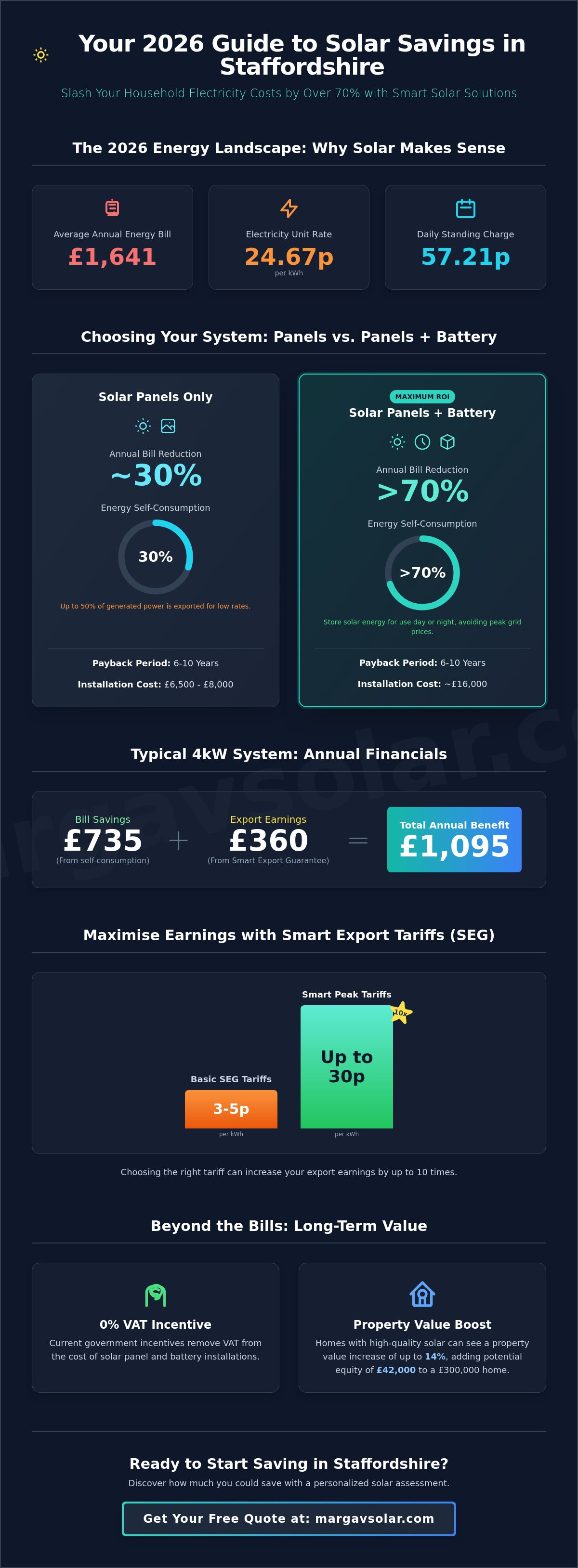
I'll show you exactly how to maximize your ROI by combining high-efficiency panels with battery storage to tap into peak export tariffs paying up to 30p per kWh. You'll discover how a standard 4kW system can generate £735 in annual bill savings while earning an extra £360 through the Smart Export Guarantee. This guide previews the 2026 energy forecast, breaks down the current 0% VAT incentive, and explains why a 6 to 10 year payback period is now the standard for Staffordshire homes.
Key Takeaways
- Learn why 2026 is a pivotal year for Staffordshire solar adoption as average annual energy bills remain high at £1,641.
- Find out exactly how much can solar panels save on bills Staffordshire with a detailed breakdown of the 6 to 10 year payback period for 4kW systems.
- Compare the financial performance of solar-only setups against battery storage solutions to prevent wasting up to 50% of your generated power.
- Master the 2026 Smart Export Guarantee (SEG) landscape to find tariffs that pay premium rates for your surplus energy.
- Understand how local Staffordshire topography and sunshine hours affect your specific ROI from Cannock Chase to the Trent Valley.
The Financial Reality of Solar Energy in Staffordshire (2026)
Energy markets have shifted significantly since the volatile years of the early 2020s. As of May 2026, Staffordshire residents are facing average electricity unit rates of 24.67p per kWh. While these prices have stabilized compared to previous peaks, they remain high enough to make solar adoption a primary financial strategy for West Midlands households. Understanding how much can solar panels save on bills Staffordshire requires looking beyond simple monthly reductions. It's about calculating a Return on Investment (ROI) that accounts for the 0% VAT on installations and the rising value of energy independence.
The year 2026 is a pivotal moment for Solar power in the United Kingdom. With installation costs for a 4kW system now ranging between £6,500 and £8,000, the entry point is more accessible than a decade ago. Your financial return comes from two distinct streams. First, there are direct savings from "avoided costs," which is energy you generate and use rather than buying it from the grid. Second, there are earnings from the Smart Export Guarantee (SEG). While basic export rates sit around 3-5p per kWh, smart homeowners in areas like Stafford or Lichfield are now accessing premium tariffs that pay up to 30p per kWh during peak demand.
Understanding Your Electricity Bill Reductions
Your bill consists of a standing charge, currently around 57.21p per day, and your usage rate. Solar panels primarily target the usage rate. By generating your own power, you're effectively "locking in" a low energy price for the next 25 years. In 2026, the self-consumption ratio for a typical Staffordshire home represents the percentage of solar energy used directly on-site compared to the total generated, typically ranging from 30% for standard setups to over 70% with battery integration. This ratio is the biggest factor in determining your final bill. The more you use at home, the less you buy at 24.67p per unit.
The Property Value Boost in the West Midlands
The financial benefits aren't limited to your monthly bank statement. Regional studies across the West Midlands show that homes with high-quality solar installations and "A" or "B" rated Energy Performance Certificates (EPCs) can see a property value increase of up to 14%. For a £300,000 semi-detached home in Tamworth or Cannock, that's a potential equity gain of £42,000. This long-term asset growth often outweighs the initial installation cost long before the 6 to 10 year bill-saving payback period is reached. Buyers in 2026 now view solar panels as an essential feature rather than a luxury add-on.
Comparing Systems: Solar Panels vs. Solar + Battery Storage
When determining how much can solar panels save on bills Staffordshire homeowners often face a choice between a traditional panel-only setup or a system with integrated storage. In 2026, the financial difference between these two paths is stark. A panel-only system for a typical three-bedroom house costs between £6,500 and £8,000. While this is a lower entry price, you're essentially tethered to the sun's schedule. Without a way to store that power, most households export 50% or more of their generation back to the grid during the day when the house is empty. Selling power for 5p per unit only to buy it back at 24.67p in the evening creates a missed opportunity for significant savings.
A cost-benefit analysis by Carbon Brief suggests that maximizing on-site usage is the most effective way to protect against price volatility. This is where battery storage becomes the primary driver of ROI. By adding an 8kWh battery, the total installation cost rises to approximately £16,000, but the bill reduction potential jumps from 30% to over 70%. You're no longer just a passive generator; you're an active energy manager who can avoid the most expensive peak-time rates.
The ROI of "Panel Only" Installations
Panel-only installations remain a viable choice for a specific demographic in Staffordshire. If you work from home in Stafford or run a home business in Lichfield, your daytime energy demand naturally aligns with solar production. You can run high-draw appliances like washing machines and dishwashers during peak sunlight hours. For these users, a standard 4kWp system offers a stable 6 to 10 year payback period. However, the limitation of a grid-tie system without storage is that you're still 100% dependent on the National Grid once the sun sets.
The Financial Power of Battery Storage
Batteries are the game changer for 2026 energy independence. They allow you to shift your self-consumption from a meager 30% to a massive 80% or more. High-end local solutions, such as GivEnergy systems, enable you to store excess solar energy for evening use and even "top up" the battery using cheap off-peak night rates from the grid. This synergy between solar and storage ensures you're always using the cheapest possible unit of electricity. If you want to dive deeper into the technical specs, our guide to solar battery storage explains the hardware in detail. To see how these components fit your specific roof, you might consider booking a professional solar panel maintenance check to evaluate your current setup's potential.
Regional Factors: Why Staffordshire Geography Affects Your Savings
Geography determines your energy harvest. While the South Coast of England often gets the most attention for solar potential, Staffordshire holds a strong middle ground with an average of 1,450 sunshine hours per year. This is slightly above the UK national average of 1,403 hours, meaning local systems often outperform national estimates. When calculating how much can solar panels save on bills Staffordshire homeowners must consider their specific micro-climate. For example, homes in the higher elevations of Cannock Chase may experience more frequent cloud cover but benefit from cooler air temperatures that keep panels running at peak efficiency. In contrast, the Trent Valley offers wider horizons with less hill-shading, though early morning mist can occasionally delay the start of generation.
Local air quality also plays a role. In areas with higher particulate matter, such as industrial zones near Stoke-on-Trent, panels can see a 5% to 8% drop in efficiency if not kept clean. This makes regular solar panel maintenance essential for protecting your ROI. Even the tilt of your roof matters. While a 35-degree south-facing roof is the gold standard, homes in North Staffordshire often benefit from slightly steeper pitches to capture the lower winter sun compared to properties in the south of the county.
Roof Orientation and Pitch in Local Architecture
Staffordshire's architectural heritage presents unique opportunities. The long rows of Victorian terraces in towns like Stafford and Newcastle-under-Lyme often feature narrow but steep roofs. While a single south-facing bank is ideal, 2026 trends show a rise in East-West splits. These configurations are becoming more popular because they spread power generation across the day. An East-West system captures the morning sun for breakfast and the evening sun for dinner, aligning perfectly with the typical family's peak energy usage. This reduces the need to draw expensive power from the grid during those high-cost periods.
Climate Resilience and Seasonal Savings
Modern solar technology has evolved to handle the UK's famously grey skies. In 2026, many Staffordshire installations now utilize bifacial panels. These panels have glass on both sides, allowing them to capture "albedo" or reflected light from the roof surface behind the panel. This is particularly effective during our overcast winters when light is diffused rather than direct. Solar PV cells operate more efficiently at lower temperatures, making a crisp, sunny February morning in Leek more productive than a sweltering July afternoon in Birmingham. This temperature-dependent efficiency ensures that your system continues to provide substantial bill reductions even outside the height of summer.
Maximising ROI: Smart Tariffs, SEG, and Incentives
The Smart Export Guarantee (SEG) is no longer a small bonus; it's a core pillar of your financial strategy. In 2026, while basic fixed rates hover around 3p to 5p per kWh, smart tariffs are transforming how much can solar panels save on bills Staffordshire. If you have battery storage, you can export electricity during peak hours, typically 4 pm to 7 pm, when the grid is under pressure. Some advanced tariffs, such as Octopus Flux, offer peak export rates exceeding 30p per kWh. This means you could potentially earn more per unit by selling your stored solar energy than it costs to buy grid power during off-peak windows.
To access these lucrative deals, your system must be installed by a certified professional. Grid-tie approval from the National Grid depends on having the correct paperwork, including NICEIC certification and MCS registration. Without these, you won't be able to register for SEG payments or legal grid export. Fortunately, the UK government has maintained the 0% VAT rate on residential solar and battery installations through 2026. This keeps your upfront costs between £6,500 and £8,000 for a standard 4kW system, significantly accelerating your path to pure profit.
Smart Tariffs and Grid Trading
The real profit in 2026 lies in automation. Using platforms like GivEnergy Cloud, your system can automatically decide when to charge from the sun, when to hold energy for your own use, and when to sell it back to the grid for the highest price. This "grid trading" can shorten your payback period by several years. If you own an electric vehicle, integrating an EV charging point allows you to divert excess solar directly into your car. This effectively "fuels" your commute for free and avoids the standard 24.67p per kWh grid rate.
Maintenance and Long-Term Costs
Solar is a low-maintenance technology, but it isn't "set and forget." To keep your system performing at the levels discussed in earlier sections, you should budget for professional cleaning every 18 months. Dust and traffic film from Staffordshire’s A-roads can reduce light absorption by up to 10%. You'll also need to plan for inverter upgrades around the 10 to 12 year mark. The inverter works harder than any other component, and a modern replacement can often improve your overall system yield by 5% or more. If you're ready to see how these savings apply to your specific roof, you can request a custom solar quote today.
Conclusion: Is Solar Worth It for You in 2026?
The numbers for 2026 make a compelling case for renewable energy. For a typical three-bedroom semi-detached home in the West Midlands, the financial benefit is clear. By combining a 4kW system with smart battery storage, you can expect to retain over £1,000 annually that would otherwise go to your energy supplier. When analyzing how much can solar panels save on bills Staffordshire, it's vital to look at the "cost of inaction." Every year you delay your installation, you're essentially choosing to pay the full 24.67p per kWh rate while missing out on up to £360 in potential export earnings. Over a decade, that's a £10,000 difference in your household budget.
Staffordshire's specific conditions, from the sunshine hours in the Trent Valley to the unique architecture of our market towns, require a tailored approach. Relying on national averages can lead to underperforming systems. Instead, focus on these five steps to secure your ROI:
- Verify your roof's structural integrity and orientation.
- Review your 2025-2026 energy usage patterns to size your battery storage.
- Confirm your installer holds NICEIC and MCS certifications for grid-tie approval.
- Select an agile tariff to maximize your Smart Export Guarantee returns.
- Schedule a professional local site survey for a fixed-price quote.
Customising Your Solution
Standardized kits or generic national installers often overlook the nuances that drive efficiency. A professional local survey accounts for specific shading issues from nearby trees or neighboring buildings, which is critical for accurate ROI forecasting. We ensure that your residential solar PV system is paired with the right inverter and battery capacity to meet your specific evening demands. This bespoke approach is what allows how much can solar panels save on bills Staffordshire to reach its maximum potential of 70% or more in total bill reductions.
Contact MarGav Solar Today
MarGav Solar brings 20 years of local expertise to every project. We understand the Staffordshire landscape and the technical requirements for a successful, long-term installation. From the initial design of your solar array to EV charging points and ongoing maintenance, we provide end-to-end support. Our team handles the complexities of grid-tie approval and certification so you can focus on the savings. Don't leave your energy future to chance. Contact MarGav Solar today for a comprehensive consultancy session and take the first step toward a fixed-price, high-ROI solar solution.
Secure Your Energy Future Today
The path to energy independence is clearer than ever. You now understand how much can solar panels save on bills Staffordshire when you pair high-efficiency panels with intelligent battery storage. By moving away from standard grid reliance, you're protecting your household budget from 24.67p per kWh rates and positioning yourself to profit from peak-time exports. The combination of 0% VAT and maturing smart tariffs makes 2026 the ideal time to upgrade your home.
At MarGav Solar, we provide the technical precision needed to maximize these returns. With over 20 years of local installation expertise, our NICEIC and MCS certified professionals are specialists in GivEnergy battery integration. We don't just install hardware; we design long-term financial solutions that stand the test of time. Your journey toward lower bills and a smaller carbon footprint starts with a single conversation.
Get a Fixed-Price Solar Quote for Your Staffordshire Home today. We look forward to helping you take control of your energy costs.
Frequently Asked Questions
How much can I realistically save on my electricity bill in Staffordshire?
You can realistically reduce your electricity costs by 70% or more when combining panels with a battery storage system. For a standard 3-bed home, this translates to over £1,000 in annual savings based on 2026 price cap rates. When calculating how much can solar panels save on bills Staffordshire residents should factor in both the avoided cost of grid power and the income from selling surplus energy back to the National Grid.
Do solar panels work on cloudy days in the West Midlands?
Yes, solar panels generate electricity using daylight rather than direct heat from the sun. Even on overcast days in the West Midlands, modern photovoltaic cells capture diffuse light to power your home. While output is lower than on a bright July afternoon, the consistent light levels in Staffordshire ensure your system contributes to your energy needs throughout the winter months.
What is the average payback period for solar panels in 2026?
The average payback period for a standard 4kW system in 2026 is between 6 and 10 years. This timeframe has shortened due to the ongoing 0% VAT incentive and the widening gap between grid electricity prices and solar generation costs. Once your system has paid for itself, the electricity it generates is essentially free for the remainder of the panels' 25-year lifespan.
Can I sell my excess electricity back to the grid in Staffordshire?
You can absolutely sell your surplus electricity through the Smart Export Guarantee (SEG) scheme. All major UK energy suppliers are legally required to pay you for the renewable energy you export. In 2026, savvy homeowners are using battery storage to hold their energy and export it during evening peak windows when certain tariffs pay up to 30p per kWh.
Does solar energy increase my property value in the local area?
Solar installations can increase the value of a West Midlands property by up to 14%. Buyers in 2026 prioritize energy-efficient homes with "A" or "B" rated EPCs to avoid future price volatility. A professionally installed system is viewed as a long-term asset that reduces the cost of living, making your home more attractive in the local Staffordshire housing market.
Do I need planning permission for solar panels in Staffordshire?
Most solar installations fall under "Permitted Development" and don't require formal planning permission. However, you must consult your local council if you live in a listed building or a designated conservation area, such as parts of Lichfield or Stafford. The panels must also be installed in a way that minimizes their effect on the external appearance of the building.
How long do solar panels and batteries last before needing replacement?
High-quality solar panels are designed to last between 25 and 30 years with minimal maintenance. While the panels themselves are incredibly durable, you should plan for an inverter replacement around the 10 to 12 year mark. Modern lithium-ion batteries typically come with 10-year warranties and are expected to maintain high performance for 15 years before their capacity begins to decline.
Is Staffordshire sunny enough to make battery storage worthwhile?
Staffordshire receives approximately 1,450 hours of sunshine annually, which is more than enough to make battery storage a high-ROI investment. Batteries don't just rely on the sun; they allow you to take advantage of smart "time-of-use" tariffs. By storing cheap off-peak electricity from the grid at night, you can power your home during the day even if the weather is particularly gloomy. This dual-use strategy is a key factor in how much can solar panels save on bills Staffordshire.


