
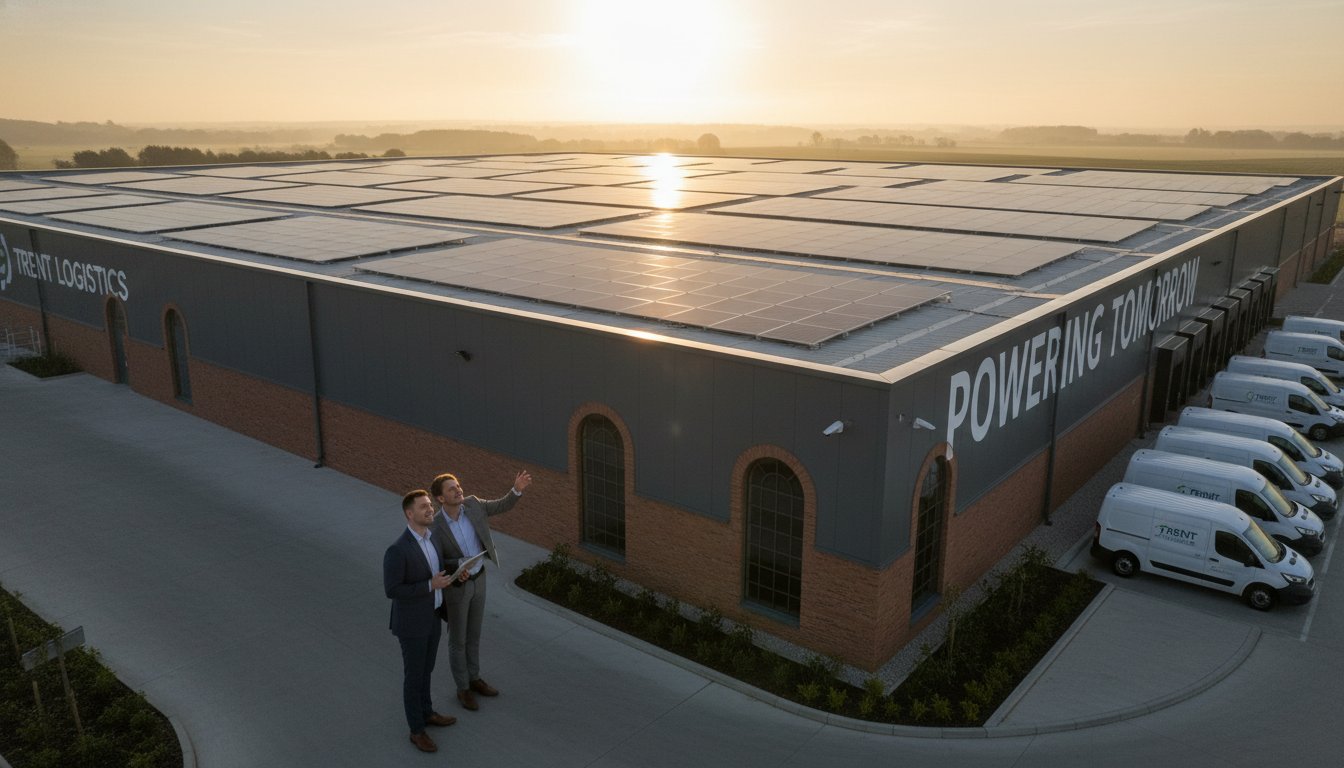
Did you know that a typical installation of commercial solar panels Burton upon Trent now pays for itself in as little as four to seven years? While electricity rates have remained unpredictable since 2021, local businesses are finding that their rooftops are the key to long term budget certainty. You've likely felt the pressure of rising operational costs and the increasing demand for high carbon footprint reporting. It's a challenging environment where energy security often feels like a moving target.
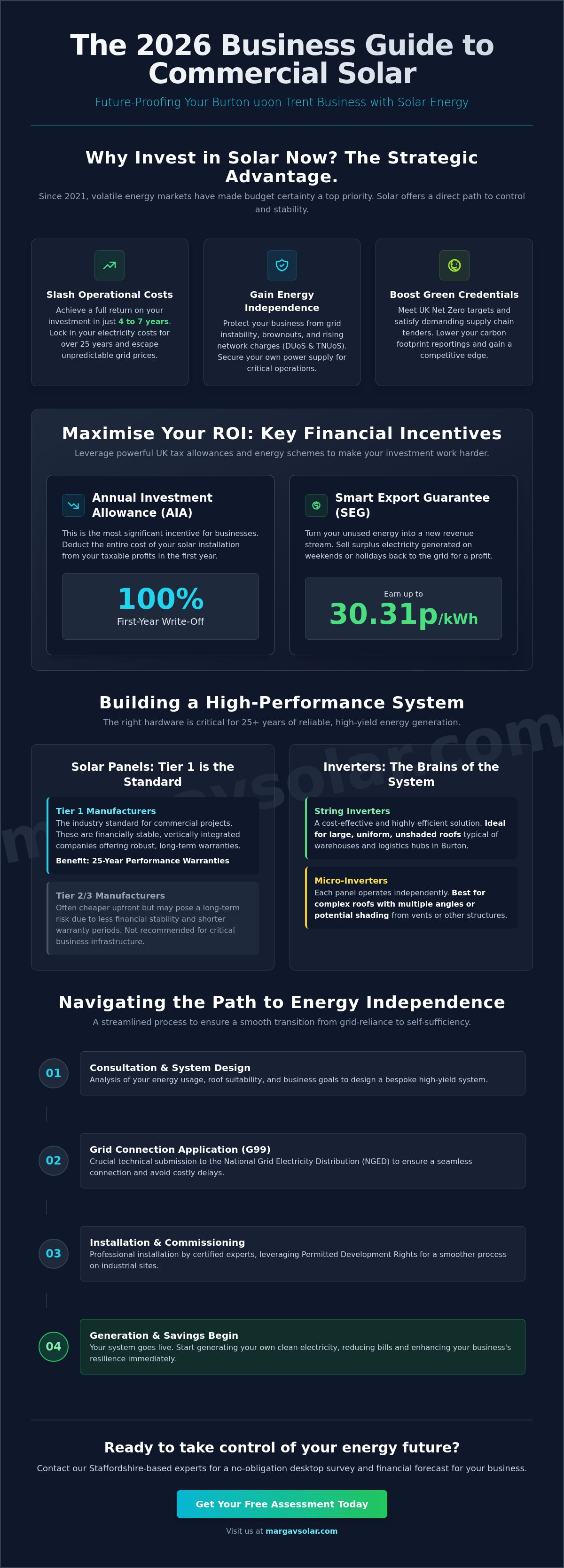
This 2026 guide helps you reclaim control by explaining how to slash your electricity bills and enhance your green credentials for future tenders. We'll explore the 100% Annual Investment Allowance that lets you deduct the full cost of your system from taxable profits, and the latest Smart Export Guarantee rates which can reach 30.31p/kWh. You'll also find clear details on managing G99 applications with National Grid Electricity Distribution and why current Permitted Development Rights make the transition smoother than ever for the region's industrial and logistics hubs.
Key Takeaways
- Learn how to write off 100% of your installation costs in the first year by leveraging the Annual Investment Allowance and current Capital Allowances.
- Identify why high-efficiency Tier 1 equipment is the standard for commercial solar panels Burton upon Trent to ensure 25-year performance warranties.
- Understand the technical requirements for G99 applications to National Grid Electricity Distribution to avoid common grid connection delays.
- Compare string inverters and micro-inverters to determine which technology best suits your facility's specific roof layout and energy demand.
- Discover how fixed-price contracts and local Staffordshire expertise can eliminate hidden costs during your business's transition to energy independence.
Future-Proofing Your Business: Why Burton upon Trent Companies Are Investing in Solar in 2026
Commercial energy tariffs in East Staffordshire have faced significant volatility since 2021, leaving many local firms struggling with unpredictable overheads. By May 2026, electricity rates for industrial units have remained high, making energy the second largest operational cost for many. This economic pressure has transformed the perception of renewable energy. It's no longer just a "green" initiative; it's a core strategic asset. Installing commercial solar panels Burton upon Trent allows a business to lock in a fixed cost for electricity for over 25 years, providing a powerful hedge against grid instability.
Burton's unique economic landscape makes it a prime location for high-yield solar. The town's heavy concentration of logistics hubs and manufacturing facilities offers vast, unshaded roof spaces that are perfect for large-scale arrays. These businesses often operate during daylight hours, which aligns perfectly with peak solar generation. Understanding how solar panels work is essential here, as modern systems now use high-output monocrystalline panels rated between 500W and 600W. This technology ensures that even on typical overcast Midlands days, your facility continues to generate significant power.
Aligning with UK Net Zero targets is also a practical requirement for modern tenders. Many supply chain contracts now demand proof of carbon reduction. By generating your own power, you meet these high carbon footprint reporting requirements while simultaneously lowering your operational costs.
The Economic Case for Solar in the Midlands
There is a common myth that the Midlands is too grey for solar, but the data tells a different story. Modern commercial solar panels Burton upon Trent are highly efficient at capturing diffuse light. With the permanent £1 million Annual Investment Allowance, businesses can deduct 100% of the installation cost from their taxable profits in the first year. For a typical 50kW system in 2026, the average payback period in the Burton area is between 4 and 7 years.
Energy Security and Grid Independence
Relying solely on the National Grid is becoming a risky strategy for energy intensive businesses. Grid constraints in East Staffordshire can lead to unexpected brownouts or limits on expanding your operations. Solar gives you a level of grid independence that protects your production lines. It also shields you from rising Distribution Use of System (DUoS) and Transmission Network Use of System (TNUoS) charges that are often applied during peak industrial hours. By using your own generated power, you don't have to worry about these hidden costs impacting your bottom line.
Choosing the Right Commercial Solar System: A Buyer’s Framework for Staffordshire Businesses
Selecting the right hardware for your facility is about balancing long term durability with peak performance. For high-yield installations of commercial solar panels Burton upon Trent, Tier 1 manufacturers are the industry standard. These companies are vertically integrated and financially stable, providing 25-year performance warranties that protect your capital. While Tier 2 panels might seem cheaper upfront, they often lack the long term reliability required for industrial environments where downtime equals lost revenue.
The heart of your system is the inverter technology. For large, uniform warehouse roofs in the East Midlands, string inverters offer a cost-effective solution with high efficiency. However, if your roof has complex angles or potential shading from ventilation units, micro-inverters allow each panel to operate independently. This prevents a single shaded panel from dragging down the entire string's output. To keep these components running at peak efficiency, scheduling regular solar panel maintenance is essential to prevent debris buildup from reducing your 2026 generation targets.
The "Energy Hub" Approach: Solar, Storage, and EV
Forward-thinking Burton businesses are moving beyond simple "panel-only" setups. By creating a unified energy hub, you can maximise every kilowatt generated. Integrating solar battery storage allows your business to capture energy generated during weekend downtime or sunny afternoons for use during expensive peak hours. This stored energy can also power on-site EV charging points, offering a massive incentive for staff and reducing your company's fleet fuel costs. Any surplus that your battery cannot hold can be sold back to the grid via the Smart Export Guarantee (SEG). Managing this complex ecosystem is simplified through platforms like GivEnergy Cloud, which provides real-time data on your consumption and savings.
Scalability and System Design
Design your system for where your business will be in five years, not just where it is today. If your 2026 roadmap includes electrifying your delivery fleet, your initial system capacity should account for that increased load. Structural integrity is also a critical factor. Most Burton warehouses use trapezoidal or standing seam metal roofs, which are ideal for solar, but older brick-and-mortar facilities require a detailed structural survey. A typical commercial array adds between 15kg and 20kg of weight per square metre. Ensuring your roof can handle this load is a non-negotiable first step. If you're ready to see how a custom design fits your facility, you can request a technical site survey from our local team.
Calculating ROI and Financial Incentives for Commercial Solar in East Staffordshire
The financial landscape for commercial solar panels Burton upon Trent has shifted from speculative to highly secure. By May 2026, the combination of high energy prices and aggressive tax incentives has made solar one of the most predictable capital investments available to local directors. Unlike traditional machinery that depreciates without providing a direct revenue stream, a solar array generates immediate cash flow by reducing monthly utility outgoings. For VAT-registered businesses in Burton, the standard 20% VAT on installation is generally reclaimable, further lowering the initial barrier to entry.
Revenue isn't just about what you save; it's also about what you earn. Through the Smart Export Guarantee (SEG), your business can sell any surplus electricity back to the grid. In 2026, some premium export tariffs have reached as high as 40p/kWh for the first year, with standard rates often sitting around 30.31p/kWh. This turns your warehouse roof into a secondary revenue stream during weekends or bank holidays when your facility's internal demand is low.
Property value and compliance also play a major role in the ROI calculation. Upgrading to solar significantly improves your building's Energy Performance Certificate (EPC) rating. With tightening regulations on commercial rentals, a higher EPC rating isn't just a "nice to have" feature; it's essential for maintaining the marketability and valuation of your Staffordshire property assets. Whether you choose to fund the project through CapEx, asset finance, or a Power Purchase Agreement (PPA), the long term equity gain is substantial.
Tax Benefits and Capital Allowances in 2026
Current UK tax legislation provides a powerful tailwind for renewable energy. The permanent Annual Investment Allowance (AIA) limit of £1 million allows most Burton businesses to deduct the full 100% cost of their solar installation from their taxable profits in the very first year. This "Full Expensing" model, which serves as the permanent successor to previous super-deduction schemes, effectively means the government subsidises a significant portion of your transition to clean energy. It's a direct way to reduce your Corporation Tax liability while building energy independence.
Burton-Specific ROI Projections
Consider a manufacturing plant in the DE14 postcode area. With a typical 100kW system, the business can expect a payback period between 4 and 7 years, depending on their specific energy profile. Local business rates are currently protected from increases resulting from solar improvements, ensuring your efficiency gains aren't penalised. If your business already has an older system, investing in inverter upgrades can often boost your existing ROI by 10% to 15% without the need for additional roof work.
Navigating the Installation Process: From DNO Applications to Commissioning
The transition to solar for a Burton based business is a structured five step journey. It begins with a technical site survey where engineers assess your roof's structural integrity and your facility's electrical load profile. Unlike residential setups, commercial solar panels Burton upon Trent require a precise match between generation and consumption to ensure the fastest ROI. Following the survey, we move to the most critical administrative hurdle: the DNO application.
For systems with a capacity over 3.68kW per phase, a G99 application must be submitted to National Grid Electricity Distribution (NGED). This process typically takes between 45 and 65 working days, with application fees generally ranging from £300 to £750. Once approval is secured, we finalise the system design and provide a fixed price contract. Installation is then scheduled to ensure minimal disruption to your operations. The final stage involves commissioning, where you receive your NICEIC certification and full access to your energy monitoring dashboard.
Dealing with Local Grid Constraints
Grid capacity in the East Midlands can be a bottleneck. If your local substation is near its limit, the DNO might restrict how much energy you can export. In these cases, we implement export limitation solutions that allow you to generate maximum power for your own use without overloading the grid. MarGav Solar manages the entire G99 technical submission, ensuring your business doesn't get bogged down in the complex paperwork required by National Grid Electricity Distribution.
Planning Permission for Burton Commercial Sites
Most commercial rooftop installations in Staffordshire fall under Permitted Development Rights. A significant change in November 2023 removed the previous 1MW capacity limit for permitted development, making it much easier for large warehouses to install high capacity systems. However, if your business is located in a listed building or a conservation area within Burton town centre, full planning permission may still be required. All our projects strictly adhere to the Construction (Design and Management) Regulations 2026 (CDM) to ensure the highest health and safety standards. This includes comprehensive Risk Assessments and Method Statements (RAMS) for all work at height. If you're ready to start your technical assessment, you can book a professional site survey today.
Partnering with MarGav Solar: Local Expertise for Your Commercial Energy Transition
MarGav Solar brings over 20 years of experience to the Staffordshire renewable energy sector, providing a level of stability that's rare in the fast-moving solar industry. For those considering commercial solar panels Burton upon Trent, this longevity translates into a deep understanding of local industrial infrastructure and building types. We don't just sell components; we provide a complete energy strategy tailored to your business's 2026 growth plans. Our commitment to quality is backed by our use of fully employed local installers. We never use subcontractors, ensuring that every wire and mounting bracket meets our rigorous internal standards.
Transparency is the foundation of our commercial partnerships. We provide fixed-price installation contracts that eliminate the risk of "budget creep" or hidden fees once the project begins. From the initial consultancy through to long-term operation and maintenance (O&M), your business deals with a single point of contact. This end-to-end support ensures that your system continues to perform at peak efficiency, maintaining the 85% performance levels expected over its 25-year lifespan.
Why a Local Installer Beats a National Firm
National solar companies often rely on remote call centres and generic templates, but we understand the specific nuances of the DE postcode area. Being local means we can offer significantly faster response times for maintenance, cleaning, or repairs. We've spent two decades building relationships with local stakeholders and have a nuanced understanding of East Staffordshire Borough Council requirements. When you choose a local expert, you're getting personalised service from professionals who can be on-site in minutes, not days, if your system requires attention.
Next Steps for Your Burton Business
Transitioning to solar is a significant strategic move, and we make the process as data-driven as possible. We offer a free, no-obligation commercial energy audit to help you visualise your potential savings. To get the most accurate ROI forecast, it's helpful to have your last 12 months of half-hourly energy data ready for our engineers. This allows us to map your generation capacity against your actual consumption patterns, ensuring your system is sized perfectly for your facility's needs. If you're ready to lock in your energy costs and protect your bottom line, you can get your free commercial solar quote today.
Securing Your Company's Energy Future in Burton
The transition to commercial solar panels Burton upon Trent represents one of the most stable capital investments your business can make in 2026. By leveraging the 100% Annual Investment Allowance and securing long term budget certainty, you're doing more than just cutting costs. You're building a resilient energy hub that supports everything from industrial production to EV fleet charging. The data is clear; with a typical payback period of four to seven years, the financial argument for solar is now as strong as the environmental one.
Choosing a partner with a deep local history ensures your project moves from the initial technical survey to grid connection without unnecessary delays. MarGav Solar provides over 20 years of industry experience and a team of NICEIC and MCS certified installers who understand the specific grid constraints of East Staffordshire. We stand by our work with a fixed-price installation guarantee, so you won't face any hidden surprises. It's time to take control of your utility overheads and strengthen your brand's green credentials for future tenders. Book Your Free Commercial Energy Audit with MarGav Solar and start your journey toward energy independence today.
Frequently Asked Questions
Do I need planning permission for commercial solar panels in Burton upon Trent?
Most rooftop installations fall under Permitted Development Rights, meaning you won't need full planning permission. This is true as long as the panels don't protrude more than 200mm from the roof surface and aren't installed above the highest part of the roof. However, if your business is in a conservation area or a listed building near the town centre, you must consult East Staffordshire Borough Council before starting work.
How long does a typical commercial solar installation take to complete?
The physical on-site installation usually takes between 5 and 15 working days depending on the array size. While the building work is relatively fast, the entire project timeline is longer due to the DNO approval process. You should allow 45 to 65 working days for National Grid Electricity Distribution to approve your G99 application before the panels are fixed to your roof.
What is the lifespan of commercial solar panels and inverters in 2026?
Modern monocrystalline panels are built to last 25 to 30 years and typically come with a performance warranty guaranteeing at least 85% efficiency after a quarter century. Inverters have a shorter operational life and usually require an upgrade or replacement after 12 to 15 years. Planning for an inverter replacement mid-way through the system's life is a standard part of a smart commercial energy strategy.
Can I install solar if I rent my business premises in Staffordshire?
Yes, you can install commercial solar panels Burton upon Trent on a leased building, but you'll need written consent from your landlord. This is usually managed through a "License for Alterations." Many tenants now use "Green Leases" to split the installation costs with landlords, as the solar panels improve the property's EPC rating and overall market value for the owner.
How much maintenance do commercial solar panels actually require?
Solar PV systems are low maintenance because they have no moving parts, but they aren't "set and forget." You should schedule professional cleaning at least once a year to remove dust and bird droppings, which can lower your output by 15% or more. Annual electrical health checks are also recommended to ensure the cabling and inverters are operating safely and at peak performance levels.
Is my roof strong enough for a large-scale solar PV system?
Most industrial warehouses in Burton feature steel frames that easily support the 15kg to 20kg per square metre weight of a solar system. A structural engineer will always perform a load-bearing assessment during your initial site survey. If your roof is older or made of timber, we may need to calculate the specific stress points to ensure the structure meets 2026 safety standards.
What happens to my solar generation during a power cut?
Standard grid-tied solar systems automatically shut down during a power cut to prevent electricity from flowing back into the grid and endangering utility workers. If your business requires uninterrupted power, you'll need to pair your solar panels with battery storage. Systems equipped with a "gateway" or "island mode" can isolate your building from the grid, allowing your business to continue running on stored solar energy.
Are there any grants available for businesses in Burton for solar energy?
There are currently no direct cash grants provided by the local council, but the national tax incentives are substantial. The Annual Investment Allowance lets you deduct 100% of the system cost from your taxable profits in the year of purchase. This effectively acts as a 25% discount for many corporations, making it the most significant financial incentive available for renewable energy in the UK today.


