
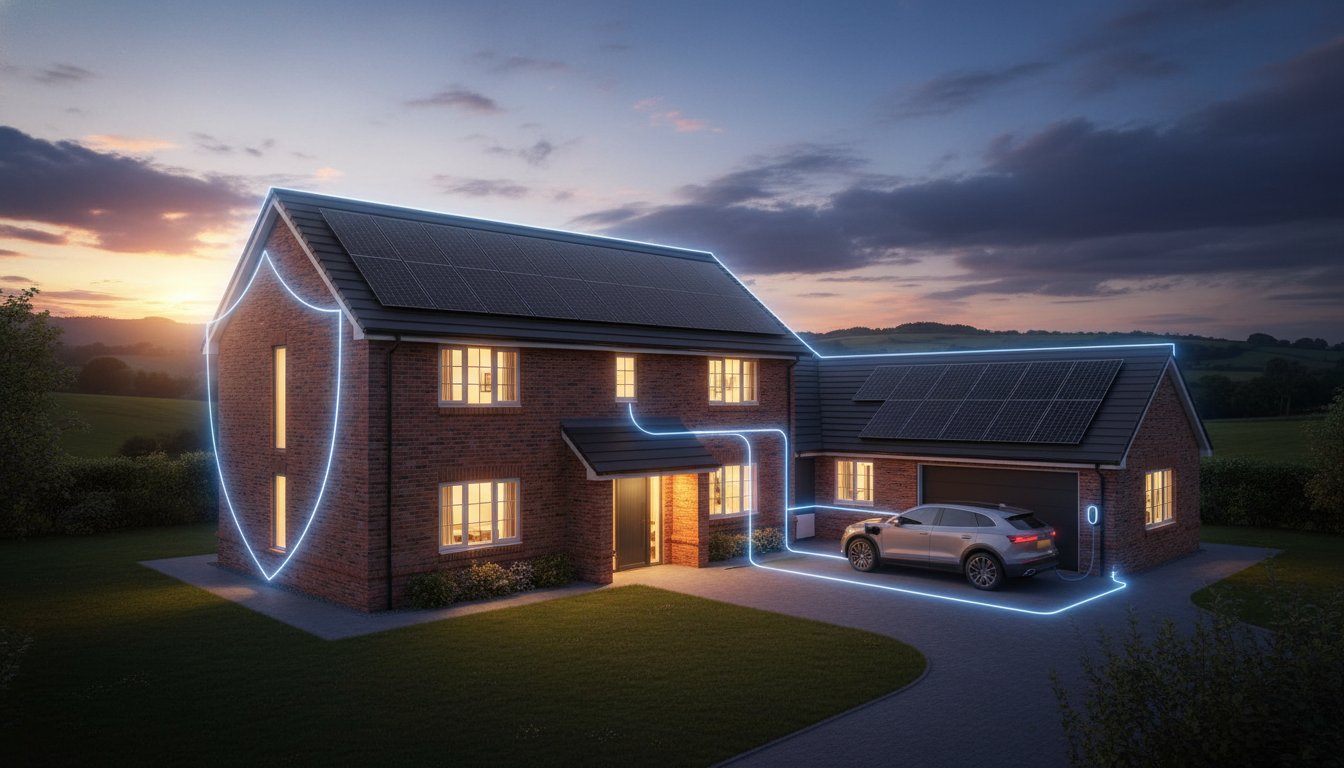
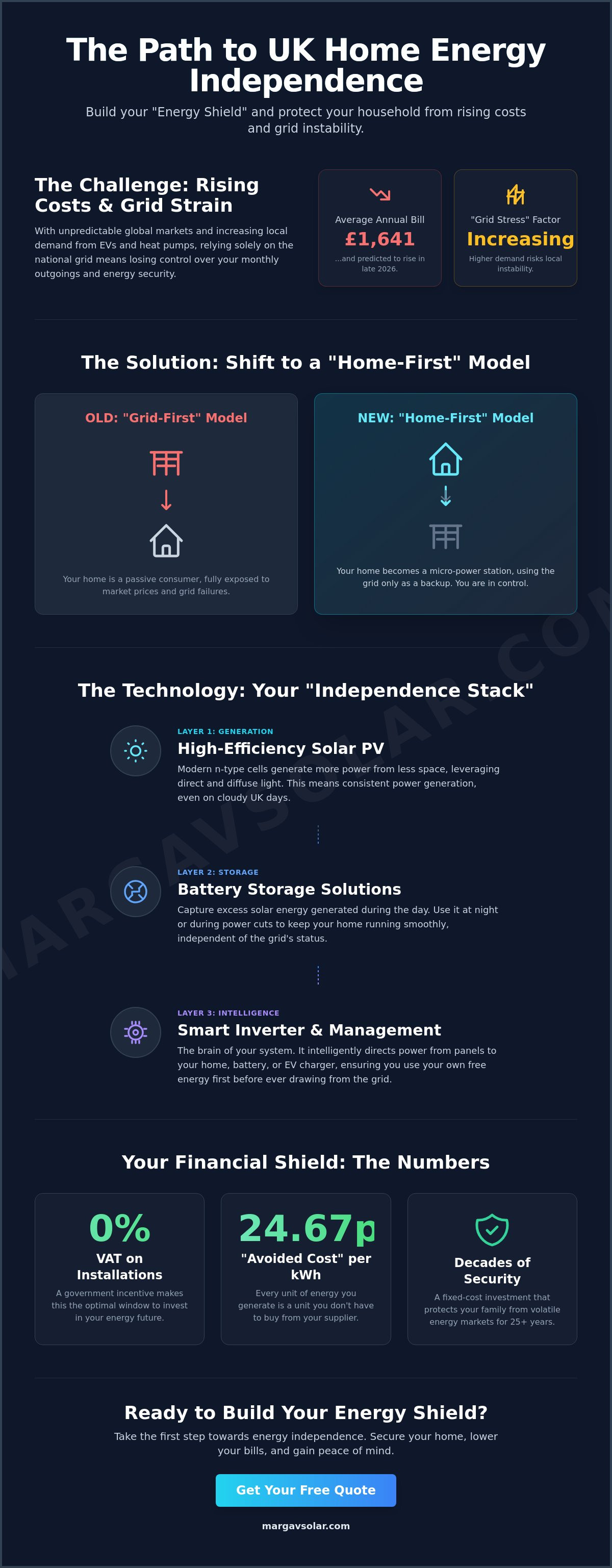
What if the next inevitable spike in energy prices didn't cost your household a single penny? With the average annual energy bill currently at £1,641 and prices predicted to rise in late 2026, it's natural to feel like you're losing control of your monthly outgoings. You might worry that the UK climate isn't enough for solar self-sufficiency or fear being left in the dark during grid instability. Building a path toward energy independence UK home by home is the most effective way to secure your financial future. It's about creating a strategic "Energy Shield" that uses the national grid as a backup rather than your primary source of power.
You'll discover how to shield your household from price volatility through smart residential solar PV and battery storage strategies. We'll explore the impact of the May 2026 Energy Independence Bill and why the current 0% VAT rate on installations makes this the optimal window to act. This article provides a clear roadmap to lowering your bills, securing your power during grid failures, and contributing to net-zero targets. From inverter upgrades to EV charging points, you'll learn exactly how to take control of your energy future today.
Key Takeaways
- Understand how the "Home-First" model allows you to achieve the energy independence UK home owners need to bypass national price volatility.
- Identify the essential components of the "Independence Stack," including high-efficiency solar PV, battery storage, and smart inverter upgrades.
- Learn why UK cloud cover doesn't stop solar generation and how modern panels leverage diffuse light to power your home even on grey days.
- Follow a practical four-step roadmap to right-size your solar array and optimize your household's energy efficiency before installation.
- Discover how regular maintenance and regional planning expertise ensure your renewable system remains future-proof for decades.
What Does Energy Independence Mean for a UK Home in 2026?
To understand What Does Energy Independence Mean in a residential context, we have to look beyond national security. For a modern household, it's the ability to generate, store, and manage the majority of your own power. It isn't about total isolation or cutting the cables. Instead, it's about strategic autonomy. You remain connected to the grid for backup, but you prioritize your own solar-generated electrons for daily life. This shift represents the practical reality of achieving energy independence UK home by home in a post-fossil fuel era.
We're witnessing a fundamental transition from a "Grid-First" to a "Home-First" model. In the old way, you'd pull power from the grid and pay whatever the rate was. In 2026, the home becomes its own micro-power station. While the new Energy Independence Bill announced in May 2026 aims to modernize the national grid, real security comes from local generation. By producing electricity on your own roof, you move from being a passive consumer to an active "prosumer" who controls their own supply.
The Driving Forces: Why UK Homeowners are Choosing Autonomy
The psychological impact of the 2022-2025 energy crisis still lingers. Families in Staffordshire and across the country remember the shock of unpredictable bills. While the price cap for April to June 2026 sits at £1,641, the threat of future spikes remains. Ongoing global conflicts are already sparking predictions of price rises for the latter half of the year. People want certainty.
There's also the "Grid Stress" factor. As more neighbors install EV charging points and switch to heat pumps, the local network faces unprecedented demand. Choosing autonomy isn't just about saving money. It's about ensuring your household remains powered when the wider infrastructure struggles. This desire for energy security is now a top motivator for homeowners looking to future-proof their properties.
The Financial Shield: Protecting Against Wholesale Price Spikes
Generating your own power via residential solar PV systems decouples your lifestyle from global gas markets. When you produce electricity on-site, you aren't at the mercy of wholesale price surges. The most valuable unit of energy you'll ever use is the "avoided cost" unit. This is the electricity you didn't have to buy from a supplier at the current average rate of 24.67p per kWh. Every watt you generate is a watt you don't pay for.
By integrating battery storage solutions, you can capture excess solar energy during the day and use it at night. This setup creates an "Energy Shield" for your property. The Energy Shield is a fixed-cost investment that protects your household against the variable risks of an unstable global market.
The Independence Stack: Essential Technology for Self-Sufficiency
Building an energy independence UK home requires more than just a few panels on a roof. To truly insulate your household from the volatility of the national grid, you need to implement what we call the "Independence Stack." This is a three-layer infrastructure consisting of generation, storage, and intelligence. Without all three components working in harmony, your home remains tethered to external price shocks. The goal is to create a system where your home prioritizes its own harvested energy before ever asking the grid for help.
The stack starts with the engine of the system: your solar panels. However, the hardware is only as effective as the logic that controls it. While the UK Government's Warm Homes Plan outlines a national vision for cleaner energy, the responsibility for individual security lies with the homeowner. By choosing high-specification hardware, you ensure that your fixed-cost investment delivers the highest possible yield for decades to come.
Generation: High-Efficiency Solar PV in the 2026 Market
Solar technology has moved forward rapidly. In 2026, n-type cell technology has become the standard for residential systems. These cells offer significantly higher efficiency than older p-type models, meaning you can generate more power from a smaller roof area. This is vital for UK homes where space is often limited. Professional solar panel installation is critical here. An expert installer ensures that orientation and shading are accounted for, maximizing your "avoided cost" savings even during the grey winter months when every photon counts.
Storage: The Role of Advanced Battery Solutions
Battery storage is the non-negotiable component of the stack. Without it, you're forced to export your excess daytime energy for a low Smart Export Guarantee (SEG) rate, only to buy it back at the full rate of 24.67p per kWh in the evening. Implementing solar battery storage in Staffordshire allows for effective "load shifting." You store your own clean energy during peak solar hours and use it when the sun goes down. Modern Lithium-iron phosphate (LFP) batteries are the preferred choice for residential use because they provide thousands of cycles and superior safety compared to older lithium-ion variants.
Intelligence: Smart Management with GivEnergy Cloud
The intelligence layer is the "brain" that manages the flow of electricity. It's no longer enough to have a simple inverter; you need a system that anticipates your needs. The GivEnergy Cloud provides this by using AI-driven energy forecasting. It analyzes local weather data and your historical consumption patterns to optimize battery discharge and identify "vampire loads" that waste electricity. If your current setup lacks this level of insight, inverter upgrades and replacements can transform a passive system into a truly smart, self-managing energy hub.
Solar vs. Grid: Debunking the "Cloudy UK" Myth
The most common hurdle for anyone pursuing energy independence UK home status is the belief that our weather is simply too poor for solar. It's a persistent myth that refuses to fade. Many homeowners assume that panels require scorching heat or cloudless skies to be effective. In reality, solar PV technology relies on light, not heat. In fact, solar panels actually lose efficiency in extreme heat, making the UK's temperate, breezy climate surprisingly suitable for consistent generation.
Modern 2026 panels utilize "diffuse light." This is the light that filters through cloud cover or reflects off the ground. While a clear summer day provides the highest peak production, the high-efficiency n-type cells we discussed in the previous section are far more sensitive to the blue and violet spectrum of light than older technology. This means your system continues to harvest energy even when the Staffordshire sky is a uniform shade of grey. You aren't just generating power on "good" days; you're harvesting every available photon from dawn until dusk.
The "Winter Gap" is a reality, but it doesn't break the roadmap to self-sufficiency. During the darkest months, your generation will naturally decrease. However, by combining your array with smart storage and grid-trading, you maintain financial autonomy. You move from being a victim of the grid to a strategic partner that uses it only when it's most cost-effective.
Direct Consumption vs. Battery Buffering
To maximize your independence, you must understand how you use your power. Direct consumption is the "use it or lose it" phase. This involves running high-draw appliances like dishwashers or washing machines at midday when your panels are at their peak. Battery buffering is the evolution of this concept. It allows you to save that midday harvest for the evening, significantly reducing your reliance on the grid during peak hours when electricity rates are highest.
Independence Levels Based on Capacity:
- Low Independence: No battery storage. You rely heavily on the grid for evening power and only save on daytime usage.
- Medium Independence: 5kWh to 10kWh battery. You can cover most evening lighting and entertainment, but may need the grid for heavy winter heating.
- High Independence: 15kWh+ battery storage. You can store enough energy to bypass the grid for days at a time, using it only as a final backup.
The Smart Export Guarantee (SEG) and Grid Trading
Financial independence doesn't require being 100% physically off-grid. The Smart Export Guarantee (SEG) allows you to sell your excess energy back to suppliers. As of May 2026, rates have become much more lucrative. Good Energy currently offers a fixed rate of 25p/kWh for their solar and battery customers, while OVO Energy provides a variable rate of 20p/kWh. These rates are remarkably close to the average electricity unit rate of 24.67p, meaning your exported energy can almost cancel out the cost of what you buy.
Dynamic tariffs like Octopus Agile further reward battery owners by allowing them to charge from the grid when prices are low or even negative. To access these premium export rates and ensure your system is safe for grid-trading, a professional installation with NICEIC certification is essential. This validates that your home meets the rigorous standards required to become a reliable part of the UK's decentralized energy future.
The 4-Step Roadmap to Achieving UK Home Energy Independence
Achieving energy independence UK home by home is a transition that requires a logical, phased approach. You can't simply bolt hardware onto a building and expect instant autonomy. Instead, you must follow a roadmap that prioritizes efficiency and strategic sizing. This process ensures that every pound you spend contributes directly to reducing your reliance on the grid and shielding your household from the predicted price rises of late 2026.
The roadmap is built on four distinct steps. First, you must address the "leaks" in your current energy profile through an audit. Second, you design a generation system tailored to your specific location. Third, you integrate storage and high-draw appliances. Finally, you use data to optimize the entire ecosystem. By following this sequence, you move from being a passive bill-payer to a manager of a sophisticated domestic power station.
Phase 1: Assessing Your Potential
Before looking at hardware, you need to understand your "Baseload." This is the minimum amount of electricity your home consumes 24 hours a day to keep things like fridges and standby devices running. Analyze your last 12 months of energy bills to find your average daily kilowatt-hour (kWh) usage. This data is the foundation of your system design. A professional site survey is also vital at this stage to check your roof's structural integrity and identify any micro-shading issues that could impact your yield.
Many homeowners make the mistake of thinking bigger is always better. However, right-sizing your system for your actual consumption ensures a faster return on investment than simply covering every inch of roof with panels. The goal is to maximize self-consumption rather than just maximizing export.
Phase 2: Implementation and Integration
Once you have your data, the implementation phase begins. It is often more cost-effective to bundle solar battery storage with your panel installation. Combining these works saves significantly on labor costs and ensures that your components are perfectly matched from day one. During this phase, you should also consider how your home's largest energy draws will be powered. Integrating EV charging points into your solar priority list allows you to fuel your transport using the sun, effectively bypassing the petrol station and the grid simultaneously.
Future-proofing is equally important. Even if you don't need a massive battery today, your system should be ready for inverter upgrades as your energy needs grow. As you move through these steps, you'll see your dependency on external suppliers drop. If you're ready to start your own transition, you can explore our full range of residential solar PV systems to see which configuration fits your property best.
Phase 3: Active Monitoring and System Optimization
The final step is the shift from installation to management. Using the intelligence layer discussed earlier, you should monitor your system's performance weekly. This isn't just about watching the numbers go up. It's about identifying habits you can change to increase your independence. For example, you might notice that shifting your washing machine cycle by just two hours allows it to run entirely on stored battery power rather than pulling from the grid during a cloudy spell. Optimization is the secret to turning a good system into a great one.
Future-Proofing Your Independence with MarGav Solar
Realizing the vision of an energy independence UK home isn't a one-day event. It is a commitment that spans decades. While the initial installation of panels and batteries sets the foundation, the long-term success of your "Energy Shield" depends on the quality of the partnership you choose. MarGav Solar brings over 20 years of experience in the UK renewable market to every project. We understand that homeowners aren't just looking for hardware; they're looking for a reliable strategy to navigate the shifting energy regulations of 2026 and beyond.
Choosing a partner with deep roots in the industry ensures that your system remains an asset rather than a liability. As the 0% VAT rate on solar and battery installations approaches its scheduled end on March 31, 2027, the window for high-ROI investment is narrowing. We position ourselves as an end-to-end partner, guiding you from the initial technical site survey through to the 20-year maintenance cycle of your system. This continuity is what transforms a simple solar array into a true engine of self-sufficiency.
Local Support vs. National Call Centres
National installers often rely on distant call centres and subcontracted labor. This can lead to a disconnect when it comes to understanding the specific grid constraints within Staffordshire. Local expertise is vital for navigating the "G98" or "G99" application processes required to connect your system to the local network. We know the regional infrastructure and can provide accurate forecasting based on local weather data rather than generic national averages.
This regional focus is essential across the country; for instance, those in the South West can learn more about Carbon Saving Group to find specialist renewable energy solutions for homes in Devon and Cornwall.
Working with a local specialist also provides budget certainty. We prioritize fixed-price installation contracts, which is essential for household planning in the current economy. Beyond the physical build, we support our clients with the necessary electrical certifications and MCS paperwork. This documentation is the key to unlocking the best Smart Export Guarantee rates from suppliers like Good Energy or OVO, ensuring your system starts paying for itself from the moment it's commissioned.
Long-Term Performance and Maintenance
Even the highest-efficiency n-type cells require care to maintain their peak performance. Dust, bird droppings, and environmental debris can slowly erode your generation capacity, pulling you back toward grid reliance. Professional solar panel maintenance and cleaning are vital for keeping your independence levels at their maximum. A system that is ignored is a system that loses money.
As technology evolves, your home energy needs will likely change. You might add a second electric vehicle or switch to an all-electric heating system. We help you stay ahead of these changes through strategic inverter upgrades. Modern inverters offer better integration with AI-driven clouds and larger battery stacks, allowing your "Independence Stack" to grow alongside your family. Your journey toward a secure, self-powered future starts with a conversation about your specific goals. Book a consultation with MarGav Solar to start your independence journey and take the first step toward permanent energy security.
Securing Your Energy Future Beyond 2026
The transition to a self-sufficient household is no longer a distant ambition. It's a practical response to the price volatility and grid instability of the mid-2020s. By implementing a strategic "Independence Stack" of high-efficiency solar PV and advanced battery storage, you can decouple your home's running costs from the global market. You've seen that the UK climate is more than capable of supporting a productive system, provided you follow a logical roadmap of efficiency, right-sizing, and active monitoring.
Achieving energy independence UK home by home requires a partner who understands the local landscape. MarGav Solar provides Staffordshire-based support backed by over 20 years of renewable energy expertise. Our NICEIC-certified installations ensure your system is safe, efficient, and ready to capitalize on the best export rates available today. Whether you're starting with a new solar array or looking for inverter upgrades to optimize an existing setup, the right strategy makes all the difference.
Don't leave your household's financial security to chance. Get Your Custom Energy Independence Roadmap from MarGav Solar and take control of your power today. Your journey toward a cleaner, more resilient home is just one step away.
Frequently Asked Questions
Is it possible to go completely off-grid in the UK?
While it is technically possible to go completely off-grid, it is rarely the most practical choice for most households. Most people aim for strategic autonomy, where they generate and store the majority of their power but remain connected to the national grid as a final backup. This setup allows you to benefit from the Smart Export Guarantee (SEG) by selling excess energy back to suppliers when your batteries are full.
How much does it cost to achieve energy independence for a 3-bedroom home?
The total investment for a 3-bedroom property depends on your specific energy "baseload" and the capacity of the battery storage you require. Factors such as roof orientation, the number of panels, and whether you include EV charging points will influence the final configuration. Homeowners should look at the "avoided cost" of electricity, currently averaging 24.67p per kWh, to calculate their long-term savings and return on investment.
Do solar panels work effectively in the UK during winter?
Solar panels remain effective during the winter because they operate on light rather than heat. Although daylight hours are shorter, modern n-type cells are designed to capture diffuse light even on heavily overcast days. To maintain a high level of energy independence UK home owners can use smart battery systems to store energy or top up from the grid during cheaper overnight periods when solar generation is at its lowest.
How long do solar batteries typically last before needing replacement?
Modern Lithium-iron phosphate (LFP) batteries generally last between 10 and 15 years. Their lifespan is measured in cycles, and most high-quality units can handle thousands of charges while maintaining the majority of their original capacity. Ensuring your system receives regular technical inspections and is paired with a high-quality inverter will help you get the most out of your storage investment.
Can I add more panels or batteries to my system later?
Most residential solar and storage systems are modular, meaning you can expand your capacity as your household needs grow. If you decide to add an electric vehicle or switch to electric heating in the future, you can often scale up your "Independence Stack." It is important to check if your existing setup requires inverter upgrades to manage the increased power flow from additional components.
What happens to my energy independence during a power cut?
Standard solar installations usually shut down during a power cut to prevent electricity from leaking back into the grid while engineers are working on it. However, if your system includes a battery with an emergency power supply (EPS) or "island mode" capability, you can continue to run essential appliances. You should verify with your installer that your battery storage solution is configured to provide power during grid failures.
Are there any UK government grants available for energy independence in 2026?
The most significant current incentive is the 0% VAT rate on solar panels and battery storage, which is available until March 31, 2027. The ECO4 scheme also provides funding for energy efficiency measures for eligible low-income households until December 31, 2026. While the Great British Insulation Scheme ended in March 2026, the Boiler Upgrade Scheme still offers grants of £7,500 for those switching to heat pumps.
Does energy independence significantly increase my property value in the UK?
Homes with lower running costs and higher EPC ratings are increasingly desirable in the UK property market. Achieving energy independence UK home by home makes a property more attractive to buyers who are wary of future energy price volatility. A system that includes solar PV, battery storage, and EV charging points is often seen as a premium feature that future-proofs the home against rising living costs.


