

Your solar panels might still be on the roof, but if they were installed more than eight years ago, they're likely operating at a fraction of the efficiency offered by modern 400W+ modules. It's a common frustration for Staffordshire homeowners who see their energy bills rising despite having a system in place. If you're currently thinking about upgrading my existing solar panel system, you're likely facing the classic dilemma of whether to add new components or replace the old ones entirely. With many original inverters reaching their ten-year limit and the lack of battery storage leaving you reliant on the grid after sunset, the need for a modernised approach has never been more urgent.
We know that navigating the technicalities of Feed-in Tariff (FIT) contracts and new 2026 standards can feel overwhelming. This guide promises to clear the confusion, showing you exactly how to maximise your energy independence using high-efficiency tech and smart storage solutions. You'll learn how to audit your current hardware, integrate GivEnergy battery systems, and future-proof your home for EV charging. By the end of this article, you'll have a clear roadmap to lower bills and total energy autonomy without risking your existing financial incentives.
Key Takeaways
- Learn how modern 450W+ panels can double the energy yield of your legacy system through a process called solar repowering.
- Understand the technical differences between repowering and expanding when upgrading my existing solar panel system to avoid performance-draining component mismatches.
- Discover how hybrid inverters and GivEnergy battery storage solutions allow you to store surplus energy for evening use and provide backup during power cuts.
- Identify the essential 2026 regulatory requirements, including DNO notifications, that are necessary when increasing your system's output capacity.
- Find out how a professional system audit in Staffordshire can determine the most cost-effective way to future-proof your home for EV charging.
Why Upgrade Your Existing Solar Panel System in 2026?
Solar technology doesn't just sit still. If your array was installed during the early boom of the 2010s, it's likely underperforming compared to what is possible today. Upgrading my existing solar panel system is often referred to as "solar repowering." This process involves swapping out legacy, low-efficiency panels for modern high-yield versions that generate significantly more power from the same footprint. For many homeowners in Staffordshire, this is the most logical step toward energy independence, especially as older components begin to show signs of wear. If you are starting from scratch, you might look at a solar panel installation in Staffordshire, but for those with existing infrastructure, repowering is a faster route to better results.
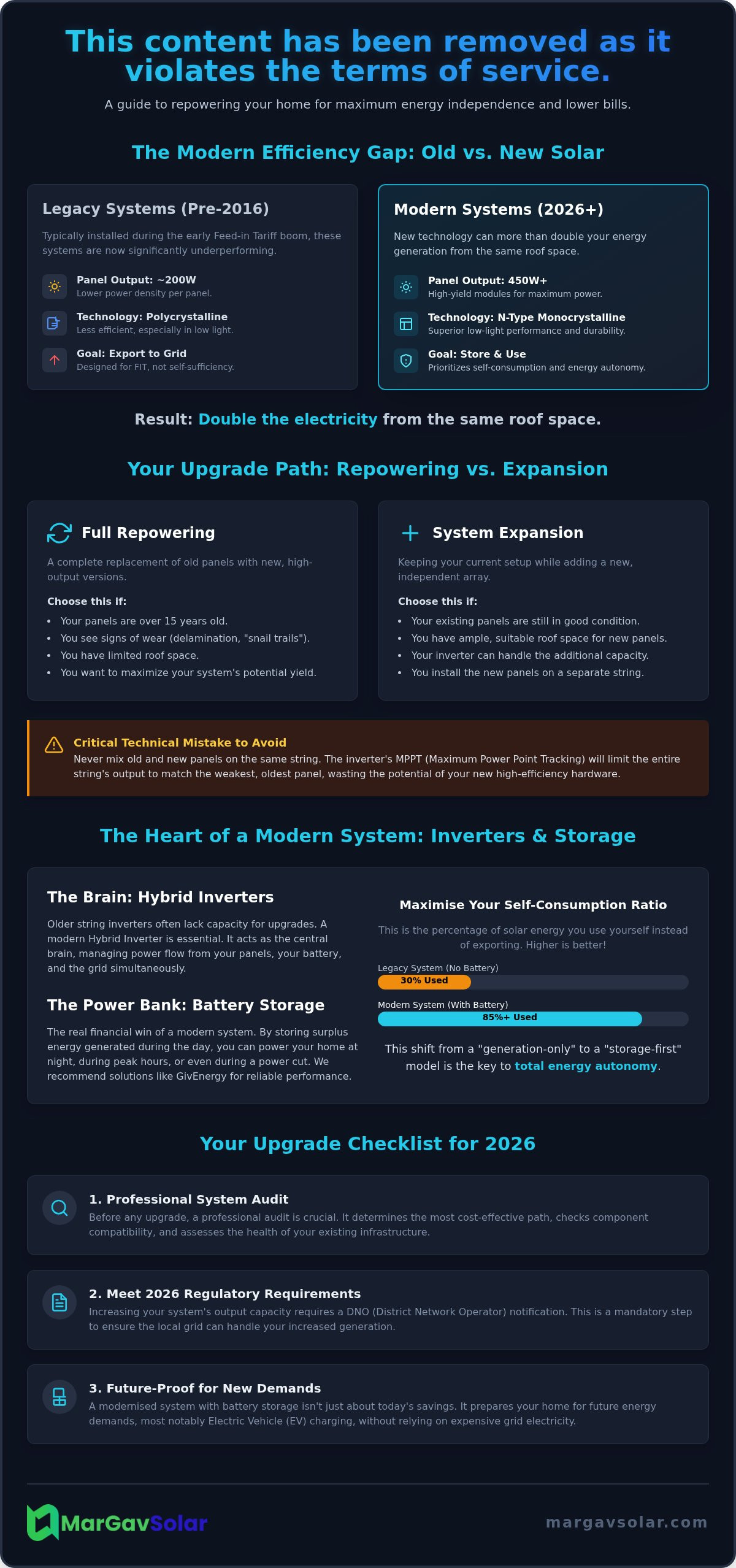
The difference in output is stark. Older 200W panels are now being replaced by 400W or even 450W+ modules. This "Efficiency Gap" means a modern system can produce double the electricity using the same roof space. In 2026, the focus has moved from simply generating power to capturing and keeping it. While early systems were designed to export energy for a high Feed-in Tariff, modern upgrades prioritise storage to combat high electricity rates. A foundational step in understanding photovoltaic systems is recognising that every component, from the mounting brackets to the silicon cells, has become more resilient and productive over the last decade.
The Evolution of Solar Technology
Most older systems use blue Polycrystalline cells, which are less efficient than modern alternatives. Today, the standard has shifted to N-Type Monocrystalline technology. These panels are far more effective in the low-light conditions we often see in Staffordshire. They start generating earlier in the morning and continue later into the evening. Modern 2026 hardware also comes with improved degradation profiles. This ensures your investment maintains its output for decades rather than seeing a sharp drop-off after the first ten years. When upgrading my existing solar panel system, you're not just getting more power; you're getting a more durable energy source. For readers interested in how these modern standards are applied for residential and industrial clients in other regions, you can visit GES Energy to learn more about their approach.
Modernising your setup allows you to take full advantage of the Smart Export Guarantee (SEG). However, the real financial win comes from adding battery storage. By increasing your Self-Consumption Ratio, which is the percentage of solar energy your home actually uses rather than exporting, you drastically reduce your reliance on the grid. In 2026, energy autonomy is the most effective way to protect your household from volatile utility prices. Moving from a "generation-only" model to a "storage-first" model ensures that every photon captured contributes directly to your savings.
Repowering vs. Expansion: Which Path Is Right for You?
When you start thinking about upgrading my existing solar panel system, you'll quickly reach a fork in the road: do you replace everything or simply add more? Full repowering involves a total replacement of your old modules with modern, high-output versions. System expansion, by contrast, keeps your current setup while adding a new, independent array. The biggest technical mistake homeowners make is trying to mix old and new panels on the same string. Because of how Maximum Power Point Tracking (MPPT) works, the inverter will limit the entire string's output to match the weakest, oldest panel. This effectively wastes the potential of your new high-efficiency hardware.
Your inverter acts as the gatekeeper for any upgrade. Older string inverters often lack the capacity to handle additional power from an expanded array. If you want to add battery storage, you'll likely need to swap your old unit for a hybrid inverter. These specialised devices manage power from both your panels and your battery, acting as the central brain of a modernised home energy ecosystem. Our team can provide a professional audit to see if you're ready for inverter upgrades in Staffordshire.
When to Choose Full Repowering
If your panels are over 15 years old, look for signs of physical wear like delamination or "snail trails", which are discoloured lines on the cells. These indicate moisture ingress and failing seals. For homes with limited roof space, replacing 200W panels with 450W versions is more logical than trying to find room for more. This path also resets your protection with a fresh 25-year warranty. Aligning with Department of Energy guidance on solar upgrades, total replacement is often the most cost-effective long-term move when the original system's performance has dropped significantly.
When to Choose System Expansion
Expansion works best if your original panels are still performing well and you have ample south-facing roof space. We typically recommend a "Second String" approach. This involves connecting the new panels to a separate MPPT input on a new inverter, ensuring the old panels don't drag down the performance of the new ones. In Staffordshire, it's vital to check that your roof rafters can support the additional weight of a second array. Structural integrity is just as important as electrical compatibility when you're adding significant new hardware to an older property.
The Brain of the Upgrade: Inverters and Battery Storage
The inverter is the hardest working component in any photovoltaic setup. It converts DC power from your panels into usable AC power for your home, 365 days a year. Most standard string inverters have a lifespan of roughly 10 years. If your system was installed during the early 2010s, your unit is likely approaching its end-of-life. When upgrading my existing solar panel system, the inverter is the most logical place to start. A modern replacement does more than just convert power; it provides the digital infrastructure needed for sophisticated energy management.
By choosing inverter upgrades in Staffordshire, you gain access to high-resolution performance data. You'll see exactly where your energy goes in real time through your smartphone or tablet. For many, this involves using the GivEnergy Cloud to monitor storage levels and household demand. This level of control was simply not available a decade ago. It allows you to move from being a passive generator to an active manager of your own micro-grid. While homeowners in other regions might look for federal home energy credits to support their transitions, the primary driver in the UK remains the immediate reduction in utility bills through these smart optimisations.
AC-Coupled vs. Hybrid Inverter Upgrades
If your existing inverter is relatively new and performing well, an AC-coupled battery is often the best choice. This is a "plug-and-play" solution that sits alongside your current setup without requiring you to replace your existing solar inverter. However, for systems reaching the 10-year mark, a hybrid inverter upgrade is almost always more cost-effective. A hybrid unit replaces your old solar inverter and includes the battery management system in one single enclosure. This reduces the number of potential failure points in your system. Choosing a hybrid model now prevents you from paying for separate labour costs when your original inverter eventually fails. It's a streamlined approach that prepares your home for a battery-first future.
Integrating EV Charging
A primary motivation for solar upgrades in 2026 is the installation of an EV charging point. Modern systems employ "Solar Diversion" technology. This ensures that any surplus energy not used by your domestic appliances or stored in your battery is directed straight into your vehicle's battery. Without a smart management system, the high draw of an EV charger could easily exceed your home's capacity. An upgraded system manages these loads automatically, balancing your household demand with your charging needs. During the sunny summer months, a modernised array can generate enough surplus electricity to charge an electric vehicle entirely for free. This effectively eliminates your commuting costs while maximising the return on your solar investment.
Navigating the Upgrade Process: Regulations and Protection
Before you start swapping out panels, you need a clear baseline of your current setup. The first step in upgrading my existing solar panel system is a comprehensive professional audit. This isn't just a quick visual inspection; it's a deep dive into your hardware's health and electrical integrity. We often find that a thorough solar panel maintenance check reveals underlying issues, such as micro-cracks or loose mounting, that must be addressed before any new tech is integrated. Once the audit is complete, you'll have a clear picture of whether your roof and wiring are ready for the next decade of generation.
If your upgrade increases the total capacity of your array, you'll need to notify the Distribution Network Operator (DNO). In Staffordshire, this typically involves filing a G98 or G99 notification. G98 is generally for smaller systems under 3.68kW per phase, while G99 is a more involved application for larger setups. You can't skip this step. Increasing your export capacity without grid permission can lead to fines or even disconnection. Additionally, ensuring your installer provides MCS Certification for the new components is vital. Without it, you won't be able to register for the Smart Export Guarantee (SEG) to get paid for the surplus energy you send back to the grid.
Protecting Your Feed-in Tariff (FIT)
This is the most critical hurdle for homeowners with systems installed between 2010 and 2019. To keep your lucrative FIT rates, you must follow strict "like-for-like" replacement rules. Generally, you can replace a faulty panel with a modern one, but if the total system capacity increases by more than 5%, you risk voiding your original contract. For many, the safest way to expand is to install a completely separate, independent system with its own meter. This keeps your legacy FIT income secure while the new array qualifies for the SEG. It's essential to notify your FIT provider before work begins to avoid any payment freezes.
The Importance of NICEIC Certification
Safety is paramount when you're increasing the current flowing through your home's circuits. NICEIC certification ensures your installer has been independently assessed for technical competence and safety. An upgrade often puts more strain on your consumer unit and existing wiring than the original install. A certified professional will verify that your system meets 2026 Building Regulations and "Part P" compliance. This protects your home from fire risks and ensures your building insurance remains valid. If you're ready to see how these regulations apply to your property, book a professional system audit to get started.
Expert Solar Upgrades in Staffordshire with MarGav Solar
Choosing the right partner for upgrading my existing solar panel system is the difference between a high-performing asset and a technical headache. At MarGav Solar, we position ourselves as energy consultants rather than just installers. With over 20 years of industry expertise, we understand that every home in Staffordshire has unique energy demands and physical constraints. We don't believe in a one-size-fits-all approach. Instead, we focus on tailoring modern technology to your specific goals, whether that's achieving total energy autonomy or simply reducing your monthly outgoings. While we are experts in solar panel installation in Staffordshire, our specialised upgrade service is designed specifically to breathe new life into legacy systems.
Our process begins with the MarGav "System Audit." This is a rigorous evaluation of your old hardware, where we check the condition of your panels, the mounting system's integrity, and the performance of your current inverter. We look for signs of degradation that might be hidden from the ground. By auditing first, we ensure that any upgrade we suggest is technically viable and financially sound. We won't recommend adding expensive battery storage to a system with failing panels. Our goal is to provide a clear, honest assessment so you can make an informed decision about your home's energy future.
Transparency is at the core of how we work. We operate on a fixed-price installation contract model, meaning the price we quote is the price you pay. There are no hidden fees or unexpected "add-ons" once the work begins. Beyond the installation, we offer comprehensive long-term maintenance and repair packages. Many national companies disappear once the final invoice is paid, leaving homeowners stranded when a component fails years later. As a local Staffordshire business, we provide the ongoing support and rapid response times you need to keep your system generating at peak efficiency for another two decades.
Our Local Expertise and 20 Years of Experience
We've spent two decades working with Staffordshire's unique housing stock and specific grid quirks. We know which local areas have stricter DNO constraints and how to navigate them efficiently. Being a family-run business means we take personal pride in every project. Unlike national "install and forget" companies, we have a physical presence in the county. If you have a question or an issue, we're just a short drive away. This local knowledge allows us to anticipate structural or electrical challenges that generic UK-wide providers often miss, ensuring your upgrade is safe, legal, and optimised for the local climate.
Next Steps: Your Personal Energy Transition
Ready to modernise your setup? The first step is a simple consultation to discuss your current system's performance. To make this call as productive as possible, try to have your original MCS certificate, your recent electricity bills, and the model number of your current inverter to hand. This information helps us provide a more accurate initial assessment. We'll then arrange a site visit to conduct your professional health check and audit. Take control of your energy bills and Contact MarGav Solar for a free Staffordshire solar upgrade audit today to start your journey toward a future-proofed home.
Take Control of Your Energy Independence
The landscape of residential solar has shifted from simple generation to intelligent energy management. Whether you choose a full repowering to maximise your roof's potential or a strategic system expansion to add battery storage, the goal remains the same: reducing grid reliance. Modernising your setup ensures you can capture every watt of Staffordshire sunshine, providing the power needed for evening use and EV charging. By addressing aging inverters and underperforming panels now, you protect your long-term investment while maintaining compliance with 2026 regulations.
When you're ready to begin upgrading my existing solar panel system, working with a local expert is essential. MarGav Solar brings over 20 years of renewable energy expertise and the peace of mind that comes with being a NICEIC Certified Installer. We provide the specialised, Staffordshire-based support needed to audit your current hardware and design a future-proofed solution that works for your home. Don't let a legacy system hold back your energy autonomy.
Book Your Staffordshire Solar System Audit with MarGav Solar Today and start saving more on your energy bills.
Frequently Asked Questions
Can I add a battery to my existing solar panel system without changing the panels?
Yes, you can add battery storage using an AC-coupled system. This setup works independently of your solar inverter, meaning you don't need to replace your existing panels or hardware. It's a popular choice for homeowners who want to store surplus energy for evening use without the cost of a full system overhaul. This is often the first step people take when upgrading my existing solar panel system to increase self-consumption.
Will upgrading my solar panels void my Feed-in Tariff (FIT) payments?
Upgrading your panels doesn't automatically void your FIT payments, but you must follow strict rules. Generally, you can replace faulty panels on a "like-for-like" basis. However, if the total capacity of the array increases by more than 5%, your FIT contract may be affected. We recommend consulting your FIT provider or an expert energy consultant before making changes to ensure your ongoing payments are protected.
Do I need permission from the grid (DNO) to add more solar panels?
You must notify the Distribution Network Operator (DNO) if your upgrade increases the system's export capacity beyond the original permission. For most Staffordshire homes, this involves a G98 or G99 application. Failing to secure grid permission can lead to technical issues or legal complications with your utility provider. We handle these applications as part of our professional consultancy service to ensure your system remains fully compliant with local grid constraints.
Can I mix different brands or sizes of solar panels on the same roof?
Mixing different brands or sizes on the same electrical string is a mistake because the weakest panel will limit the output of the entire string. If you have extra roof space, it's better to install the new panels as a completely separate "second string" connected to a modern dual-MPPT inverter. This approach ensures both your old and new panels operate at their maximum possible efficiency without interfering with each other.
How long does it take to upgrade an existing solar PV system?
Most residential upgrades in Staffordshire are completed within one to two days. A simple inverter replacement or battery installation often takes less than a day, while a full repowering of the roof array might take two. We provide a clear timeline during our initial audit so you can plan accordingly. Our goal is to minimise downtime, ensuring your home is back to generating and storing clean energy as quickly as possible.
Is it worth replacing my old inverter if it is still working?
It's often highly beneficial to replace an inverter that's approaching its ten-year limit. Older models lack the smart monitoring and battery integration capabilities found in modern hybrid inverters. By upgrading before a failure occurs, you avoid emergency repair costs and gain access to advanced energy management tools like the GivEnergy Cloud. This proactive approach is a key part of effectively upgrading my existing solar panel system for long-term reliability.
What is the lifespan of modern solar panels compared to those from 10 years ago?
Modern N-Type monocrystalline panels are significantly more durable than the polycrystalline modules common a decade ago. While older panels often carried 10-year product warranties, today's hardware typically comes with 25 to 30-year performance guarantees. They also experience much lower annual degradation, meaning they retain a higher percentage of their original power output over their entire lifespan. This makes them a far more resilient investment for Staffordshire's variable weather conditions.
Does MarGav Solar provide maintenance for systems they didn’t originally install?
Yes, we provide comprehensive maintenance and repair services for systems installed by other companies. Our expert team can perform technical inspections, cleaning, and component replacements to restore your system's efficiency. Many national installers have left the market, leaving homeowners without local support. We bridge that gap by offering Staffordshire residents professional maintenance and repair services to keep their legacy systems running safely and effectively.


