

Is your solar inverter just a ticking time bomb, or is it the secret to unlocking a decade of lower energy bills? If you're currently researching the cost to upgrade solar inverter UK systems, you've likely felt the anxiety of a system underperforming or the fear of being overcharged for a "simple" swap. It's frustrating to watch your Feed-in Tariff payments vanish while you're stuck in a maze of jargon about string, micro, and hybrid technology. You aren't alone in wanting a clear, honest breakdown of what it takes to get your array back online.
We'll help you understand the 2026 market by explaining the real-world factors that drive hardware and labour expenses. You'll learn how to distinguish between different inverter types and why this upgrade is the perfect time to consider battery integration. This guide provides a clear roadmap for your project, from explaining current safety standards to finding a reliable, NICEIC-certified installer in Staffordshire who can restore your system's peak performance without the typical national-aggregator markup.
Key Takeaways
- Identify the three primary cost drivers, including hardware, labour, and DNO compliance, to avoid unexpected expenses during your project.
- Compare the long-term value of string, micro, and hybrid systems to determine the best cost to upgrade solar inverter UK homeowners can expect in 2026.
- See how upgrading to a modern, high-efficiency inverter can significantly boost your energy harvest compared to older units installed a decade ago.
- Explore why the transition to a hybrid inverter is the ideal time to add battery storage and future-proof your home's energy resilience.
- Learn why choosing a local Staffordshire specialist ensures your installation meets specific regional grid requirements and NICEIC safety standards.
Understanding the Cost of Solar Inverter Upgrades in 2026
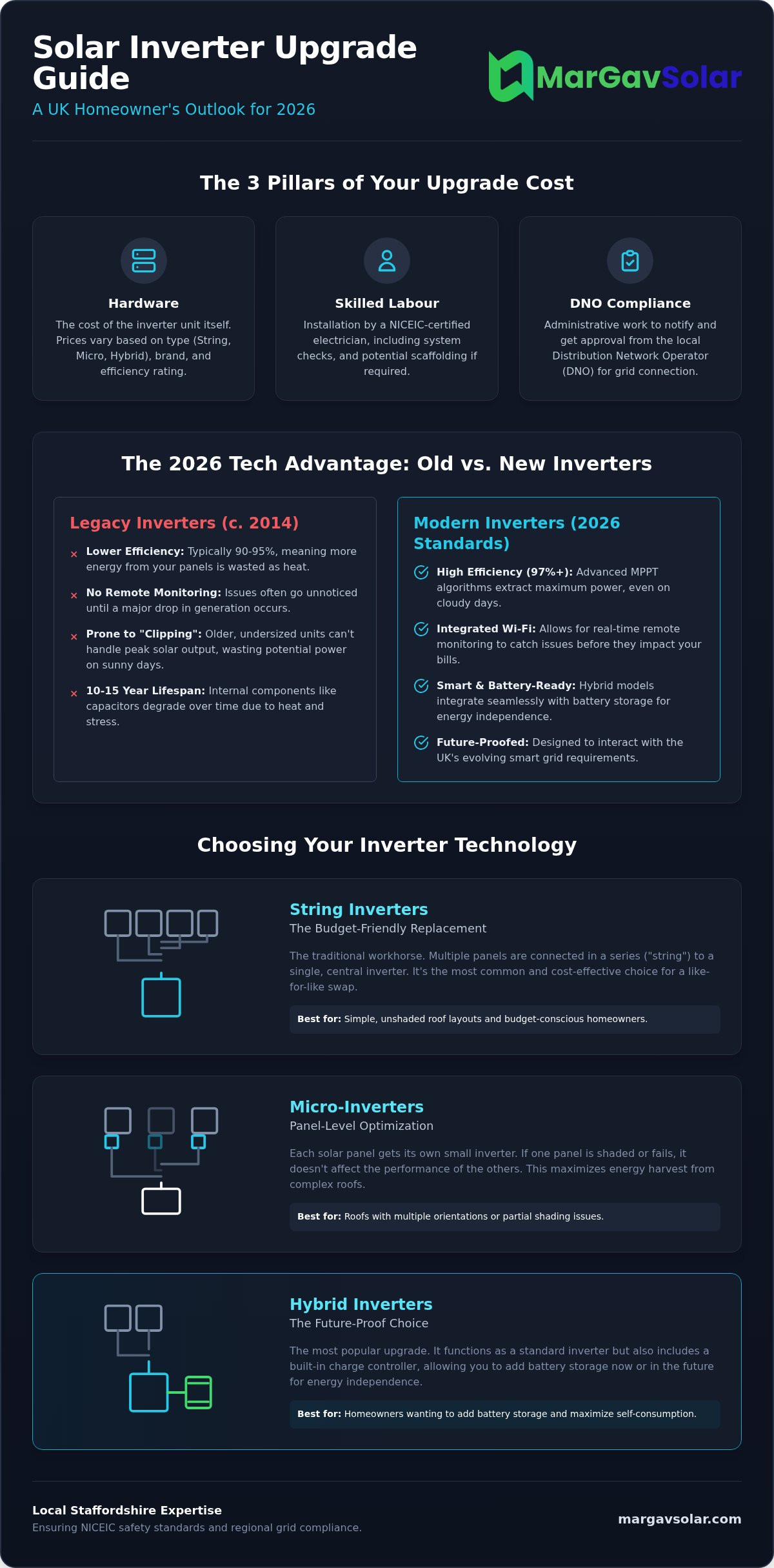
A Solar inverter acts as the central intelligence of your renewable energy setup. While your panels are built to endure the elements for 25 years or more, the inverter is a complex electronic device that works under constant thermal and electrical stress. When calculating the cost to upgrade solar inverter UK installations, it's vital to look beyond the initial purchase price. In 2026, the market is shaped by advanced smart-grid requirements and integrated monitoring. A professional swap involves three main pillars: hardware, skilled labour, and administrative compliance with local Distribution Network Operators (DNO).
Why Inverters Need Replacing After 10 Years
Most original string inverters have a design life of roughly 10 to 15 years. Unlike the static panels on your roof, the inverter contains sensitive internal components like capacitors that eventually degrade due to constant heat cycles. You'll know it's time for a change when you see persistent error codes, hear unusual physical buzzing, or notice a sharp drop in your daily generation. Replacing a failing unit before it dies completely prevents system downtime and protects your long-term Feed-in Tariff (FiT) or Smart Export Guarantee (SEG) income. Our 20 years of experience in Staffordshire shows that proactive replacement is always more cost-effective than emergency repairs.
The Price of Efficiency: Old Tech vs. 2026 Standards
Modern inverters aren't just replacements; they're significant upgrades. Current 2026 standards include advanced Maximum Power Point Tracking (MPPT) which extracts more energy from your panels, especially during cloudy Staffordshire afternoons. Many units now feature integrated Wi-Fi, allowing us to monitor your system's health remotely and catch issues before they require a site visit. We also focus on preventing "clipping." This occurs when an inverter's capacity is too small to handle the peak output of your panels, causing you to lose potential energy on sunny days. By right-sizing your hardware, you ensure every watt of sunshine is converted into usable power.
String, Micro, or Hybrid: How Inverter Type Impacts Your Budget
The technology you select is the single biggest variable when calculating the cost to upgrade solar inverter UK homes. In 2026, we see three distinct paths: standard string units, micro-inverters, and hybrid systems. While premium brands offer extended warranties and superior monitoring, reliable mid-range options provide excellent value for those on a tighter budget. According to Energy Saving Trust guidance, choosing the right tech depends on your roof's orientation and your future energy goals.
Micro-inverters are often more expensive upfront because each panel gets its own dedicated unit. However, they save money long-term on roofs with complex shading or multiple orientations. If one panel is shaded by a chimney, the rest of the string continues to perform at 100%. For most straightforward UK installations, however, a centralized inverter remains the standard choice. We've seen a massive surge in hybrid technology recently, as homeowners look to integrate smart-grid features and storage solutions into their existing arrays.
Standard String Inverters: The Budget-Friendly Replacement
A standard string inverter is the traditional workhorse of the industry. It's the most common choice for homeowners who originally installed panels under the Feed-in Tariff (FiT) scheme. Since many of these systems have simple, unshaded roof layouts, a "like-for-like" swap is often the most logical path. Labour requirements for these replacements are typically straightforward, involving a direct exchange of the wall-mounted unit and a safety check of the existing DC cabling. It's a reliable way to get your system back to peak performance without overcomplicating the setup.
Hybrid Inverters: Preparing for Battery Storage
Hybrid inverters are currently the most popular upgrade choice across Staffordshire. Unlike a standard AC inverter, a hybrid model is "battery-ready." It manages both your solar panels and a home battery system within a single unit. Choosing a hybrid model now prevents the need for a second, expensive inverter installation later. If you're interested in maximizing your self-consumption, you can read more in our guide to Solar Battery Storage in Staffordshire. While the hardware cost for a DC hybrid is higher than a standard string unit, the long-term ROI is often superior due to increased energy independence.
Deciding which technology fits your home requires a balance of current needs and future plans. We often suggest that homeowners look at their energy usage patterns before committing to a specific hardware tier. If you're unsure which path is right for your roof, our team at MarGav Solar can provide a professional assessment of your existing array to ensure you don't overspend on unnecessary features.
Beyond the Hardware: Labour, Scaffolding, and Certification Costs
Scaffolding is a common concern for homeowners, but it isn't always necessary. If your inverter is located in a garage, utility room, or loft, we can usually complete the swap without roof access. However, if the upgrade reveals damaged DC isolators or requires new cabling to the array, safe external access becomes mandatory. This can add significant expense to the project. We always recommend a site survey to determine if your specific layout requires these additional safety measures.
DNO Applications and G98/G99 Certification
Grid compliance is a legal requirement in the UK. When you swap an inverter, you must notify your District Network Operator (DNO). A standard G98 notification is usually sufficient for like-for-like replacements. If you're increasing your system capacity or installing a larger hybrid unit to prepare for battery storage, a G99 application is required. In 2026, homeowners should verify potential G99 application fees with their local DNO, as these can vary by region. Keeping your MCS-compliant paperwork up to date is vital for maintaining insurance validity and proving system health during future house sales.
Labour and Travel: The Local Staffordshire Advantage
The UK labour market for qualified solar electricians remains highly competitive in 2026. Choosing a local firm significantly reduces the cost to upgrade solar inverter UK installations by eliminating long-distance travel surcharges. A professional commissioning typically takes between 3 and 5 hours. This timeframe includes testing string voltages, configuring smart monitoring apps, and verifying safety shut-offs.
We believe that NICEIC Certification is the gold standard for this work. It guarantees that the person handling your high-voltage equipment meets rigorous national safety benchmarks. Our team at MarGav Solar brings 20 years of renewable energy expertise to every job, ensuring your upgrade is handled with the precision that local Staffordshire homes deserve. This local knowledge also helps when dealing with regional grid requirements specific to Western Power Distribution.
Is it Worth it? Calculating the ROI of a Modern Inverter Upgrade
The most common objection we hear from homeowners is the "if it isn't broken, don't fix it" argument. While waiting for a total failure might seem like a way to save on the cost to upgrade solar inverter UK services, it often leads to higher long-term expenses. A sudden inverter failure during the peak generation months of May or June can result in four to six weeks of system downtime while you source parts and an installer. During this window, you lose 100% of your Feed-in Tariff (FiT) or Smart Export Guarantee (SEG) income, effectively paying for the delay through lost earnings.
Modern 2026 inverters offer a clear "Efficiency Gain" over models installed back in 2012. Improvements in power electronics mean today's units are significantly better at extracting energy during low-light conditions. This increased yield, combined with smart monitoring that identifies panel-level underperformance, ensures your system isn't just running, but thrives. By reducing household energy waste through real-time data, a new inverter pays for itself through improved daily performance and the prevention of costly emergency repairs.
The "Battery-Ready" ROI Play
Upgrading to a hybrid model is the fastest way to transform your ROI profile. This path allows for seamless GivEnergy Cloud integration, giving you total control over how your power is used or stored. Modern inverters allow for dynamic energy tariff optimising by automatically shifting your house load to the cheapest hours of the day. By storing solar energy for use during expensive peak evening hours, you reduce your grid reliance and protect yourself against future energy price spikes. This transition from a simple solar array to a smart home energy hub is where the true financial value of a 2026 upgrade lies.
Warranty and Maintenance Savings
Reliability provides its own form of return on investment. A new inverter typically comes with a 10-year manufacturer warranty, offering "fit and forget" peace of mind that an out-of-warranty unit cannot match. Instead of risking expensive call-out fees and component costs for an aging device, you secure a decade of protected generation. Regular Solar Panel Maintenance further extends the life of your new hardware by ensuring the surrounding environment is clean and well-ventilated. If you want to see how a modern system can lower your monthly bills, you can request a bespoke upgrade quote from our Staffordshire team today.
Choosing a Local Staffordshire Expert for Your Inverter Replacement
While national aggregators often dominate search results for the cost to upgrade solar inverter UK services, they frequently lack the granular knowledge required for a seamless installation in the West Midlands. Local expertise matters because your system must interface correctly with the regional power grid, managed here by National Grid Electricity Distribution (formerly Western Power Distribution). A local specialist understands the specific voltage characteristics and notification protocols required by our regional DNO, ensuring your system is commissioned without administrative delays.
Selecting a local partner also provides a significant advantage in aftercare. If a warranty issue arises or you need a follow-up technical adjustment, a Staffordshire-based team can respond far quicker than a national firm juggling contractors across the country. When reviewing quotes, look for total transparency regarding the hardware brands being used and the specific scope of the aftercare package. A reliable quote should always include the cost of the unit, professional labour, and all necessary safety certifications.
The MarGav Solar Difference in Staffordshire
With 20 years of renewable energy expertise, we've built our reputation on being a trusted Staffordshire Solar Panel Installer. We don't believe in "hidden surprise" invoices. Our fixed-price installation contracts mean the price you're quoted is the price you pay, covering everything from the initial safety audit to the final DNO notification. Our commitment to the local community means we only recommend hardware with proven long-term reliability and accessible UK-based warranties, ensuring your investment is protected for the next decade and beyond.
How to Get an Accurate Inverter Upgrade Quote
To provide an accurate assessment of the cost to upgrade solar inverter UK systems, we need a few specific details about your current setup. Having your existing inverter model number, the total count of your solar panels, and information about your Wi-Fi signal strength near the installation point helps us determine the best hardware for your home. While some firms offer generic "over the phone" estimates, we prioritise a detailed technical inspection. This allows us to check the health of your existing DC isolators and cabling, preventing safety issues before they start.
If you're ready to restore your system's efficiency or want to explore how a hybrid upgrade can prepare your home for battery storage, the process is straightforward. You can contact MarGav Solar for a tailored inverter upgrade quote today. Our NICEIC-certified team will review your current generation data and provide a clear, professional recommendation designed to maximise your energy independence right here in Staffordshire.
Securing Your Energy Independence for the Next Decade
Upgrading your solar inverter is far more than a simple repair; it's a strategic opportunity to modernise your entire home energy system. By choosing high-efficiency hardware and considering battery-ready hybrid technology, you're investing in a setup that extracts every possible watt from the Staffordshire sunshine. Understanding the real-world cost to upgrade solar inverter UK installations helps you move beyond generic online estimates and focus on a solution that provides genuine, long-term ROI through increased efficiency and reduced downtime.
As specialists in high-efficiency inverters and GivEnergy storage integration, MarGav Solar brings 20 years of local expertise to every project. Our NICEIC-certified and MCS-compliant team focuses on transparency, offering fixed-price contracts that eliminate the anxiety of hidden fees. We're here to ensure your solar array remains a high-performing asset for years to come. Get a Fixed-Price Inverter Upgrade Quote from MarGav Solar today to see how we can future-proof your home. Your panels still have plenty of life left in them; give them the high-performance brain they deserve to keep your energy bills under control.
Frequently Asked Questions
How much does a solar inverter cost to replace in the UK?
The total cost to upgrade solar inverter UK systems depends on whether you choose a standard string unit or a battery-ready hybrid model. While hardware prices vary by brand, a professional installation includes the unit, skilled labour, and safety certifications. In 2026, many Staffordshire homeowners choose hybrid models to future-proof their homes, ensuring they can easily add battery storage as energy prices continue to fluctuate.
Can I replace my solar inverter myself to save on costs?
Replacing an inverter yourself is highly discouraged and often dangerous due to high-voltage DC electricity. Professional installation by a NICEIC-certified specialist is required to ensure grid compliance and to maintain your manufacturer warranty. MarGav Solar focuses on professional replacements and does not support DIY component sales. Safety and system certification are paramount for maintaining your home insurance and ensuring a smooth house sale in the future.
Is it better to repair or replace a faulty solar inverter?
If your inverter is over 10 years old, replacement is almost always better than repair. Older units often suffer from degraded internal components that are expensive to fix individually. A new inverter provides a fresh 10-year warranty and superior efficiency, whereas a repair only fixes one specific fault on an aging device. Modern units extract more power from your panels, making the upgrade a better long-term investment.
Will a new inverter work with my 10-year-old solar panels?
Yes, modern inverters are designed to be backward compatible with existing solar arrays. Our technical survey ensures the new hardware matches the voltage and current specifications of your older panels. In many cases, the advanced tracking technology in a 2026 inverter can actually improve the daily energy yield from a decade-old system by managing the power conversion more effectively than original equipment from the early 2010s.
How long does it take to swap a solar inverter?
A standard inverter replacement typically takes between 3 and 5 hours to complete at your property. This timeframe includes the safe decommissioning of your old unit, mounting the new hardware, and performing all necessary electrical safety tests. We also spend time configuring your smart monitoring software and ensuring the system is correctly communicating with your home Wi-Fi and the regional power grid for accurate data tracking.
Do I need scaffolding for an inverter upgrade?
Scaffolding is rarely required for an inverter upgrade because most units are located in accessible areas like garages, utility rooms, or lofts. You only need scaffolding if the project requires access to the roof, such as replacing damaged DC cabling or isolators at the panel level. We confirm whether scaffolding is necessary during our initial technical inspection of your Staffordshire property to ensure there are no surprises.
Does a new inverter require a new DNO application?
You are legally required to notify your District Network Operator (DNO) of any inverter change. For a like-for-like swap, a simple G98 notification is usually sufficient. However, if you're upgrading to a higher capacity or a hybrid system, a G99 application may be necessary. We handle all the administrative paperwork and compliance notifications as part of our fixed-price installation service to ensure your system remains fully legal.
Can I upgrade to a hybrid inverter without buying a battery immediately?
You can certainly install a hybrid inverter now and add battery storage later. This is a popular way to manage the cost to upgrade solar inverter UK projects by spreading the investment over several months. A hybrid model functions perfectly as a standard solar inverter while remaining battery-ready. This allows you to integrate a storage solution like GivEnergy whenever your Staffordshire home is ready for full energy independence.


