

What if the flashing red light on your garage wall is actually a silent alarm that's draining your bank account every single day? It's a common worry for homeowners who rely on their panels to keep monthly costs down, especially when the weather is clear but the savings aren't showing up. You probably feel a sting of anxiety every time you check your generation app and see a flatline or a confusing error message that looks like a foreign language.
It's frustrating to deal with hardware that feels like a black box, but spotting the early signs my solar inverter is failing is the best way to protect your investment. This 2026 diagnostic guide simplifies the process, helping you distinguish between a temporary grid glitch and a terminal component failure. We'll provide a clear checklist to confirm if your inverter is the culprit, explain how to safely attempt a reset, and show you why upgrading to a smart hybrid system now offers better ROI than ever. From Staffordshire-specific maintenance tips to decoding modern cloud alerts, you'll gain the clarity needed to get your home back to peak efficiency without the guesswork.
Key Takeaways
- Understand why the inverter acts as your system's brain and why it typically requires replacement years before your solar panels do.
- Learn how to spot the physical and digital signs my solar inverter is failing, including production flatlines and chassis fault lights.
- Master basic DIY troubleshooting techniques, such as a safe system restart, to determine if a professional repair is actually necessary.
- Explore how local factors like Staffordshire's humidity and UK grid voltage changes can stress your system's internal components.
- See why replacing a faulty unit with a 2026 hybrid model is often a smarter long-term investment than a simple like-for-like repair.
Understanding the Role of Your Solar Inverter
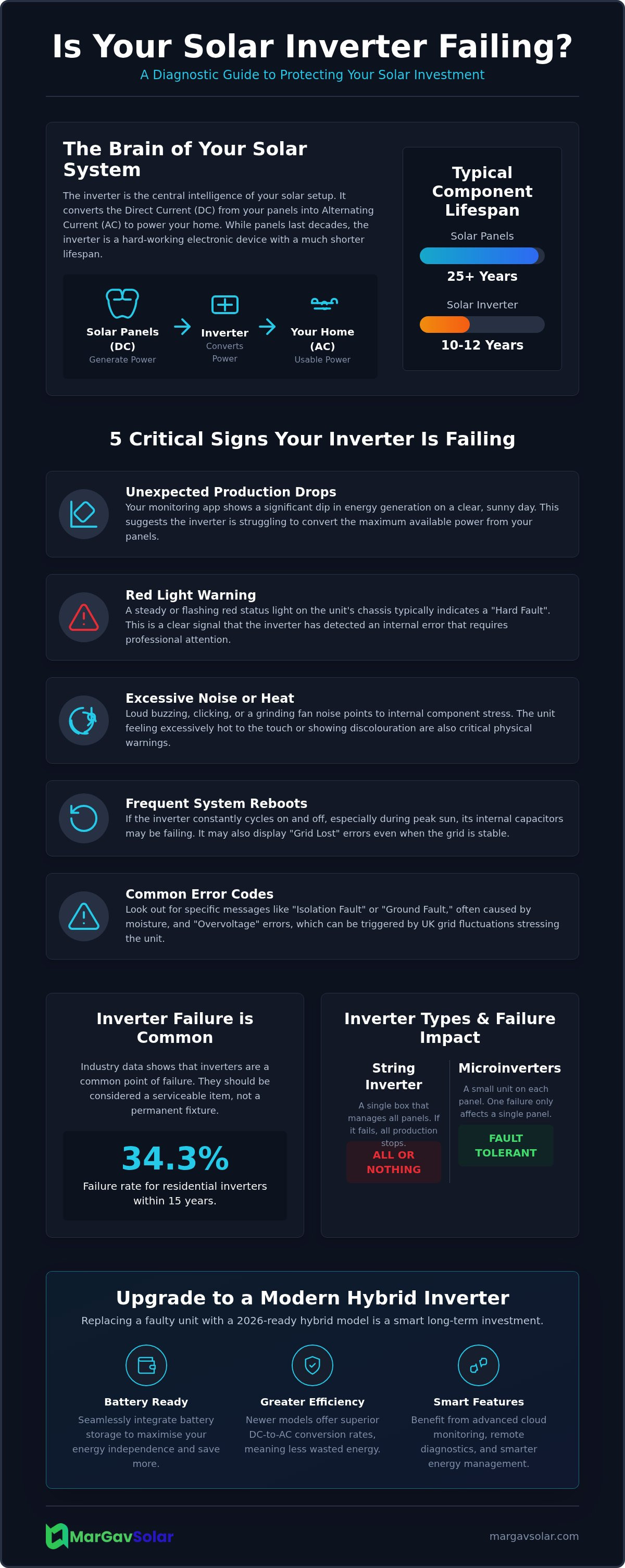
Your solar panels are the workhorses of your system, but the inverter is the central intelligence. Understanding the Role of Your Solar Inverter is vital because it handles the complex task of converting Direct Current (DC) generated by your roof into the Alternating Current (AC) that powers your kettle and TV. While high quality panels often last over 25 years, the inverter is a sophisticated electronic device packed with capacitors and circuit boards. These components work under constant heat and electrical stress, which is why most units have a typical lifespan of 10 to 12 years before they require professional attention.
When this "brain" starts to struggle, it doesn't always announce itself with a loud bang. Often, the first signs my solar inverter is failing are subtle. You might notice your energy bills creeping up because the system has stopped exporting excess power to the grid or isn't covering your daytime baseload. In Staffordshire's variable climate, damp and temperature swings can accelerate component wear. If the inverter stops working, your entire investment effectively becomes a very expensive roof decoration, silently draining your ROI every day it stays offline.
String Inverters vs. Microinverters
Traditional systems use a string inverter, a single box usually located in a loft, garage, or utility room. If this unit fails, your entire solar production stops immediately. It's an "all or nothing" scenario that makes detection relatively easy but the impact immediate. Conversely, microinverters are small units attached to each individual panel. While they offer better fault tolerance, they can make diagnosing issues more complex. You're often looking for a drop in partial production rather than a total blackout. For many Staffordshire homes with complex rooflines or shading issues, microinverters provide peace of mind that a single component failure won't kill the whole system's output.
The Connection to Battery Storage
If you've invested in energy storage, the inverter's health is even more critical. A hybrid inverter is the bridge between PV panels and storage, managing the flow of electricity to your home, the grid, and your battery. When an inverter begins to fail, you might find your battery isn't charging during the day or is failing to discharge when the sun goes down. Communication drops between these two devices are often early signs my solar inverter is failing, preventing you from using the free energy you've harvested. Keeping this bridge functional is the only way to maintain your energy independence.
5 Critical Signs Your Solar Inverter Is Failing
Identifying the signs my solar inverter is failing requires a mix of digital monitoring and physical inspection. While these units are designed to be "set and forget," they often provide subtle warnings before a total shutdown occurs. If you notice any of the following symptoms, your system's efficiency is likely already compromised.
- Unexpected Production Drops: If your monitoring app shows a significant dip in energy generation during a cloudless day, the inverter may be struggling to track the maximum power point of your panels.
- The "Red Light" Warning: Most modern units have a status LED. A steady or flashing red light usually indicates a "Hard Fault" that requires professional attention.
- Audible Disturbance: While a faint hum is normal, excessive buzzing, clicking, or the sound of a grinding fan suggests internal component stress or mechanical failure.
- Physical Heat and Discolouration: High temperatures are the primary enemy of electronics. Look for warping, browning of the plastic casing, or a faint "burning" smell near the unit.
- Frequent System Reboots: If the unit constantly cycles on and off or displays "Grid Lost" errors during peak sun hours, the internal capacitors may be reaching the end of their functional life.
Monitoring these symptoms is essential for long-term reliability. Industry data supports this vigilance; a survey discussed in Inverter Upgrades: Is It Time for a Replacement? highlights a 34.3% failure rate for residential inverters over 15 years. This statistic underscores why homeowners should treat their inverter as a service-item rather than a permanent fixture.
Deciphering Common Error Codes
When a fault occurs, the screen or app will often display a specific code. An "Isolation Fault" or "Ground Fault" is common in Staffordshire, where high humidity or dampness can affect external wiring or the DC isolator. "Overvoltage" errors are frequently linked to the UK grid itself, specifically when local voltage rises beyond the inverter's safety threshold. While some codes are temporary and clear after a sunset, persistent errors usually signal a terminal hardware issue that won't fix itself. If you're seeing repeated codes, it might be time to book a professional health check to prevent further damage.
Monitoring App Discrepancies
Your monitoring software is your first line of defence. A "flat-lining" production graph during sunny intervals is a classic indicator of a hardware hang-up. However, you must distinguish between a Wi-Fi connection issue and a genuine inverter failure. If your app says "Offline" but the physical unit has a green light, it's likely just a router problem. For those using the GivEnergy Cloud, you can drill down into specific string voltages to see if the fault lies with a single panel or the central inverter unit itself. This level of detail helps pinpoint whether you need a simple software update or a full hardware replacement.
Common Causes of Inverter Failure in the UK
Solar inverters are robust, but they aren't invincible. While the UK doesn't suffer from extreme desert heat, our unique combination of damp winters and fluctuating grid stability creates a specific set of challenges. Most homeowners start looking for signs my solar inverter is failing around the decade mark. This is usually when internal components, specifically capacitors, begin to degrade under the constant strain of power conversion and environmental stress.
Environmental Factors in Staffordshire
Staffordshire's climate is notoriously humid. For inverters installed in garages or on external walls, this moisture is a significant risk. High humidity can lead to internal corrosion or "tracking" on circuit boards, which triggers frustrating isolation faults. It isn't just the air, either. Insects and debris often find their way into cooling vents, seeking warmth. This blocks airflow and causes the unit to throttle its performance or shut down entirely to prevent overheating. This is why professional solar panel maintenance is so important; a technician doesn't just clean the glass, they clear these vital cooling paths. Robust solar system monitoring and maintenance ensures these environmental "silent killers" don't cut your system's life short.
Thermal Stress: The Loft Trap
Many early UK solar installations placed the inverter in the loft to keep it out of sight. While convenient, lofts are often the worst environment for sensitive electronics. In summer, loft temperatures can soar, forcing the inverter to work harder to stay cool. This thermal stress accelerates the aging of internal solder joints and circuit boards. If your unit is in a poorly ventilated space, you might notice the fan running constantly or hear an aggressive grinding noise. These are clear signs my solar inverter is failing due to heat exhaustion. Relocating a unit to a cooler, well-ventilated area can often extend its life, but once the internal damage is done, a replacement is usually the only path forward.
Electrical Stress and Grid Surges
The UK grid isn't a perfectly steady stream of power. Your local Distribution Network Operator (DNO) manages a grid that fluctuates based on local demand. These surges or "overvoltage" events force the inverter's internal surge protection to work overtime. Every time your inverter "trips" to protect itself from a grid spike, it puts stress on the internal relays. Over time, these components simply wear out. Older inverters also struggle to handle the higher DC voltages produced by modern, high-efficiency panels. If you've recently upgraded your array or live in an area with frequent grid instability, these electrical stresses are the most likely reason your system is underperforming.
Troubleshooting: DIY Checks vs. Professional Diagnostics
Before you assume the worst, it's helpful to rule out simple system glitches. While the signs my solar inverter is failing can be alarming, some issues are caused by external factors like a temporary grid spike or a tripped breaker in your home. Following a logical checklist can save you from unnecessary stress and help you provide better information to a technician if a repair is needed.
- Step 1: Perform a Power Cycle. Much like a computer, an inverter can occasionally "hang." Follow your manufacturer's specific shutdown sequence, typically switching off the AC isolator first, then the DC isolator. Wait for five minutes to allow internal capacitors to discharge fully before reversing the process.
- Step 2: Check Isolator Switches. Ensure that the AC and DC isolator switches (usually located near the inverter) are firmly in the "ON" position. Sometimes these can be knocked or trip during maintenance.
- Step 3: Inspect the Consumer Unit. Look at your home's main fuse board. Check if the RCD or circuit breaker dedicated to the solar PV system has tripped. If it trips again immediately after resetting, don't try a third time; this indicates a genuine electrical fault.
- Step 4: Review Historical Logs. Open your monitoring platform to see if the production drop was sudden or gradual. Sudden stops often point to fuse issues, while gradual declines suggest component wear.
- Step 5: Call the Experts. If these steps don't restore power, contact an NICEIC-certified installer to perform a professional thermal and electrical test.
When to Call a Professional
Safety is the absolute priority when dealing with solar energy. You should never attempt to open the inverter casing yourself. These units contain high-voltage DC electricity that can remain lethal even after the system is switched off. Furthermore, most manufacturers require repairs to be carried out by MCS-certified technicians to keep your warranty valid. A professional diagnostic report isn't just for your peace of mind; it's a vital document if you need to make an insurance claim for "loss of generation" or hardware failure. If your DIY checks don't resolve the issue, it's time to book an expert inverter diagnostic with our Staffordshire team.
Checking Your Warranty Status
Most inverters installed in the last decade came with a 5 to 10-year manufacturer warranty. You can usually find your serial number and manufacture date on a sticker on the side of the unit. If you're past the 5-year mark, check if you or the original installer purchased an extended warranty. At MarGav Solar, we've seen how a well-kept maintenance log can fast-track warranty claims with brands like GivEnergy. Having a record of professional cleanings and annual checks proves you've looked after the hardware, making it much harder for manufacturers to dispute a claim based on "poor environment" or "neglect."
Inverter Upgrades: Is It Time for a Replacement?
If you've identified the signs my solar inverter is failing, you're at a crossroads. A like-for-like replacement of an old string inverter is possible, but it's often a missed opportunity to modernise your entire home. Modern 2026-era hybrid inverters act as the foundation for a complete smart home ecosystem. Unlike older units that only handled solar panels, a hybrid model is battery ready. This means you can add energy storage later without the expense of replacing the inverter again, which is a major cost saving as your energy needs evolve.
Technology has moved quickly over the last decade. Older inverters often lose a significant portion of energy during the conversion from DC to AC. Newer models boast efficiency rates of 98% or higher, ensuring more of the sun's energy actually reaches your appliances. Integrating these units with smart platforms like the GivEnergy Cloud allows for granular control over your energy usage. You can see exactly how your system handles high-drain loads, such as an EV charging point, ensuring your home remains future-proofed for the electric transition.
ROI of a Modern Inverter
The "Cost of Doing Nothing" is a real financial drain on many Staffordshire households. Every day a failing inverter stays on your wall, you're losing the value of the energy your panels are producing but can't convert. It's often more cost-effective to perform an inverter upgrade than to keep paying for professional repairs on a unit that's out of warranty. Smart monitoring systems now provide real-time alerts that reduce future maintenance costs by identifying small efficiency dips before they become total failures.
The Replacement Process in Staffordshire
Switching out your hardware doesn't have to be a headache. At MarGav Solar, we manage the entire end-to-end process, from safely removing the old unit to commissioning the new system. We ensure your new inverter is perfectly matched to your existing panel array's voltage and string configuration. Since we're based in Staffordshire, we provide local support that national installers often can't match. This includes ensuring all work is carried out by NICEIC-certified technicians. The first step is a local site survey to assess your current setup and determine if an upgrade is the right financial move for your home. If you've spotted the signs my solar inverter is failing, don't wait for a total blackout to take action.
Protecting Your Solar Investment for the Long Term
Your solar system is only as strong as its weakest link. While your panels might be decades away from retirement, the inverter is a harder-working component that naturally wears down over time. By learning to recognise the early signs my solar inverter is failing, you can prevent minor glitches from turning into total system downtime. Whether it's a persistent error code or a mysterious production drop, taking action now ensures your energy bills stay low and your home remains powered by clean energy.
If your system is approaching the ten-year mark or showing symptoms of distress, don't wait for a complete failure to explore your options. Modern hybrid technology offers a chance to add battery storage and improve your overall efficiency. Our team brings 20+ years of experience and local Staffordshire expertise to every job. As NICEIC and MCS accredited installers, we provide the technical precision needed to keep your system performing at its peak.
Ready to secure your energy future? Book an Inverter Health Check with MarGav Solar today. It's the simplest way to gain peace of mind and ensure your solar investment continues to deliver maximum ROI for years to come.
Frequently Asked Questions
How long does a typical solar inverter last in the UK?
Most solar inverters in the UK have a functional lifespan of 10 to 15 years. While your panels might last 25 years or more, the inverter's internal electronics are under constant heat stress and will likely need replacing at least once. Staffordshire's damp climate can also impact longevity if the unit isn't well-protected. Regular maintenance can help you spot the early signs my solar inverter is failing before a total shutdown occurs.
My inverter has a red light but the panels look fine—what should I do?
A solid red light typically indicates a "Hard Fault" that has stopped energy production. You should first try a safe power cycle by following the manufacturer's shutdown sequence. If the light remains red after a restart, it's one of the clearest signs my solar inverter is failing due to internal hardware damage. Don't attempt to open the casing yourself; instead, contact an accredited technician to perform a safe electrical diagnostic and check for grid issues.
Is it cheaper to repair or replace a solar inverter?
Replacement is usually the more cost-effective choice for units older than eight years. While a minor repair might seem cheaper upfront, older components are likely to fail soon after the initial fix. Upgrading to a modern hybrid inverter also adds battery readiness and improved conversion efficiency. This future-proofs your home and often delivers a better long-term return on investment than patching up an obsolete string inverter that's already out of its warranty period.
Can I still generate electricity if my inverter is failing?
No, you cannot use the electricity your panels produce if the inverter isn't functioning correctly. The panels generate Direct Current (DC), but your home appliances and the UK grid require Alternating Current (AC). The inverter is the only component that performs this vital conversion. If it fails, your panels will continue to sit in the sun, but the energy they capture has nowhere to go and cannot be used to power your home.
What is the most common cause of solar inverter failure?
Heat and component degradation are the most frequent culprits. Over time, the internal capacitors that manage electrical flow simply wear out from the stress of constant conversion. In Staffordshire, poorly ventilated lofts are a major factor, as they trap heat and bake the internal circuit boards. Dust buildup and insects blocking cooling vents also contribute to premature failure by causing the unit to overheat during peak summer hours when production should be at its highest.
Will a new inverter work with my old solar panels?
Yes, modern inverters are generally compatible with older panel arrays, provided the electrical specifications match. A professional installer will check your existing string voltages and panel wattage to ensure the new unit can handle the load safely. This is often an ideal time to upgrade to a smart system that provides better monitoring than your original setup, allowing you to track performance more accurately through modern cloud-based apps and mobile devices.
How much does a professional inverter diagnostic cost in Staffordshire?
Diagnostic costs vary depending on the complexity of your system and your specific location within Staffordshire. While we don't provide fixed repair quotes without an inspection, a professional visit includes a full electrical safety check and a thermal analysis of your hardware. This investment provides a clear roadmap for whether you need a simple fix or a full hardware replacement, helping you avoid unnecessary downtime and the high cost of lost energy generation.
Can I replace my own solar inverter to save money?
No, you shouldn't attempt to replace a solar inverter yourself. It's dangerous and often illegal under UK building regulations. Inverters handle high-voltage DC electricity that remains lethal even after sunset. To maintain your insurance validity and any remaining hardware warranties, the work must be done by an MCS-certified and NICEIC-accredited installer. We don't sell components for DIY use because professional installation is critical for home safety and ensuring your system remains grid-compliant.


