
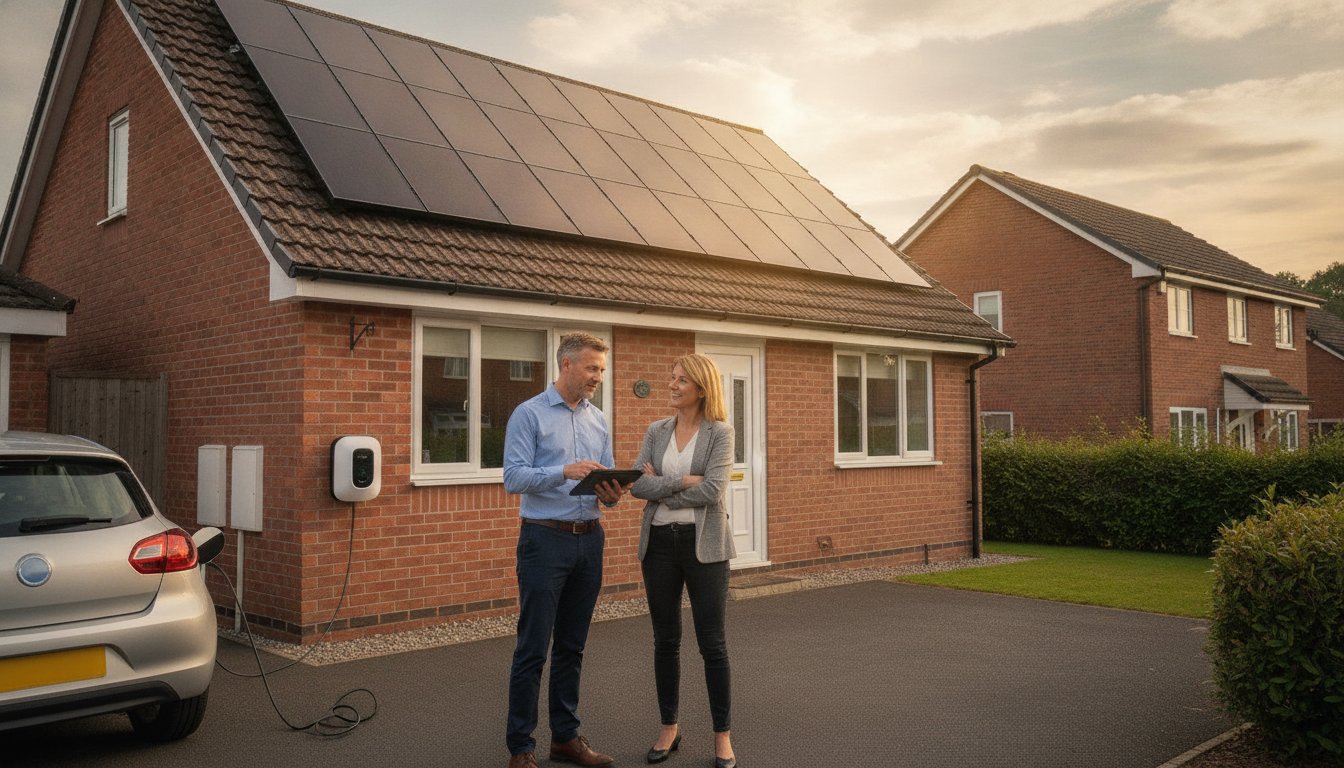
What if the grey, overcast skies over Cannock Chase or the Potteries were actually a goldmine for your household budget? It's natural to feel skeptical about solar power in the Midlands, especially when technical jargon like kWp and DNO applications makes the process feel more like a science experiment than a home improvement. You want to lower your bills, but you're likely worried about roof damage or whether the UK weather will actually deliver a return. Booking a professional home solar assessment Staffordshire residents can rely on is the first step to clearing that fog and seeing the real numbers for your specific roof.
We understand that you need a clear roadmap, not a sales pitch. This guide explains exactly what to expect from a survey and how to prepare your home for maximum energy independence. You'll discover how a 4kW system can save a typical household around £735 a year on electricity while taking advantage of the 0% VAT rate available until March 2027. We'll also look at how GivEnergy battery storage and EV chargers fit into your system, using fixed-price installation contracts to ensure you're getting the most out of every ray of light without any hidden surprises.
Key Takeaways
- Understand why a professional home solar assessment Staffordshire is a technical audit rather than a sales pitch, ensuring your roof pitch and local shading are accurately measured.
- Learn the 5-step site survey process, from structural roof inspections to reviewing your energy bills for a tailored solar solution.
- Discover how to future-proof your system by integrating GivEnergy battery storage and EV charging points based on your specific load profile.
- Get clarity on Staffordshire planning permissions, including permitted development rights and special rules for conservation areas or listed buildings.
- See how local expertise leads to fixed-price installation contracts and long-term support through professional maintenance and inverter upgrades.
Why a Home Solar Assessment is Your First Step to Energy Independence
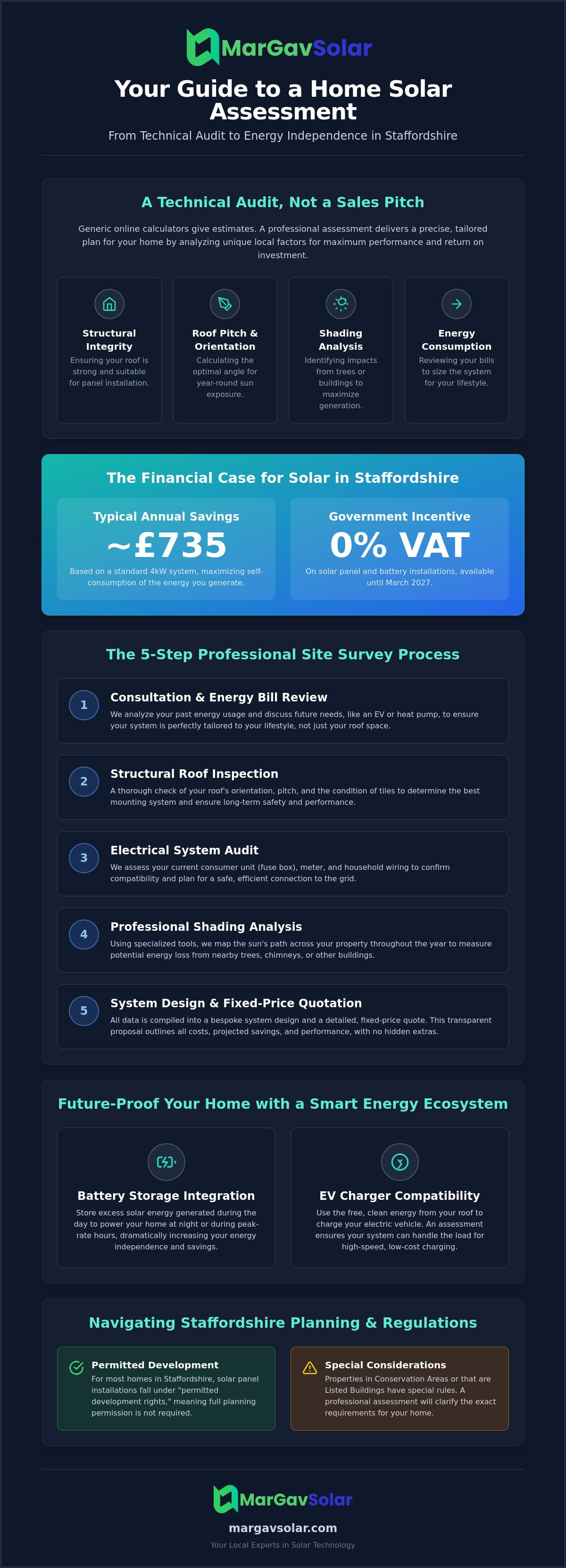
A home solar assessment Staffordshire homeowners schedule is far more than a simple sales appointment. It's a rigorous technical audit designed to bridge the gap between "having a roof" and "generating your own power." While generic online calculators provide a rough estimate based on regional averages, they often fail to account for the specific nuances of Midlands architecture. Whether you live in a Victorian terrace in Stoke-on-Trent or a modern detached home in Stafford, your roof's pitch, orientation, and local shading factors are unique. A professional surveyor looks at the physical integrity of your tiles and the specific path of the sun across your property to ensure every panel performs at its peak.
Modern energy independence isn't just about bolting hardware to your rafters. It's about designing a bespoke photovoltaic (PV) system that acts as a smart ecosystem. This assessment evaluates how your home consumes power throughout the day. By looking at your historical energy data, an expert can determine if you're a candidate for battery storage or if your current electrical setup can support high-speed EV charging. This technical foundation is what allows for a fixed-price contract, removing the anxiety of "hidden extras" once the scaffolding goes up.
The Financial Case for Solar in Staffordshire
Your potential savings are directly tied to how well your system matches your lifestyle. In Staffordshire, where electricity rates fluctuate alongside national trends, the goal is to maximise "self-consumption." A 4kW system can save a typical household roughly £735 annually, but these numbers only hold true if the system is sized correctly. A professional assessment prevents you from over-investing in unnecessary hardware that your home cannot effectively use, ensuring your ROI remains as high as possible. With the 0% VAT incentive on solar and battery installations running until March 2027, the financial window for high-return investments is currently wide open.
Environmental Impact and Property Value
The 5-Step Process of a Professional Solar Site Survey
Following the consultation, the surveyor performs a structural roof inspection. This involves checking the orientation and pitch of your property, alongside the physical condition of your roof tiles. We then conduct an electrical system audit, assessing your current consumer unit and meter for solar compatibility. After that, we use professional shading analysis tools to measure how nearby trees or chimneys might impact energy production throughout the day. Finally, all this data is used for system design and a detailed quotation, providing you with a bespoke plan tailored to your property’s unique layout.
Measuring Your Roof’s Potential
While South-facing roofs are traditionally the gold standard, they aren't your only option. East-West split systems are becoming increasingly popular across the Midlands. These setups allow you to capture energy during the morning and late afternoon, which often matches typical household consumption patterns better than a single peak at midday. During the assessment, we also examine roof materials. Whether your home features traditional Staffordshire blue clay tiles or modern slate, the mounting system must be chosen carefully to maintain water-tightness. We also identify obstacles like vent pipes, skylights, or dormer windows that could reduce the available area for panels. Most of these installations fall under permitted development rights, though we always verify this against local council guidelines during the survey.
Evaluating the Electrical Backbone
Your solar panels are only as good as the infrastructure supporting them. A key part of the survey is checking the capacity of your existing fuse board. We need to ensure it can handle the load from a solar inverter without requiring a full rewire. If you're considering Solar Battery Storage in Staffordshire: The Complete 2026 Homeowner’s Guide, we'll also determine the best location for the storage units. Lofts can be convenient, but garages often provide a more stable temperature for lithium-ion batteries. Our goal is to create a seamless integration that works with your home's current backbone. If you're ready to see how your property stacks up, you can book a technical survey with our local team to get started.
Assessing Beyond Panels: Battery Storage and EV Charging Integration
A professional home solar assessment Staffordshire residents book in 2026 is no longer just about the roof. We've moved beyond treating solar panels as isolated components. Instead, a modern survey focuses on your "load profile." This is a detailed map of how and when your household consumes electricity. If you're planning to transition to an electric vehicle, your assessment must account for that future demand. Without this foresight, you might install a system that generates plenty of power during the day but leaves you reliant on expensive grid energy to charge your car at night. By synchronising panel output with battery capacity, we create a "whole home" approach that ensures every kilowatt generated is used efficiently.
Integrating these technologies requires a technical understanding of how they talk to each other. During your survey, we evaluate whether your property is a candidate for battery storage. We don't just look for a space on the wall; we assess your peak discharge requirements. This ensures your battery can actually power high-draw appliances like kettles or power showers without tripping back to the grid. It's about building a system that works for your specific lifestyle, not a one-size-fits-all package.
The GivEnergy Advantage
As specialists in the field, we often focus on integrating GivEnergy battery storage solutions. These systems are particularly popular across the Midlands because of their robust smart monitoring capabilities. During your assessment, we'll discuss how you can use the GivEnergy Cloud: The Ultimate Guide for Staffordshire Homeowners to track your energy flow in real-time. We also evaluate your home for Emergency Power Supply (EPS) needs. For homes in more rural parts of the county where minor grid flickers can occur, having a battery configured for EPS means your essential lights and internet stay on even when the local grid goes down.
Future-Proofing for Electric Vehicles
If you already own an EV or have one on your 2026 wishlist, the site survey is the time to plan your charging infrastructure. We assess your driveway or garage to find the optimal location for EV Charging Points in Staffordshire: The 2026 Homeowner’s Guide. A smart charger can be configured to divert excess solar energy directly into your car's battery. This effectively gives you "free miles" by using power that would otherwise be exported for a lower rate. We'll help you decide between smart chargers that offer solar-matching features and standard units, ensuring your electrical backbone is ready for the high-current demands of modern motoring. We also ensure all plans align with national Staffordshire Planning Permission and Local Regulations so your installation is fully compliant from day one.
Staffordshire Planning Permission and Local Regulations
A vital part of any home solar assessment Staffordshire homeowners receive is determining whether your property adheres to local planning rules. Most residential solar installations fall under permitted development rights. This means you don't usually need a full planning application, provided the panels don't protrude more than 200mm from the roof slope and aren't higher than the roof line itself. However, these rules shift if you live in one of the county's many historic pockets. For example, if your home faces a highway in a conservation area in Lichfield or Stafford, you might face stricter limitations on where panels can be placed. During your home solar assessment Staffordshire surveyors will identify if your roof falls under these specific local constraints.
Listed buildings are another matter entirely. If you're lucky enough to own a piece of Staffordshire's heritage, you'll need listed building consent before any work begins. This is where local expertise becomes invaluable. Our team understands the specific requirements of local councils across the county, ensuring your transition to renewable energy doesn't run into legal hurdles. Beyond planning, we also look at safety standards. Holding NICEIC Certification: The Complete Guide for Staffordshire Homeowners ensures that your electrical work meets the highest national standards, protecting both your property and your long-term investment.
Navigating Local Constraints
Homeowners on the fringes of the Peak District or within Cannock Chase may encounter additional layers of scrutiny. In these areas, the visual impact of solar PV is a primary concern for local authorities. If your property does require a formal planning application, don't let the paperwork deter you. Most councils are supportive of green energy initiatives in 2026, provided the design is sympathetic to the surroundings. We handle the technical drawings and specifications required to make your application as smooth as possible, drawing on our 20 years of local industry expertise.
The DNO Application Explained
Before your system can go live, it must be registered with the Distribution Network Operator (DNO). In Staffordshire, this is National Grid. You'll often hear the terms G98 and G99. G98 is a simple "fit and inform" process for smaller systems, while G99 is a more detailed application for larger arrays or systems with significant battery storage. We manage this entire process for you, from the initial application to the final connection offer. Most grid connection approvals in Staffordshire are processed within four to six weeks, though smaller systems often receive confirmation much faster. This administrative step is essential for accessing the Smart Export Guarantee (SEG), which requires your installation to be MCS-certified to ensure you get paid for the energy you send back to the grid. If you're unsure about your property's status, you can request a professional planning review as part of your initial survey.
Booking Your MarGav Solar Assessment: From Survey to Savings
Choosing the right partner for your renewable energy journey is just as important as the hardware you select. With 20 years of industry expertise, MarGav Solar has built a reputation across the county for technical precision and honest advice. We don't believe in high-pressure sales tactics. Instead, we focus on providing a professional home solar assessment Staffordshire residents can trust to be accurate. Once the survey is complete, we provide a fixed-price installation contract. This removes the anxiety of unexpected costs, ensuring the price you're quoted is exactly what you'll pay for your completed system. Our local team manages every detail, providing end-to-end support from the first roof inspection to the final grid connection.
The transition from assessment to installation is seamless. We use the data gathered during your site visit to ensure the Solar Panel Installation in Staffordshire: A Comprehensive Guide matches your property's specific needs. By choosing a local Staffordshire-based team, you're not just getting an installer; you're gaining a long-term energy partner who understands the local climate and grid requirements. Our goal is to move you from the planning stage to real-world savings as efficiently as possible.
Beyond the Installation
A solar system is a long-term investment designed to last for 25 years or more. To maintain peak efficiency, your panels require occasional professional attention. We offer dedicated solar panel maintenance and cleaning services to ensure that Midlands weather and local debris don't hinder your energy production. Over time, even the best systems may need technical refreshes. We specialise in inverter upgrades and replacements for existing installations across Staffordshire, helping older systems benefit from modern efficiency standards. For more details on protecting your investment, see our Solar Panel Maintenance in Staffordshire: The Complete 2026 Homeowner’s Guide.
Start Your Journey Today
Preparing for your home solar assessment Staffordshire visit is simple and helps our surveyors provide the most accurate projections. We recommend gathering your electricity bills from the last 12 months to help us understand your seasonal consumption patterns. It's also helpful to ensure our NICEIC-certified installers have clear access to your loft space and your current consumer unit. During the visit, we'll discuss your future goals, such as adding an EV charger or more battery capacity. This engineering-led approach ensures your system is right for you today and ready for tomorrow. If you're ready to discover exactly what solar can do for your home, get in touch to book your local assessment and take the first step toward energy independence.
Take Charge of Your Home’s Energy Future Today
Securing your energy independence in 2026 starts with shifting from guesswork to technical precision. By choosing a professional home solar assessment Staffordshire families can ensure their system is perfectly matched to their roof's orientation and their household's specific load profile. You've seen how a site survey goes beyond just panels to include the seamless integration of battery storage and EV charging points while navigating the complexities of local planning and grid connection paperwork.
As a local Staffordshire family-run business with over 20 years of renewable energy expertise, we pride ourselves on delivering engineering-led advice rather than high-pressure sales. Our NICEIC and MCS certified installers handle everything from the initial structural audit to long-term maintenance and inverter upgrades. Don't leave your savings to chance with generic calculators. Book Your Professional Home Solar Assessment with MarGav Solar to receive a bespoke roadmap for your property. We're ready to help you turn your Staffordshire roof into a powerful, sustainable asset for decades to come.
Frequently Asked Questions
Do I need planning permission for solar panels in Staffordshire?
Most residential solar installations in Staffordshire fall under permitted development rights and don't require a formal planning application. However, if your property is a listed building or located in a conservation area, such as parts of Lichfield or Stafford, you'll likely need specific consent. Your surveyor will verify your property's status during a home solar assessment Staffordshire to ensure full compliance with local regulations.
How long does a home solar assessment take to complete?
A professional site survey usually takes between 60 and 90 minutes to complete. During this time, the surveyor will conduct a structural roof inspection, audit your electrical system, and perform a detailed shading analysis. This thorough approach ensures that the resulting system design is perfectly tailored to your home's unique layout and energy needs.
Is my roof suitable for solar if it faces East or West?
Yes, East and West-facing roofs are excellent candidates for solar PV systems. While South-facing panels often produce the highest total volume of electricity, an East-West split can be more effective at matching typical household consumption. This setup captures energy during the morning and late afternoon, which helps many families reduce their reliance on the grid during peak times.
Will solar panels still work during a typical cloudy Staffordshire winter?
Solar panels generate electricity from daylight rather than direct heat, so they continue to work even on overcast days. While the output is lower during the shorter, cloudier days of a Midlands winter, the panels still contribute to your home's energy needs. Modern high-efficiency panels are specifically designed to capture a broad spectrum of light to maximise generation in the UK climate.
What information do I need to provide before the solar survey?
You should have your electricity bills from the last 12 months ready so the surveyor can accurately map your consumption patterns. It's also helpful to think about your future energy goals, such as whether you plan to install an EV charging point. Ensuring clear access to your loft and your current consumer unit will help the technical audit proceed smoothly.
Can I install battery storage later if I only get panels now?
You can absolutely add battery storage to your system at a later date. While it's often more cost-effective to install everything at once, we can use AC-coupling to integrate batteries into existing solar PV systems. If you think you might want storage later, let your surveyor know during the home solar assessment Staffordshire so they can recommend a compatible inverter.
How much can I actually save on my energy bills in the Midlands?
A typical 4kW solar system in Staffordshire can save a household roughly £735 per year on electricity bills. Homeowners can also earn up to £360 annually through Smart Export Guarantee (SEG) payments for the surplus energy they send back to the grid. These combined benefits mean many local residents see a total financial gain of over £1,000 each year.
What happens if my roof needs repairs before the solar installation?
Any structural repairs or tile replacements should be completed before the solar panels are installed. If the surveyor identifies issues like sagging timbers or cracked tiles during the site visit, they'll flag these as necessary fixes. Addressing these concerns early ensures your roof is strong enough to support the mounting system for its expected 25-year lifespan.


