

In 2026, your home charging point isn't just a socket on the wall; it's a smart energy gateway that must be synchronised with your solar yield to achieve true energy independence. Many Staffordshire homeowners feel stuck between the desire for green energy and the confusion of how a car actually pulls power from a roof. You might worry that the UK weather won't provide enough charge or that integrating an EV charger for home with solar panels is too complex for your existing setup. It's a common frustration, but modern technology makes this transition more accessible than ever.
This guide clears the fog, showing you how to power your vehicle using 100% renewable energy from your own roof. We'll outline how to reduce your household expenditure by maximizing the current 0% VAT on energy-saving installations and leveraging competitive Smart Export Guarantee rates. You'll discover the exact "Solar-to-EV" workflow, how battery storage solves the "cloudy day" problem, and why MarGav Solar's 20 years of expertise helps ensure your devices communicate perfectly. This is your blueprint to minimise grid reliance and finally start driving on pure, homegrown sunshine.
Key Takeaways
- Understand how your solar inverter converts DC energy from your roof into usable AC power for your vehicle's lithium-ion battery.
- Learn how to select the right EV charger for home with solar panels by looking for smart features like solar matching and load balancing.
- Discover how battery storage systems allow you to store daytime solar yield for efficient evening charging, reducing your reliance on the grid.
- Get a step-by-step method for calculating your solar potential based on your annual mileage and available Staffordshire roof space.
- Find out why a professional, NICEIC-certified installation is essential for maintaining safety standards and protecting your equipment warranties.
How Solar EV Charging Works for Staffordshire Homeowners
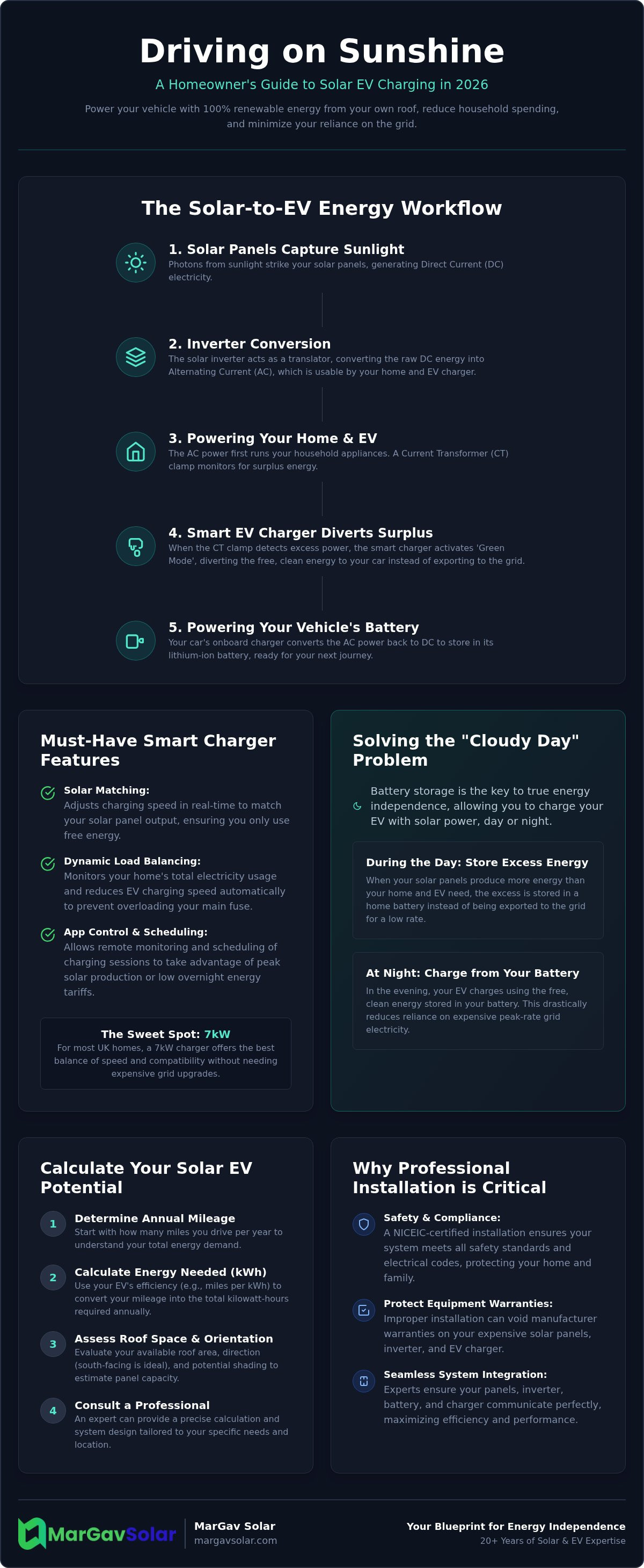
Understanding how your roof powers your commute starts with a simple particle of light. When photons strike your solar panels, they create a Direct Current (DC). However, your car and home appliances run on Alternating Current (AC). This is where the solar inverter steps in, acting as the translator for your energy system. It converts that raw solar energy into a format your car can actually use. For a foundational look at this technology, you can explore the history of How Solar EV Charging Works through stationary rooftop arrays.
If you use a standard EV charger for home with solar panels, you might accidentally pull power from the grid even when the sun is shining. Most chargers want to deliver a steady 7kW stream. If your panels only produce 4kW during a hazy Staffordshire afternoon, a non-smart charger will grab the remaining 3kW from the grid. This leads to unexpected costs. Smart energy apps solve this by providing real-time monitoring, allowing you to see exactly where every watt is going and ensuring you aren't paying for power you could have had for free.
The Technology Behind Solar Diversion
Solar diversion is the process of prioritising household appliances and car charging over grid export. To manage this, installers use Current Transformer (CT) clamps. These small sensors clip around your main incoming power cable to monitor which way the electricity is flowing. When they detect excess power heading toward the grid, the smart charger triggers 'Green Mode' and redirects that energy into your car battery instead. It's a seamless way to ensure you only charge when your roof produces a surplus.
AC vs. DC Charging: What Happens at Home?
While public rapid chargers use High-Voltage DC, residential systems in Staffordshire rely on AC charging. Your electric vehicle has an onboard charger that converts this AC power back into DC for the battery cells. Most Staffordshire homes have a single-phase electrical supply, which makes 7kW the 'sweet spot' for charging speed. It provides enough power to refill most batteries overnight without overloading your domestic fuse board or requiring expensive grid upgrades. Your car's internal conversion limit often dictates the final speed, but a 7kW unit offers the best balance for a typical EV charger for home with solar panels setup.
With over 20 years of industry experience, we've seen how critical the communication between the inverter and the charger is. If these two components don't talk to each other, you lose efficiency. Choosing a single-provider installation ensures your solar panels, battery, and charger work as one cohesive unit rather than separate, conflicting devices.
Choosing the Best Solar-Compatible EV Charger in 2026
Selecting the right hardware is about more than just picking a box that looks good on your driveway. In 2026, the best chargers act as intelligent conductors for your home's energy orchestra. An EV charger for home with solar panels must feature solar matching technology to be truly effective. This feature allows the charger to adjust its output in real-time, based exactly on what your panels are producing. Without this, you risk pulling expensive peak-rate electricity from the grid whenever a cloud passes over your Staffordshire home.
You also need to decide between tethered and untethered designs. Tethered chargers have the cable permanently attached, offering maximum convenience for daily use. Untethered units provide a cleaner look and allow you to swap cables if you change vehicles or need a longer reach. Regardless of the style, app-based control is no longer optional. With dynamic energy tariffs becoming the norm, your charger must be able to schedule sessions automatically when prices are lowest or solar yield is at its peak.
Smart Integration Features
Dynamic load management is a critical safety feature for modern properties. It monitors the total power draw of your home, ensuring that if you turn on the oven and power shower while the car is charging, the system automatically dials back the EV's intake to protect your main fuse. While the hardware choice is important, the safety of your home's electrical system is paramount. Securing a Professional Installation ensures that your setup complies with the latest electrical codes and handles the high sustained loads required for vehicle charging.
We also look for chargers that offer multiple operating modes. 'Solar-only' mode is perfect for weekends when the car can sit and soak up every spare watt. 'Solar-boost' mode is better for busy weekdays, using a mix of solar and grid power to guarantee a full battery by morning. For high-power chargers, we handle the G98 or G99 applications to the Distribution Network Operator (DNO) on your behalf, ensuring your local grid connection can support the increased demand without issue.
Durability and Aesthetics for Staffordshire Properties
Staffordshire's damp climate demands high weatherproofing standards. Look for an IP65 rating to ensure your EV charger for home with solar panels can withstand driving rain and frost over a decades-long lifespan. Many homeowners now prioritise Red Dot-awarded designs that complement modern architecture or blend discreetly into traditional brickwork. Future-proofing is equally vital; choosing a charger compatible with bi-directional charging (V2H/V2G) means your car might one day power your home during a blackout.
With 20 years of expertise, we focus on brands that offer seamless communication between your car and your energy storage. If you want a system where every component works in harmony, consider an integrated solar and EV charging solution that maximises your self-consumption levels.
The Role of Battery Storage in Solar EV Charging
An EV charging point installation is significantly more effective when you pair it with a home battery. Without storage, your car only soaks up solar energy while it's parked during daylight hours. For many Staffordshire professionals, the car is away from the driveway during the sunniest parts of the day. A battery captures that surplus energy, holding it until you return home. When Choosing the Best Solar-Compatible EV Charger, you must consider how it interacts with this stored power. While direct panel-to-car charging is the most efficient due to lower conversion losses, using a battery ensures you aren't exporting energy at 15p per kWh only to buy it back at 30p later that evening.
Oversight is key to managing these complex flows. Integrating your hardware with the GivEnergy Cloud provides total system visibility. You can see exactly when your battery is full and automate when your EV charger for home with solar panels should start pulling from that stored reserve. During the low-output winter months, the battery acts as a vital buffer. It smooths out the peaks and troughs of generation to keep your vehicle topped up without constant grid reliance.
The 'Golden Triangle' of Energy Independence
Your solar panels, solar battery storage, and EV charger form a single, unified ecosystem. In a well-configured system, the software prioritises your home's immediate needs first. Surplus energy then flows to the battery. Only once the battery is sufficiently charged does the system direct power to the car. This hierarchy ensures your lights and fridge stay on for free before the car starts its charging cycle. Smart automation handles the switch between these sources and off-peak grid power, so you don't have to manually flip any switches.
Maximising ROI with Smart Tariffs
Batteries are essential for navigating 2026's agile UK energy tariffs. During winter, when solar yield is lower, you can use your battery to avoid expensive peak-rate charging. Force-charging a battery at night when electricity is at its cheapest can provide cheap EV power the next morning. This synergy between GivEnergy hardware and smart tariffs means you're always using the most cost-effective electron available. It turns your home into a mini power station that thinks for itself. With 20 years of expertise, we ensure these components talk to each other perfectly, protecting your long-term investment.
Calculating Your Solar EV Potential: Panels, Power, and Performance
Determining if your roof can fully power your car requires a clear look at your driving habits and available roof space. First, calculate your daily kWh requirement based on your annual mileage. For example, if you drive 10,000 miles a year at an average efficiency of 3.5 miles per kWh, your vehicle needs roughly 2,850 kWh annually. Dividing this by 365 days gives you a daily target of about 7.8 kWh. Your EV charger for home with solar panels needs to pull this amount from your system to maintain a zero-carbon commute.
Next, assess your roof capacity and orientation. A South-facing roof in Staffordshire provides the highest yield, but East/West splits are increasingly popular for EV owners. This split spreads generation across the day, providing power for morning school runs and evening returns. Shading from chimneys or nearby trees can drop output by 20% or more, so clear lines of sight are vital. You must also factor in seasonal variance. While summer offers weeks of "free" miles, winter requires a smart grid strategy to supplement lower solar production.
How Many Panels Do You Actually Need?
We often use the '1-kilowatt rule' to help homeowners visualise their potential. On a clear day, 1kW of solar capacity generates enough energy to provide roughly 3 to 4 miles of range for every hour of peak sun. To balance both household appliances and car charging, a 4kWp to 6kWp system has become the 2026 standard for Staffordshire families. This size typically allows for a daily power split where the home's base load is covered first, leaving a healthy surplus for the car battery.
Staffordshire Solar Yields in 2026
In the West Midlands, a well-positioned 4kWp system can produce around 3,400 to 3,800 kWh per year. This exceeds the annual requirement for a 10,000-mile driver, but only if the system is running at peak efficiency. Regular solar panel maintenance is critical to prevent dust and debris from blocking those vital photons. High-efficiency panels now perform remarkably well on the overcast days common to our local climate, ensuring you still harvest energy even when the sky is grey.
Every property is unique, and getting the maths right is the difference between true independence and unexpected bills. When planning an EV charger for home with solar panels, precise data is your best tool. Request a solar EV potential assessment to see exactly how many panels your driveway needs.
Professional Installation: Transforming Your Staffordshire Home
Installing an EV charger for home with solar panels requires more than just a mounting bracket and a drill. It's a high-voltage project that demands a deep understanding of your property's specific electrical capacity. We start with a comprehensive site survey to assess your fuse board and earthing requirements. Many Staffordshire homes, especially older properties, may need a dedicated circuit to handle the sustained 7kW draw of a modern charger safely. We also map out the most efficient cable runs to minimise disruption to your driveway and landscaping while maintaining peak conductivity.
MarGav Solar provides fixed-price contracts, ensuring local families face no hidden surprises mid-project. This transparency is backed by our 20 years of industry experience, providing a level of reliability that DIY or generalist electrical services can't match. During the handover, we don't just leave you with a manual; we walk you through your smart apps and configure your solar diversion settings. This ensures your car prioritises excess solar yield from the very first day, turning your roof into a fully functional filling station.
Electrical Safety and Certification
Ensuring your solar panel installation meets the latest IET wiring regulations is non-negotiable for both safety and insurance compliance. We integrate Surge Protection Devices (SPDs) into every setup. These components are vital for protecting your vehicle's sensitive electronics and onboard computer from external voltage spikes. By choosing NICEIC-certified installers, you guarantee that every connection is tested, verified, and officially logged with local building control.
Long-term Support and Maintenance
Technology evolves quickly, but your system's reliability should remain constant over decades. Our 20-year expertise allows us to offer annual health checks that keep your solar-to-EV link running at peak efficiency. We often find that a periodic check-up or a strategic inverter upgrade can significantly improve your ROI as your family's energy needs change. If you decide to add more panels or a second charger as your fleet grows, we ensure the new components integrate seamlessly with your existing infrastructure. This single-provider approach eliminates the communication errors common when mixing different installation teams.
Take Control of Your Energy Future
Transitioning to homegrown energy is no longer a complex puzzle for Staffordshire homeowners. By aligning your roof's generation with smart storage and a high-performance EV charger for home with solar panels, you can effectively bypass rising grid costs. This guide has shown how the "Golden Triangle" of solar, battery, and charging works together to ensure every photon is used efficiently, whether you're charging under the summer sun or using a smart battery buffer during a grey West Midlands winter.
The key to long-term success lies in a seamless, professional installation that respects the latest safety regulations and maximizes your ROI. With NICEIC Certified Installers and over 20 years of renewable energy expertise, MarGav Solar ensures your system is future-proofed and reliable. We offer fixed-price installation contracts so you can plan your transition with absolute confidence. It's time to stop paying for fuel and start harvesting it from your own roof. Book Your Free Staffordshire Solar EV Consultation with MarGav Solar and take the first step toward true energy independence today.
Frequently Asked Questions
Can I charge my EV with solar panels if I don't have a battery?
Yes, you can charge your vehicle directly from your panels without a battery. However, you must plug in your car during daylight hours when your system is actively producing energy. Without storage, any surplus power not used by your car or home will be exported to the grid. For many Staffordshire residents, this makes solar charging most effective on weekends or for those who work from home.
How many solar panels do I need to charge a Tesla or similar EV?
A typical setup requires approximately 10 to 14 high-efficiency panels to create a 4kWp to 6kWp system. This capacity generally provides enough surplus energy to cover roughly 8,000 to 10,000 miles of driving per year. The exact number depends on your daily mileage and your car's efficiency. A larger array ensures you have enough power for both your household appliances and your vehicle's battery during shorter winter days.
What happens if it's a cloudy day in Staffordshire? Will my car still charge?
Your car will still charge on cloudy days, but the rate of generation will be lower than in direct sunlight. Modern solar panels are designed to harvest diffuse light, meaning they produce energy even when the Staffordshire sky is overcast. In these conditions, your smart charger might pull a small amount of supplementary power from the grid to maintain a steady charge, or it may simply charge the car more slowly.
Do I need a special type of EV charger to work with solar panels?
You need a "solar-aware" smart charger to maximise your savings. While any unit can charge a car, a specific EV charger for home with solar panels communicates with your inverter to detect surplus energy. This technology prevents the system from pulling expensive electricity from the grid. It allows you to set "solar-only" modes, ensuring your car only charges when your roof is producing 100% green, free power.
Is it cheaper to charge my car with solar or a night-time energy tariff?
Solar energy is the most cost-effective option because the "fuel" is free once your system is installed. During winter months, a night-time off-peak tariff is a vital secondary tool. Many Staffordshire residents find the best balance by using solar during the day and force-charging their battery or car at night when rates are lowest. This hybrid approach ensures you never pay peak-time prices for your commute.
How long does it take to charge an electric car from 0 to 100% using only solar?
Charging a 60kWh battery from empty to full using only solar typically takes between one and three days, depending on the time of year. A standard 4kWp system produces roughly 15 to 25kWh on a sunny summer day. Since most drivers only use a fraction of their battery daily, your roof can easily replenish those "lost" miles within a few hours of peak sunshine, making a 100% solar charge achievable for daily use.
Can I install my own solar EV charger at home?
You shouldn't attempt to install an EV charger yourself. This work involves high-voltage electrical connections and must comply with strict building regulations and IET wiring standards. A professional installation by NICEIC-certified experts ensures your home's main fuse is protected and your warranty remains valid. Professional installers also handle the necessary DNO applications required to notify the local grid of your new high-power device.
Will solar EV charging work with my existing solar panel system?
Yes, solar EV charging is compatible with most existing solar setups. You may need to add a smart sensor or consider an inverter upgrade to allow the charger to "see" your solar production accurately. If your current system is older, it's a great time to consider adding battery storage. This allows you to store the energy your existing panels produce during the day for use in your car later that evening.


