

Choosing to install your own solar panels to save on labor costs might actually be the most expensive financial mistake you make in 2026. While the idea of a weekend project sounds appealing, the reality of DIY solar panels vs professional installation UK has changed significantly due to strict safety regulations and shifting tax incentives. You're likely searching for a way to slash your electricity bills and protect your home from rising energy costs without falling into a trap of voided insurance or damaged roof structures.
It's completely understandable to feel frustrated by the technical maze of G98 notifications and MCS certifications. You want a high-yielding system that pays for itself, not a legal headache that prevents you from earning money back. This guide clarifies the financial and safety realities of both paths so you can make the smartest investment for your property. We'll look at why skipping professional help means missing out on 0% VAT relief and Smart Export Guarantee (SEG) payments, and how expert fitting ensures your system remains a safe, profitable asset.
Key Takeaways
- Learn why professional installation is often more cost-effective than DIY by securing 0% VAT relief and eligibility for annual Smart Export Guarantee (SEG) payments.
- Understand the technical hurdles of G98 and G99 grid connections and why Microgeneration Certification Scheme (MCS) standards are vital for legal compliance.
- Compare the financial realities of DIY solar panels vs professional installation UK to protect your home insurance and increase your property value.
- Discover how to avoid critical safety risks, such as DC arc fires and structural roof damage, by using certified electrical experts.
- Find out how fixed-price contracts from experienced Staffordshire installers eliminate hidden costs like scaffolding and DNO application fees.
Is DIY Solar Legal in the UK? Understanding the Regulations
You can legally buy and physically install solar components on your own property in the UK. However, the "legal to build" aspect is only half the story. While Solar power technology has become more accessible, the regulatory framework governing its connection to the National Grid and home electrical systems is incredibly strict. The debate of DIY solar panels vs professional installation UK often hinges on these legalities, as a system that isn't properly certified can lead to fines, forced removal, or an invalidated home insurance policy.
Permitted Development vs. Planning Permission
Most residential solar installations fall under "Permitted Development" rights. This means you don't usually need formal planning permission. To stay within these rules, panels shouldn't protrude more than 200mm (20cm) from the roof slope. If you're installing on a flat roof, the equipment must not be the highest part of the building.
Staffordshire homeowners living in conservation areas or listed buildings face tougher hurdles. In these cases, you must consult local planning authorities before starting any work. Ground-mounted arrays also have specific size limits and proximity rules regarding property boundaries. Ignoring these local bylaws can result in costly enforcement notices that require you to dismantle your entire setup.
The Electrical Safety Threshold
The biggest legal bottleneck for DIYers is Part P of the Building Regulations. This law dictates that most electrical work in "special locations," including solar PV circuits, must be carried out by a competent person or notified to local building control. DIY electrical work often fails to meet the rigorous BS 7671 standards required for a safe home environment.
When comparing DIY solar panels vs professional installation UK, the certification factor is a dealbreaker. Professional installers provide NICEIC certification, which proves the work is safe and compliant. Without this, or an equivalent MCS certificate, you'll struggle to prove to your insurer or the District Network Operator (DNO) that your system won't cause a fire or destabilize the local power grid. Self-certifying is simply not an option for non-professionals, meaning you'd have to pay a private building control officer hundreds of pounds to inspect and sign off on your DIY handiwork, often negating any initial savings.
The Technical Risks: Why Professional Skills Matter
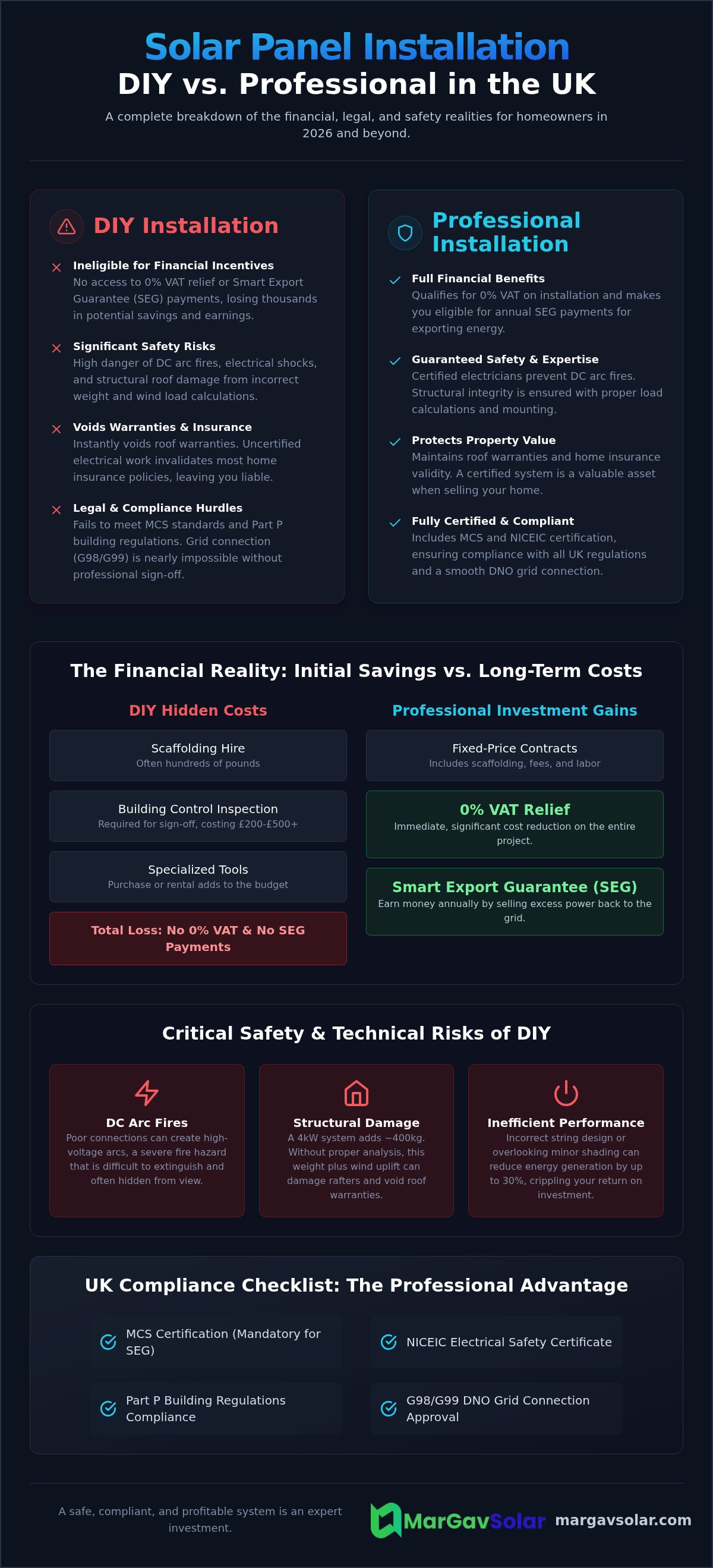
The physical act of mounting panels is often where the debate of DIY solar panels vs professional installation UK meets its most dangerous reality. A standard 4kW system adds roughly 280kg to 400kg of dead load to your roof rafters. When weighing up DIY solar panels vs professional installation UK, remember that professionals use specialized software to ensure the roof can handle both this weight and the upward force of wind. Without professional wind-loading calculations, a strong gale can create a "sail effect," potentially ripping panels and tiles clean off the structure.
Electrical safety is the other invisible hurdle. Solar systems generate high-voltage Direct Current (DC), which is far more prone to "arcing" than the Alternating Current (AC) in your home sockets. A single loose connection or a poorly crimped cable can lead to a DC arc fire. These fires are notoriously difficult to extinguish and can smoulder undetected under your panels. Professional string design and shading analysis also ensure you get the highest possible yield; a DIYer might lose 30% of their generation just by placing a string in a spot that catches a chimney shadow for two hours a day.
Roof Warranties and Structural Liability
Your roof likely came with a 20 or 25-year guarantee. If you drill into the rafters or disturb the tiles yourself, that warranty is usually voided instantly. Professional installers use specific flashing kits and mounting brackets designed to maintain a watertight seal. If a DIY installation leads to a slow leak, you'll be footing the bill for both the solar removal and the structural timber repairs. This becomes a massive red flag during property surveys; uncertified solar can stall a house sale or force a significant price reduction when the buyer's surveyor identifies the structural risk.
Insurance and Home Safety
Maintaining home insurance is nearly impossible with a self-fitted system. Most UK insurers explicitly require work to be completed by a firm registered with the Microgeneration Certification Scheme (MCS) or NICEIC. If a fire occurs, even if it wasn't caused by the solar panels, an insurer may refuse to pay out if they discover uncertified high-voltage equipment on the property. A Certificate of Compliance is a legal document issued by a qualified installer that confirms the system meets all current UK building and electrical safety standards for insurance purposes.
Choosing a professional solar panel installation ensures these technical boxes are ticked from day one. If you're unsure about your roof's capacity, getting a professional assessment from MarGav Solar can save you from a very expensive structural mistake.
DIY vs. Professional Solar: The Financial Reality
Many homeowners assume that doing the work themselves is the fastest way to lower the payback period of a renewable energy system. While you might save on the hourly rate of a technician, the financial comparison of DIY solar panels vs professional installation UK reveals a massive tax disadvantage for the self-builder. Buying your own components means paying the standard 20% VAT rate on every panel, cable, and bracket. This initial tax hit often negates the perceived savings of a "budget" DIY project.
The VAT Trap Explained
UK tax law currently offers a 0% VAT rate on residential solar installations, a relief scheduled to run until March 31, 2027. Crucially, this 0% rate only applies when the equipment is supplied and installed by a professional firm. If you buy the panels yourself from a retail outlet, you pay the full 20% tax. On a mid-sized system, this extra tax can easily exceed £1,500. This often means the savings from DIY labour are wiped out before you even step on a ladder, as the professional price includes the equipment at a tax-free rate.
SEG Payments and Long-Term ROI
The real financial blow to DIYers comes after the installation. When evaluating DIY solar panels vs professional installation UK, the loss of the Smart Export Guarantee (SEG) is a critical factor. To get paid for excess electricity you send back to the grid, you must provide an MCS certificate. Since DIYers aren't MCS-certified, they're locked out of these payments entirely. At a competitive rate of 15p per kWh, a typical 3.5kWp system could earn around £225 annually. Over a 20-year lifespan, that's £4,500 in lost revenue that a DIY system simply can't recover.
When you factor in solar battery storage, the ROI math shifts even further. A battery allows you to use your own power at night, but without professional commissioning, you may struggle to access the best time-of-use tariffs. Additionally, consider the hidden costs of safety. Professional firms include scaffolding and fall protection in their fixed-price contracts. A DIYer renting scaffolding and buying specialist DC testing meters will quickly see their budget vanish. Even future inverter upgrades are more cost-effective when handled by experts who can maintain the system's certification and safety standards.
The 'Grid Connection' Hurdle for UK Homeowners
Every solar system that exports power must be registered with your Distribution Network Operator (DNO). These are the companies responsible for the physical cables and substations in your area. They care deeply about your installation because poorly regulated exports can destabilise the local grid and cause power surges for your neighbours. When comparing DIY solar panels vs professional installation UK, many homeowners overlook the fact that the DNO has the legal power to disconnect your property if they discover an unnotified system.
A major barrier for the DIY route is the technical documentation required for these applications. DNOs demand professional single-line diagrams (SLDs) and proof that your equipment appears on the official "Type Test" register. This register ensures that your inverters and batteries won't interfere with the grid's frequency. Most DIYers lack the specialized CAD skills and electrical engineering knowledge to produce these documents, leading to rejected applications and stalled projects.
Staffordshire Grid Specifics
In Staffordshire, the network is managed by National Grid (formerly Western Power Distribution). The application process depends on the size of your system. For small arrays up to 3.68kW per phase, a G98 "Connect and Notify" process applies. This allows you to commission the system and inform the DNO within 28 days. However, if you're installing a larger system or adding significant battery storage, you must follow the G99 process. This requires formal approval before any work begins and can take between 8 to 12 weeks for the DNO to process. Professional installers handle this entire administrative burden, ensuring your system is fully compliant with local capacity limits.
MCS Certification: The Golden Ticket
The Microgeneration Certification Scheme (MCS) is the industry's quality benchmark. A common myth on internet forums is that you can install the panels yourself and simply pay a professional to "sign it off" later. In reality, most reputable firms will refuse to do this. By signing off on work they didn't perform, the professional inherits 100% of the safety and structural liability. Without that MCS certificate, you can't access the Smart Export Guarantee (SEG) to earn money back from your energy supplier.
Choosing a professional team ensures your home remains a safe, grid-connected asset from day one. If you want to avoid the paperwork headache and secure your export payments, contact MarGav Solar for a fully certified installation that meets all National Grid requirements.
Why Staffordshire Homeowners Choose MarGav Solar
MarGav Solar has spent over 20 years refining the process of bringing renewable energy to the Midlands. When you weigh up DIY solar panels vs professional installation UK, the most significant difference is the long-term support and reliability you receive. We offer fixed-price contracts that include every essential element, from specialized scaffolding to final DNO notifications. This ensures the price we quote is the price you pay. You won't face hidden fees for structural checks, specialist meters, or safety certifications that often surprise DIYers mid-project.
Our NICEIC-certified installers handle the complex high-voltage electrical work that frequently leads to DIY errors. While a self-build might seem cheaper on paper, MarGav ensures you benefit from the 0% VAT rate on both labor and materials. This tax saving, combined with guaranteed eligibility for SEG payments, usually makes our professional service a more financially sound investment than a solo project. We take the risk out of the equation, providing you with a system that is safe, legal, and optimized for maximum yield.
Local Support and Expertise
Choosing a local Staffordshire team provides a level of security that a DIY kit simply cannot match. If a component fails or your generation drops, we're just a phone call away. Our end-to-end service includes long-term solar panel maintenance to keep your system performing at its peak for decades. We don't just fit panels and leave; we ensure your investment remains a high-performing asset.
We only use high-efficiency, tier-1 components to ensure your roof generates the maximum possible power. For homeowners looking to future-proof their properties, we can seamlessly integrate EV charging points into your professional solar setup. This holistic approach ensures your home's electrical infrastructure is safe, balanced, and ready for the demands of 2026 and beyond.
Your Path to Sustainable Energy
The MarGav process is designed to be entirely risk-free. We start with a detailed consultation to assess your roof's structural integrity and orientation. Our team then creates a bespoke design focused on maximizing your ROI. Once the installation is complete, we provide all the necessary certifications to protect your home insurance and property value. This documentation is vital when comparing DIY solar panels vs professional installation UK, as it serves as your proof of compliance for future house sales.
We provide smart monitoring tools so you can track your savings in real-time without needing to troubleshoot the hardware yourself. Request a professional quote from MarGav Solar today to compare against your DIY estimate and discover the true value of an expert installation.
Secure Your Home's Energy Future
Deciding on the right path for your renewable energy journey often comes down to balancing immediate savings against long-term security. While a weekend project might feel like a win, the financial reality of DIY solar panels vs professional installation UK shows that expert fitting pays for itself through 0% VAT relief and years of guaranteed export income. You aren't just buying hardware; you're investing in a certified system that protects your roof, your home insurance, and your property's resale value.
Choosing a professional route removes the stress of navigating G98 grid notifications and complex safety standards. With 20+ years of excellence as Staffordshire local experts, our team ensures your system is NICEIC and MCS compliant from day one. This certification is your ticket to a high-yielding, risk-free energy solution that works for your home's specific needs. It's the difference between a temporary fix and a permanent, income-generating asset for your property.
Ready to start saving? Get a Professional Solar Quote for Your Staffordshire Home and take the first step toward a safer, more profitable energy future today.
Frequently Asked Questions
Is it legal to install solar panels yourself in the UK?
Yes, it is legal to physically mount solar panels on your property yourself. However, all electrical work must comply with Part P of the Building Regulations. This means you must either be a qualified competent person or pay local building control to inspect and certify the work, which often negates any initial savings from a DIY project.
Can I get the Smart Export Guarantee (SEG) with DIY solar panels?
No, you cannot access SEG payments without an MCS certificate. Energy suppliers require this certification to prove the system meets national safety and quality standards. By choosing the DIY route, you lose out on annual earnings that can reach £225 for a typical 3.5kWp system exporting at a rate of 15p per kWh.
Will DIY solar panels void my home insurance?
In most cases, yes. Most UK insurers require that high-voltage electrical systems are installed by certified professionals. If you cannot provide an NICEIC or MCS certificate following a fire or structural issue, your insurer will likely reject your claim. This leaves you personally liable for all repair costs and potential damage to neighbouring properties.
Do I need an MCS certificate for solar panels in the UK?
While an MCS certificate isn't a legal requirement for the panels to function, it's essential for financial viability. It is the only way to qualify for SEG export payments and is often required by mortgage lenders when you sell your home. Without it, your solar array is viewed as an uncertified modification rather than a property asset.
Can a professional electrician sign off my DIY solar installation?
It is very rare to find an electrician willing to sign off on DIY work. When a professional signs a completion certificate, they take full legal responsibility for the entire installation, including the structural mounting and cabling they didn't perform. Most reputable installers won't risk their accreditation or insurance to validate a self-build project.
Is there still 0% VAT on professional solar installations in 2026?
Yes, the 0% VAT rate for residential solar panel installations is currently in effect and scheduled to run until March 31, 2027. This incentive applies only to professional installations where the firm supplies and fits the equipment. In the debate of DIY solar panels vs professional installation UK, this 20% tax saving on parts often covers the professional labour costs.
What happens if I don't notify the DNO about my solar panels?
Failure to notify the Distribution Network Operator (DNO) is a breach of the Electricity Safety, Quality and Continuity Regulations. The DNO has the power to disconnect your system if it poses a risk to the local grid. For systems under 3.68kW, you must submit a G98 notification within 28 days of commissioning to remain legal.
How much can I save by choosing professional installation over DIY?
While DIY saves on upfront labour, professional installation is often more profitable over five years. When comparing DIY solar panels vs professional installation UK, professionals secure the 0% VAT relief and SEG eligibility. A typical homeowner avoids paying 20% VAT on components and gains roughly £4,500 in export income over the system's 20-year lifespan, which DIYers cannot claim.


