

What if your business's biggest overhead in 2026 isn't your rent or payroll, but the cost of ignoring the transition to electric transport? Many UK business owners feel overwhelmed by the complexity of commercial EV charging point installation UK. You're likely concerned about high upfront costs, the headache of DNO applications, and whether your current grid capacity can even handle the extra load. It's a lot to manage when you're already focused on daily operations.
This guide will show you how to turn that complexity into a long-term competitive advantage. By adopting a solar-first strategy, you can build a scalable infrastructure that significantly reduces energy overheads. We'll explore how to access the latest OZEV grants, such as the Workplace Charging Scheme which provides up to £500 per socket, and how to ensure your site meets the strict requirements of Building Regulations Part S. You'll discover a clear roadmap to future-proof your premises, simplify fleet management, and leverage integrated battery storage. By utilizing fixed-price installation contracts, you can keep your business moving forward while ensuring your budget remains entirely predictable.
Key Takeaways
- Learn why the 2035 petrol and diesel ban makes EV infrastructure a vital tool for attracting talent and future-proofing your fleet operations.
- Identify whether AC fast chargers or DC rapid chargers best suit your business based on stay duration and vehicle turnover.
- Discover how to slash operational expenses by pairing your commercial EV charging point installation UK with solar PV and battery storage.
- Simplify the complex process of DNO applications and site surveys to ensure full compliance with current UK building regulations.
- See how fixed-price contracts and local expertise provide a predictable, stress-free path to a self-sustaining energy ecosystem.
The Business Case for Commercial EV Charging Point Installation in the UK
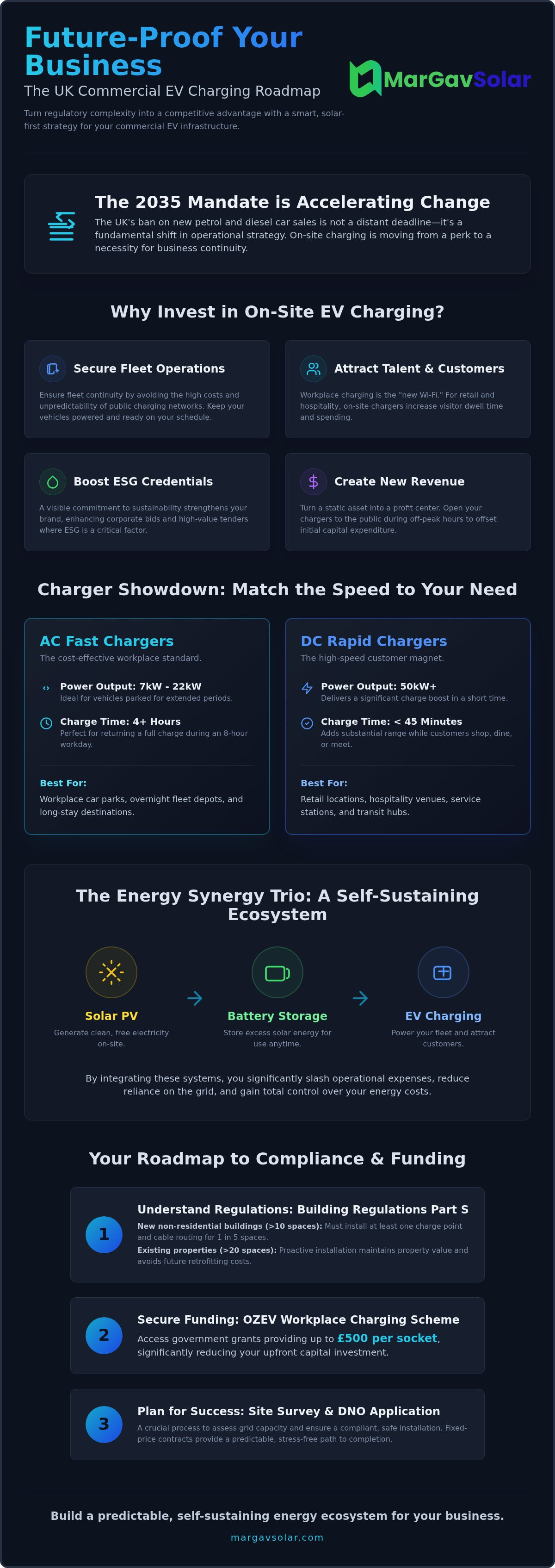
The UK government's mandate to end the sale of new petrol and diesel cars by 2035 has shifted the conversation from "if" to "when." For businesses, commercial EV charging point installation UK represents a fundamental shift in operational strategy. Companies managing delivery vans or sales fleets must secure their own charging hubs to avoid the high costs and unpredictability of public networks. It's about fleet continuity. Without on-site power, your transition to electric transport will be dictated by the availability of external chargers rather than your own schedule.
A robust electric vehicle charging infrastructure also serves as a visible marker of your ESG (Environmental, Social, and Governance) commitments. This is no longer just a "nice to have" feature; it's a critical component for corporate bidding and securing high-value tenders. It also offers a potential new revenue stream. By opening your car park to the public during off-peak hours, you can turn a static asset into a profit centre that helps offset the initial capital expenditure.
Meeting Employee and Customer Demand
Workplace charging is quickly becoming the "new Wi-Fi" for modern offices. Employees who don't have off-street parking at home rely on their employers to provide reliable power. This facility is essential for those utilizing salary sacrifice schemes, as it lowers the total cost of EV ownership for your team. In the retail and hospitality sectors, rapid charging facilities are proven to increase visitor dwell time. Customers are more likely to choose a destination where they can gain significant range while they shop, eat, or attend a meeting. If they can top up their battery while they engage with your business, they're likely to stay longer and spend more.
The Impact of UK Building Regulations
Compliance is a major driver for immediate action. Under Building Regulations Part S, which came into effect in June 2022, all new non-residential buildings with more than 10 parking spaces must install at least one active charging point. They must also provide cable routing for one in five spaces to facilitate future growth. For existing commercial properties with more than 20 spaces, staying ahead of these mandates is a smart way to maintain property value. Opting for commercial EV charging point installation UK now ensures you aren't left behind as standards evolve. By installing infrastructure today, you avoid the disruptive groundworks and higher costs associated with emergency retrofitting when regulations tighten further.
Selecting the Right Infrastructure: AC Fast vs. DC Rapid Chargers
Choosing the right hardware for a commercial EV charging point installation UK isn't just about picking the fastest unit available. It requires a strategic look at how your vehicles or visitors use your site. AC fast chargers, typically ranging from 7kW to 22kW, are the standard choice for workplace environments. These units are cost-effective and perfectly suited for vehicles parked for four hours or more. In contrast, DC rapid chargers (50kW and above) are essential for transit hubs or retail locations where users expect a significant battery boost in under 45 minutes.
Hardware durability also plays a role in your decision. Tethered units come with a fixed cable, offering convenience for fleet drivers who don't want to dig through a boot for their own leads. However, socketed units are often preferred for public-facing areas. They're more resilient against vandalism and accommodate any EV driver who carries their own Type 2 cable. If you're unsure which hardware fits your site's electrical capacity, consulting with specialists in EV charging points can prevent costly mistakes during the design phase.
Matching Hardware to Dwell Time
Dwell time is the most important metric for ROI. For staff working an eight-hour shift, a 7kW charger is usually sufficient to return a full charge by the end of the day. If your business hosts visitors for shorter meetings, 22kW chargers provide a better experience, though these require a 3-phase power supply. Before committing to a commercial EV charging point installation UK, you must assess if your building has the 3-phase infrastructure to support these higher speeds without requiring a major grid upgrade.
Smart Charging and Software Management
The hardware is only half of the equation. Modern commercial chargers must be "smart" to comply with UK regulations. This allows for load balancing, a technology that dynamically distributes available power across multiple units. If ten cars plug in at once, the system ensures the building's main fuse doesn't trip by slightly reducing the charge rate to each vehicle. Back-end software also simplifies administration. You can set different tariffs for employees and the public, use RFID cards for secure access, and generate automated reports for tax purposes. For companies with take-home fleets, these platforms can even track home charging sessions to ensure employees are accurately reimbursed for business mileage.
Energy Synergy: Integrating Commercial EV Charging with Solar PV
MarGav Solar brings over 20 years of expertise to these complex integrations. We don't just install a box on a wall; we design systems where solar PV, battery storage, and EV chargers work in harmony. By using fixed-price installation contracts, we ensure your transition to renewable energy is predictable and transparent from the start. This end-to-end support is why many Staffordshire businesses choose a local specialist over faceless national corporations.
The Total Cost of Ownership (TCO) for an electric fleet is heavily influenced by the source of its power. Charging via the grid at peak daytime rates can be expensive, potentially eroding the savings you expected when switching from diesel. By using self-generated solar energy, you drop the "cost per mile" significantly for every unit produced on-site. Smart inverters play a vital role here. They monitor your building's load and automatically prioritise solar gain for vehicle charging before exporting any power back to the grid. For a deeper look at how this works on a local level, check out our Solar Panel Installation in Staffordshire: A Comprehensive Guide.
Battery Storage as a Grid Buffer
The technical side of commercial EV charging point installation UK often feels like a bureaucratic maze. The most critical hurdle is the Distribution Network Operator (DNO) application. Depending on your site's capacity, you'll likely need to navigate G98 or G99 notifications. While G98 is a simple "connect and notify" for smaller systems, most commercial sites require a G99 application to gain prior approval before any work begins. This ensures the local grid can handle the increased load without blowing a fuse in the street. MarGav Solar manages this entire process on your behalf, liaising with local operators like National Grid to secure the necessary permissions.
Financial support remains available through the Workplace Charging Scheme (WCS). This OZEV-backed grant currently provides up to £500 per socket for up to 40 sockets across your business sites. It's a significant way to lower the initial capital expenditure, but the application must be handled correctly to ensure the funds are released. By opting for fixed-price installation contracts, you avoid the risk of unexpected costs during the groundwork or electrical upgrade phases.
The 5-Step Installation Process
- Step 1: Initial consultancy and load monitoring: We assess your current electrical usage to determine how many chargers your site can support without overloading your main supply.
- Step 2: DNO application and approval: We handle the technical submissions to ensure your connection is legal, safe, and approved by the local network operator.
- Step 3: Civil works and electrical infrastructure installation: This phase includes any necessary trenching, cabling, and the physical mounting of the charging units.
- Step 4: Commissioning, testing, and staff training: We ensure every socket is fully operational and your team knows how to use the back-end management software.
- Step 5: Ongoing maintenance and OZEV grant finalisation: We submit the final paperwork to secure your grant funding and provide a plan for long-term system health.
Compliance and Safety Standards
Safety is paramount in high-traffic commercial environments. All installations must strictly adhere to the latest IET Wiring Regulations. A key requirement is PEN fault protection, which prevents electric shocks in the event of a fault in the supplier's neutral wire. Without this, your business could face significant liability. This is why NICEIC certification is non-negotiable. It proves your system has been installed to the highest industry standards, which is a core requirement for most commercial insurance policies. If you're ready to secure your site's energy future, contact our team for a professional EV charging consultation.
Expert Commercial EV Installation in Staffordshire: The MarGav Advantage
National corporations often treat commercial EV charging point installation UK as a volume game, sending out third-party contractors who may never visit your site twice. MarGav Solar takes a different path. Based in Staffordshire, we've spent over 20 years refining our approach to electrical and renewable systems. We understand that for a business, an installation isn't just a hardware purchase; it's a long-term commitment to infrastructure. By offering fixed-price installation contracts, we remove the financial ambiguity that often plagues large-scale projects. You won't find hidden fees for groundworks or unexpected electrical upgrades halfway through the build.
Our end-to-end support covers everything from the initial DNO paperwork to ongoing 2026 maintenance for your commercial EV charging point installation UK. Because we're local, we have a deep understanding of Staffordshire-specific grid constraints. We've navigated the requirements of National Grid across the county's major industrial estates and business parks. This local insight allows us to anticipate hurdles before they cause delays, ensuring your project stays on track and within budget. Our NICEIC certified team handles the entire process, ensuring your site remains compliant with the latest safety standards.
Why a Local Staffordshire Partner Matters
Choosing a local partner means you aren't just another ticket in a national queue. If you require technical support or maintenance, our response times are measured in hours, not days. We're part of the same community and are dedicated to supporting the local Staffordshire economy's green transition. Our "Solar-First" philosophy ensures your EV infrastructure works in tandem with your building's energy profile to lower operational costs. By sourcing your expertise locally, you gain a partner who is invested in the long-term success of your energy strategy.
Getting Started with MarGav Solar
The first step toward a self-sustaining energy ecosystem is a professional site survey. We don't believe in one-size-fits-all solutions. Instead, we customise your charging strategy to match your current fleet needs and your 2026 growth projections. Whether you need a handful of AC fast chargers for staff or a high-powered DC rapid hub for clients, we ensure the electrical design is robust. It's time to move beyond the complexity of national providers and work with a team that values reliability. Contact MarGav Solar for a Commercial EV Consultation today to begin your site assessment and secure your business's energy future.
Powering Your Business Forward
Transitioning to an electric fleet is about more than just legal compliance. It's a strategic move to lower overheads through solar integration and build a resilient, future-proof site. By selecting the right mix of AC and DC infrastructure, you ensure your premises remain a valuable asset for both employees and clients. A professional commercial EV charging point installation UK provides the foundation for this self-sustaining energy ecosystem.
MarGav Solar brings 20+ years of renewable energy experience to every project. Our Staffordshire-based local team ensures you receive personalized support and NICEIC certified installations that meet the highest safety standards. We focus on transparent, fixed-price contracts so you can plan your budget with total confidence. Ready to secure your energy future? Request a Fixed-Price Commercial EV Installation Quote today. Taking control of your energy production and usage is the smartest way to guarantee your business stays competitive in 2026 and beyond.
Frequently Asked Questions
How much can my business save by installing commercial EV chargers?
Your business can save significantly by switching from diesel to electricity, especially when charging on-site. Average workplace charging costs around 25.9p per kWh, which is often 50% cheaper than public AC alternatives. If you integrate your commercial EV charging point installation UK with solar PV, you drop these costs even further by using self-generated power. These savings help pay back the initial capital expenditure while protecting your fleet from volatile fuel price spikes.
What is the Workplace Charging Scheme (WCS) and is my business eligible in 2026?
The Workplace Charging Scheme is a voucher-based grant that covers up to 75% of purchase and installation costs. It provides up to £500 per socket for a maximum of 40 sockets across all your sites. In 2026, the scheme remains open to businesses, charities, and public sector organizations, with a current extension until March 31, 2027. It's a vital tool for reducing the upfront financial burden of building your charging infrastructure.
Do I need planning permission for commercial EV charging point installation in the UK?
Most businesses don't need planning permission for a standard commercial EV charging point installation UK. As of May 2025, these installations fall under permitted development rights for the majority of commercial properties. However, you'll still need to seek specific consent if your premises are a listed building or situated within a conservation area. It's always best to have your installer verify the site's status during the initial consultancy phase to avoid legal complications.
How long does a typical commercial EV charger installation take?
A typical installation takes between one and three days for the physical works, depending on the amount of trenching and cabling required. However, the end-to-end timeline is often longer due to the DNO application process. Obtaining approval from the local network operator can take several weeks before any groundworks begin. We manage these timelines closely to ensure your business operations face minimal disruption during the transition to electric vehicle infrastructure.
Can I charge customers for using my business EV charging points?
Yes, you can generate revenue by setting specific tariffs for customers or visitors. Modern back-end software allows you to manage different rates for staff and the public. Under the Public Charge Point Regulations 2023, you must ensure pricing is transparently displayed in pence per kWh. Additionally, any chargers with a capacity of 8kW or above must offer a contactless payment option to remain compliant with current UK law.
What happens if my site does not have enough electrical capacity for multiple chargers?
If your grid capacity is limited, you don't necessarily need an expensive substation upgrade. We utilize smart load management to dynamically distribute available power across all active sockets, ensuring your main fuse never trips. Another effective solution is installing battery storage. This allows you to store energy during low-demand periods and discharge it when multiple vehicles plug in, effectively buffering the load and keeping your installation costs predictable and manageable.
How often do commercial EV chargers need maintenance?
We recommend an annual maintenance check to ensure your system remains safe and efficient. These inspections include testing the electrical components, checking for physical wear on cables, and updating the back-end software. Regular maintenance is often a requirement for commercial insurance policies and helps maintain the validity of your NICEIC certification. It also ensures your chargers remain reliable for employees and customers, preventing downtime that could disrupt your daily business operations.
What is the difference between a DNO and an energy supplier in the context of EV charging?
The DNO (Distribution Network Operator) manages the physical cables and infrastructure that bring electricity to your site. In Staffordshire, this is usually National Grid. You must notify them of any new charging load to ensure grid stability. Your energy supplier is the company that sells you the electricity and sends your monthly bill. While you can switch suppliers to find better EV tariffs, you cannot change your DNO, as they're determined by your geographic location.


