
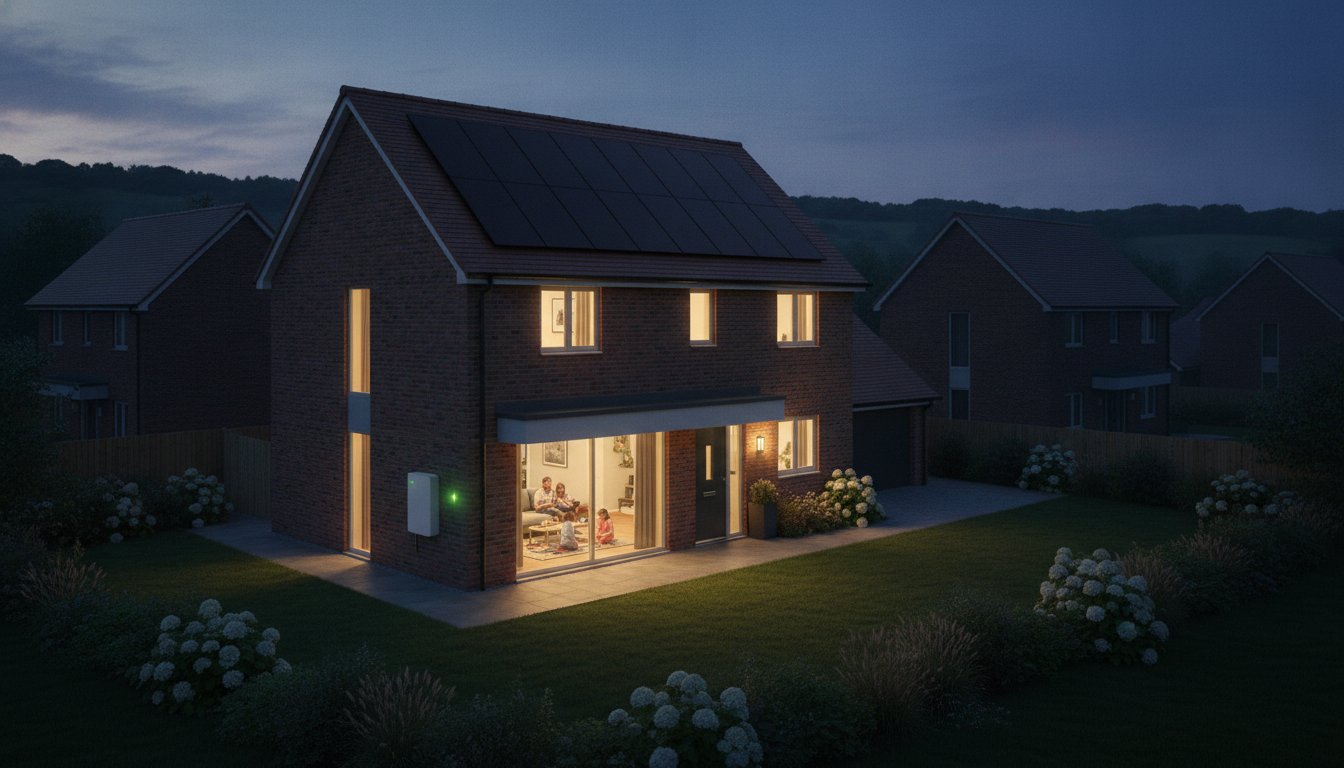
What if your solar panels could do more than just lower your bills during the day? Many homeowners are surprised to learn that standard solar setups often shut down during a blackout for safety reasons. To achieve true energy independence, you need a specialized solar battery backup system Staffordshire residents can rely on to "island" their homes from the grid. With UK electricity standing charges continuing to climb in 2026, simply generating power isn't enough anymore. You need the ability to store that energy and use it when the sun goes down or when the local network fails.
It's frustrating to invest in green technology only to feel vulnerable during a power cut or overwhelmed by the fear of "cowboy" installers. You deserve a home that runs seamlessly regardless of grid stability or fluctuating utility costs. This article explores how modern battery storage solutions maximize your self-consumption and allow you to capitalize on off-peak charging rates. We'll break down the latest 2026 regulations, including the 0% VAT relief currently available for battery installations, to help you secure your energy future with confidence.
Key Takeaways
- Learn why a true solar battery backup system Staffordshire installation requires "islanding" capabilities to keep your power running when the local grid fails.
- Understand how Staffordshire's unique mix of rural and urban properties impacts grid reliability and why backup is becoming a priority in 2026.
- Discover the technical differences between LFP and NMC battery chemistries and how "Depth of Discharge" affects your home's energy security.
- Get a clear overview of the professional installation process, including the essential G98 or G99 grid connection applications required for your property.
- Find out how to maximize your return on investment by combining solar generation with smart off-peak grid charging to bypass rising utility costs.
Understanding Solar Battery Backup Systems vs. Standard Storage
Many homeowners in the UK assume that having a battery means they're immune to power cuts. This is a common misconception. Most standard solar installations are grid-tied, meaning they're designed to shut down instantly if the National Grid fails. This safety feature, known as anti-islanding, prevents your system from sending electricity back into a "dead" grid where engineers might be working. To maintain power during an outage, you specifically need a solar battery backup system Staffordshire engineers have configured with an automatic transfer switch or a dedicated backup gateway.
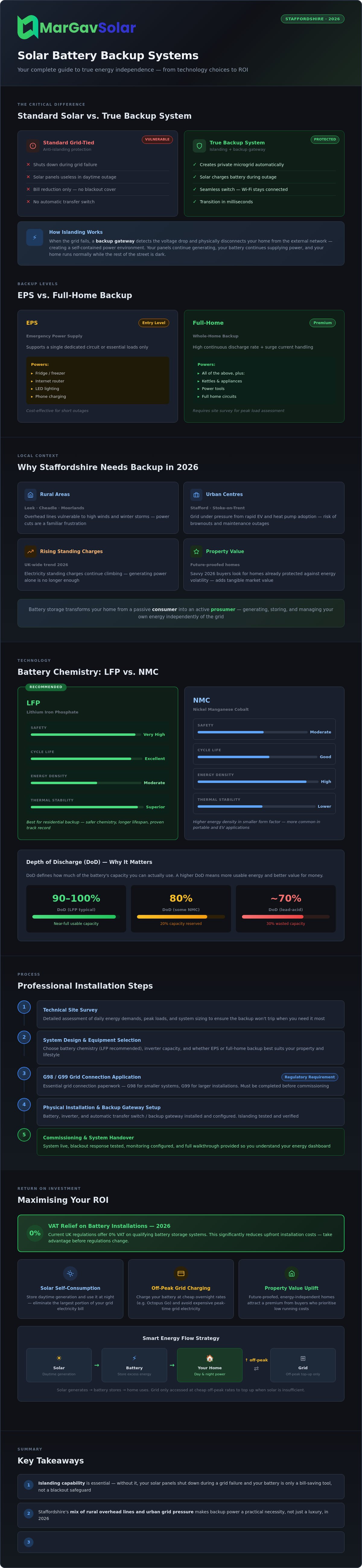
This gateway acts as a smart traffic controller. When it detects a drop in grid voltage, it physically disconnects your home from the external network and creates a private microgrid. It's helpful to understand what a home energy storage system is and how it interacts with your inverter to manage these transitions. Without this specialized hardware, your battery is simply a tool for reducing bills, not a safeguard against blackouts. It's the difference between saving money and keeping the lights on when the rest of the street goes dark.
What is Islanding and Why Does it Matter?
Islanding creates a self-contained power environment within your property. When the grid goes down, your system "islands" itself so your solar panels can continue charging the battery and your battery can continue powering your home. Islanding is the technical capability to operate independently from the National Grid during a failure. This transition must be seamless. A high-quality backup system detects the failure in milliseconds, ensuring your Wi-Fi doesn't even drop and your clocks don't need resetting. Without this capability, your solar panels are effectively useless during a daytime power cut.
EPS vs. Full Backup: Choosing Your Level of Security
Not every backup setup provides the same amount of power. An Emergency Power Supply (EPS) is often the entry-level choice. It typically supports a single dedicated circuit or a few essential loads like your fridge, internet router, and a few LED lights. It's a cost-effective way to stay safe and connected during short outages. You won't be able to run the oven, but you won't be sitting in the dark with spoiled food.
Full-home backup is more ambitious. It requires a battery with a high continuous discharge rate and an inverter capable of handling the "surge" current from appliances like kettles or power tools. At MarGav Solar, we conduct a detailed technical site survey to assess your daily energy demands. This helps us determine whether a targeted EPS or a robust whole-home solar battery backup system Staffordshire solution is the best fit for your lifestyle and budget. We look at your peak loads to ensure the system doesn't trip when you need it most.
Why Staffordshire Homeowners are Prioritising Backup in 2026
Staffordshire's geography plays a significant role in how residents think about power. From the exposed edges of the Peak District to the bustling streets of Stoke-on-Trent, the local grid faces diverse challenges. In 2026, relying solely on the National Grid feels increasingly risky as infrastructure ages and energy standing charges continue to rise across the UK. A solar battery backup system Staffordshire homeowners install provides a buffer against these uncertainties, turning a house from a passive consumer into an active "prosumer."
Energy independence isn't just about environmental goals anymore; it's a practical response to a changing market. With the UK's move toward more complex pricing structures, the ability to store your own power is the most effective way to shield your household from price spikes. Adding a robust backup system also increases the tangible value of your property. In 2026, savvy buyers in the Staffordshire real estate market look for homes that are already future-proofed against energy volatility.
Grid Reliability Across Staffordshire
For those living in rural areas like Leek, Cheadle, and across the Moorlands, power cuts are a familiar frustration. These regions often rely on overhead lines that are vulnerable to high winds and winter storms. Even in urban centres like Stafford and Stoke-on-Trent, the grid is under pressure from the rapid adoption of electric vehicles and heat pumps. This increased load can lead to local brownouts or maintenance-related outages. If you're tired of resetting your appliances, looking into battery storage solutions can provide the peace of mind that your home will stay powered regardless of local network issues.
Smart Tariffs and Off-Peak Charging
The financial case for backup systems has never been stronger. By integrating your system with UK smart meters, you can take advantage of dynamic pricing. This allows you to charge your batteries with cheap, off-peak electricity during the night and use that stored energy during expensive peak hours. Many homeowners follow advice on battery storage to maximise these savings, often seeing a significant reduction in monthly utility bills.
To manage this effectively, advanced monitoring is essential. Using tools like the GivEnergy Cloud allows you to track your generation and consumption in real-time. You can set your system to prioritise backup reserves if a storm is forecast, ensuring you always have a safety net. This level of control ensures that your investment works for you 24 hours a day, not just when the sun is shining.
Choosing the Right Battery Technology for Staffordshire Homes
Selecting the right hardware for your solar battery backup system Staffordshire installation involves more than just picking the highest capacity. You need to consider the battery chemistry, as this dictates how the system performs over time. Lithium Iron Phosphate (LFP) has become the gold standard for home storage, largely replacing Nickel Manganese Cobalt (NMC). LFP cells are chemically more stable and typically offer a longer cycle life. This is vital when you're relying on the battery for emergency power, as you need to know the cells won't degrade prematurely after years of daily use.
Depth of Discharge (DoD) is another critical metric that often confuses homeowners. If a battery has a 10kWh capacity but only a 90% DoD, you only have 9kWh of usable energy. For true backup scenarios, you want a system that allows 100% discharge. This ensures every bit of stored energy is available when the grid fails. It's also vital to distinguish between capacity (kWh) and power (kW). While kWh tells you how long the power lasts, the kW rating tells you what you can run at any one time. A 3kW inverter won't handle a kettle and a power shower simultaneously, even if the battery is full.
GivEnergy and High-Performance Backup
We often recommend GivEnergy for Staffordshire properties because their systems are built specifically for the UK's unique energy market. Their All-in-One systems are particularly popular as they combine the inverter and battery into a single, high-power unit capable of running most heavy appliances during a blackout. Alternatively, modular stacks allow you to start small and add more capacity as your needs grow. It's a great time to upgrade your home's infrastructure, especially since the VAT on solar and battery storage is currently 0%. For a deeper look at the technical specifications of these units, check out our Solar Battery Storage guide.
Battery Lifespan and Staffordshire Weather
Staffordshire winters can be unforgiving, particularly in exposed areas like Leek or the Moorlands. Cold temperatures can significantly impact battery performance, as the chemical reactions required to discharge power slow down in the frost. If you're planning to install your solar battery backup system Staffordshire in an unheated garage or on an external wall, look for units with integrated heating elements. These internal heaters keep the battery cells at an optimal temperature, ensuring you have full power available even on the coldest January nights. Most quality systems now come with a 10-year warranty, but you should also check the "cycle life" rating to ensure the battery is rated for at least 6,000 to 10,000 charges.
The Professional Installation Process in Staffordshire
Installing a solar battery backup system Staffordshire property owners can trust isn't a simple "plug and play" task. It requires a deep understanding of your home's electrical architecture. Unlike a standard battery that just offsets your bills, a backup system must be safely isolated from the grid during a failure. This involves installing a gateway or an automatic changeover switch, which requires precise wiring and a thorough understanding of local grid requirements. We manage the entire process, from the initial technical design to the final "pull the plug" test that proves your home can run independently.
You can't simply connect a high-capacity battery to the network without the proper permissions. In Staffordshire, we handle all the complex paperwork for G98 or G99 grid connection applications with the National Grid (formerly Western Power Distribution). G98 is typically for smaller systems, while G99 is required for larger battery arrays that have a higher export potential. Navigating these regulations is essential for compliance and ensures your home insurance remains valid. If you're ready to secure your home's power, you can request a technical site survey to begin the process.
Certification and Safety Standards
Working with high-voltage battery storage and AC mains requires specialized expertise. It's vital to choose an NICEIC-certified installer to ensure all work meets the latest UK building regulations. NICEIC certification guarantees the electrical safety of your backup system transition. We also maintain MCS accreditation, which is a key requirement for homeowners who want to access the Smart Export Guarantee (SEG) or future energy incentives. These certifications provide the peace of mind that your system is installed to the highest industry standards.
Staffordshire Site Surveys: What to Expect
Every successful installation begins with a comprehensive site survey. We don't just look at your roof; we examine your current consumer unit and earthing arrangements. Older properties in towns like Stafford or the Potteries often require earthing upgrades to support a modern solar battery backup system Staffordshire installation. We also identify the best physical location for the hardware. Batteries are heavy and require adequate ventilation to maintain efficiency over their 10 to 15-year lifespan. Whether it's a reinforced garage wall or a dedicated utility space, we ensure the location is safe, accessible, and optimized for performance. We also work with you to customize your backup circuits, ensuring your most important appliances stay powered during an outage.
Maximising the ROI of Your Backup System
Investing in a solar battery backup system Staffordshire residents use isn't just about security; it's a strategic financial move. By 2026, the gap between peak and off-peak energy prices has widened significantly. This makes the ability to "buy low and use high" essential for a quick return on investment. Beyond the daily savings, a backup system acts as a hedge against future market volatility. If global energy prices spike again, your stored reserves provide a buffer that standard fixed-rate tariffs simply can't match. You're effectively pre-purchasing your electricity at a lower, controlled rate.
It's also worth quantifying the "peace of mind" factor. For professionals working from home in Stafford or families relying on essential medical equipment, the cost of a power cut isn't just measured in spoiled food. It's measured in lost productivity and stress. An un-interruptible home ensures that your life continues without a hitch, regardless of what's happening with the local grid. This reliability adds a layer of value to your property that is increasingly attractive to future buyers in the Staffordshire housing market.
Future-Proofing with EV Integration
Your home energy ecosystem doesn't stop at the battery. Many homeowners are now looking at how their backup setup complements their EV charging points. While Vehicle-to-Home (V2H) technology is the next frontier for Staffordshire, current smart management is already vital. A key part of our design process is managing the load. We ensure your car charger doesn't accidentally drain your backup battery during a grid failure. By prioritizing essential home loads, we make sure you have lights, heating, and Wi-Fi before the system allocates power to your vehicle.
Long-term Maintenance and Care
To ensure your solar battery backup system Staffordshire installation continues to deliver high returns, long-term care is essential. Scheduling regular solar maintenance ensures your panels are generating the maximum possible energy to keep your battery topped up. Dirt and debris can slowly sap your generation potential, extending your ROI period.
We also provide remote monitoring services to catch performance dips before they become expensive problems. Our team can often diagnose and fix software-related issues without even visiting your property. With over 20 years of experience in the solar industry, MarGav Solar understands the nuances of local installations. This depth of expertise is your best guarantee that your system will remain a high-performing asset for its entire 10 to 15-year lifespan.
Secure Your Staffordshire Home's Energy Future
A true solar battery backup system Staffordshire families can depend on is about more than just lowering monthly utility bills. It's about ensuring your home remains a sanctuary of power and comfort when the local grid fails. By selecting the right battery chemistry and ensuring your system is configured for islanding, you transform your property into a self-sufficient energy hub. We've explored how professional installation and smart management of off-peak charging provide both immediate financial returns and long-term security against energy market volatility.
Don't wait for the next power cut to discover the limitations of a standard solar setup. Our team brings over 20 years of local expertise to every project, using NICEIC and MCS certified installers to guarantee safety and compliance. As specialists in GivEnergy backup solutions, we help you navigate the technical complexities of grid applications with ease. Book Your Free Staffordshire Solar Backup Survey with MarGav Solar today to take the first step toward total energy independence. You'll gain the peace of mind that comes from a home that's truly ready for the future.
Frequently Asked Questions
Will my solar panels charge my battery during a power cut?
Yes, your panels will continue to charge your battery during a blackout if your system includes an automatic transfer switch or backup gateway. This hardware allows your solar array to function as a microgrid while safely disconnected from the National Grid. Without this specific component, your panels will shut down for safety reasons to prevent exporting power to a dead line where engineers might be working.
How long will a solar battery backup system last during an outage?
The duration depends on your battery's usable capacity and your home's energy consumption. A typical 10kWh solar battery backup system Staffordshire installation could power essential loads like LED lights, Wi-Fi, and a fridge for over 24 hours. However, using high-draw appliances like electric hobs or power showers will deplete the stored energy much faster, potentially shortening the backup time to just a few hours.
Is a battery backup system worth it for a Staffordshire home with a stable grid?
Yes, because the primary benefit is often financial rather than just emergency backup. Even if your local grid is stable, a battery allows you to store cheap off-peak electricity from smart tariffs to use during expensive peak hours. This significantly lowers your monthly utility bills and protects you from the rising standing charges seen across the UK in 2026.
Do I need planning permission for a solar battery in Staffordshire?
Planning permission is rarely required for battery storage in Staffordshire as it usually falls under permitted development. However, if you live in a listed building or a conservation area, you must verify this with your local council before starting work. Most residential installations are considered minor internal or external modifications that don't require formal applications.
Can I add a backup battery to my existing solar panel system?
You can definitely add a battery to an existing solar array through a process called AC-coupling. This involves installing a battery-specific inverter that works alongside your current solar inverter. It's a popular option for homeowners who already have panels but want to upgrade their energy security and take advantage of the current 0% VAT relief on battery storage.
What is the difference between AC-coupled and DC-coupled backup systems?
DC-coupled systems are typically more efficient for new installations as the energy stays in DC form from the panels to the battery. AC-coupled systems are the standard choice for retrofitting a solar battery backup system Staffordshire properties already have. While AC-coupled systems involve an extra conversion step, they offer greater flexibility when adding storage to older solar PV setups.
How much maintenance does a solar battery backup system require?
These systems are remarkably low-maintenance because they have no moving parts. You should keep the area around the battery clear of dust and ensure the ventilation remains unobstructed to prevent overheating. Most modern units include remote monitoring, allowing us to check the health and performance of your system without needing to visit your home for routine inspections.
Does a battery backup system protect against surges when the power comes back on?
A battery backup system provides a layer of protection against the voltage spikes that often occur when grid power is restored. The gateway or backup box effectively isolates your home's circuits from the grid during the outage. When the power returns, the system synchronizes with the grid before reconnecting, shielding your sensitive electronics from sudden, damaging surges.


