
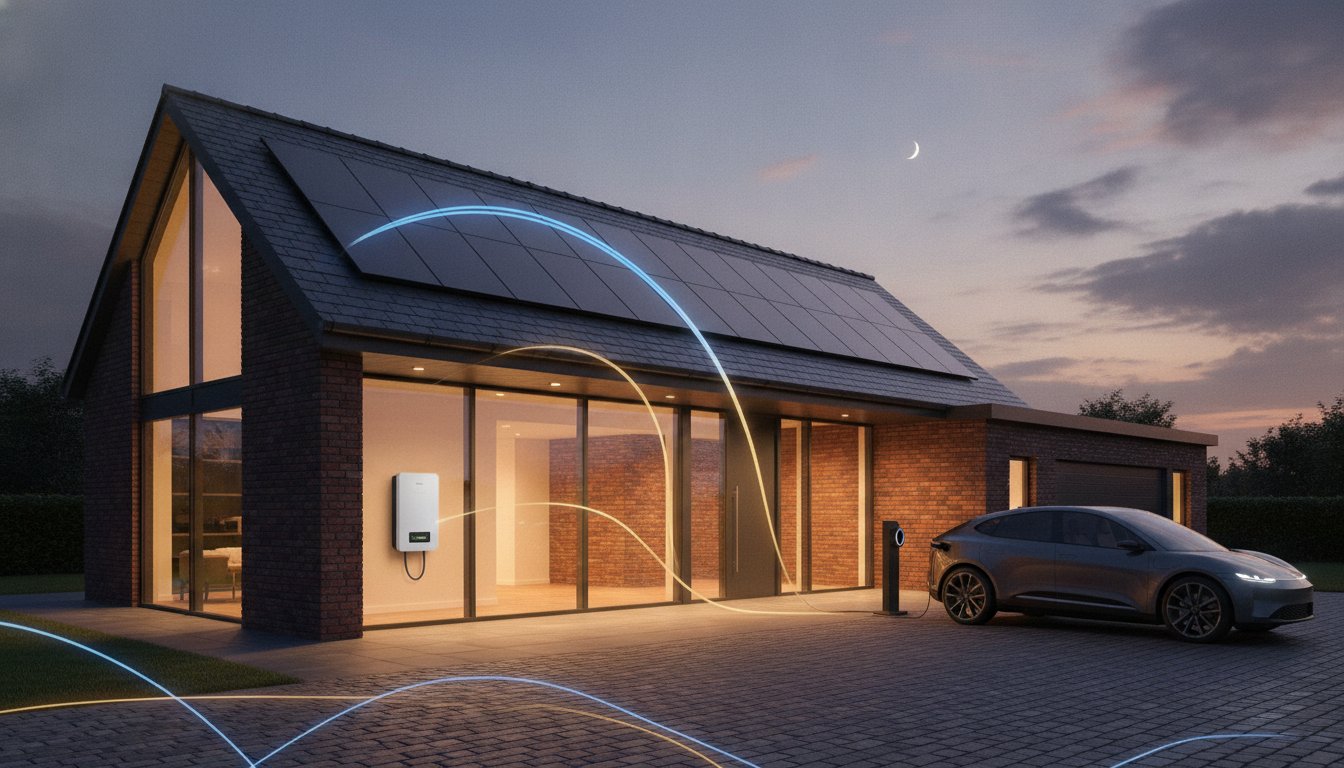
Most homeowners think sizing a battery is about matching their daily usage, but that's often a recipe for overspending. In reality, learning how to size a solar battery system is about building a bridge between your peak generation hours and your peak consumption. With the average UK household now using 2,500 kWh of electricity per year according to 2026 Ofgem data, getting this calculation wrong could mean you're still paying for expensive grid power at 8 PM or, conversely, sitting on storage you'll never actually fill.
You're likely feeling the pressure of the new BS 7671 Amendment 4 regulations, which have restricted where you can actually install these units since April 2026. It's natural to worry about how your EV charger or heat pump might skew your needs, or if a 10kWh system is overkill for a damp UK winter. This guide will help you master the technical steps to calculate a capacity that maximises your savings and energy independence. We'll break down the math, look at future-proofing for new technologies, and give you the confidence to speak with an installer about your specific home requirements.
Key Takeaways
- Distinguish between kilowatt-hours (capacity) and kilowatts (power output) to ensure your battery can handle high-demand appliances like kettles and power showers.
- Learn how to size a solar battery system by calculating your specific "Evening Window" consumption to bridge the gap between sunset and bedtime.
- Identify how future lifestyle changes, such as installing an EV charger or a heat pump, will dramatically shift your energy storage requirements during the winter.
- Compare the financial benefits of self-consumption against current SEG export tariffs to understand the true return on investment for your storage system.
- Recognize why a professional technical load analysis is vital for compliance with 2026 fire safety standards and for maximizing your battery's operational lifespan.
Understanding the Basics: Capacity vs. Power Output
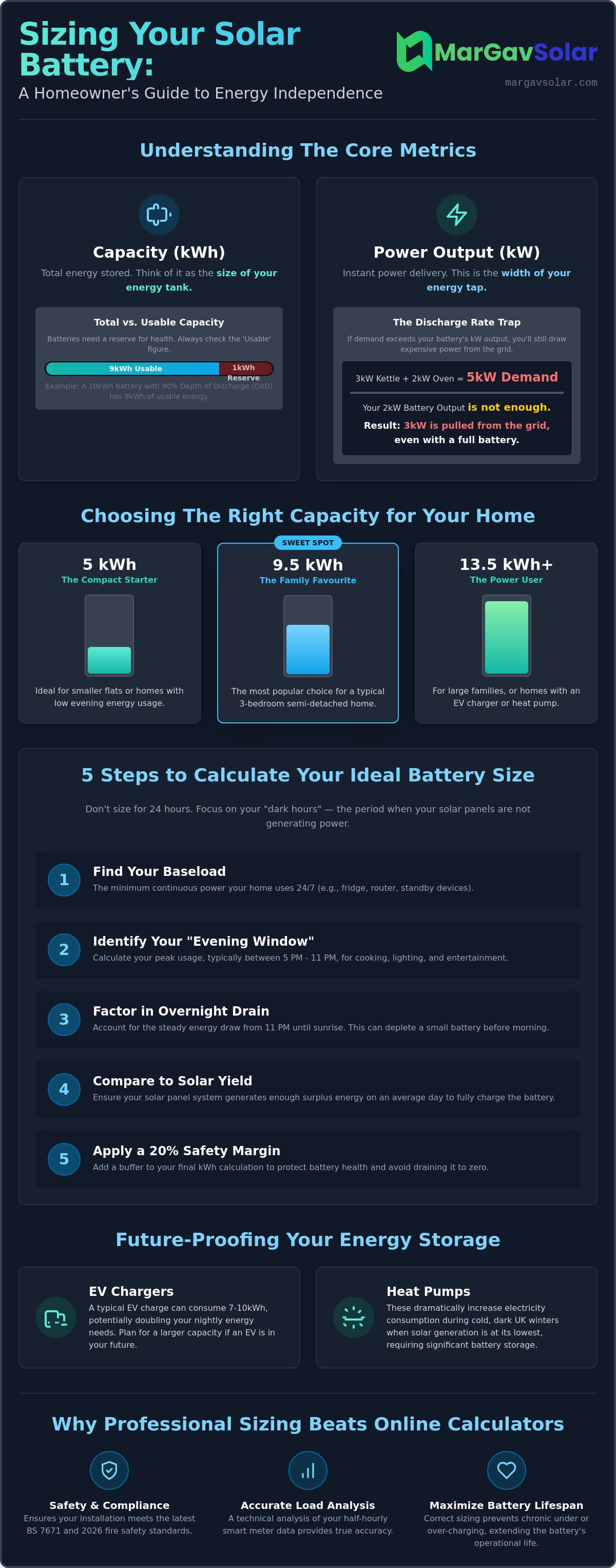
Before you dive into the specifics of how to size a solar battery system, you must understand the two numbers that define its performance. Think of your battery like a water tank in your loft. The capacity, measured in kilowatt-hours (kWh), represents the total size of the tank. The power output, measured in kilowatts (kW), represents the width of the tap. You can have a massive tank, but if the tap is only a tiny trickle, you won't be able to run a bath or power a high-demand appliance like a kettle.
It's also vital to distinguish between "Total Capacity" and "Usable Capacity." Most modern rechargeable battery technology requires a small amount of energy to remain in the cells to maintain health. If a manufacturer advertises a 10kWh battery but specifies a 90% depth of discharge, your usable capacity is actually 9kWh. Always look for the usable figure to ensure your calculations are accurate.
Why kWh Matters for Energy Independence
Your kWh capacity dictates how many hours of "off-grid" life you have once the sun goes down. In 2026, Ofgem estimates the average UK household uses roughly 6.9 kWh per day. Choosing the right size involves balancing your budget with your independence goals. Common UK battery sizes generally fall into three brackets:
- 5kWh: A compact entry-point often suitable for smaller flats or homes with low evening usage.
- 9.5kWh: Currently considered the "sweet spot" for a typical three-bedroom semi-detached home, providing enough buffer for evening meals and entertainment, such as using high-quality amplifiers from Guitars-n-Gear.
- 13.5kWh: A high-capacity option for larger families or those looking to cover almost all their evening needs through storage.
The Discharge Rate (kW) Trap
Many homeowners focus entirely on storage and ignore the discharge rate, which is a mistake. If your battery has a continuous discharge rate of 2kW, but you turn on a 3kW kettle and a 2kW oven at the same time, your battery can't keep up. In this scenario, your system will pull the remaining 3kW from the grid, even if your battery is 100% full.
Your inverter plays the lead role here, as it's responsible for managing this power flow and converting the stored energy for use in your home. Peak Discharge is the maximum burst of power a battery can provide for high-demand appliances. Ensuring your battery's kW output matches your household's peak "spikes" in energy use is just as important as the total capacity itself.
Step-by-Step: Calculating Your Ideal Battery Size
Many online guides suggest using your total daily electricity consumption to determine capacity. This is a common mistake. If your solar panels power your home during daylight hours, sizing a battery for your full 24-hour usage leads to an oversized, expensive system. Learning how to size a solar battery system correctly requires focusing specifically on the "dark hours" when your panels aren't producing energy.
To get an accurate figure, follow these five technical steps:
- Step 1: Find your Baseload. This is the minimum amount of power your home uses to keep essentials running, like your fridge-freezer, router, and standby devices.
- Step 2: Identify your Evening Window. For most UK families, this is between 5 PM and 11 PM. This is typically when cooking, lighting, and entertainment create the highest demand.
- Step 3: Factor in Overnight Drain. Calculate the energy needed from 11 PM until sunrise. While lower than the evening peak, this steady draw can deplete a small battery before morning.
- Step 4: Compare to Solar Yield. Ensure your solar array actually produces enough surplus during the day to fill the battery size you're considering.
- Step 5: Apply a 20% Safety Margin. To protect the long-term health of the cells, you should avoid draining them to zero. Adding a buffer ensures you don't hit the "empty" mark prematurely. For a deeper dive, this technical guide for sizing a battery system explains how system losses and Depth of Discharge (DoD) impact these calculations.
Analyzing Your Smart Meter Data
Your smart meter is the most powerful tool for this task. Instead of guessing, use apps like Octopus or Hugo to access your half-hourly usage data. Look specifically at your winter bills. Since winter yields the least solar energy and requires the most lighting and heating, it represents your "worst-case scenario." Identifying the difference between steady draws and short "spikes" from a washing machine helps determine if you need more capacity or a higher discharge rate. If you're unsure about your specific load, a professional assessment of battery storage solutions can provide the precision needed for a custom fit.
The "Overnight Load" Method
This method focuses entirely on bridging the gap from sunset to sunrise. In the UK, this window changes drastically throughout the year. While a 5kWh battery might easily cover a short summer night, it could fall short during a 16-hour winter darkness period. Sizing for the average of these two extremes often provides the best balance between initial cost and year-round energy independence. By calculating the total kWh used during these hours, you can find a capacity that keeps you off the grid until the sun returns.
Future-Proofing: EVs, Heat Pumps, and Lifestyle Changes
When you're planning how to size a solar battery system, it's easy to focus on your current energy bills. However, your home in 2026 likely looks very different than it did five years ago. Transitioning to electric transport or renewable heating can double or even triple your household's electrical demand. If you don't account for these shifts now, you might find yourself with a system that's undersized before it has even paid for itself. The most effective way to manage this uncertainty is to choose modular battery storage solutions that allow for "stacking." This means you can start with a 5kWh or 9.5kWh unit today and simply add another module later as your needs grow.
Integrating EV Charging Points
An electric vehicle is essentially a massive battery on wheels. To put it in perspective, a typical home battery holds around 10kWh, whereas a modern EV battery can exceed 70kWh. Trying to charge your car entirely from your home battery is usually a mistake. You'll deplete your home's entire energy reserve in minutes, leaving nothing for your lights or fridge.
Instead, focus on "Solar Diverting." This technology prioritises your home's appliances first, then fills your home battery, and finally sends any remaining surplus to your vehicle. For homeowners with EV charging points in Staffordshire, the smartest strategy is to use your home battery to cover your evening "Baseload" while scheduling the car to charge during cheap, off-peak grid windows. This preserves your battery cycles for high-tariff hours.
The Heat Pump Factor
This is where inverter upgrades become essential. A high-spec inverter ensures that your high-demand heating system doesn't outpace your battery's ability to deliver power. When considering how to size a solar battery system for a heat pump home, you need to calculate a "buffer" that accounts for these long, steady draws. Smart management platforms like the GivEnergy Cloud now allow you to automate this, ensuring your battery stays charged from the grid during off-peak times if the weather forecast predicts a cold snap, protecting your comfort and your wallet.
UK Economic Factors: SEG Tariffs vs. Self-Consumption
In mid-2026, the average UK electricity rate sits at 26.11p per kWh. If you export your surplus solar energy under a standard Smart Export Guarantee (SEG) tariff, you'll likely receive between 2p and 6p per kWh. This massive gap represents a significant loss of potential value. When you evaluate how to size a solar battery system, you're essentially deciding how much of that 20p per unit difference you want to keep in your own pocket. The goal is to minimise exports and maximise the energy you use within your own four walls.
Staffordshire typically receives between 950 and 1,050 kWh of solar radiation per square metre annually. This means your panels will hit their maximum generation potential frequently in the summer, but far less so in the winter. A battery bridges this seasonal gap. It also provides a unique economic benefit through Time of Use (ToU) tariffs. By charging your battery from the grid at off-peak rates, which can be as low as 7p per kWh during the night, you can use that cheap energy during the 26.11p peak hours. This strategy ensures your battery remains a financial asset even when the Staffordshire sky is overcast.
Maximising Self-Consumption ROI
Integrating solar battery storage in Staffordshire is a calculated financial move rather than just a green lifestyle choice. Using your own solar power is worth three to four times more than exporting it to the grid. A battery’s ROI is primarily driven by the "price spread" between peak and off-peak electricity. By bypassing peak grid pricing, a correctly sized system ensures you aren't selling power for 5p only to buy it back three hours later for 26p. To see how these economic factors apply to your specific roof and energy habits, you can request a technical load analysis from our team today.
Smart Management with GivEnergy Cloud
Software now plays a critical role in how to size a solar battery system effectively. A smaller battery can often perform like a much larger unit if it's managed by intelligent scheduling. Using the GivEnergy Cloud, homeowners can automate grid charging when the forecast predicts low-sun periods or winter storms. This 24/7 monitoring identifies system inefficiencies and ensures you're always drawing from the cheapest possible source. This level of automation means you don't need to manually micromanage your energy use to see a return on your investment.
Why Professional Sizing Beats Online Calculators
Online calculators are designed to give you a rough estimate, but they often fail to account for the physical and regulatory realities of your specific property. Learning how to size a solar battery system involves more than just tallying up your daily watt-hours. A DIY approach carries significant risks, including inefficient battery cycling that shortens the unit's lifespan and the potential to void manufacturer warranties. Most importantly, the April 2026 BS 7671 Amendment 4 regulations have introduced strict fire safety requirements regarding battery placement. A professional installer ensures your system is compliant, safe, and eligible for insurance coverage through NICEIC certification.
Your local grid connection is another factor a calculator can't see. In Staffordshire, the Distribution Network Operator (DNO) often places limits on the total capacity and discharge rate of systems connected to the grid. If you install a battery that exceeds these limits without prior approval (G98/G99 applications), you could face fines or be forced to disconnect. A professional load analysis handles these legal hurdles before a single bolt is tightened.
The Technical Survey Process
During a physical survey, an expert looks at the "invisible" factors that dictate performance. This includes checking your fuse box for spare capacity and measuring cable runs to calculate "Voltage Drop." If cables are too long or too thin, energy is lost as heat before it even reaches your appliances. Staffordshire has a diverse range of housing stock, from thick-walled Victorian terraces to modern new builds. Each requires a different approach to cable routing and fire separation to meet the latest 2026 standards.
MarGav Solar: Your Local Staffordshire Experts
With 20 years of expertise, MarGav Solar provides a level of precision that an algorithm simply cannot match. We perform a comprehensive technical load analysis that looks at your real-world usage patterns rather than broad averages. Our commitment to fixed-price installation contracts means the figure you see at the start is the figure you pay at the end, with no hidden costs for wiring upgrades or safety modifications.
We don't just walk away once the lights are on. We provide long-term maintenance and warranty support to ensure your system continues to deliver the high bill savings you expect. Ready to right-size your home? Book a professional solar consultation with MarGav Solar to get a clear, compliant, and cost-effective capacity figure tailored to your household.
Secure Your Home's Energy Future
Deciding how to size a solar battery system is one of the most important steps toward long-term energy independence. By focusing on your evening consumption window and accounting for future high-demand appliances like heat pumps, you'll avoid the common trap of overspending on capacity you don't need. It's vital to ensure your battery's discharge rate matches your household's peak power spikes so you aren't forced to draw from the grid during expensive periods.
MarGav Solar brings over 20 years of renewable energy expertise to every project. As NICEIC Certified Installers and specialists in GivEnergy and high-efficiency storage solutions, we handle the technical load analysis and DNO applications for you. Get a Fixed-Price Battery Storage Quote from MarGav Solar today to ensure your system is safe, compliant, and perfectly matched to your home. Taking control of your electricity bills has never been more achievable. With the right professional guidance, you'll enjoy a more resilient, cost-effective home for years to come.
Frequently Asked Questions
What is the average solar battery size for a 3-bedroom house in the UK?
A 5kWh to 10kWh battery is the average size for a three-bedroom house in the UK. This capacity typically covers the evening energy needs of a family using the 2026 Ofgem average of 6.9 kWh per day. Choosing the right size within this range depends on whether you have high-demand appliances like electric showers or if you plan to charge an EV at home.
Can I add more batteries to my system later if my needs change?
Yes, most modern battery storage solutions are modular, allowing you to add more capacity later. If you're unsure how to size a solar battery system for future needs, starting with a 5kWh or 9.5kWh unit and "stacking" additional modules as your energy demand grows is a sensible strategy. Just ensure your initial inverter is compatible with future expansions.
How long will a 10kWh battery power my house during a blackout?
A 10kWh battery can power basic essentials like lights, routers, and fridges for 15 to 24 hours during a blackout. However, if you use high-load appliances like an electric oven or a kettle, that duration will drop significantly. Your battery's discharge rate also limits how many appliances you can run simultaneously while off-grid.
Does a solar battery still charge on cloudy days in Staffordshire?
Solar batteries definitely still charge on cloudy days in Staffordshire. While solar panels are most efficient in direct sunlight, they still generate electricity from diffuse daylight. Even on an overcast day, your system will trickle-charge the battery, though it may take longer to reach 100% capacity compared to a clear summer afternoon.
Should I size my battery based on my summer or winter energy usage?
When considering how to size a solar battery system, you should ideally size it based on your winter evening usage. Winter yields the least solar power and requires the most lighting and heating, making it the most challenging time for your system. Sizing for a winter "worst-case scenario" ensures you remain less reliant on the grid when electricity prices are highest.
What is the lifespan of a modern lithium-ion solar battery in 2026?
The average lifespan of a modern lithium-ion solar battery in 2026 is between 10 and 15 years. Most units are rated for 6,000 to 10,000 charge cycles before their capacity drops below 80% of the original rating. Since solar panels last 25 to 30 years, you will likely need to replace your battery once during the lifetime of your PV system.
Is it better to have a battery that is too big or too small?
It's generally better to have a battery that is slightly too large rather than too small. An undersized battery will reach its limit quickly, forcing you to buy expensive grid power during peak evening hours. A slightly larger system provides a buffer for lifestyle changes, such as working from home more often or purchasing an electric vehicle.
Do I need a special inverter to add a battery to my existing solar panels?
You will likely need an inverter upgrade or an AC-coupled inverter to add a battery to an existing solar array. Standard string inverters only manage power from panels to the house. A hybrid inverter or a dedicated battery inverter is required to manage the two-way flow of electricity between the battery, the panels, and your home.


