

What if the solar company you trust with your roof today isn't around to answer the phone when your inverter needs a service in 2035? It's a genuine concern for many homeowners. You've likely seen the headlines about the 0% VAT savings and the £15 billion Warm Homes Plan, but the technical jargon in quotes can be overwhelming. You want the 70% reduction in electricity bills, not the anxiety of a poor installation or a warranty that disappears overnight. Learning how to choose a solar company Staffordshire families can trust is about more than just finding the lowest price; it's about securing a 25-year partnership.
We'll help you master the vetting process so you can move forward with total confidence. This guide provides a clear framework for verifying installer credentials during the 2026 MCS transition and explains the specific grid requirements for the Staffordshire region. You'll discover how to identify installers who offer long-term maintenance and fixed-price contracts, ensuring your system delivers high yields without hidden costs or technical hiccups. By the end, you'll have a practical checklist to select a partner that will support your energy independence for decades to come.
Key Takeaways
- Master how to choose a solar company Staffordshire residents can rely on by identifying the credentials that separate established experts from short-term "pop-up" installers.
- Learn why MCS and NICEIC certifications are non-negotiable for securing Smart Export Guarantee (SEG) payments and ensuring the structural safety of your home.
- Discover how to spot "over-optimistic" performance estimates and why a physical site survey is essential for an accurate, fixed-price quote.
- Understand the technical difference between G98 and G99 grid applications and how to navigate Staffordshire-specific planning rules for conservation areas.
- Gain peace of mind by prioritising installers who offer dedicated maintenance and repair services to protect your investment for its full 25-year lifespan.
The 2026 Staffordshire Solar Landscape: Why Vetting Matters Now
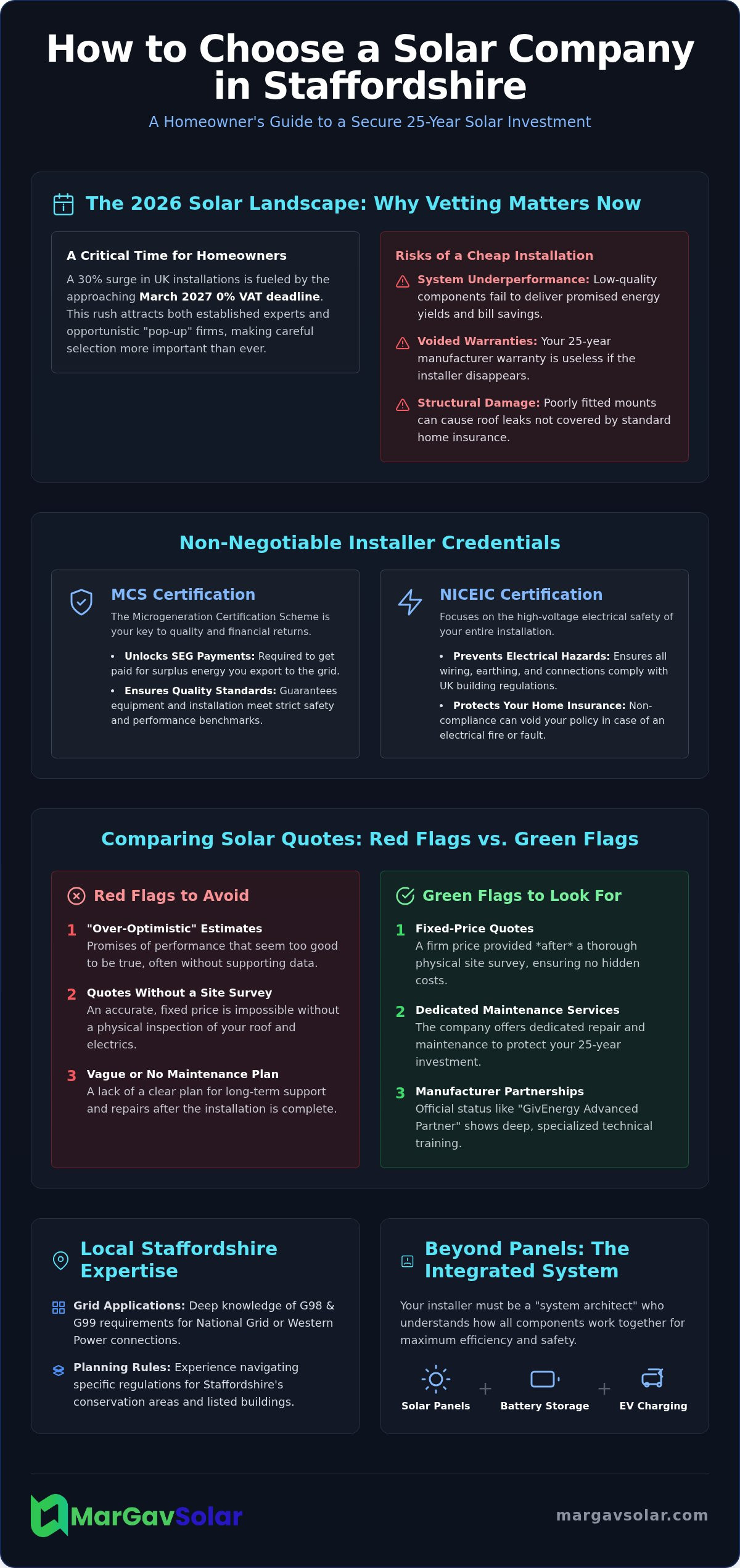
The solar market in Staffordshire has reached a boiling point in 2026. Following a 30% surge in UK installations during 2024, the local region is now a primary target for both established experts and opportunistic "pop-up" firms. This rush is largely fueled by the approaching March 2027 deadline for 0% VAT on solar and battery storage. Homeowners are racing to beat the tax hike, creating a perfect environment for inexperienced installers to offer "too good to be true" quotes. When you're deciding how to choose a solar company Staffordshire, look past the initial price tag. A cheap installation often masks long-term financial risks:
- System underperformance: Low-quality components rarely meet the high-yield promises made during the sales pitch.
- Voided warranties: If a company disappears within three years, your 25-year manufacturer warranty becomes incredibly difficult to claim.
- Structural damage: Poorly fitted mounting systems can lead to roof leaks that aren't covered by standard home insurance.
The broad UK solar power landscape proves that quality and longevity are the only ways to see a real return on investment. In Staffordshire, where weather conditions can be unpredictable, your system needs to be built to last.
The Rise of Integrated Energy Systems
The days of simply bolting a few panels to a roof are gone. In 2026, high-efficiency systems are complex energy ecosystems. Most homeowners now prioritise solar battery storage to maximise their energy independence, especially as electricity prices remain volatile. Integrating EV charging points into this setup adds another layer of technical difficulty. Your installer must be a system architect who understands home grid balancing. If the components don't communicate effectively, you'll lose efficiency and could potentially compromise the safety of your home's electrical system.
Understanding the 2026 Regulatory Environment
The regulatory map has changed significantly this year. The £15 billion Warm Homes Plan, launched in January 2026, provides new grants for energy upgrades, but eligibility is strict and requires professional oversight. In Staffordshire, connecting to the grid via National Grid or Western Power requires specific technical knowledge of Smart Export Guarantee (SEG) rates. These rates vary between suppliers, and choosing the right hardware is essential to access premium export tariffs. Learning how to choose a solar company Staffordshire that understands these nuances is the only way to future-proof your system before the 2027 tax changes take effect.
Essential Credentials Every Staffordshire Solar Company Must Have
When you're researching how to choose a solar company Staffordshire, the alphabet soup of certifications can feel like a distraction. However, these credentials are the only thing standing between a high-yield investment and a costly mistake. The Microgeneration Certification Scheme (MCS) is your first non-negotiable. In 2026, the MCS is undergoing a major redevelopment to strengthen consumer protection, but its core purpose remains. Without an MCS-certified installer, you cannot access the Smart Export Guarantee (SEG). This means you'll effectively be giving away your surplus energy for free to the National Grid instead of getting paid for it.
According to the Energy Saving Trust guidance, using a certified installer ensures that the equipment meets international standards for safety and performance. Beyond the MCS, you should look for companies that hold manufacturer-specific status, such as being a GivEnergy Advanced Partner. This indicates the team has undergone deep technical training directly from the hardware provider. It's vital for the complex battery storage systems that are standard in 2026.
The Critical Role of NICEIC in Solar Safety
While the MCS covers the technology, NICEIC certification focuses on the electrical safety of the installation. A solar array is a high-voltage power plant on your roof. An NICEIC-certified installer ensures the DC wiring, earthing, and inverter connections comply with strict UK building regulations. This isn't just about safety; it's about insurance. If a fire or electrical fault occurs and your system wasn't installed by a certified electrician, your home insurance provider may refuse to pay out. Always verify credentials on the official UK registers before signing a contract.
Consumer Protection: HIES and RECC
Financial security is just as important as technical skill. Two bodies provide this: the Renewable Energy Consumer Code (RECC) and the Home Insulation & Energy Systems Quality Assured Scheme (HIES). These organisations protect you in several ways:
- Deposit Protection: If you pay a deposit and the company goes bust before installation, your money is safe.
- Workmanship Guarantees: HIES provides an insurance-backed guarantee. If the installer ceases trading, another company will be paid to fix any workmanship issues.
- Mediation: Both bodies offer free dispute resolution services if things don't go to plan.
Choosing an installer with these protections ensures you aren't left stranded. If you want to see how these standards are applied in practice, you can check our team's certifications to understand what a fully vetted installer looks like.
Comparing Solar Quotes: Red Flags vs. Green Flags
Comparing quotes is often the most confusing part of learning how to choose a solar company Staffordshire residents can rely on. You'll likely receive several documents with wildly different price points and energy yield promises. To cut through the noise, you need to look for "Green Flags" that indicate a long-term commitment to quality. The gold standard in 2026 is a Fixed-Price Installation Contract. This protects you from hidden costs if the installer discovers electrical issues mid-project. If a quote doesn't explicitly state that the price is fixed, you're at risk of "scope creep" where the final bill is significantly higher than the estimate.
Conversely, unbranded hardware or "Tier 2" panels are major red flags. While they save money upfront, they often lack the efficiency and degradation guarantees of Tier 1 alternatives. Always ask for the specific datasheet of the panels being quoted. If an installer is vague about the brand, they're likely cutting corners on your 25-year investment. A reputable company will be proud to showcase the high-efficiency components they use.
The Site Survey: A Vetting Litmus Test
A quote generated solely via Google Maps is a significant risk. While satellite technology is helpful for initial estimates, it cannot determine the structural integrity of your roof or the capacity of your current consumer unit. A professional installer will always conduct a physical site survey. They should climb into your loft to inspect the rafters and check your fuse board for compatibility with modern battery and EV charging systems. If a company won't visit your home before asking for a deposit, they aren't the right partner for you.
Performance Estimates and ROI Calculations
Every quote must include a Standard Assessment Procedure (SAP) calculation. This is the industry-standard way to predict how much energy your specific roof will generate based on its orientation and local Staffordshire weather data. Be wary of any company promising "zero energy bills." While solar can reduce costs by up to 70%, total independence is rare for most UK homes.
You can use the Energy Saving Trust guide to solar installation to verify if the ROI figures you've been given are realistic. Comparing the efficiency ratings of different solar panel installation options is only possible when you have a physical survey as a baseline. Accurate data is the only way to ensure your system actually delivers on its financial promises.
Local Expertise: Navigating Staffordshire’s Grid and Planning
Local knowledge is the secret weapon in your vetting process. While national firms might offer slick marketing, they often stumble when faced with the specific requirements of the National Grid (formerly Western Power) in the West Midlands. When considering how to choose a solar company Staffordshire homeowners should prioritise installers who manage the entire grid application process. In 2026, this isn't just a courtesy; it's a necessity. Most modern systems include high-capacity batteries, which typically require a G99 application rather than the simpler G98 "connect and notify" route.
National companies often fail to account for local grid constraints in areas like Tamworth, Stafford, or Newcastle-under-Lyme. This leads to project delays or, in the worst cases, a total rejection of your system's export capabilities. A Staffordshire-based expert understands these regional bottlenecks and maintains direct lines of communication with the DNO to ensure your application is processed efficiently.
Managing the DNO Application Process
The Distribution Network Operator (DNO) acts as the gatekeeper of the local electricity grid. In Staffordshire, this is National Grid. They control how much power your system can safely export. For systems under 3.68kW per phase, a G98 notification is usually sufficient after the work is done. however, as high-yield panels and battery storage become the 2026 standard, most homes now require G99 prior approval. Your installer should handle all G98/G99 paperwork as part of their service. If they expect you to manage this technical bridge to the National Grid yourself, it's a major sign they lack local expertise.
Staffordshire Planning and Conservation
Staffordshire’s landscape is diverse, ranging from the historic streets of Lichfield to the protected vistas of Cannock Chase. While most solar installations fall under "Permitted Development" and don't require planning permission, there are critical exceptions. Listed buildings and properties within Conservation Areas or Areas of Outstanding Natural Beauty (AONB) face much stricter rules. Local knowledge speeds up the installation of inverter upgrades and new arrays in these restricted zones. An expert who has worked with Stafford or Lichfield planning departments will know exactly which mounting systems and panel styles are likely to be approved. To ensure your project meets all local regulations, you can request a local grid assessment from our Staffordshire-based team.
MarGav Solar: Why 20 Years in Staffordshire Matters
Longevity is the ultimate proof of quality when you're deciding how to choose a solar company Staffordshire. MarGav Solar has been a fixture in the local renewable energy sector for over 20 years. While many firms have entered the market recently to capitalise on the 2026 solar boom, we've spent two decades refining our consultancy-led approach. We don't just install hardware. We design bespoke energy ecosystems that actually deliver on their high-yield promises. Our commitment to fixed-price contracts ensures that the price you're quoted after our physical site survey is the price you pay; there are no hidden electrical or structural surprises later in the project.
Our end-to-end support covers everything from the initial grid application to the final electrical certification. We understand that a solar array is a significant financial commitment, which is why we prioritise transparency and technical excellence. By choosing a partner with deep roots in the Staffordshire community, you're ensuring that your installer will be around to support your system for its entire 25-year lifespan.
Long-Term Partnership vs. One-Off Sale
Most installers focus on the initial sale and then move on to the next lead. We take a different view. Our business is built on solar panel maintenance and repair because we know your system needs to perform at its peak every single year. Professional cleaning alone can increase your energy yield by up to 20% by removing the grime and pollutants that accumulate over a Staffordshire winter. We also provide inverter upgrades and system health checks for non-MarGav customers. This long-term support means you'll always have a specialist to call, whether you need a routine service or a critical repair.
Integrated Energy Solutions for Staffordshire
Modern energy independence requires a joined-up strategy. Our expertise in GivEnergy Cloud technology allows us to maximise your 2026 ROI by managing the synergy between your PV panels and battery storage. We specialise in high-efficiency systems that seamlessly combine solar power, battery storage solutions, and EV charging points. This "Consultancy First" approach ensures your home's grid is balanced and future-proofed against rising electricity costs. By choosing a partner with two decades of Staffordshire expertise, you aren't just buying panels; you're securing a sustainable future with a team that understands every nuance of the local energy landscape.
Securing Your Staffordshire Energy Future
The 2026 solar market moves fast, but your decision shouldn't be rushed. By focusing on essential MCS and NICEIC credentials, you protect your financial return and your home’s safety. Understanding how to choose a solar company Staffordshire families can rely on means looking beyond the initial installation to the decades of performance that follow. A partner who understands the specific constraints of the National Grid in the West Midlands will ensure your system is connected without unnecessary delays.
MarGav Solar brings 20+ years of industry expertise to every project. As Staffordshire’s local solar specialists, our NICEIC and MCS certified installers provide end-to-end support, from the first site survey to ongoing maintenance. We believe in fixed-price contracts to eliminate the fear of hidden costs, allowing you to invest with total peace of mind. Our team is here to ensure your transition to renewable energy is smooth, professional, and built to last.
Ready to take the next step? Request Your Fixed-Price Staffordshire Solar Quote from MarGav Solar today. Your journey toward energy independence starts with the right local partner.
Frequently Asked Questions
How do I know if a Staffordshire solar company is MCS certified?
You can verify an installer’s credentials by visiting the official Microgeneration Certification Scheme (MCS) website and using their online search tool. Simply enter the company name or your Staffordshire postcode to see a list of certified professionals. It's essential to confirm this before signing any contracts. Without this certification, you won't be able to apply for the Smart Export Guarantee (SEG) to earn money back for the excess energy you send to the grid.
Do I need planning permission for solar panels in Staffordshire?
Most residential solar installations in Staffordshire fall under "Permitted Development" and don't require formal planning permission. However, you must check with your local council if you live in a listed building or a designated Conservation Area, such as parts of Lichfield or Stafford. Properties within an Area of Outstanding Natural Beauty (AONB) also face stricter regulations. A local expert who knows how to choose a solar company Staffordshire residents trust will handle these checks for you.
What is the difference between a G98 and G99 application in the UK?
A G98 application is a "connect and notify" process used for smaller systems under 3.68kW per phase. In contrast, a G99 application is required for larger systems, including most modern setups that feature high-capacity battery storage or EV charging points. For a G99, you must obtain prior approval from the National Grid before the installation can begin. This ensures the local Staffordshire grid can safely handle the increased power flow from your property.
How long does a typical solar installation take in Stafford?
The physical installation of panels and electrical components typically takes between one and two days for a standard residential property in Stafford. However, the entire timeline is longer. You should account for the initial site survey, the technical design phase, and the time required for National Grid to approve your connection. While the work on your roof is quick, the administrative vetting and approval process can take several weeks to complete properly.
Will a local Staffordshire solar company be more expensive than a national one?
Local companies are often more cost-effective than national firms when you consider the total value. While national installers might use aggressive marketing, local Staffordshire specialists have lower travel overheads and a better understanding of regional grid constraints. This local knowledge prevents expensive mid-project delays or technical rejections. Choosing a local partner ensures you receive a fixed-price contract based on an accurate, physical assessment of your home's specific electrical and structural needs.
What happens if my solar installer goes out of business?
If your installer is a member of a consumer protection scheme like HIES or RECC, your investment is protected by an insurance-backed guarantee. This means that if the company ceases trading, another certified professional will be paid to rectify any workmanship issues covered by the policy. Always confirm that your chosen partner provides this protection during the procurement phase. It ensures your 25-year investment remains secure regardless of the company's long-term financial status.
Can I add a battery or EV charger to my existing solar system later?
You can certainly add these components later, though it's often more cost-effective to install them as a single integrated system. Adding a battery later might require an AC-coupled solution or an inverter upgrade to manage the new power flow. Similarly, EV charging points can be integrated into your existing home grid at any time. When researching how to choose a solar company Staffordshire, look for installers who specialise in these modular energy solutions for future-proofing.
How often should I have my solar panels cleaned and maintained in Staffordshire?
We recommend a professional cleaning at least once a year to remove dust, bird droppings, and industrial pollutants that can reduce your system's efficiency by up to 20%. General maintenance and system health checks should occur every two to three years. These inspections ensure your inverter is functioning correctly and that all electrical connections remain safe. Regular maintenance is the best way to protect your ROI and ensure the system lasts for its full 25-year lifespan.


