
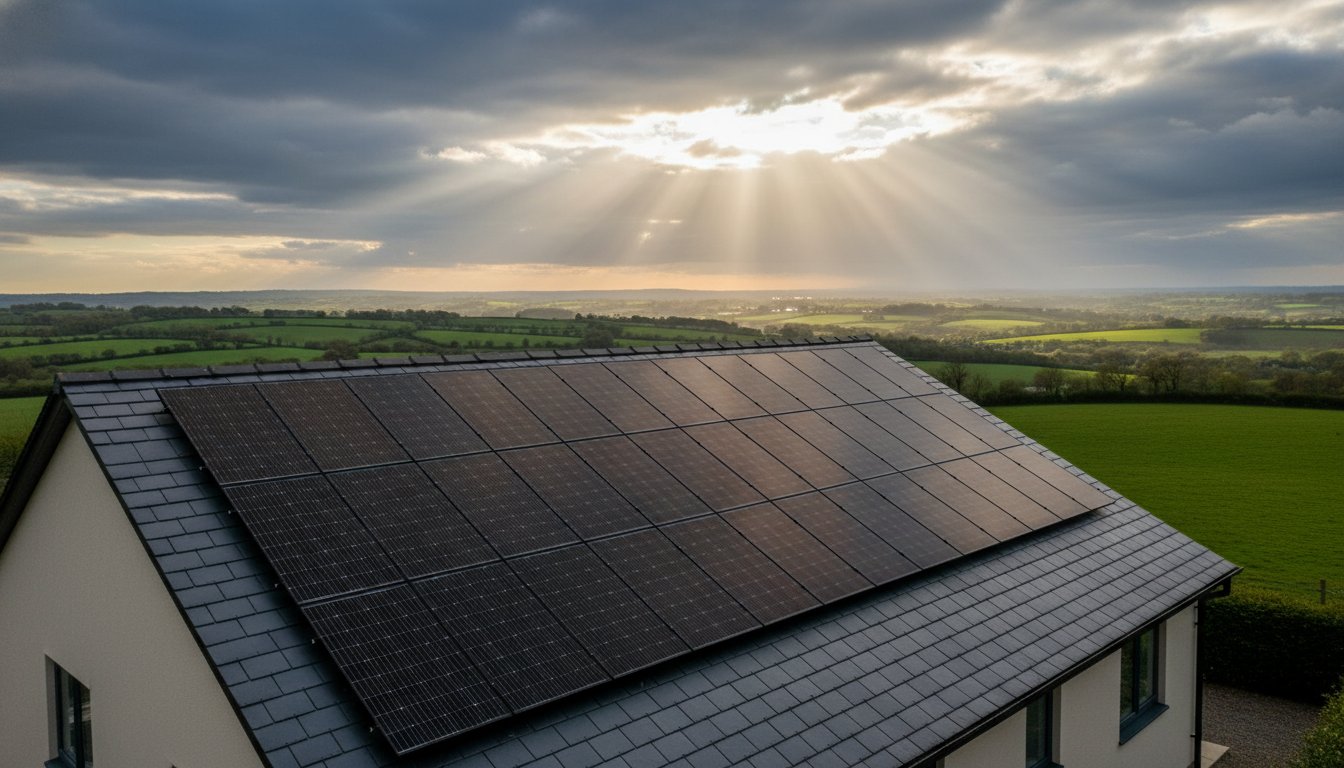
If British weather is famously overcast, why did the country hit a record-breaking 15.2 GW of solar generation in April 2026? It's the question every homeowner asks before making the switch: is solar power reliable in the UK when the clouds refuse to budge? You've likely heard conflicting advice or worried that a rainy week in Staffordshire means your investment becomes an expensive roof ornament. It's a valid concern, especially with energy price caps set to rise again this July.
We understand the anxiety of spending money on hardware only to fear it won't perform during a dark winter. The reality is that modern PV technology has moved far beyond needing direct, tropical sunlight. This guide shows you how today's systems thrive on diffuse light to provide a consistent, high-yield energy source for your home. We'll explore how pairing panels with smart battery storage overcomes local weather patterns and provide a clear roadmap for building a reliable, 25-year system that stands up to the British climate.
Key Takeaways
- Understand the science of diffuse light and how modern panels generate power without needing direct, tropical sun.
- Discover why the question of whether is solar power reliable in the UK is now answered by record-breaking generation levels in 2026.
- Learn why battery storage is the essential missing link for maintaining a consistent energy supply during dark winter nights.
- Identify the professional standards and hardware warranties that protect your investment from common pitfalls and equipment failure.
- Explore how tailoring a system to the specific Midlands climate maximizes long-term yield and system health.
Defining Reliability: Does Solar Work in the Grey British Climate?
The biggest misconception about solar energy is that it requires a cloudless sky to function. When homeowners ask is solar power reliable in the UK, they're often thinking about "peak sun hours" rather than "consistent yield." Reliability isn't defined by having a scorching afternoon every day; it's measured by a system's ability to generate predictable power across the year. In March 2026, the UK officially surpassed 2 million solar installations, a milestone that wouldn't be possible if the technology failed every time a cloud passed over the Midlands.
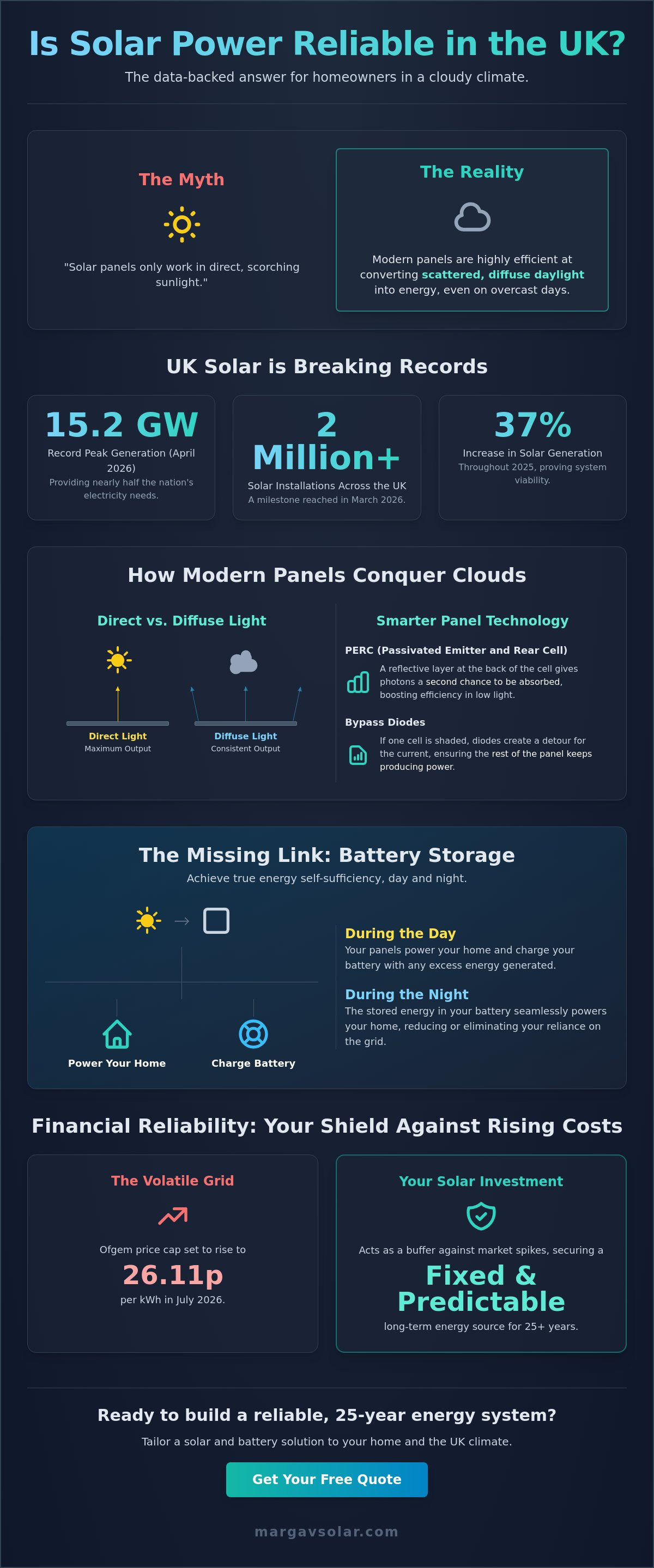
The rapid expansion of Solar power in the United Kingdom proves that homeowners aren't just taking a gamble on the weather; they're following the data. On April 22, 2026, the UK set a new generation record of 15.2 GW, providing nearly half of the nation's electricity needs. This level of output happens because modern panels don't need direct, blinding sunlight to work. They need daylight. Even on a typical grey Tuesday in Staffordshire, photons are still hitting your roof, and your system is still harvesting energy.
The Difference Between Light and Heat
Solar PV systems operate on light, not heat. In fact, solar panels are often more efficient in the UK's temperate climate than in scorching deserts. High temperatures can actually cause electrical resistance to increase, which lowers the voltage. Modern monocrystalline panels use specific temperature coefficients to stay stable during cool, bright spring mornings. This means a crisp, sunny day in October can sometimes produce better results than a humid, hazy day in August. By focusing on photons rather than thermometer readings, your system maintains a steady flow of energy throughout the changing seasons.
Energy Security in an Unstable Market
Reliability also has a financial dimension. With the Ofgem energy price cap set to rise to 26.11p per kWh in July 2026, the traditional grid is becoming less "reliable" as a source of affordable living. Generating your own power acts as a buffer against these volatile global market spikes. For households in Staffordshire, a residential solar PV system serves as a form of financial insurance. Solar reliability is the ability to meet a baseline of domestic demand regardless of cloud cover. It's about reducing your dependence on an unpredictable external market by securing a fixed, long-term energy source right on your roof.
The Science of Diffuse Light: How Panels Generate Power on Cloudy Days
Clouds don't stop the sun's energy; they just scatter it. To understand why is solar power reliable in the UK, you have to look at the difference between direct and diffuse radiation. Direct radiation comes straight from the sun on a clear day. Diffuse radiation is the light that has been scattered by molecules and particles in the atmosphere, such as clouds. Modern monocrystalline silicon cells are incredibly sensitive to this scattered light. Even when the sky looks like a flat sheet of grey, your panels are busy harvesting the photons that manage to filter through.
The efficiency of these systems has skyrocketed over the last five years. Older technology struggled in low-light conditions, but modern cells use PERC (Passivated Emitter and Rear Cell) technology. This adds a reflective layer at the back of the cell, giving photons a second chance to be absorbed. This means your system doesn't just sit idle during a Staffordshire drizzle. It continues to generate a steady baseline of power to run your fridge, router, and standby devices. If you're wondering how your specific roof might handle these conditions, a professionally designed residential solar PV system can be optimized to catch light from multiple angles, making East or West-facing roofs almost as productive as South-facing ones.
The Role of Modern Cell Technology
One common myth is that a single patch of shade or a heavy cloud over one corner of your roof will kill the entire system's output. This was true a decade ago, but today's panels use bypass diodes. These components act like a detour for electricity. If one part of a panel is shaded, the current simply flows around it, ensuring the rest of the array keeps working at full capacity. This technical evolution is a primary reason why UK government energy data showed a massive 37% increase in solar generation throughout 2025. The hardware is simply getting better at handling the "imperfect" British weather.
Weather Patterns and Solar Yield
Staffordshire weather is unpredictable, but solar generation doesn't have to be. You might even experience the "cloud edge" effect on partly cloudy days. This happens when sunlight reflects off the silver lining of a passing cloud, temporarily magnifying the light intensity. For a few moments, your panels can actually produce more power than they would on a perfectly clear day. While winter yields are naturally lower because the days are shorter, the reliability remains. A well-maintained system provides a predictable seasonal curve, allowing you to plan your energy usage with confidence. You aren't chasing the sun; you're harvesting the daylight that is always present from dawn until dusk.
Reliability vs. Self-Sufficiency: Why Battery Storage is the Missing Link
Generating electricity is only half the battle. When homeowners ask is solar power reliable in the UK, they're often thinking about the 6 PM winter blackout. This is known as the "Reliability Gap." It's the period where household demand peaks for cooking and heating just as solar generation drops to zero for the night. Without a way to capture the diffuse light energy harvested during the day, you're forced to rely on the grid during the most expensive evening hours.
Battery storage solutions transform intermittent generation into a 24/7 resource. Instead of exporting your surplus energy for a few pence per kWh, you keep it for your own use. This shift significantly boosts your "Reliability Score." It ensures your home runs on your own green energy even when the Staffordshire sky is pitch black. By storing what you've generated during the day, you create a consistent energy cycle that doesn't depend on the sun being visible at the exact moment you turn on the kettle.
Solar Only vs. Solar + Battery
| Feature | Solar Only System | Solar + Battery Storage |
|---|---|---|
| Daytime Usage | High potential | High potential |
| Evening/Night Usage | Grid dependent | High (Stored energy) |
| Blackout Protection | None | Emergency Power Supply (EPS) |
| Grid Independence | Approx. 20-30% | Up to 80% |
GivEnergy and Smart Management
Software is the brain of a modern energy system. Tools like the GivEnergy Cloud allow you to monitor system health and generation patterns in real-time. By 2026, predictive charging has become a standard feature for high-end systems. The software analyzes tomorrow's weather forecast; if it predicts a particularly dark day, it can top up the battery using cheap off-peak grid electricity overnight. This ensures you always have a power buffer, regardless of the local weather patterns.
An Emergency Power Supply (EPS) function adds another layer of security. If the local grid fails, your solar battery storage can provide power to essential circuits like lights, your router, and the fridge. This makes your home energy system more resilient than the mains grid itself. It proves that with the right storage capacity, solar is a truly reliable choice for the modern UK household.
Protecting Your Investment: Hardware Reliability and Professional Standards
The debate around weather often distracts from the technical side of the equation. When asking is solar power reliable in the UK, you must consider the physical durability of the components on your roof. The "solar cowboy" era of the early 2010s left some homeowners with failing systems and no support. Today, reliability is anchored in rigorous standards like NICEIC certification. This ensures that every electrical connection is safe, compliant, and built to handle the high DC voltages generated by your array.
Modern solar panels are designed for a 25-year lifespan, often carrying performance warranties that guarantee a specific output after two decades. However, the inverter, which is the brain that converts solar energy for home use, typically has a shorter lifecycle of around 10 to 12 years. Recognizing that inverter upgrades are a planned part of your system's life is key to long-term success. Replacing an aging inverter with a modern, high-efficiency model can often boost your generation yield by capturing more energy from that same diffuse light discussed in previous sections.
Choosing Tier 1 Hardware
Reliability starts with Tier 1 hardware. This classification refers to manufacturers who have been vetted by major financial institutions for their quality and long-term stability. Using these components ensures that if a part fails in year 15, the manufacturer will still exist to honor the warranty. In Staffordshire, where wind speeds can be significant, the mounting system is just as critical as the panels. Professional mounting ensures your system stays secure during winter storms, preventing micro-cracks in the cells that could lead to gradual power loss.
The Necessity of Maintenance and Cleaning
A system is only as reliable as its weakest electrical connection. Over time, environmental factors can take a toll. Professional solar panel maintenance prevents small issues from becoming total system outages. Bird proofing is a prime example; nesting pigeons can damage wiring and cause hot spots on panels. Regular cleaning also removes the film of grime and traffic pollution that can block up to 10% of light from reaching the cells. To keep your system performing at its peak, consider booking a professional solar panel maintenance and cleaning service to protect your long-term ROI.
Local Expertise: Maximising Solar Reliability in Staffordshire with MarGav Solar
National statistics provide a broad answer to the question of is solar power reliable in the UK, but local performance depends on regional nuances. A solar panel installation in Staffordshire requires more than just high-end hardware; it demands an understanding of the Midlands’ specific light patterns and roof orientations. MarGav Solar’s 20-year legacy in the region means every system is built on decades of real-world data from local homes. We don't rely on generic nationwide averages. Instead, we design custom systems that account for the specific shading of Staffordshire’s varied architecture, from historic cottages to modern estates.
Our approach ensures that reliability isn't just a theoretical claim. By providing end-to-end support, we manage everything from the initial design to long-term maintenance and cleaning. This lifecycle management is what keeps a system performing at its peak for 25 years or more. When you work with a local specialist, you aren't just getting panels; you're getting a partner who understands the local grid infrastructure and how to maximize your yield in the unique Staffordshire climate.
Why Local Matters for Reliability
Proximity is a key component of long-term system health. If a component requires attention, local installers provide faster response times than national companies. We also hold deep knowledge of local Distribution Network Operator (DNO) requirements, ensuring your system is correctly registered for the Smart Export Guarantee (SEG). A typical Staffordshire home, when properly surveyed, can maintain a remarkably consistent energy profile. Our local case studies show that even during the shorter days of February 2026, when solar contributed 2% to the national grid, well-designed domestic systems in the Midlands continued to meet significant portions of their owners' base loads.
Taking the Next Step to Energy Independence
A reliable home energy ecosystem often extends beyond the roof. Many of our clients now integrate EV charging points into their solar and battery setups. This allows you to fuel your vehicle with the same diffuse light captured during the day, further reducing your reliance on volatile grid prices. We believe a professional on-site survey is essential for this level of integration. Remote online quotes often miss the subtle shading from a neighbor's chimney or the specific condition of your electrical consumer unit. A physical inspection ensures your hardware is positioned for maximum reliability from day one. Book your Staffordshire solar reliability survey with MarGav Solar today to see how your home can thrive in the 2026 energy market.
Secure Your Energy Future in Staffordshire
The transition to home-grown energy is no longer a gamble on the weather. Modern technology has moved past the need for constant, direct sun. You now understand how diffuse light keeps your system generating through the greyest Staffordshire afternoons. By adding battery storage, you ensure the power you harvest at midday is still available to run your home at midnight. This combination of advanced hardware and smart management is the definitive answer to whether is solar power reliable in the UK. It's about consistency, not just peak sun hours.
MarGav Solar brings over 20 years of local expertise to every installation. Our NICEIC Certified Installers handle everything from the initial custom design to long-term maintenance and equipment warranties. We build systems designed to stand up to the Midlands climate for decades. Don't leave your energy security to chance or volatile grid prices. Request a Free Professional Solar Survey for Your Staffordshire Home today. It's time to take control of your energy bills with a system you can trust regardless of the clouds.
Frequently Asked Questions
Do solar panels work on cloudy days in the UK?
Yes, solar panels generate electricity on cloudy days by capturing diffuse light. While output is lower than on a clear day, modern high-efficiency panels are designed to harvest energy from the entire visible light spectrum. This ensures that your system produces a baseline of power even during typical overcast British weather. You don't need direct sun for your home to benefit from renewable generation.
What happens to my solar panels when it snows?
Snow will temporarily block generation if it builds up a thick layer on the panels. However, because panels are dark and tilted, they absorb heat and usually shed snow much faster than the rest of your roof. Cold weather actually improves electrical conductivity. Once the snow slides off, you'll often see a spike in efficiency because the panels stay cool while the light reflects off the surrounding white ground.
How much electricity do solar panels produce in a UK winter?
Winter production is typically around 20% of summer peaks due to shorter daylight hours and lower sun angles. In February 2026, solar still contributed 2% to the UK's total electricity generation. While yields are lower during the darkest months, the energy produced helps cover base loads like refrigeration and standby electronics. Pairing your system with battery storage helps you make the most of every watt generated during these shorter days.
Are solar panels reliable enough to go completely off-grid in England?
Going completely off-grid is rarely practical for the average UK home because of the significant drop in winter generation. Most homeowners find that a grid-tied system with battery storage offers the best balance. This allows you to use your own green energy while having the security of the mains grid during extended dark periods in December and January. It provides energy security without the risks of total isolation.
What is the lifespan of a typical UK solar panel system?
A typical system lasts over 25 years, with many panels still performing at 80% capacity after three decades. You should expect to replace the inverter every 10 to 12 years to maintain peak performance. Regular maintenance and scheduled inverter upgrades ensure the system remains a consistent energy source for the long term. This durability makes solar one of the most stable home improvements you can make.
Do I need to clean my solar panels to keep them reliable?
Yes, periodic cleaning is essential to maintain maximum output. Dust, bird droppings, and traffic pollution can create a film that blocks light and reduces efficiency. Professional solar panel maintenance and cleaning ensures that the cells receive as much light as possible. Keeping the surface clear prevents "hot spots" and ensures your system continues to provide a high yield regardless of the local environment.
Can solar panels survive high winds and storms in the UK?
Solar panels are built to withstand extreme UK weather, including heavy rain and high wind speeds. Installers use specialized mounting systems that are wind-rated for your specific region. When questioning is solar power reliable in the UK, rest assured that the hardware is tested against the harshest storms the British Isles can offer. Correct professional installation is the key to ensuring the array stays secure for its entire 25-year lifespan.
Does the UK government still offer grants for solar panel reliability upgrades?
Several incentives remain active in May 2026, including the 0% VAT rate on solar and battery installations until March 2027. The Warm Homes Plan and the Home Upgrade Grant (HUG) provide financial support for energy efficiency measures for eligible households. These schemes make it more affordable to install a high-quality system that enhances your home's energy reliability. You should check current eligibility criteria for these specific 2026 programs.


