
By early 2025, MCS data revealed that over 1.3 million UK households had transitioned to renewables, yet nearly 14% of residents report technical issues within the first two years of operation. You've likely noticed that finding trustworthy solar power companies in Staffordshire feels like a minefield of conflicting quotes and confusing battery specs. It's completely normal to worry about whether a local installer understands the specific DNO constraints in Stoke-on-Trent or if your project requires planning permission in protected areas like the Peak District.
This guide shows you exactly how to filter out the noise and secure a high-yield system that meets all 2026 UK building regulations and safety standards. You'll find a concrete vetting checklist for local contractors, an explanation of the latest Staffordshire grid connection rules, and the secrets to choosing a long-term maintenance partner who will actually answer the phone in five years.
Key Takeaways
- Learn how to verify essential UK certifications like MCS and NICEIC to ensure you are hiring reputable solar power companies that guarantee high-quality, compliant installations.
- Discover why local Staffordshire expertise is critical for navigating specific planning constraints in conservation areas and managing connections with the regional electricity grid.
- Identify the vital differences between full-service local installers and sales-only firms to avoid hidden costs and ensure professional long-term maintenance.
- Master a five-step evaluation framework to assess site-specific factors like roof orientation and shading for a maximum-yield energy return on your investment.
- Understand how fixed-price contracts and professional technical surveys protect your budget and ensure your system is accurately sized for your home’s energy needs.
What Do Solar Power Companies Actually Do for Homeowners?
Choosing to transition to renewable energy involves more than just buying hardware. Professional solar power companies manage a complex engineering lifecycle that transforms a standard house into a micro-power station. This process begins with a technical feasibility study. In 2026, these studies use LiDAR and 3D modeling to assess roof shading with 98% accuracy. These firms don't just supply equipment; they act as the bridge between homeowners, local planning authorities, and the National Grid. They handle the essential G98 or G99 applications required for grid connection in the UK, ensuring your system complies with all safety regulations.
A high-quality Rooftop solar power system relies on precise electrical design to function efficiently for three decades. Expert solar power companies provide end-to-end support, covering everything from the initial structural survey of your rafters to the final MCS (Microgeneration Certification Scheme) sign-off. This certification is vital for Staffordshire residents who want to access the Smart Export Guarantee (SEG) to earn money back for the excess energy they send to the grid.
The Difference Between Installers and Consultants
The UK market features two distinct types of firms: sales-only agencies and full-service installers. Sales-only companies often focus on aggressive marketing and then subcontract the actual labour to third parties. This often leads to communication breakdowns and issues with long-term accountability. By contrast, a hybrid company that combines consultancy with in-house installation offers the best ROI. These professionals take full responsibility for the solar panel installation process, which is crucial for maintaining your 25-year equipment warranties. If a component fails in 2035, you want the original installer to be the one answering the phone.
Comprehensive Energy Solutions Beyond Panels
Modern energy needs have evolved rapidly. By 2026, a simple "panels-only" approach is rarely sufficient for the average Staffordshire home. Leading companies now integrate high-efficiency solar PV with advanced battery storage units, such as the latest lithium-iron-phosphate (LFP) systems. These units allow you to store energy generated during the day for use at night, significantly reducing reliance on expensive peak-time electricity. A full-service solar company acts as a turnkey renewable energy partner.
- Battery Integration: Managing the installation of smart inverters that balance house loads and battery charging automatically.
- EV Infrastructure: Installing dedicated EV charging points that sync with your solar output to charge your vehicle for free.
- Certification: Providing the Part P building regulation notifications and electrical safety certificates required for UK home insurance.
Professional firms ensure that all these components communicate through a single smart-home interface. This level of technical oversight is what separates a DIY-style project from a professional asset that adds genuine value to your property.
How to Vet a Solar Installer: A 5-Step Evaluation Framework
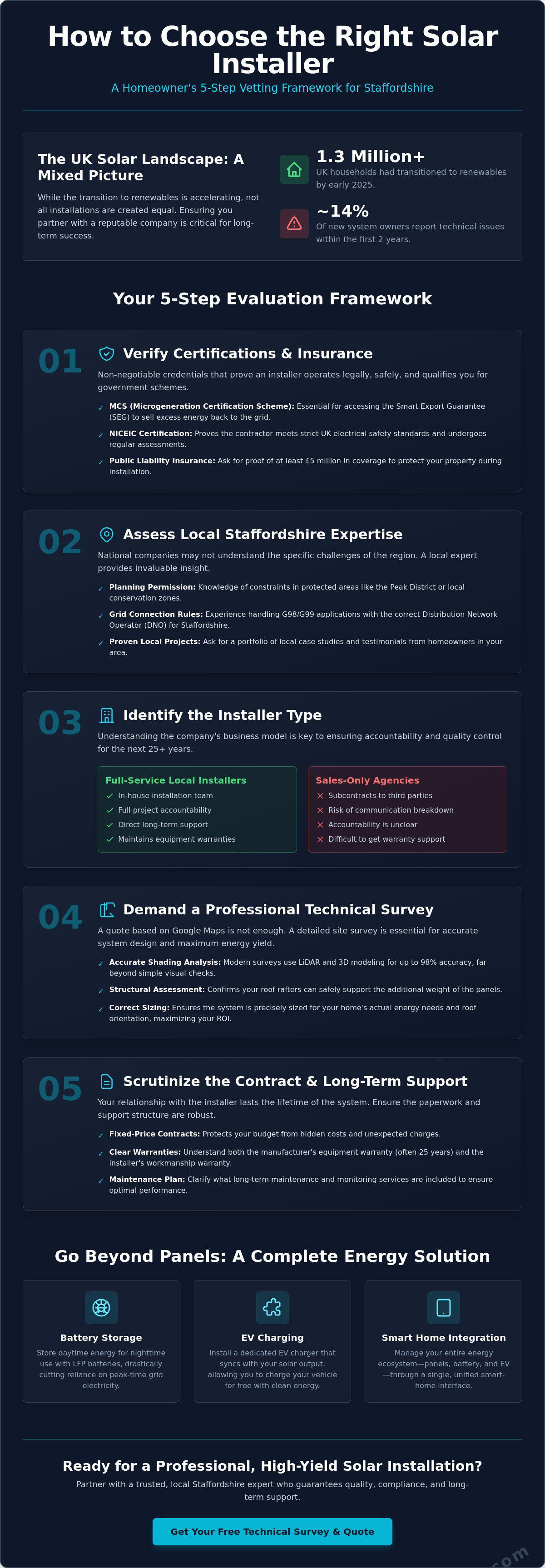
Selecting from the numerous solar power companies operating in Staffordshire requires a methodical approach. Don't settle for the first quote that lands in your inbox. Use this five-step framework to ensure your investment is protected and your system performs as promised over its 25-year lifespan.
Checking Certifications and Insurance
Every reputable installer must hold specific credentials to operate safely and legally. NICEIC certification is essential because it proves the contractor meets strict UK electrical safety standards and undergoes regular assessments. You should also verify their MCS (Microgeneration Certification Scheme) registration on the official database. Without an MCS certificate, you won't be able to access Smart Export Guarantee (SEG) payments from your energy supplier. For a broader look at what to expect during this process, the Energy Saving Trust guide to solar installation provides a solid foundation for UK homeowners. Always ask to see proof of Public Liability insurance, typically covering at least £5 million, to protect your property during the build.
Look for local Staffordshire case studies rather than generic national testimonials. A company that has completed 80+ installs in areas like Stafford, Cannock, or Stoke will understand local grid constraints and DNO (Distribution Network Operator) requirements. Avoid companies that provide a final price based solely on Google Earth images. A physical site survey is mandatory to assess roof structural integrity and potential shading from chimneys or nearby trees. Technical depth at this stage prevents surprise costs later, such as unexpected roof reinforcements or consumer unit upgrades that can add £500 or more to the bill.
Evaluating the Quality of Hardware and Warranties
High-quality solar power companies prioritise Tier 1 hardware from manufacturers like Jinko, REC, or Longi. These brands offer 25-year product warranties, not just performance guarantees. Performance guarantees promise the panels will produce a certain amount of power, but the product warranty covers actual physical defects or weather damage. Consider how inverter upgrades can extend the life of your system, as most standard string inverters require replacement after 10 to 12 years. Hybrid inverters are now the 2026 standard for those planning to add battery storage later.
Demand a fixed-price contract before signing any paperwork. Some installers hide costs for scaffolding, bird proofing, or meter tail upgrades in the small print. Ensure the company has a dedicated maintenance and repair infrastructure based in the Midlands. If a fault occurs in three years, you don't want to wait six weeks for a subcontractor to travel from the other side of the country. If you're ready to see how these standards apply to your home, you can request a detailed technical assessment from a local specialist to get started.
Local vs. National: Why Staffordshire Expertise Matters
Choosing between a massive national franchise and local solar power companies often comes down to who understands the ground you're standing on. In Staffordshire, the "local" tag isn't just about a shorter commute for the installers. It's about a deep understanding of the region's specific infrastructure and heritage. From the industrial heritage of the Potteries to the rural expanses of the Moorlands, every installation faces unique regional hurdles that generic national templates often miss.
Proximity translates directly into reliability. If your system requires an emergency repair or a warranty check, a company based in Stafford or Stoke can provide a response within 24 to 48 hours. National firms often struggle with logistics, sometimes leaving homeowners waiting weeks for a technician to travel from a distant hub. A local team understands the Staffordshire climate, including the higher wind loads found in elevated areas like the Staffordshire Moorlands, ensuring your mounting system is fit for purpose.
Managing DNO Applications in Staffordshire
Your solar system must be legally connected to the grid through National Grid Electricity Distribution, the operator for the West Midlands. This requires a G98 application for small systems or a G99 application for larger arrays and battery setups. Local solar power companies have established relationships with the regional engineers who manage the Staffordshire grid. They're aware of specific areas where the network is constrained. This prevents unexpected costs for grid reinforcements that national providers might overlook until it's too late.
Planning Permission and Building Regulations
While most solar projects fall under Permitted Development, Staffordshire presents specific challenges. The county contains 264 conservation areas and thousands of listed buildings, particularly in historic hubs like Lichfield and Leek. Local experts know exactly which council departments require full planning applications and which will accept "stealth" installs with all-black panels. Consulting a Complete Guide on How To Install Solar Panels provides a solid foundation for understanding the technicalities of the process, but local knowledge is what gets the paperwork approved.
Structural integrity is another critical factor for Staffordshire's older housing stock. Many Victorian terraces and mid-century semi-detached homes require detailed structural surveys to ensure the roof can support the 18kg to 20kg weight of each panel. A local surveyor who knows the common construction methods used in Staffordshire towns can spot potential issues early, preventing structural damage and ensuring your home remains safe for decades.
How to Plan Your Project with a Solar Company
Transitioning from research to reality involves a structured roadmap. Most reputable solar power companies follow a five-stage process to ensure your Staffordshire home achieves maximum efficiency by 2026 standards. This timeline usually spans four to eight weeks from the first call to the final flick of the switch.
- Step 1: Initial Consultation. Experts analyze your 12 month smart meter history to size your system based on actual consumption rather than floor area.
- Step 2: Technical Site Survey. An engineer visits to check roof structural health, measure exact dimensions, and assess your consumer unit's capacity.
- Step 3: Bespoke System Design. Designers create a 3D model of your roof, integrating software like the givenergy cloud to project your future savings and battery discharge cycles.
- Step 4: Installation Day. Scaffolding usually goes up 24 hours prior. The physical install takes 1 to 2 days, covering panel mounting, inverter wiring, and final commissioning.
- Step 5: Handover and Maintenance. You receive your MCS certificate and a scheduled plan for solar panel maintenance to protect your long term yield.
The Importance of a Bespoke Energy Audit
A "one-size-fits-all" approach often leads to underperforming systems that fail to cover evening peak loads. If an installer quotes you without looking at your half-hourly usage data, they're guessing. By 2026, solar power companies should be using your smart meter's export files to determine if you need a 5kW or 10kW battery storage setup. A professional audit is the foundation of a 20-year energy strategy. It ensures you don't overspend on panels you won't use or undersize a system that leaves you reliant on the grid during winter.
Post-Installation Support and Monitoring
Monitoring used to be an optional extra, but it's now essential for ROI. Real-time apps allow you to track exactly how your air source heat pump or EV charger interacts with your solar generation. Your installer must provide a formal handover pack. This includes your G98 or G99 grid connection documents, your Part P building regulations certificate, and warranty details. You should also schedule your first professional health check for 24 months post-install to ensure the UK's weather hasn't impacted your roof fixings or cable connections.
Ready to see how much your Staffordshire home could save? Book your technical site survey with our expert team today.
Why MarGav Solar is Staffordshire’s Trusted Renewable Partner
Selecting the right partner among the various solar power companies operating in the West Midlands is a decision that impacts your home for decades. MarGav Solar stands out because we've spent over 20 years refining our approach to renewable energy. We've completed hundreds of successful installations across Stoke-on-Trent, Stafford, and the surrounding rural villages. Our reputation is built on a foundation of total transparency. We use fixed-price installation contracts for every project. This ensures that the initial quote you receive remains the final price you pay. You won't find hidden surcharges for scaffolding, cable runs, or grid connection fees in our agreements.
Our team consists of NICEIC-certified experts who understand the specific structural requirements of Staffordshire’s diverse housing stock. Whether you own a traditional Victorian terrace or a modern detached home, we tailor the technology to fit your roof's unique profile. We focus on high-efficiency systems that deliver measurable results from day one. By using only tier-one components, we ensure your property transition is both sustainable and financially sound. We handle every detail, from initial DNO applications to final commissioning, providing a seamless end-to-end service that takes the stress out of the transition.
The MarGav Difference: Expert Consultancy
Our 20 years of industry experience means we don't guess; we calculate. We use advanced shading analysis and yield prediction software to ensure your system design is optimized for the Staffordshire climate. We never use third-party subcontractors. Every installer on your roof is a dedicated MarGav professional who lives and works locally. This internal control allows us to maintain a perfect safety record and consistent workmanship. We also prioritize long-term maintenance. Protecting your investment is our priority, so we offer scheduled health checks to ensure your hardware remains in peak condition for its entire 25-year lifespan.
Get Started with a Local Staffordshire Expert
If you're ready to reduce your reliance on the National Grid, you can book a no-obligation energy consultation with our team today. During this session, a MarGav specialist will visit your property to conduct a full technical survey. We analyze your current electricity spend and roof integrity to build a custom model. You'll receive a bespoke proposal that outlines your expected ROI and total system cost in GBP (£). Many solar power companies rush this initial phase, but we take the time to answer every technical question you have. Contact our local Staffordshire office today to begin your journey toward energy independence.
Take Control of Your Energy Future in Staffordshire
Transitioning to renewable energy is one of the most significant investments you'll make for your property this decade. By 2026, the UK government's commitment to net-zero targets and the evolution of the Smart Export Guarantee make selecting the right partner more critical than ever. You now have the tools to apply a 5-step framework to vet solar power companies, focusing on technical credentials and regional knowledge. Prioritising a local Staffordshire team ensures your system is designed for our specific weather patterns and local grid requirements.
MarGav Solar brings 20+ years of industry expertise directly to your doorstep. Our NICEIC and MCS certified installers handle every detail, from initial structural assessments to final commissioning. We're a Staffordshire-based local team dedicated to helping homeowners reduce their reliance on the national grid. You don't have to navigate the complexities of renewable technology alone when expert guidance is available locally. Secure your home against rising energy costs with a system built to last.
Book your expert Staffordshire solar consultation with MarGav Solar today
Your journey toward sustainable energy independence starts with a single, informed decision. We look forward to helping you power your home for decades to come.
Frequently Asked Questions
How do I choose between local and national solar power companies?
Local solar power companies in Staffordshire offer faster response times and specific knowledge of regional roof types. You'll usually find that local teams can visit your site within 48 hours for a physical survey. National firms often provide standardized pricing models, but they might rely on remote satellite imagery which can miss shading details from nearby buildings in areas like Stafford or Lichfield.
What certifications should I look for in a Staffordshire solar installer?
You must ensure your installer holds MCS (Microgeneration Certification Scheme) accreditation. This certification is a legal requirement if you want to access Smart Export Guarantee (SEG) payments for the electricity you export. Look for membership in the Renewable Energy Consumer Code (RECC) or HIES. These bodies protect your deposit and provide a 2-year workmanship warranty as a minimum industry standard.
Do solar power companies in Staffordshire handle planning permission?
Most solar power companies handle the entire planning process if your home isn't covered by Permitted Development rights. While 90% of UK domestic installations don't need formal permission, homes in conservation areas or listed buildings require specific consent. Your installer should submit the G98 or G99 grid connection application to National Grid Electricity Distribution before any work begins on your roof.
How long does a typical home solar installation take in the UK?
A standard 4kW solar array typically takes 1 to 2 days to install on a residential roof. This timeframe includes fixing the mounting rails, laying the panels, and wiring the inverter into your consumer unit. You should expect scaffolding to remain on your property for approximately 5 to 7 days. This allows for safe setup and removal before and after the technical work is completed.
Can a solar company help me integrate battery storage later?
Your installer can definitely add battery storage later by using an AC-coupled system or a hybrid inverter. Data from 2025 shows that 70% of new UK solar installations now include a battery at the start. If you wait, you'll need to ensure your initial inverter is "battery ready." This prevents the need for a costly £800 to £1,200 equipment replacement when you eventually upgrade.
What happens if my solar company goes out of business?
Your investment stays protected through insurance-backed guarantees if your installer ceases trading. Organizations like HIES provide a 10-year insurance policy that covers your workmanship warranty regardless of the company's status. Product warranties for panels often last 25 years and are held by the manufacturer. This means you can contact the manufacturer directly to find a different local technician for any necessary repairs.
Are there any Staffordshire-specific grants for solar power in 2026?
Staffordshire residents can access the Home Upgrade Grant (HUG2) if their property isn't on the gas grid and has an EPC rating of D to G. The UK government also maintains a 0% VAT rate on solar installations through March 2027. You should check the Staffordshire County Council website for "Solar Together" group-buying schemes. These schemes can reduce total installation costs by 10% to 20% through bulk purchasing.
How often should I have my solar system serviced by a professional company?
You should schedule a professional health check for your system every 2 to 3 years. A technician will check the DC string voltages and inspect the inverter for any error logs or heat damage. While panels are mostly self-cleaning at a 20-degree pitch, a professional clean every 12 months is recommended if you live near heavy foliage or high-traffic roads in Stoke-on-Trent or Newcastle-under-Lyme.


