
What if your Staffordshire home could generate more electricity on a grey Tuesday in October than it actually consumes? You've likely watched your monthly energy bills climb as UK price caps fluctuate, and the sheer variety of new 2026 battery systems and high-efficiency solar panels can feel overwhelming. It's frustrating to want a greener home while worrying if West Midlands weather will actually provide a return on your investment.
This guide shows you exactly how modern solar panels harness even the most stubborn Staffordshire clouds to turn your property into a self-sustaining power station. We will break down the latest 2026 hardware, explain how 400W+ N-type modules outperform older systems, and help you vet the most reliable installers across the county. You'll learn how to cut your reliance on the National Grid and finally take control of your household energy costs for good.
Key Takeaways
- Learn how the latest solar panels integrate with 2026 energy standards to turn your Staffordshire property into a self-sufficient power station.
- Discover the science behind modern PV systems and how high-efficiency inverters convert sunlight into usable electricity for your home.
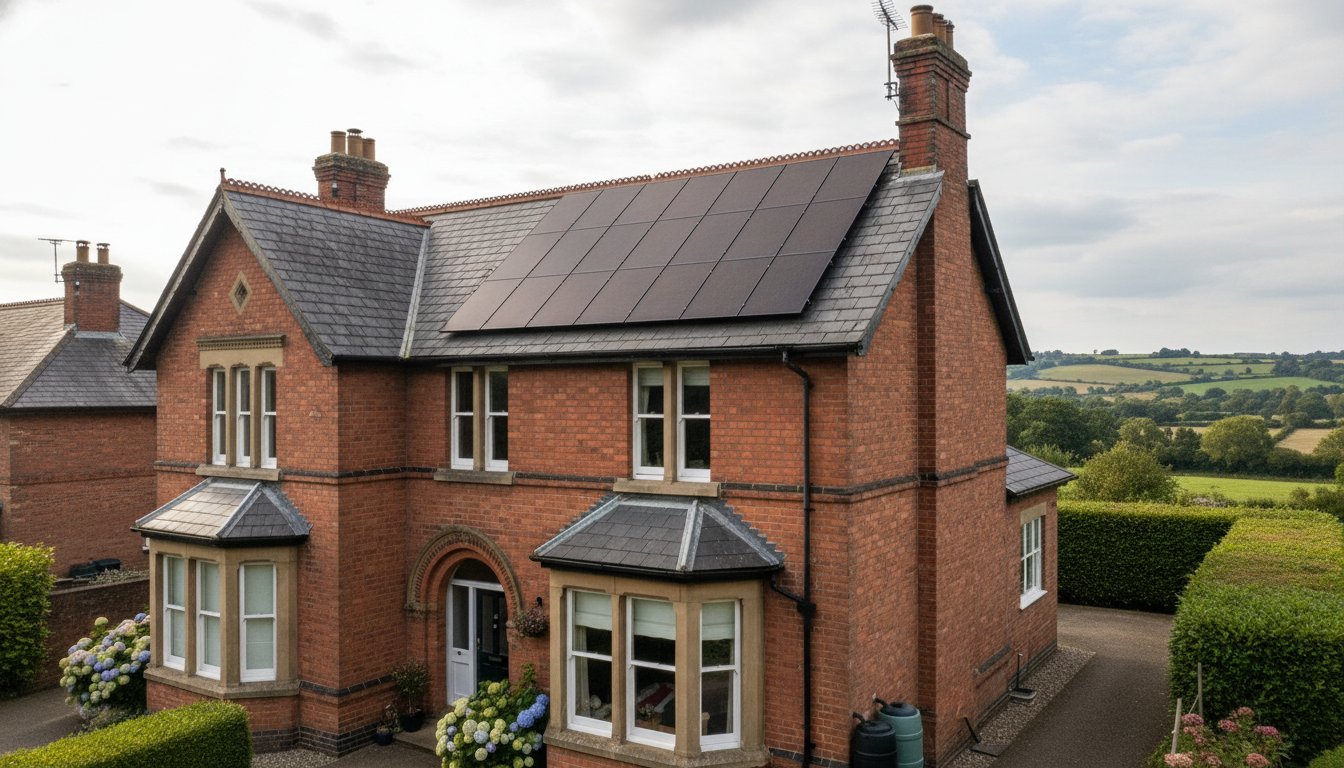
- Identify the ideal technology for your roof, including aesthetic "all-black" panels perfect for Staffordshire’s heritage homes and conservation areas.
- Navigate local planning laws and "Permitted Development" rights to ensure a smooth, compliant installation process for your property.
- Calculate your financial benefits by exploring the Smart Export Guarantee (SEG) and the projected break-even point for 2026 energy investments.
Understanding Solar Panels: Why Staffordshire Homeowners are Switching in 2026
In 2026, solar panels aren't just gadgets for the eco-conscious. They've become essential home infrastructure, much like central heating or high-speed fiber. Modern photovoltaic (PV) systems now meet the 2025 Future Homes Standard, which mandates a 75% to 80% reduction in carbon emissions for new builds. For existing Staffordshire homes, this technology offers a way to decouple from volatile energy markets. MarGav Solar has spent 20 years installing these systems across the county, witnessing the shift from expensive early-adopter tech to the highly efficient, affordable modules available today. Homeowners now view solar as a permanent fixture that adds tangible value to their property while securing their energy future.
The Environmental and Financial Impact in the West Midlands
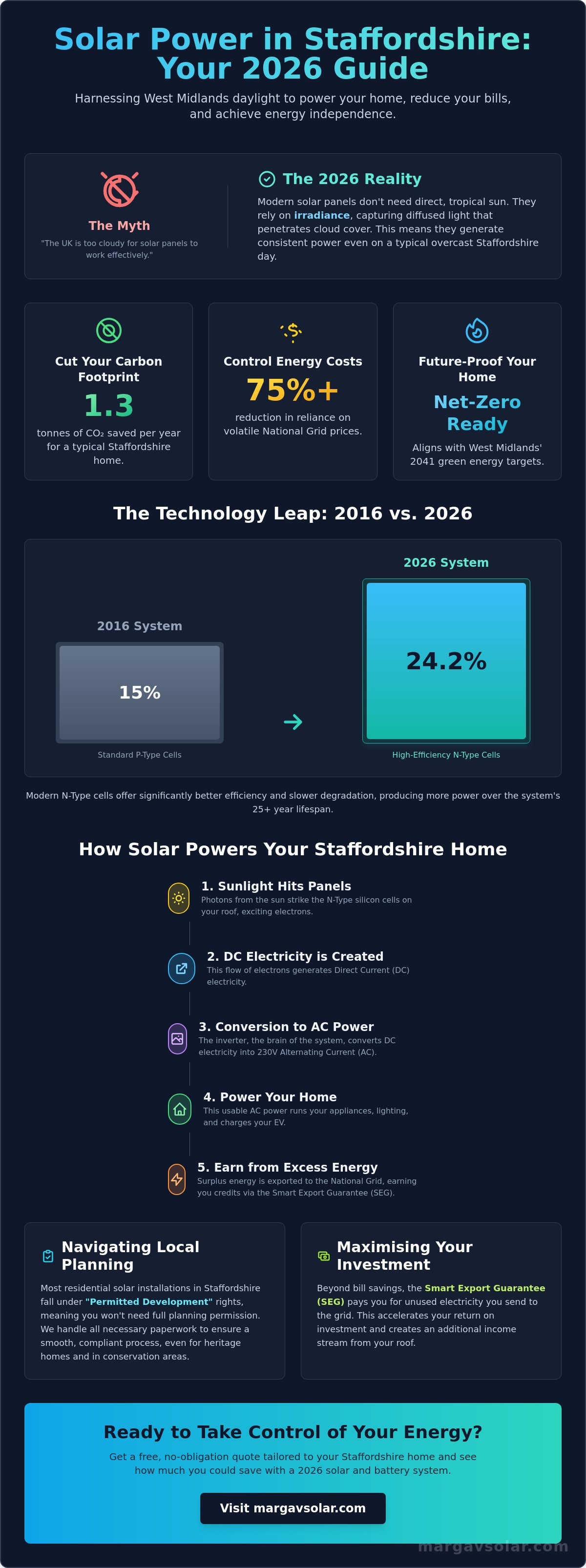
Staffordshire households are feeling the strain on the local electricity grid as electric vehicle (EV) adoption hit 32% of new car sales in 2025. This increased demand makes self-generation a financial necessity. By installing a system, a typical semi-detached home in Stoke-on-Trent or Stafford can reduce its annual carbon output by approximately 1.3 tonnes. Local sustainability initiatives, such as the Staffordshire County Council's climate action fund, have accelerated this transition. You can explore more about these regional benefits in our Solar Energy Solutions in Staffordshire guide. Generating your own power protects you from peak-time grid charges while supporting the West Midlands' goal of reaching net-zero by 2041.
- Reduction of carbon footprints by over 1,000kg per year for average homes.
- Protection against fluctuating National Grid prices.
- Support for local West Midlands green energy targets.
Debunking the "UK is Too Cloudy" Myth
A common misconception is that the West Midlands lacks the "tropical" sun required for solar energy. This isn't true. Modern solar panels rely on irradiance, which is the power per unit area received from the sun in the form of electromagnetic radiation. Modern PV cells capture diffused light that penetrates cloud cover, meaning they generate electricity even on a typical overcast day in Cannock or Leek. 2026 panel efficiency has reached an average of 24.2%, a significant jump from the 15% efficiency seen in 2016. This evolution in Solar panel technology ensures that Staffordshire homes produce reliable energy year-round. You don't need a cloudless sky to see a return on investment; you just need daylight.
The shift in technology means that even north-facing roofs or homes in the shadow of the Peak District can now benefit from solar. The combination of bifacial panels and improved battery storage allows homeowners to capture every available photon, regardless of the British weather. It's about efficiency, not just direct sunlight.
The Science of Sunlight: How Modern PV Systems Power Your Home
Sunlight travels 93 million miles to reach your roof. When those photons hit the silicon wafers in your solar panels, they trigger a flow of electrons. This is the photovoltaic effect. Modern 2026 systems utilize N-type silicon cells, which offer significantly better degradation rates than older P-type models. This means your system produces more electricity over a 25 year period. The energy begins as Direct Current (DC), flowing from the roof down to your home's nerve centre.
From Photovoltaic Cells to the Distribution Board
High-efficiency hardware is the backbone of a reliable setup. We only install Tier 1 solar panels. These are manufactured by companies with a proven track record of quality and financial stability. This hardware handles the diffuse light common in the West Midlands far better than budget alternatives from five years ago. MarGav Solar provides end-to-end support, covering everything from the initial consultancy to the final electrical wiring. Our team ensures every connection meets NICEIC certification standards for total safety. If you're looking for a step-by-step guide to solar panel installation, industry experts highlight how professional integration prevents energy loss at the distribution board. Proper wiring ensures that the power generated on your roof actually makes it to your appliances without bleeding off as heat.
Inverters: The Brains of Your Solar Installation
The inverter is the hardest-working component in your system. It converts the raw DC energy from your roof into usable 230V AC power for your toaster, kettle, and TV. You have two main choices: string inverters or micro-inverters. String inverters are cost-effective for clear, south-facing roofs. Micro-inverters are better for Staffordshire homes with complex shading issues from chimneys or trees. A high-quality inverter usually lasts 10 to 15 years, while the panels themselves can last 30. You can learn more about choosing the right hardware in our guide to Inverter Upgrades in Staffordshire. Modern 2026 inverters also include smart monitoring. You can see exactly how much energy you're generating from your phone in real-time.
Newer systems are also much better at handling low-light conditions. In 2026, half-cut cell technology allows a panel to keep working even if the bottom half is in the shade. This is a massive leap forward for UK homeowners who deal with overcast skies. If you're ready to see how these components fit on your roof, you can request a technical site survey to get started.
Choosing the Right Solar Technology for Your Staffordshire Property
Selecting the correct hardware determines your long-term return on investment. Most Staffordshire homeowners now opt for monocrystalline solar panels because they offer superior efficiency, often reaching 20% to 23%. While polycrystalline options were cheaper in previous decades, their lower performance makes them less viable for the limited roof space found on typical UK semi-detached and detached homes. For those living in conservation areas or heritage properties near Lichfield or Stafford, all-black panels provide a sleek, uniform appearance. These modules use black backsheets and frames to blend into traditional slate or rosemary tile roofs, satisfying aesthetic concerns without sacrificing power.
Understanding how solar technology works helps you appreciate why high-efficiency cells are worth the initial cost. Photovoltaic cells convert light into DC electricity, which an inverter then switches to AC for your home. System sizing should always be based on your annual consumption. An average UK home uses approximately 2,900 kWh per year, typically requiring a 3.5kW to 4.5kW system. If you plan to install a heat pump or upgrade to an electric vehicle by 2027, it is wise to "over-size" your array now. This future-proofs your energy system, preventing the need for expensive structural additions later.
Integrating Battery Storage and EV Charging
Battery storage is the vital component for maximizing your ROI in the UK. Without a battery, you might export up to 60% of your generated energy back to the grid for a low export tariff. By adding storage, you keep that power for evening use. Using the GivEnergy Cloud platform allows for smart monitoring, letting you track exactly how much energy you save. This integration is perfect for powering EV charging points with 100% solar energy, significantly reducing your household's total carbon footprint and transport costs.
Assessing Your Roof: Orientation and Pitch
The ideal setup for a Staffordshire roof is south-facing with a pitch between 30 and 40 degrees. This maximizes the direct sunlight captured throughout the day. However, East/West configurations are increasingly popular for solar panels because they spread generation across the morning and evening. This often matches the "double peak" of energy usage in most households. If you have a modern extension with a flat roof, installers use ballasted mounting systems or A-frames to achieve the perfect angle, ensuring your system performs optimally regardless of your home's original architecture.
Navigating Installation: Planning, Permissions, and Local Standards
Most homeowners in Staffordshire find that installing solar panels falls under Permitted Development rights. This means you won't usually need a full planning application. However, strict rules apply. The equipment must not protrude more than 200mm from the roof plane, and the highest part of the installation shouldn't exceed the highest part of the roofline, excluding the chimney. If you live in a conservation area in places like Lichfield or the Stafford town centre, or if your home is a Grade II listed building, you must obtain specific consent before work begins. In 2026, local authorities have tightened visual impact assessments to preserve the architectural heritage of the region.
Safety standards have also evolved. Current 2026 regulations require comprehensive edge protection and specific scaffolding configurations for all residential solar projects. These measures prevent falls and ensure the structural load of the panels doesn't compromise your roof's integrity. While some people consider a DIY approach to save money, it's a significant risk. High-voltage DC systems require specialist handling to prevent fire hazards. Attempting a self-install often voids your home insurance and equipment warranties. Choosing a professional solar panel installation ensures your system meets every UK building regulation and safety code.
The MarGav Solar 5-Step Installation Journey
- Step 1: The Initial Staffordshire Site Survey and Consultancy – We don't guess your savings. Our team performs a physical inspection and uses 3D mapping to check for shading from nearby structures or trees.
- Step 2: Bespoke System Design and Fixed-Price Quotation – We design a layout tailored to your energy needs. You receive a fixed-price quote that covers everything from the solar panels to the scaffolding, with no hidden fees added later.
- Step 3: Professional Installation and Electrical Certification – Our engineers mount the hardware and integrate the electrics. We finish by providing all necessary paperwork, including the MCS certificate and DNO notification.
Certifications That Matter: NICEIC and Beyond
Technical credentials aren't just paperwork; they're your safety net. An installer with NICEIC certification has been rigorously assessed to ensure their electrical work meets the highest UK standards. This is essential for your "Part P" building regulations compliance, which you'll need if you ever decide to sell your property. You can find more details in our NICEIC Certification Guide. Beyond electrical safety, always check for a 10-year workmanship guarantee. This protects you against installation errors, while your panels should carry a separate 25-year performance warranty.
Don't leave your home's energy future to chance. Book your expert Staffordshire site survey today to ensure a compliant and efficient installation.
Maximising Your ROI: Long-Term Benefits of Local Solar
Investing in solar panels represents a strategic financial decision that pays dividends long after the initial installation. In 2026, the financial landscape for Staffordshire homeowners is bolstered by the Smart Export Guarantee (SEG). This government-backed initiative requires energy suppliers to pay you for every unit of carbon-free electricity you export back to the National Grid. By choosing a tariff with competitive export rates, you transform your roof into a micro-power station that generates a consistent secondary income stream.
The "break-even" point for a typical Staffordshire property has tightened significantly. Based on 2025 energy price trends and installation efficiencies, most local homeowners reach their return on investment within 7 to 9 years. Choosing a local Staffordshire partner ensures your system remains at peak health for its 25-year lifespan. Local installers understand the specific microclimates of the West Midlands, from the winds of the Peak District fringes to the specific shading patterns in Stafford's residential areas, ensuring your hardware is optimised for the region's unique conditions.
Calculating Your Potential Savings
Consider a typical 4-bedroom detached home in Stafford. If this household installs a 5kWp system, they can expect to save between £700 and £950 on their annual electricity bills at 2026 price levels. These savings scale dramatically when you integrate battery storage. Without a battery, you might only use 30% of the energy your solar panels produce, whereas a storage system allows you to retain and use up to 80% of that power during the evening. A typical 2026 solar installation has a payback period of approximately 8 years when factoring in current electricity tariffs and SEG payments.
Maintenance and Cleaning for Peak Performance
System efficiency isn't static; it requires professional oversight to counter the effects of environmental debris. In Staffordshire, urban dust and bird activity can lead to "hotspots" or shading on your cells. Professional solar panel maintenance and specialized cleaning can increase your total energy yield by as much as 20% compared to a neglected system. Bird proofing is particularly vital in local rural areas to prevent nesting under the array, which can lead to wiring damage or fire risks.
The MarGav Solar approach focuses on preventative care through structured maintenance contracts. We don't just clean the glass; we perform thermal imaging and inverter health checks to catch minor faults before they impact your wallet. Keeping your system serviced by a local team means help is always nearby if a component requires urgent attention. Ready to secure your energy future? Book your free Staffordshire solar consultation today.
Start Generating Clean Energy for Your Staffordshire Home
Switching to solar panels in 2026 represents a smart move for your household finances and the local environment. Modern PV systems now achieve efficiency ratings over 22%, ensuring your property generates maximum electricity even on typically overcast British days. By leveraging the Smart Export Guarantee (SEG), you can earn payments for surplus energy sent back to the National Grid. The UK government's current 0% VAT rate on energy-saving materials makes this the ideal window to upgrade your property before policy changes occur.
Working with a local specialist ensures your system meets strict UK building regulations and MCS standards. Margav Solar provides over 20 years of renewable energy expertise right here in Staffordshire. Our NICEIC Certified Installers handle every technical detail, from initial planning permissions to long-term maintenance. You'll gain energy independence while significantly reducing your carbon footprint. We're ready to help you transform your roof into a high-performing power station.
Get a Fixed-Price Solar Installation Quote for Your Staffordshire Home
Take control of your energy future and join the thousands of Staffordshire residents already benefiting from the power of the sun.
Frequently Asked Questions
Do I need planning permission for solar panels in Staffordshire?
In most cases, you don't need planning permission for solar panels in Staffordshire because they fall under Permitted Development rights. These rights, established in 2015, allow for most domestic installations without formal applications. However, if your home is a listed building or sits within one of Staffordshire's 67 conservation areas, you'll need to contact your local council. The panels must not protrude more than 200mm from the roof slope to qualify.
How much can I save on my electricity bills with solar panels in 2026?
You can save between 50% and 70% on your annual electricity bills by using renewable energy. According to 2024 Energy Saving Trust data, a typical UK household saves roughly £450 per year, though these savings increase if you incorporate battery storage. By 2026, high energy prices and improved panel efficiency mean most homeowners see their system pay for itself within 8 years. Your specific savings depend on your daily consumption patterns.
Will solar panels work on my roof if it faces East or West?
Yes, solar panels work effectively on East or West facing roofs and typically generate about 85% of the energy produced by a South facing system. While South is the optimal direction, an East-West split is often better for families who are home during the morning and late afternoon. This configuration spreads energy generation across the day, which helps you use more of your own power and reduces reliance on the expensive National Grid.
How long do solar panels last before they need replacing?
Most modern solar arrays last between 25 and 30 years before they need replacing. They're designed with no moving parts, so they require very little maintenance over their lifespan. You'll likely see a minor performance drop of about 0.5% each year, meaning the system still operates at 80% capacity after 25 years. While the panels themselves are long lived, you might need to replace the central inverter after 12 to 15 years.
What happens to my solar energy during a power cut?
Your solar system will shut down during a power cut to ensure the safety of engineers working on the lines. This is a mandatory safety feature called anti-islanding protection. If you want your home to stay powered during a blackout, you must install a battery with an Emergency Power Supply (EPS) function. This setup allows your system to disconnect from the grid and provide electricity to your essential appliances using stored solar energy.
Can I add a battery or EV charger to my existing solar system later?
You can definitely add a battery or an EV charger to your solar setup at a later date. Many homeowners choose to start with panels and expand their system as their budget allows or when they purchase an electric vehicle. If you're planning a future upgrade, it's best to install a hybrid inverter now. This avoids the cost of replacing your standard inverter later and makes the eventual installation of a battery much simpler.
Is the UK government offering any solar grants in 2026?
The UK government currently offers a 0% VAT rate on solar installations, a benefit that's scheduled to remain in place until March 2027. For households in Staffordshire on specific benefits, the ECO4 scheme provides grants for energy efficiency improvements. You can also earn money through the Smart Export Guarantee (SEG). This requires energy suppliers to pay you for every unit of excess electricity you export back to the grid from your system.
Why should I choose a local Staffordshire installer over a national firm?
Choosing a local Staffordshire installer provides you with faster response times and better knowledge of local building styles. National firms often use subcontractors who may travel long distances, whereas a local team is usually based within a 20 mile radius. This proximity is vital for long term maintenance and warranty support. A local business also understands the specific weather patterns and planning requirements of the Staffordshire Moorlands and surrounding areas.


