

Would you gamble your home's energy independence on a global household name or a UK-centric system that just faced a massive corporate shake-up? Choosing between the GivEnergy vs Tesla Powerwall UK market offerings has never been more complex than it is in 2026. You likely want to slash those monthly bills and secure backup power, but the fear of picking a "dead-end" technology is real. With GivEnergy Ltd entering administration in April 2026 and Tesla pushing its Powerwall 3 with aggressive financing, the stakes for your Staffordshire home are incredibly high.
It's understandable to feel overwhelmed by technical specs and the new fire safety standards that now ban installations in lofts or bedrooms. You need a solution that integrates seamlessly with smart tariffs and your EV charger without falling foul of the latest BS 7671 regulations. This guide promises to clear the confusion by comparing real-world performance, warranty security, and total costs under the current 0% VAT rules. We'll preview the hardware differences, the stability of the remaining software ecosystems, and explain why a professional, NICEIC-certified installation is now more critical than ever for your long-term peace of mind.
Key Takeaways
- Compare the 13.5kWh capacity of both flagship models to understand how peak discharge rates affect your ability to run high-demand appliances like kettles and heat pumps.
- Evaluate the 2026 GivEnergy vs Tesla Powerwall UK landscape to determine if Tesla’s financial stability outweighs GivEnergy’s UK-tailored software ecosystem.
- Understand how the latest BS 7671 Amendment 4 and fire safety standards dictate exactly where you can and cannot install battery storage in your home.
- Learn how to maximise your return on investment by integrating your battery with smart tariffs for automated energy arbitrage and cheaper EV charging.
- Discover why a professional Staffordshire site survey and expert DNO application are essential for ensuring your system is legally connected to the local grid.
GivEnergy vs Tesla Powerwall: The 2026 Home Battery Showdown
The landscape of home energy storage has fundamentally shifted. In 2026, we're no longer just talking about keeping the lights on during a storm. It's about smart energy management. The battle of GivEnergy vs Tesla Powerwall UK has reached a fever pitch, driven by homeowners in Staffordshire and beyond who want to dodge high peak rates. While Tesla brings the massive financial backing of a global giant, GivEnergy has long been the darling of the UK market for its deep integration with British smart tariffs. However, the choice involves more than just a spec sheet. It's about long-term support and how a battery interacts with a grid that now generates over 53% of its power from renewable sources.
The Evolution of Home Storage in the UK
Modern batteries have evolved from passive boxes to active participants in the National Grid. This shift has pushed homeowners toward Lithium Iron Phosphate (LiFePO4) systems. These are prized for their 10,000-cycle lifespans and superior safety profiles compared to older chemistries. In Staffordshire, adoption rates are climbing as residents realise that batteries are the key to unlocking the best Smart Export Guarantee (SEG) rates. With some suppliers offering up to 20p per kWh for exports in 2026, your battery isn't just saving you money; it's actively earning it by discharging when the grid needs it most.
Why Brand Heritage Matters for UK Support
Choosing a brand isn't just about the box on the wall. It's about who answers the phone in five years. Tesla remains the "Apple of Energy," offering a sleek, vertically integrated ecosystem that feels premium. Their Powerwall 3 is a powerhouse of density and reliability. Conversely, the UK market faced a significant shake-up in April 2026 when GivEnergy Ltd, the hardware manufacturer, entered administration. While their separate software company remains solvent and the app is fully operational, this event has changed the risk profile for new buyers.
Tesla’s global scale offers a different kind of financial security, which is why many now favour their 48-month financing options. At MarGav Solar, we've spent 20 years watching these market shifts. We know that while hardware brands might change, the need for a professional, NICEIC-certified installation stays the same. Whether you lean toward Tesla's global stability or GivEnergy's UK-optimised software, your system must comply with the new BS 7671 Amendment 4 regulations to remain legal and safe.
Technical Showdown: GivEnergy All-in-One vs Tesla Powerwall 3
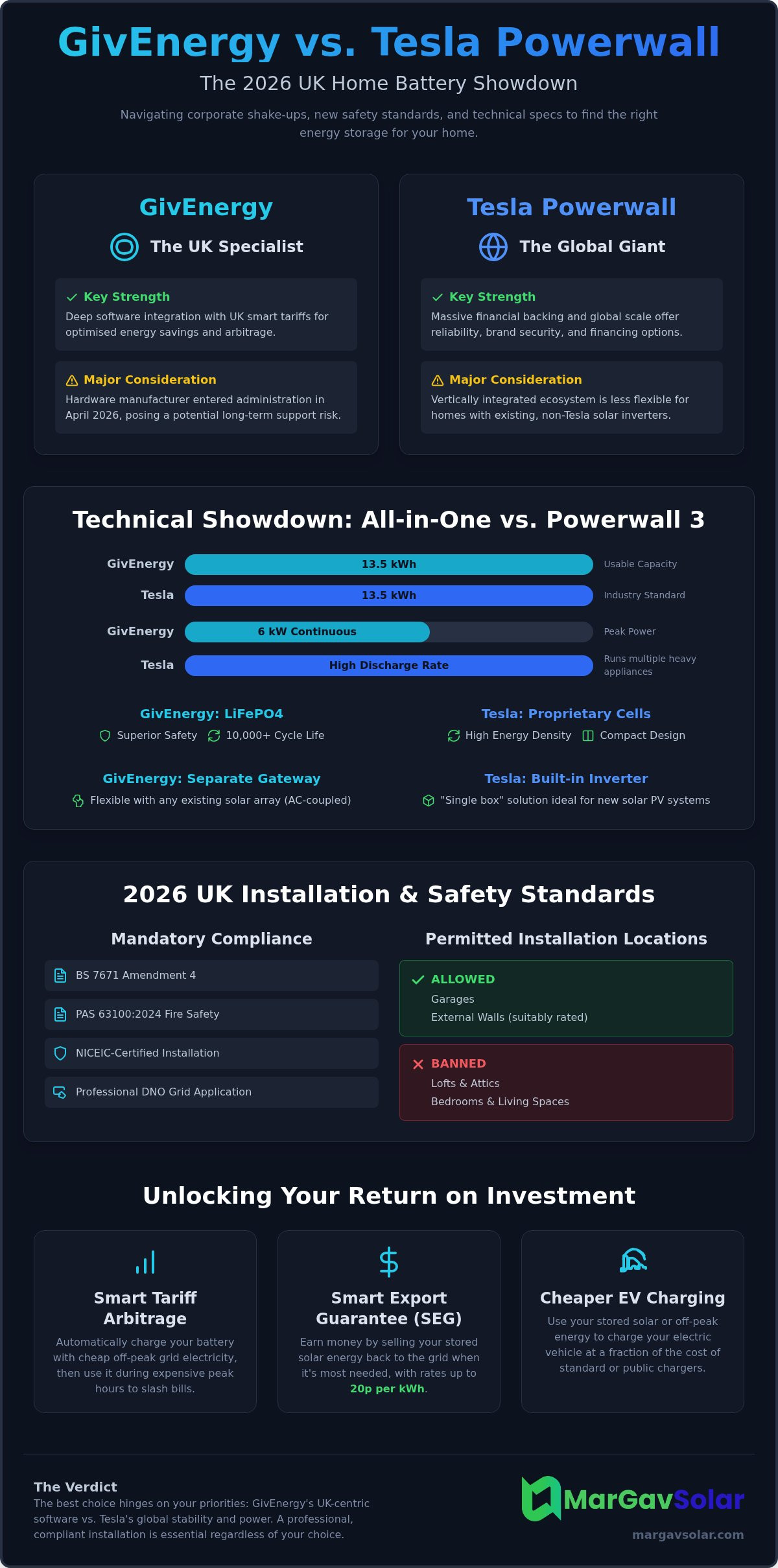
When comparing the GivEnergy vs Tesla Powerwall UK market leaders, the 13.5kWh capacity is the standard benchmark. Both systems provide enough energy to power an average three-bedroom home through the evening. However, the way they deliver that power differs significantly. Tesla’s Powerwall 3 is a beast of performance, boasting a high continuous discharge rate that easily handles multiple heavy appliances. If you're boiling a kettle while the dishwasher and heat pump are running, Tesla’s integrated inverter won't break a sweat. GivEnergy’s All-in-One is no slouch either, typically offering a 6kW continuous output, which is more than enough for most British households.
Chemistry is where the philosophies diverge. GivEnergy uses Lithium Iron Phosphate (LiFePO4), a technology widely praised for its safety and ability to handle thousands of charge cycles. Tesla uses its proprietary high-density cells, which allow for a more compact design. Regardless of the brand you choose, all installations must now adhere to the latest UK safety standards for home batteries. These 2026 regulations, including PAS 63100:2024, have strictly moved batteries out of lofts and into safer zones like garages or external walls. If you're unsure if your space complies, our team can provide a professional site survey to find the perfect spot.
Inverter Performance and Efficiency
The Powerwall 3 features a built-in solar inverter, making it an attractive "single box" solution for new solar PV systems. It simplifies the setup but can be less flexible if you already have a high-spec inverter you want to keep. The GivEnergy All-in-One uses a separate Gateway approach. This design offers massive flexibility for AC-coupled systems, allowing it to work alongside almost any existing solar array. In terms of round-trip efficiency, both systems hover around the 89% to 90% mark. This means very little energy is lost when converting power from your panels into the battery and back into your home.
Physical Installation and Footprint
Space is a premium in many Staffordshire homes. The Tesla Powerwall 3 is remarkably slim, often mounted on external walls to save internal floor space. It carries a high IP rating, so it handles the driving rain of a British winter without issue. GivEnergy’s All-in-One is a bit more substantial in its footprint but offers a modular advantage. If you find 13.5kWh isn't enough in the future, the GivEnergy ecosystem is designed for expansion. You can stack additional battery units more easily than adding a second Powerwall. However, you must ensure your garage or outbuilding has the required fire separation as per the October 2026 mandatory compliance deadline.
Software and ROI: Optimising for UK Smart Tariffs
The real winner in the GivEnergy vs Tesla Powerwall UK debate is often decided by the software. Your battery is only as smart as its brain. In 2026, energy arbitrage has become a standard household strategy. This involves charging your battery when prices are bottoming out on tariffs like Octopus Agile and discharging when they peak. Tesla’s app is famous for its "set-and-forget" simplicity. It uses machine learning to predict your home's usage patterns and weather forecasts. It's incredibly polished, but some users find it lacks the granular control needed for complex manual setups.
Recent government proposals on battery storage highlight how these systems are becoming central to cutting national bills. To make the most of this, you need to look at the Smart Export Guarantee (SEG). While some non-customers get as little as 3p per kWh, those with smart batteries can access premium rates of up to 20p per kWh from suppliers like So Energy. This turns your home into a mini-power station. The ability of your battery to respond to these price signals automatically is what determines your true return on investment.
GivEnergy Cloud and Third-Party Integration
GivEnergy remains a top choice for tech enthusiasts who want to see every detail. Their software is managed by GivEnergy Software Ltd, which remains fully operational and separate from the hardware manufacturing arm. The GivEnergy Cloud offers deep API access. This allows developers to create custom automations that go far beyond standard factory settings. You can find more details in our guide on the GivEnergy Cloud: The Ultimate Guide for Staffordshire Homeowners. It provides real-time monitoring that lets you track every watt of solar generation, battery health, and grid import with precision.
Future-Proofing with EV Charging
Comparing GivEnergy vs Tesla Powerwall UK systems in 2026 requires looking at how they handle your driveway. Integrating your battery with an EV charger is the next logical step for many Staffordshire households. The goal is to avoid "vampire charging," where your home battery drains itself to charge your car. This is inefficient due to double conversion losses. Both Tesla and GivEnergy have improved their coordination here. They ensure your car pulls from the grid during cheap off-peak windows while your battery stays reserved for your home's morning kettle and shower.
For a deeper dive into local setups, check out our EV Charging Points in Staffordshire: The 2026 Homeowner’s Guide. Coordinating these two systems can save you hundreds of pounds annually by keeping your high-load devices running on the cheapest possible electrons. It's about building a cohesive ecosystem rather than just buying individual parts.
Installation Realities for Staffordshire Homeowners
Moving from choosing a battery to seeing it mounted on your wall involves several critical local steps. The GivEnergy vs Tesla Powerwall UK debate often overlooks the practicalities of the Staffordshire grid. Before any hardware is ordered, a comprehensive site survey and electrical load analysis are essential. We look at your peak consumption periods and existing solar generation to ensure the battery size matches your lifestyle. In the Midlands, navigating the G99 application process with National Grid Electricity Distribution (the local DNO) can be complex. This application is mandatory for systems of this size to ensure your battery can legally export power without overwhelming the local substation.
Once the paperwork is clear, the choice between AC and DC coupling becomes the focus. AC coupling is generally easier for those with existing solar, while DC coupling is often more efficient for entirely new installations. The final stage is the NICEIC-certified commissioning. This isn't just a formality. It ensures your system meets the strict BS 7671 Amendment 4 regulations that became mandatory on October 15, 2026. If you're ready to secure your home's energy future, you can request a professional consultancy to determine exactly how these rules apply to your property.
Retrofitting to Existing Solar PV Systems
If you already have solar panels, the GivEnergy All-in-One is often called the "retrofitting king." Because it's an AC-coupled system, it sits alongside your current setup without needing to replace your existing inverter. The Tesla Powerwall 3, while technically superior in power density, features an integrated solar inverter. This can make retrofitting slightly more complex if you want to keep your original equipment. For those with ageing systems, this might be the perfect time for Inverter Upgrades in Staffordshire: The 2026 Guide to Maximising Solar ROI. Upgrading ensures your entire ecosystem operates at peak efficiency.
The Local Expertise Advantage
Local knowledge is vital when managing Staffordshire grid constraints. Some areas near Stafford or Lichfield may have specific export limits that require "G100" export limitation devices. A generic online quote won't account for these nuances. Using a local, experienced team ensures your GivEnergy vs Tesla Powerwall UK installation is fully compliant and optimised for the local climate. Furthermore, NICEIC Certification: The Complete Guide for Staffordshire Homeowners explains why this standard is non-negotiable for your home insurance and manufacturer warranty validity. It provides the peace of mind that your high-voltage equipment is installed to the highest possible safety standards.
The Verdict: Which Battery Should You Choose?
Deciding between GivEnergy vs Tesla Powerwall UK systems in 2026 comes down to your appetite for risk versus your desire for deep software customisation. Tesla has solidified its position as the safe, high-performance choice. With its massive global backing and the integrated inverter of the Powerwall 3, it offers a level of financial and technical stability that is hard to beat. It's the "set-and-forget" champion, perfect for households that want a premium, sleek unit that just works. If your home has high peak demands, such as multiple electric showers or a large heat pump, Tesla’s superior discharge rates make it the frontrunner.
GivEnergy remains a compelling option for those who prioritise the British-designed software ecosystem. While the administration of GivEnergy Ltd in April 2026 has introduced uncertainty regarding future hardware warranties, the separate software arm continues to provide the best integration for UK-specific smart tariffs. Tech enthusiasts still flock to it for the granular control offered by the GivEnergy Cloud. From an economic perspective, the 10-year total cost of ownership is often lower with GivEnergy due to its modularity. You can start with a single All-in-One unit and add capacity as your needs grow, whereas Tesla often requires a larger upfront investment for additional Powerwalls.
Summary Comparison Table
| Feature | Tesla Powerwall 3 | GivEnergy All-in-One |
|---|---|---|
| Usable Capacity | 13.5kWh | 13.5kWh |
| Coupling Type | Integrated DC/AC Inverter | AC-Coupled (Gateway) |
| Warranty | 10 Years (Global Support) | 10 Years (Check Status) |
| Best For... | High power & stability | Modularity & UK software |
For more details on local installation standards, see our Solar Battery Storage in Staffordshire: The Complete 2026 Homeowner’s Guide. It covers everything from planning permission in conservation areas to the latest fire safety requirements for external mounts.
Next Steps with MarGav Solar
The GivEnergy vs Tesla Powerwall UK choice shouldn't be made in a vacuum. With over 20 years of experience in the Staffordshire renewable energy sector, we understand that every home has a unique electrical profile. We don't believe in "one-size-fits-all" online quotes. Instead, we provide a bespoke consultancy that considers your roof orientation, your EV charging habits, and your local grid constraints. Our NICEIC-certified team ensures your system is fully compliant with the October 2026 regulations, protecting both your home and your investment. You can get a fixed-price quote for your GivEnergy battery installation or Tesla setup by booking a local survey today. Let's build a system that delivers real energy independence for your household.
Secure Your Energy Independence Today
The 2026 energy landscape has made the choice between GivEnergy vs Tesla Powerwall UK more significant than ever. While Tesla offers unmatched global stability and power density, GivEnergy remains the go-to for those who want deep, UK-specific software control. Success depends on more than just the brand; it requires navigating the strict BS 7671 Amendment 4 regulations and ensuring your system is optimised for smart tariffs like Octopus Agile. Your home battery is a long-term investment in lower bills and grid independence.
At MarGav Solar, we bring over 20 years of renewable energy expertise to every project. With more than 2,000 local Staffordshire installations completed, our NICEIC-certified installers understand the unique requirements of the Midlands grid. We provide the professional consultancy you need to choose the system that truly fits your lifestyle. Stop guessing with online estimators and get the facts from a local expert. You can get a fixed-price quote for your GivEnergy battery installation or Tesla Powerwall setup today. Take the first step toward a smarter, more resilient home.
Frequently Asked Questions
Can I charge a GivEnergy battery from the grid without solar panels?
Yes, you can charge a GivEnergy battery directly from the grid. This is a vital feature for homeowners who want to take advantage of energy arbitrage. When looking at GivEnergy vs Tesla Powerwall UK options, you'll find both systems allow you to "buy" cheap electricity during off-peak hours, such as overnight, to use during the expensive daytime peaks. This strategy can significantly lower your bills even during the darker winter months when solar generation is low.
Is the Tesla Powerwall 3 compatible with my existing solar inverter?
The Tesla Powerwall 3 is compatible with existing systems, but it's designed differently than previous models. It features an integrated solar inverter, which makes it an excellent choice for new installations or those looking to replace an ageing inverter. If you already have a functional solar inverter, the Powerwall 3 can be AC-coupled to your home. However, this setup might not fully utilise the unit's massive 11.5kW solar input capacity.
What happens to my battery storage during a power cut in Staffordshire?
Both systems can provide backup power during a grid failure, provided they are installed with the correct Gateway or Backup Box. When the grid goes down, the system automatically switches to "island mode," disconnecting from the network to keep your essential circuits running. This is a popular feature for Staffordshire residents in rural areas where winter storms can occasionally disrupt the local power lines.
How long do GivEnergy batteries last compared to Tesla?
Both manufacturers design their batteries to last between 10 and 15 years under normal operating conditions. GivEnergy uses Lithium Iron Phosphate (LiFePO4) chemistry, which is typically rated for up to 10,000 charge cycles. Tesla uses high-density cells that offer similar durability. When comparing GivEnergy vs Tesla Powerwall UK longevity, both companies provide 10-year warranties that guarantee the battery will retain a high percentage of its original capacity throughout that period.
Do I need a special energy tariff to make a home battery worth it?
You don't strictly need a special tariff, but a smart "time-of-use" tariff makes the investment much more profitable. Tariffs like Octopus Agile or Flux allow your battery to charge when prices are lowest, sometimes even earning you money to take excess power from the grid. Without a smart tariff, your savings are limited to the solar energy you generate yourself, which extends the time it takes for the system to pay for itself.
Can I add a second Tesla Powerwall or GivEnergy battery later?
Yes, both systems are expandable, though the approach differs. GivEnergy is highly modular, allowing you to add additional battery units to your existing Gateway setup as your energy needs grow. Tesla Powerwalls can also be "stacked" together, with most UK homes supporting up to four units. It's important to decide on your potential for future expansion during the initial design phase to ensure your cabling and DNO applications are handled correctly.
Which battery is better for charging an electric vehicle at home?
Both batteries work well with EVs, but the best choice depends on your specific charger and car. Tesla offers a perfectly integrated experience if you already own a Tesla vehicle and a Tesla Wall Connector. GivEnergy’s software is often preferred by those with third-party chargers, as it provides granular settings to ensure your car doesn't accidentally drain your home's battery storage during a high-speed charge.
Is a DNO application required for all battery installations in the UK?
A DNO application is mandatory for any battery system that connects to the grid. For the 13.5kWh units discussed here, we usually submit a G99 application to National Grid Electricity Distribution, the DNO for Staffordshire. This process ensures the local grid can handle the power your battery imports and exports. Skipping this step is illegal and can lead to your system being disconnected or your home insurance being voided.


