

The UK officially surpassed 2 million solar installations in early 2026, yet a surprising number of homeowners still feel in the dark about what they've actually bought. With the 0% VAT incentive on solar and battery systems scheduled to end in March 2027, the pressure to make a quick decision is high. However, rushing into a contract without the right questions to ask before installing solar panels can lead to poor performance or compatibility issues with your EV charging needs. You deserve a system that delivers a high yield for the next 25 years, not just a quick fix that leaves you confused by technical jargon like kWp versus kWh.
It's completely natural to feel wary of "solar cowboys" or uncertain about the real-world ROI of your investment. You want a system that integrates perfectly with your home's unique demands and provides genuine energy independence. This guide provides an expert-vetted checklist to help you master your solar consultation with total authority. We'll show you how to vet local Staffordshire specialists and understand exactly how modern hardware fits your lifestyle. By the end of this article, you'll have a clear roadmap to a future-proof energy system that maximises every kilowatt of Staffordshire sunshine.
Key Takeaways
- Learn how to evaluate your roof's structural readiness and use LiDAR mapping to account for shading before committing to an installation.
- Identify the specific questions to ask before installing solar panels to ensure your hardware, like hybrid inverters and high-efficiency panels, is built for 2026 standards.
- Understand the importance of choosing a local Staffordshire specialist with NICEIC certification to guarantee safety and long-term insurance compliance.
- Discover how to differentiate between product warranties and performance guarantees while securing a transparent, fixed-price contract.
- Prepare your home for the future by integrating EV charging points and smart battery storage to maximise your self-consumption and export credits.
Assessing Roof Suitability: Is Your Home Ready for Solar?
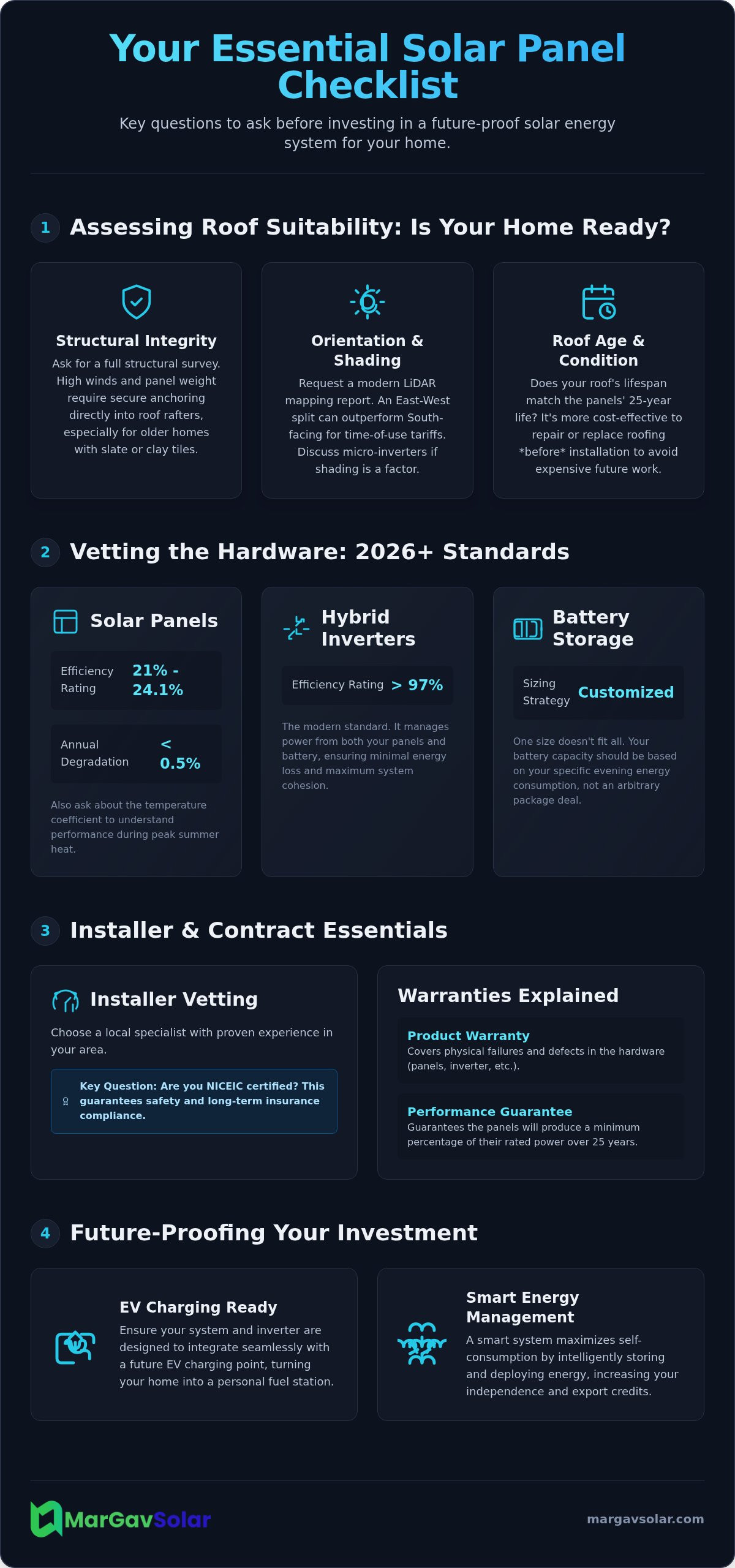
Your roof is the foundation of your entire energy strategy. While it's easy to get caught up in battery specs or inverter efficiency, the physical space where your system lives is just as critical. One of the most vital questions to ask before installing solar panels is whether your roof's structure can sustain the weight and wind pressure of a 25-year installation. Modern high-efficiency panels are often larger and heavier than older models, meaning a "one size fits all" approach to mounting simply doesn't work in 2026.
Structural Integrity and Weight Loading
Don't assume your roof is ready just because it looks sturdy from the ground. You should ask if your installer performs a full structural survey before you sign a contract. This is especially important for Staffordshire homeowners with older properties featuring original slate or clay tiles. These materials require specific mounting brackets to prevent cracking and ensure a watertight seal. In exposed areas across the county, wind loading is a serious factor. High winds can create significant uplift on your panels; a professional survey ensures the mounting system is anchored directly into the rafters rather than just the battens. Understanding the nuances of Solar panel technology helps you appreciate why a secure, weight-balanced fit is non-negotiable for long-term safety.
Orientation and Shading Analysis
The old advice was that a roof must be south-facing to be viable. In 2026, that's no longer the case. While south-facing arrays capture the most raw energy, an east-west split is often better for modern "time-of-use" energy tariffs. This setup captures morning and evening peaks when your household energy demand is typically highest. Ask your installer for a detailed shading report using 2026 LiDAR mapping tools. This technology creates a 3D model of your home to show how chimneys, nearby trees, or neighbouring buildings will cast shadows across different seasons. If your roof has complex shading, you'll need to ask about the benefits of micro-inverters or optimisers versus a standard string inverter to keep your yield high when one panel is in the dark.
Finally, consider the age of your roof covering. If your tiles are nearing the end of their lifespan, it's often more cost-effective to replace or repair the roof before the panels go on. Removing and reinstalling a solar array five years down the line to fix a leak is an expensive headache you can easily avoid. A transparent installer will be honest about whether your roof condition matches the 25-year lifespan of the panels they're quoting for.
Vetting the Hardware: Comparing Panels, Inverters, and Batteries
Choosing the right components is about more than just picking the highest wattage. In 2026, high-efficiency solar panels typically range between 21% and 24.1% efficiency. When considering your options, some of the most technical questions to ask before installing solar panels involve how these components communicate. You need a system where the inverter, battery, and panels work as a single, cohesive unit rather than a collection of mismatched parts. This ensures that the energy generated on your roof actually reaches your appliances or battery with minimal loss. For a broader perspective on the process, you can consult this Homeowner's Guide to Going Solar to understand standard industry expectations.
Hybrid inverters have become the 2026 standard for UK installations. These devices manage power from both your panels and your battery storage simultaneously. When vetting hardware, look for inverter efficiency ratings above 97%. You should also evaluate your battery storage capacity based on your specific evening energy consumption patterns. A battery that is too small will leave you drawing expensive power from the grid after sunset, while one that is too large may never reach a full charge during shorter winter days.
Solar Panel Efficiency and Degradation
Efficiency matters, but longevity matters more. Ask your installer for the specific degradation rate of the panels over 25 years. You should look for a rate of less than 0.5% annually to ensure your system remains productive in its second decade. It's also vital to inquire about the temperature coefficient. This figure tells you how much performance drops when the panels get hot during Staffordshire's peak summer months. Always verify that the manufacturer has a solid UK presence. If a company doesn't have a local office, claiming a warranty on a failing panel in ten years could become an impossible task.
Smart Battery Storage Integration
Modern energy management is about data. Ask if your proposed system supports the GivEnergy Cloud for remote monitoring and automated tariff switching. You should also inquire about the "depth of discharge" (DoD) ratings. A battery with a 100% DoD allows you to use all the stored energy, whereas older technologies might only let you use 80% before requiring a recharge. Discuss whether an AC or DC coupled system fits your home best. DC coupling is often more efficient for new solar installations, while AC coupling provides flexibility if you're adding a battery to an existing array. If you want to see how these components work together in a real-world setting, our guide to NICEIC certified installations explains the safety standards we follow for every component.
Vetting the Installer: Why Local Expertise Matters in Staffordshire
Even the best hardware fails if the installation is botched. While hardware and roof suitability are vital, the company you choose is the most important factor in your system's 25-year lifespan. One of the top questions to ask before installing solar panels is whether the team on your roof is actually employed by the company or just a sub-contracted crew hired for the day. In-house teams often take greater pride in their work and are easier to hold accountable if issues arise. With over 20 years of industry expertise, we've seen how local accountability transforms the customer experience and ensures a higher standard of finish.
Certifications and Insurance
Safety shouldn't be an afterthought. You must ask for proof of NICEIC registration before any work begins. While MCS accreditation is required for you to receive Smart Export Guarantee (SEG) payments, NICEIC certification ensures all electrical work meets Part P building regulations. This is essential for your home insurance and general safety. Additionally, verify that the installer holds sufficient Public Liability and Professional Indemnity insurance. It's also wise to check for membership in consumer protection schemes like HIES or RECC, which protect your deposit and provide a framework for dispute resolution if things go wrong.
The Local Advantage in Staffordshire
National companies often struggle with the specific geographic and grid requirements of our region. When vetting an installer, ask how many solar panel installations they have completed specifically in the Staffordshire area. Local experts understand the nuances of the local grid managed by National Grid Electricity Distribution (NGED). They'll know if your specific postcode has grid constraints that might limit the size of your array or require a G99 application. A local firm is also much more likely to provide a rapid response for maintenance or repair call-outs compared to a company based hundreds of miles away.
Financial stability is another key vetting point. Ask about the company's history. A firm that has been around for decades is more likely to be there in ten years if you need an inverter replacement or warranty support. Don't be afraid to ask for local references or to see examples of recent work in your area. Seeing a system in person and speaking to a neighbour about their experience is often more valuable than any online review. Asking these specific questions to ask before installing solar panels helps you filter out fly-by-night operations and find an established professional who knows Staffordshire's building styles, from traditional clay tiles to modern developments.
Financials, Warranties, and the "Fine Print"
Financial transparency is the bedrock of a successful solar project. With the 0% VAT incentive on solar and battery systems set to expire on March 31, 2027, many homeowners are rushing to secure quotes. However, a low headline price can often hide unexpected costs. One of the essential questions to ask before installing solar panels is whether your quote is a fixed-price installation contract. You should specifically ask if scaffolding, grid application fees, and final commissioning are included. In Staffordshire, we provide fixed-price contracts to ensure you aren't hit with "extra" charges halfway through the build.
Calculating your return on investment (ROI) requires realistic data. As of mid-2026, the Ofgem energy price cap for typical households is 26.11p/kWh. When you factor in Smart Export Guarantee (SEG) rates that now reach up to 15p per kWh, the numbers look very different than they did a few years ago. A typical 4kWp system can now earn between £150 and £400 annually in export credits alone. If you want a clear picture of your long-term savings, you can request a detailed financial breakdown tailored to your home's specific energy usage.
Understanding Warranty Tiers
Warranties are often misunderstood. You must differentiate between the panel product warranty, which covers physical defects, and the 25-year linear performance guarantee, which promises the panels will still produce a certain percentage of power in two decades. Most importantly, ask who covers the labour costs if a component fails. Many manufacturer warranties only cover the part itself, leaving you to pay the installer's call-out fee. Since inverters typically have a 10 to 15-year lifespan, planning for future inverter upgrades should be part of your initial financial strategy. Always check if these warranties are insurance-backed for extra security.
Maintenance and Aftercare
A solar array is not entirely "fit and forget." You should inquire about the recommended solar panel maintenance and cleaning schedules to keep your yield high. Bird-proofing, such as installing a perimeter mesh, is a smart addition to your initial install. It prevents pigeons from nesting under the panels, which can cause debris buildup and wiring damage. Finally, discuss how you will monitor the system. Modern apps should alert you immediately if the system underperforms, allowing you to address issues before they impact your energy bills. Effective aftercare ensures your investment remains a high-yield asset for its entire 25-year lifespan.
Future-Proofing: EV Charging and Smart Energy Management
By 2026, a solar installation is no longer a standalone product; it's the heart of a sophisticated home energy ecosystem. You aren't just buying hardware for today. You're building a foundation that must adapt as your lifestyle evolves and your energy needs grow. One of the most forward-thinking questions to ask before installing solar panels is how the system will integrate with EV charging points. With more Staffordshire residents switching to electric vehicles, your solar array should be the primary fuel source for your transport, not just your home appliances.
A truly future-proof system uses a Smart Home Energy Management System (HEMS) to automate your savings. This software monitors your generation and consumption in real-time, making split-second decisions about where your power should go. You should also discuss the potential for future expansion. It's often more cost-effective to install a larger hybrid inverter during the initial build than to replace a smaller unit in three years when you decide to add more panels or a second battery to your array.
Solar and EV Charger Synergy
Not all EV chargers are created equal. You need to ask if the charger supports "solar diversion," which allows it to prioritise excess solar energy over expensive grid power. This ensures your car only charges when the sun is shining, effectively giving you free mileage. It's also vital to discuss the impact on your home's total electrical load. A high-power EV charger can put significant strain on your main fuse. Your installer should check your fuse rating and consider load-balancing technology to prevent trips. Finally, decide between a tethered charger with a permanent cable or an untethered one that offers more flexibility for future car models with different plug types.
Smart Tariffs and Grid Interaction
Modern battery storage systems do more than just store sunlight. Ask your installer if the system can perform "load shifting." This allows your battery to charge from the grid during the night when agile energy tariffs are at their lowest, then discharge that cheap power during the morning peak. You should also inquire about Emergency Power Supply (EPS) functionality. This ensures that if the Staffordshire grid goes down, your home can still run essential circuits from your battery storage. While Vehicle-to-Home (V2H) technology is still emerging, asking about your system's compatibility with future V2H standards is a smart move for long-term energy independence. By addressing these questions to ask before installing solar panels, you ensure your investment remains relevant as the UK's energy landscape continues to shift.
Secure Your Energy Independence with Confidence
Investing in a solar ecosystem is a significant step toward energy independence and long-term savings. By prioritising structural safety, vetting local installer credentials, and ensuring your hardware is ready for future EV integration, you protect both your home and your wallet. Armed with these questions to ask before installing solar panels, you can approach any consultation with the confidence of an expert. You don't have to navigate technical jargon alone. Having a local specialist who understands Staffordshire's specific grid and building requirements makes all the difference to your system's 25-year performance.
MarGav Solar brings over 20 years of industry expertise to every project. As NICEIC and MCS accredited installers, we are specialists in high-yield GivEnergy battery storage and seamless EV charging integration. We're here to provide the transparent, fixed-price answers you need to make an informed decision for your home. Your journey to a cleaner, more affordable energy future starts with a single conversation.
Book Your Expert Solar Consultation with MarGav Solar Today
We look forward to helping you build a future-proof system that powers your life for decades to come.
Frequently Asked Questions
Do I need planning permission for solar panels in Staffordshire?
Most residential solar installations in Staffordshire fall under permitted development and don't require planning permission. This applies as long as panels don't protrude more than 200mm from a pitched roof. For flat roofs, 2026 regulations allow a protrusion of up to 600mm without permission. You'll still need to check with the local council if you live in a listed building or a designated conservation area.
How long does a typical residential solar installation take from start to finish?
The actual physical installation on your roof usually takes one to two days for a standard residential system. However, the entire process typically spans four to eight weeks. This timeline includes the initial site survey, structural assessments, and the mandatory application to National Grid Electricity Distribution (NGED) to ensure your local grid can handle the new connection.
What happens to my solar energy during a power cut?
Standard solar systems automatically shut down during a power cut to prevent electricity from flowing back into the grid, which protects engineers working on the lines. If you want your home to stay powered during an outage, you must include a battery storage system with Emergency Power Supply (EPS) functionality. This allows your home to run essential circuits using stored energy even when the grid is down.
Is it better to buy solar panels outright or look at financing options?
Buying outright typically offers the fastest return on investment because you avoid interest charges and benefit from the 0% VAT rate available until March 31, 2027. Financing can make the technology more accessible if you prefer to spread the cost. When reviewing your options, consider upcoming government-backed low-interest loans or green mortgages that specifically support renewable energy upgrades.
How much can I actually earn from the Smart Export Guarantee (SEG) in 2026?
In 2026, a typical 4kWp system can earn between £150 and £400 annually by selling surplus energy back to the grid. Some energy suppliers now offer export rates as high as 15p per kWh. Understanding these potential earnings is one of the most important financial questions to ask before installing solar panels to ensure you calculate your ROI accurately.
Can I add a battery to my solar system at a later date?
You can add a battery later, but it's often more cost-effective to install it alongside your panels. If you plan to add storage in the future, ensure your installer fits a hybrid inverter now. This avoids the need for an expensive inverter replacement later on. Alternatively, an AC-coupled battery can be added to almost any existing system without changing the original solar inverter.
What is the difference between an MCS certificate and an NICEIC certificate?
An MCS certificate is essential for proving your system meets industry standards and is required to claim Smart Export Guarantee payments. An NICEIC certificate focuses on electrical safety and confirms the work complies with UK building regulations. You need both certifications to ensure your system is safe, legally compliant, and eligible for all available financial incentives and insurance coverage.
Do solar panels still work on cloudy days in the UK?
Solar panels generate electricity using light rather than heat, so they continue to work even on typical cloudy UK days. While output is lower than in direct sunlight, modern panels with efficiency ratings up to 24.1% are highly effective at capturing diffused light. This ensures your system contributes to your home's energy needs throughout the year, regardless of the Staffordshire weather.


