

What if the most expensive component of your solar setup is designed to quit a decade before your panels do? It's a frustrating reality for many homeowners who assume their entire system is "fit and forget" for 25 years. Understanding how long do solar inverters last uk is essential because this hardworking piece of kit acts as the brain of your energy production. While your panels might soak up the Staffordshire sun for three decades, your inverter works under constant electrical stress and usually has a much shorter timeline.
You've likely invested in solar to slash your energy bills, so the prospect of an unexpected £1,500 replacement bill feels like a hidden trap. We agree that maintenance shouldn't be a mystery. This 2026 guide reveals the typical lifespan of string, hybrid, and microinverters in the UK and explains why your choice of installation spot, like a hot loft versus a cool garage, makes a massive difference. You'll learn exactly when to expect a replacement and the proactive steps you can take to stretch your hardware's life to its absolute limit.
Key Takeaways
- Most standard string and hybrid systems have a working life of 10 to 15 years, meaning they usually require one replacement during the lifetime of your solar panels.
- Understanding how long do solar inverters last uk depends heavily on temperature management, as units in cool garages typically outlive those installed in poorly ventilated lofts.
- Microinverters can offer a 25-year lifespan that matches your panels, providing a durable alternative if you want to avoid mid-life system maintenance.
- Simple proactive steps, such as maintaining 150mm of clearance for airflow and checking for fan noise, can prevent premature component failure.
- Recognising early red flags like error codes or sudden drops in energy yield allows you to plan for an upgrade before your system stops generating entirely.
Understanding the Lifespan of Solar Inverters in UK Homes
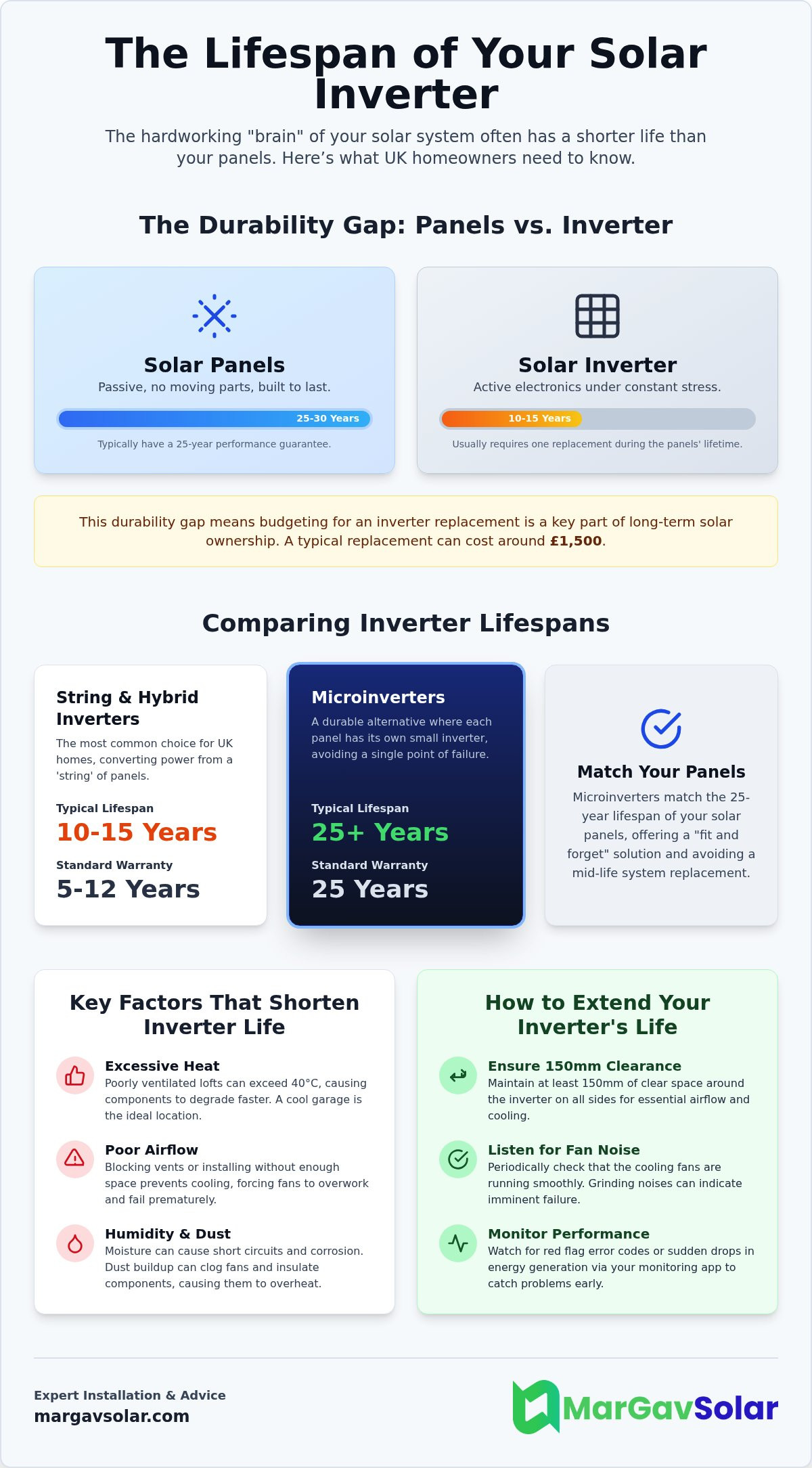
The Solar inverter is the hardest working component in any residential PV setup. While your panels sit silently on the roof, the inverter is an active electronic device that converts Direct Current (DC) from the sun into usable Alternating Current (AC) for your home. When asking how long do solar inverters last uk, the industry standard typically falls between 10 and 15 years. This timeline often surprises homeowners because they expect the entire system to last for 25 years or more, matching the performance guarantee of the panels.
Think of the panels as the body and the inverter as the heart. The body stays relatively still, but the heart beats constantly to keep the system alive. This conversion process takes a heavy toll on internal components. In the past, electrolytic capacitors were the primary point of failure due to heat. However, 2026 technology has seen a shift toward advanced film capacitors and improved solid-state designs. These modern components handle electrical stress much better than older models, but the constant high-voltage switching means parts eventually wear out.
Inverters vs. Solar Panels: The Durability Gap
Solar panels are passive. They have no moving parts and endure little internal strain beyond UV exposure and weather. Inverters, conversely, are sophisticated computers handling thousands of watts of power. They experience "thermal cycling" every single day. As the sun rises, internal temperatures spike; as it sets, the components cool down. This expansion and contraction of circuits eventually leads to solder cracks or component fatigue. It's the most hard-working component of a PV system, often processing enough energy to power a home for decades in just a few years of operation.
Typical Warranty Periods in the UK Market
Most string inverters sold in the UK come with a standard 5-year manufacturer warranty. Many top-tier brands, such as GivEnergy, now offer 10 or 12-year guarantees as standard in 2026 to reflect better build quality. Knowing how long do solar inverters last uk helps you plan your long-term maintenance budget, as you'll likely need one replacement during the system's life.
To protect these guarantees, professional installation is non-negotiable. Using an MCS-certified installer or a specialist like MarGav Solar ensures the equipment is fitted to manufacturer specifications. Without this, you might find your warranty void when you need it most. Even with a 12-year warranty, you should budget for the reality that electronic components rarely outlast the structural glass of your solar panels.
Key Factors Influencing Inverter Longevity in the Staffordshire Climate
While the UK isn't known for scorching deserts, the local environment plays a massive role in how long do solar inverters last uk. Heat is the primary enemy of electronic components. Even a mild Staffordshire summer can create micro-climates within your home that push an inverter to its limits. High temperatures cause the unit to "thermal throttle," reducing its efficiency to protect its internal circuits from permanent damage. This constant heat stress significantly shortens the lifespan of inverters compared to those kept in stable, cool environments.
Humidity and moisture also present unique challenges in the British weather. Condensation can form inside units installed in damp outbuildings, leading to short circuits or corrosion on the PCB. Additionally, the stability of your local electrical grid matters. If your home is in a rural part of Staffordshire, you might experience frequent voltage fluctuations. These small but repetitive electrical shocks force the inverter's surge protection to work harder, eventually wearing out the protective components.
The Loft Installation Problem
Many older UK solar installations placed the inverter in the loft for convenience. This is often the worst possible location. During a standard British summer, loft temperatures can easily exceed 40°C. Without proper airflow, the inverter's cooling fans must work overtime, leading to mechanical wear and eventual failure. MarGav Solar has witnessed this issue frequently over 20 years of local service. We generally recommend garage or utility room placement where temperatures remain consistent. If a loft is your only option, ensuring at least 150mm of clearance and adequate roof ventilation is vital to prevent the unit from cooking itself.
Dust and Environmental Debris
Dust is a sneaky factor that many homeowners overlook. It settles on the internal heat sinks, acting like a thermal blanket that traps heat inside the casing. This is where regular solar panel maintenance in Staffordshire becomes useful. While having your panels cleaned, a quick visual check of the inverter's cooling fins can make a huge difference. For homeowners with outdoor-rated units, salt air or high-pollution areas near busy A-roads can also cause casing corrosion. If you're concerned about your current setup, a quick health check from a local expert can identify these environmental risks before they lead to a total failure.
Comparing Lifespans: String Inverters vs. Microinverters vs. Hybrid Systems
The type of technology you choose significantly dictates how long do solar inverters last uk. While we established that the industry average is 10 to 15 years, this figure mainly applies to traditional string inverters. These units act as a single point of management for your entire array. They are generally the most cost-effective option, with replacement costs in 2026 typically ranging between £800 and £1,500. However, because they handle the high-voltage output of every panel at once, they endure significant internal stress.
Some homeowners opt for power optimisers paired with a string inverter. This setup adds complexity but improves resilience by managing each panel individually. While optimisers themselves often carry 25-year warranties, the central string inverter will still likely need replacing around the 12-year mark. Understanding these hardware differences helps you budget for the "mid-life" maintenance of your solar investment.
Why Hybrid Inverters Are Different
Hybrid inverters are the modern standard for homes with battery storage. They do double the work of a standard unit, managing two-way power flow between your panels, the battery, and the National Grid. This increased workload is particularly evident in a GivEnergy cloud-integrated system, where the inverter constantly communicates with the cloud to optimise energy usage.
Because they are active 24/7, managing battery discharge even when the sun isn't shining, you might wonder if they die sooner. Most high-quality hybrid models are engineered with more robust cooling systems to handle this 10 to 15-year lifespan despite the extra shifts. MarGav Solar specialises in these upgrades, ensuring that the additional complexity of battery integration doesn't compromise the system's overall reliability.
The Microinverter Advantage
Microinverters represent a shift in philosophy. Instead of one large box on a wall, you have small units tucked behind every individual panel. This distributed approach offers a major longevity boost for several reasons:
- Lower Voltage: Each unit only handles the power of one panel, leading to less thermal stress.
- Distributed Failure: If one microinverter fails after 18 years, the rest of your system continues to generate power.
- Warranties: Most microinverters come with a 25-year guarantee, effectively matching the lifespan of the panels.
The trade-off is the upfront cost. A full microinverter system can cost over £2,500 to replace in its entirety, compared to the lower cost of a single string unit. For many Staffordshire homeowners, the peace of mind that comes with a 25-year "set and forget" system justifies the higher initial investment.
How to Extend the Life of Your Solar Inverter
While the standard answer to how long do solar inverters last uk is usually 10 to 15 years, this timeline depends heavily on how you treat the hardware. You don't have to be an electrician to help your system thrive. The simplest step is ensuring the unit has breathing room. Manufacturers typically require at least 150mm of clearance around the casing. This space allows the heat sinks to radiate warmth away from the sensitive internal processors. If you've squeezed your inverter into a cluttered utility cupboard or surrounded it with loft insulation, you're significantly increasing the risk of a premature heat death.
Load management is another factor. While your inverter is designed to handle the peak output of your panels, consistently running it at its absolute limit causes internal components to degrade faster. If you're planning a system expansion, it's often worth talking to a specialist about whether your current unit can handle the extra stress or if an upgrade is a safer long-term bet. Keeping the software updated is just as vital. Manufacturers frequently release firmware patches that optimise how the inverter handles electrical loads, which can reduce wear on the physical circuits over time.
Professional Maintenance Checklist
A yearly health check from a qualified professional can add years to your hardware's life. During these visits, an engineer will check the torque on all electrical connections. Loose wires are a common cause of electrical arcing and localised heat buildup. They will also clear away dust from cooling fans and heat sinks that would otherwise trap heat. Regular professional inspections catch "leaky" or bulging capacitors before they fail completely, allowing for a planned repair rather than an emergency replacement. If you haven't had your system checked recently, consider booking solar panel maintenance and cleaning to ensure everything is running at peak efficiency.
Monitoring via Apps and Portals
Modern inverters are smart devices. Most systems now connect to your home Wi-Fi, allowing you to track performance through dedicated portals. These apps are your first line of defence. By keeping an eye on your daily yield, you can spot subtle efficiency drops that might indicate a struggling component. Look out for specific alerts like "Isolation Faults" or "Grid Overvoltage," which often suggest external issues that are putting unnecessary strain on your inverter. MarGav Solar provides ongoing support for Staffordshire homeowners, helping you interpret these error codes and performing remote firmware updates to keep the "brains" of your system healthy and secure.
Knowing When to Repair or Upgrade Your Inverter System
Even if you've followed every maintenance tip, there comes a point where every electronic component reaches the end of its reliable service life. Recognising the red flags early can save you from weeks of lost generation. If you hear persistent clicking sounds, it often indicates failing internal relays. Sudden drops in energy yield, even on clear days, suggest the unit is struggling to track the maximum power point of your panels. While we've discussed how long do solar inverters last uk, seeing an error code on your display or app is the most definitive sign that your "heart" is failing.
When your unit is out of warranty, you face the "Repair vs. Replace" dilemma. A specialist might be able to swap out a single circuit board for £300 to £500, but if the unit is already 12 years old, other components will likely fail soon after. Investing that money toward a modern replacement is usually the smarter financial move. Many homeowners are now choosing inverter upgrades in Staffordshire to transition to hybrid technology. This allows you to add battery storage to an older system, drastically increasing your self-consumption and protecting you from rising energy prices.
The Replacement Process
Replacing an inverter isn't a simple "plug and play" task. The new unit must be carefully matched to your existing panel string voltage. If the new inverter's MPPT (Maximum Power Point Tracking) range doesn't align with your roof's output, you'll see a massive drop in efficiency or even a total system shutdown. This is why you should never attempt a DIY replacement. High-voltage DC electricity is dangerous, and a botched installation will void your manufacturer's warranty.
A professional installation also ensures your paperwork stays legal. Your installer must update your MCS registration and notify the local Distribution Network Operator (DNO). For systems under 3.68kW, this falls under G98 regulations; larger systems require G99 notification. Without these updates, you may find your Smart Export Guarantee (SEG) payments are suspended because your system no longer matches its registered technical specifications.
Upgrading for Better ROI
Choosing a replacement in 2026 offers more than just a working system; it's a chance to improve your Return on Investment (ROI). Modern silicon carbide technology has pushed inverter efficiency from 95% to over 98%. While 3% sounds small, it adds up to hundreds of pounds in extra generation over the next decade. You can also integrate EV charging points directly into your system overhaul, creating a unified home energy hub. If your system is showing its age, contact MarGav Solar for a professional inverter health check or a quote for a high-efficiency upgrade to keep your home powered for the next decade.
Future-Proofing Your Home Energy System
Your solar inverter works harder than any other part of your PV system. While most homeowners can expect their unit to last between 10 and 15 years, your specific installation environment and maintenance routine are the deciding factors. Choosing the right location and keeping the cooling fins clear of dust can be the difference between a decade of reliable service and a premature failure. Understanding how long do solar inverters last uk helps you plan for the future rather than being caught off guard by a sudden repair bill.
If your system is approaching its tenth birthday or you've noticed a drop in daily yield, it's the perfect time to evaluate your hardware. Upgrading to a modern hybrid inverter doesn't just replace a failing part; it opens the door to battery storage and smarter energy management. With over 20 years of local Staffordshire experience and NICEIC-certified specialist installers, MarGav Solar ensures your system stays at peak performance with full equipment warranty support. Don't wait for a total shutdown to take action. Book an Inverter Health Check with MarGav Solar today to protect your investment and keep your home powered by clean, affordable energy for years to come.
Frequently Asked Questions
Is it worth replacing a solar inverter after 10 years?
It is worth replacing your inverter if it has failed or if its efficiency has dropped significantly. While some units keep running, a 10-year-old inverter is often nearing the end of its reliable life. Upgrading to a modern hybrid model allows you to integrate battery storage and benefit from 2026 efficiency standards, which can be up to 4% higher than older technology.
Can I install a solar inverter myself to save on costs?
You cannot legally or safely install a grid-tied solar inverter yourself in the UK. All installations must be performed by a qualified professional to comply with G98 or G99 regulations and to ensure your system remains eligible for Smart Export Guarantee payments. DIY attempts void manufacturer warranties and pose a significant risk of electrical fire or injury from high-voltage DC current.
What happens to my solar panels if the inverter fails?
Your solar panels will remain perfectly safe, but they will stop providing power to your home. The inverter is the sole gateway that converts the energy from your roof into usable electricity. When it fails, the system automatically shuts down as a safety precaution. Your panels will sit idle until a new unit is professionally installed and commissioned.
Do solar inverters make a noise when they are dying?
Unusual sounds are often the first sign of internal component failure. While a quiet hum is normal during periods of high generation, you should listen for loud buzzing, high-pitched whining, or constant clicking from the internal relays. These noises suggest that the capacitors or cooling fans are struggling, indicating that the unit may need a professional health check before it fails completely.
Will a new inverter increase my solar energy production?
A new inverter can increase your usable energy yield by replacing an aging, less efficient unit. Modern hardware often reaches efficiency ratings of 98% or higher due to improvements in power electronics. If your original inverter was rated at 94% or 95%, swapping it for a modern equivalent provides an immediate boost in the amount of electricity sent to your home and the grid.
Are some inverter brands more reliable for UK weather?
Reliability in the UK market depends on how well a brand handles humidity and temperature fluctuations. Brands with robust UK-based technical support, such as GivEnergy, are highly regarded because their units are engineered for the specific thermal stresses of domestic installations. Choosing a brand with a strong UK presence ensures that warranty claims and software updates are handled quickly and effectively.
How much does a typical UK solar inverter replacement cost in 2026?
The average cost for a string inverter replacement in 2026 ranges between £800 and £1,500 including professional labour. This is a key factor when calculating how long do solar inverters last uk, as it represents the primary maintenance cost over a 25-year period. While microinverters have higher total system replacement costs, their longer warranties often offset the initial price difference over time.
Does my home insurance cover solar inverter failure?
Most standard home insurance policies do not cover inverter failure caused by general wear and tear or age. You are typically covered for sudden, accidental damage from external events like lightning strikes, fire, or storm damage. For a standard internal component failure after 12 years of service, you will usually need to fund the replacement yourself or rely on a manufacturer's extended warranty.


