

The best smart tariff solar battery setup in the UK is usually a dedicated solar-and-battery tariff, or a Smart Export Guarantee (SEG) export tariff paired with a dynamic or Economy 7 import tariff. The right fit depends on when your home can charge its battery cheaply, when it needs power, and how much electricity it exports.
It’s easy to focus on the cheapest overnight rate, but export payments, standing charges and the length of the cheap-rate window also affect overall value. The Smart Export Guarantee (SEG) lets eligible households earn payments for electricity they send to the grid. Export-payment eligibility can depend on the home's equipment and metering arrangements.
This guide explains how to compare tariff structures, battery charging power and cheaper-rate windows, including the smart meter requirement. You’ll learn which setup may suit a home with solar panels and a battery, how to weigh the practical trade-offs, and what information makes the comparison useful for your household.
Key Takeaways
- Compare import rates, export payments and standing charges together, as the lowest overnight rate alone may not make a tariff the best fit.
- Match the battery’s charging power to the length of the cheap-rate window to see whether it can charge when intended.
- A smart meter is central to accessing tariffs that use time-based rates and measuring electricity exported to the grid.
- Use your household’s solar generation, electricity use and battery setup to narrow the options before choosing a tariff structure.
Which smart tariff can a professional recommend for solar panels and a battery?
Compare SEG export payments with import rates, standing charges and your household’s electricity use. Match battery capacity and inverter power to your solar surplus and the amount of electricity you need later.
There’s no single battery size or inverter setup for a typical UK household. Sizing depends on consumption patterns, solar generation and the power needed at any one time. Smart tariffs also involve trade-offs: rates can change, export terms may limit payments, and repeated battery cycling contributes to degradation.
Smart Export Guarantee payments
The Smart Export Guarantee (SEG) pays for electricity exported to the grid at a supplier-set rate per unit. Unlike a tariff that bundles import and export, SEG can be paired with a separate smart import tariff. Large energy suppliers must offer an export tariff under the scheme, while a supplier may require you to buy imported electricity from it to access a particular export rate.
The Feed-in Tariff closed to new applicants in 2019, according to the Department for Energy Security and Net Zero. For an existing FIT arrangement, a professional includes its deemed-export terms in the comparison rather than assuming the home can join SEG.
Annual import costs and export income
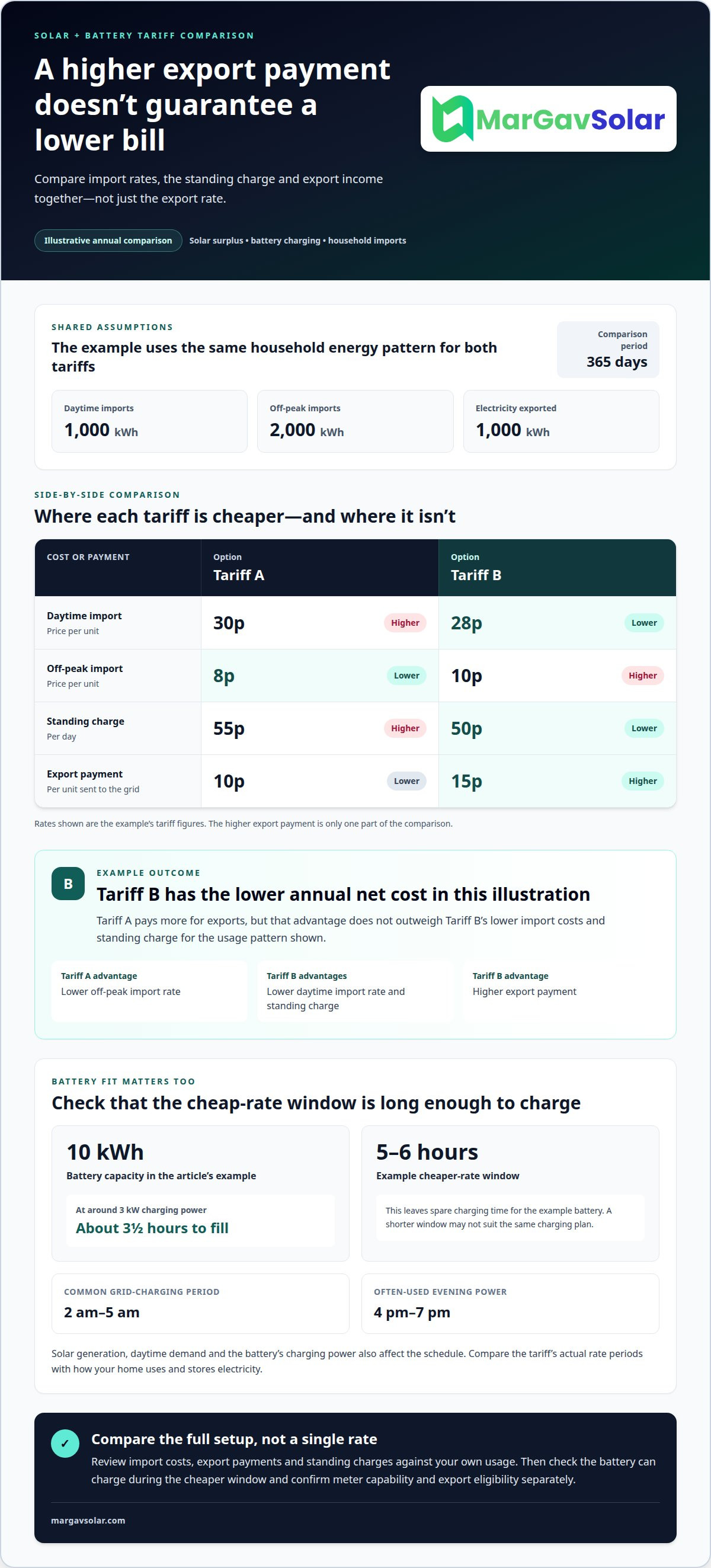
Compare the annual bill after export payments, not the export rate alone. This illustration assumes 1,000 kWh of daytime imports, 2,000 kWh of off-peak imports and 1,000 kWh of exports over 365 days. Tariff A’s higher export payment does not beat Tariff B’s lower import costs and standing charge in this example.
| Option | Daytime import | Off-peak import | Standing charge | Export payment | Annual net cost |
|---|---|---|---|---|---|
| Tariff A | 30p/kWh | 8p/kWh | 55p/day | 10p/kWh | |
| Tariff B | 28p/kWh | 10p/kWh | 50p/day | 15p/kWh |
Stored solar versus export income
Storing surplus solar can reduce later grid imports, but exported electricity may earn income. Weigh the export payment against the cost of replacing that electricity later, including battery losses. Export payments and rates can differ between tariff options, so compare them with the value of storing surplus electricity for later use.
Compare compatible import and export options to find the lowest projected annual net cost for your usage, then check whether the battery can meet your charging and discharge needs.
Battery charging power and cheap-rate window fit
A useful tariff must leave enough low-cost time to charge the battery. Compare the cheaper-rate period with charging power, solar generation and household demand.
How professionals set battery charging and discharging schedules around cheap-rate windows
A 10 kWh battery charging at around 3 kW takes about three and a half hours to fill. A five- or six-hour cheap-rate window therefore leaves spare time, while a shorter window may not suit the same charging plan.
Professionals align charging with the tariff’s actual overnight period, then schedule discharge around household use. Grid charging commonly takes place between 2 am and 5 am; stored power is often used during the evening peak, between 4 pm and 7 pm. Solar panels and daytime demand also affect the schedule.
How professionals configure time-of-use battery charging
With a time-of-use tariff, electricity prices change by period, so the schedule can prioritise charging when electricity is cheap. Economy 7 has one cheaper night period and a more expensive daytime rate. Some cited tariffs offer overnight charging around 7p/kWh in 2026, but the window and rate vary by tariff.
Dynamic tariffs change rates every half-hour. This can suit a battery that can respond to lower-priced periods, but the schedule must also leave capacity for solar generation and later household needs. An EV tariff may offer an overnight charging window; professionals coordinate battery and vehicle charging so both loads fit the available period.
Tariff names such as Charge Power and Store&Save aren’t enough to determine suitability: the practical difference is the rate schedule, window length and how the battery can use them. A professional compares those details with charging power and demand rather than assuming a name guarantees savings. A battery storage assessment can help align the system with your tariff and home’s usage.
Smart meter requirements
A smart meter can support time-based import rates and measure electricity exported from solar panels. Check meter capability, export eligibility and battery compatibility as separate parts of the setup.
Smart meter and half-hourly readings
Dynamic tariffs change the import price every half-hour, so the meter must provide readings at that interval for billing. With a fixed overnight tariff, the key question is whether the battery can charge during its cheaper window. Before switching, make sure the meter readings and supplier arrangements support the tariff you choose.
A battery is not the only consideration when assessing whether a household can receive payments for exported electricity. Eligible homes can therefore measure exported electricity without storing it first.
Meter and equipment eligibility
To qualify for an export tariff such as SEG, a household needs solar panels installed by an accredited installer and proof of installation. The meter must measure exports, and the owner can apply to an SEG supplier for an Export MPAN, the unique identifier for export electricity.
Supplier export plans can have different conditions. Some require the household to import electricity from the same supplier that pays for exports. Compare this requirement with the import tariff, meter capability and battery system before switching. A heat pump can also affect which import plan suits the home’s demand.
Permissions, grid notifications and safety
For a home battery installation, the installer must notify the local grid operator, known as the Distribution Network Operator (DNO). This notification concerns the connection to the electricity network and is separate from smart-meter eligibility or an export tariff application.
After commissioning, battery owners should receive an MCS Certificate within 10 days. The installer also assesses the battery, inverter and electrical connection as part of the installation, rather than treating a smart meter as proof that the equipment is suitable. Together, grid notification and commissioning documentation help establish the installation’s connection and recorded handover.
Solar and battery smart tariffs
A suitable tariff matches solar generation, battery use and household demand, rather than simply chasing a low rate. The smart meter, export terms and any vehicle charging also shape the setup.
Choosing a smart tariff solar battery setup UK homeowners can use well starts with comparing electricity use, solar output and battery capability. A professional identifies compatible import and export arrangements, then considers how charging periods work with the home’s renewable generation.
Choosing a solar battery system with professional advice
Start with the home’s generation and demand profile, then work out how much electricity needs to be stored for later use. A system planned around daytime surplus and evening consumption may differ from one supporting a heat pump or vehicle charging. Energy Saving Trust has researched over a million tariff and technology combinations, showing how much the right match depends on the household.
The Smart Export Guarantee pays for eligible exported electricity, while dynamic tariffs change import prices every half-hour. Consider both structures together: storing solar may reduce later imports, while exporting may earn income. The best balance depends on when the home uses electricity and the export rate available.
Professional configuration of a battery for smart tariffs
Once the tariff and equipment are selected, configure the battery to respond to the tariff’s price periods. It can charge from the grid when rates are lower, retain capacity for expected solar generation, and discharge when household electricity would otherwise cost more.
A smart tariff solar battery setup UK households can use effectively needs a schedule suited to the meter and controls. Dynamic pricing can make that schedule more responsive than a fixed overnight period, while a heat pump or vehicle adds demand to account for. Savings depend on import and export rates, charging losses and how much stored electricity the home uses.
For a system designed around your panels, tariff and household loads, discuss a solar and battery system with MarGav Solar.
MarGav Solar: Battery Storage Solutions
MarGav Solar provides Battery Storage Solutions for homes using solar generation alongside a smart tariff. Its professional advice can help align a battery system with household electricity use, solar output and tariff charging periods. If you’re also planning solar panels or an electric vehicle, Residential Solar PV Systems and EV Charging Points can form part of a wider home energy setup.
This is a useful next step if you’re weighing battery storage, adding a battery to solar panels or considering how an EV may affect electricity demand. MarGav Solar also provides Solar Panel Maintenance & Cleaning for existing systems. Discuss your home’s solar, battery and tariff plans with MarGav Solar.
Plan for the way your home uses energy next
Household energy needs can change as routines, appliances and plans evolve. Treat the tariff and battery as parts of a home energy plan, not isolated choices. A smart tariff solar battery setup in the UK is most useful when its settings reflect your household’s current priorities and allow for future needs.
Before deciding, identify the outcome you value most: using more of your own solar electricity, earning from exports or coordinating household demand with an electric vehicle. Share those priorities with a professional, along with a clear picture of your usual energy routines. This shifts the discussion from choosing a tariff by name to shaping a system around how you expect to use electricity.
If you’re weighing the right next step, a conversation can help turn your priorities into a practical plan. Contact MarGav Solar for advice and move towards an energy setup that feels right for your home.
Frequently Asked Questions
What is a time of use tariff?
A time-of-use tariff charges different prices for electricity at different times. A fixed time-of-use plan has set cheaper and more expensive periods, while a dynamic tariff can change its price every half-hour. For example, a household may schedule battery or vehicle charging for a lower-priced period. The best fit depends on how those periods align with household electricity use.
Which Batteries Work Best with Smart Tariffs?
A suitable battery works with the tariff’s charging schedule and the home’s solar setup. Consider how it handles grid charging, solar generation and household demand, rather than choosing by capacity alone. For example, a household using more electricity in the evening may need a different operating plan from one that uses most of its power during daylight hours.
How Do You Actually Make Money with a Battery?
A battery can reduce electricity bought at expensive times by storing solar power or charging from the grid during cheaper periods. Exporting surplus electricity can also earn payments through an export tariff. For illustration, charging a 10 kWh battery at 7p/kWh costs 70p, while the example compares this with grid electricity priced at 24p/kWh. Losses and tariff terms affect the net benefit.
How can a professional help choose the right smart tariff?
Compare the home’s import pattern, solar generation, export potential and battery charging capability with the tariff terms. Include other planned loads, such as an EV charger or heat pump, and consider how they affect the charging schedule. For a Staffordshire household, this connects the tariff choice with the property’s solar generation, equipment and everyday electricity use.
Which UK smart electricity tariffs work with home solar and battery storage?
Options include dedicated solar-and-battery tariffs, or a Smart Export Guarantee export tariff paired with a dynamic or Economy 7 import tariff. Economy 7 has a cheaper night period; dynamic tariffs change every half-hour. Some export plans require the household to buy imported electricity from the same supplier. The right combination depends on the home’s usage and the terms of each tariff.
What are the current UK import and export rates for solar battery smart tariffs?
There is no single rate for every household: import prices vary by supplier and tariff, while suppliers set export rates. The Great Britain electricity price cap rate used in the comparison is 26.32p per unit from 1 October 2026. Solar export rates can range from a few pence to over 30p/kWh. Compare the applicable import and export terms together.


