
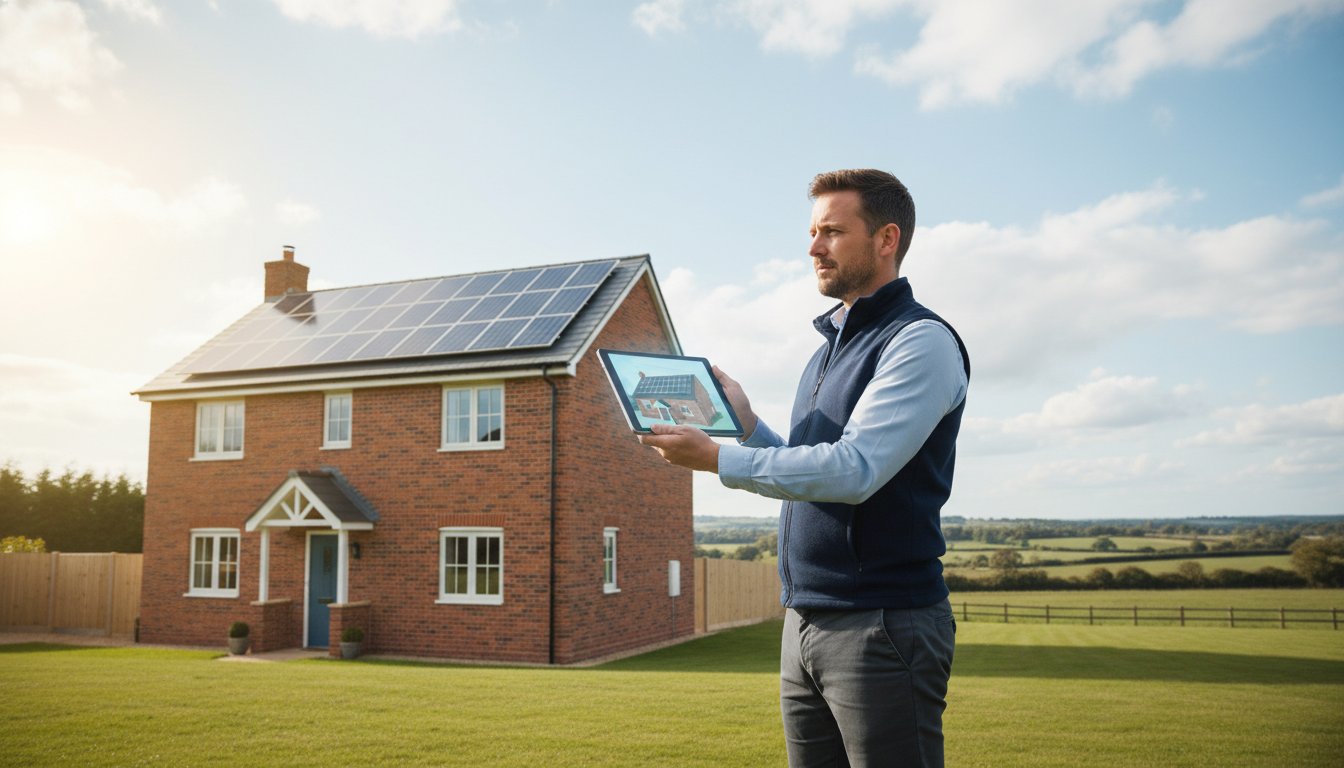
By June 2026, every new home built in England must legally include solar panels, yet thousands of existing homeowners still worry their property is the "wrong" shape or direction for clean energy. You've likely seen conflicting advice about North-facing pitches or feared that 2026 electricity price hikes will outpace your potential savings. It's natural to ask is my roof suitable for solar panels UK before committing to an investment that needs to last for decades.
We understand the concern that a fragile structure or a bit of shade might disqualify your home. Modern PV technology has changed the game. Whether you have a flat roof or a complex pitched design, this guide provides a definitive framework to assess your property. You'll discover how to evaluate your roof's condition, understand the ROI of different orientations, and learn how to take advantage of the 0% VAT rate on installations before it expires in March 2027. We'll break down the structural requirements and professional steps needed to turn your home into a viable energy generator.
Key Takeaways
- Learn why South-facing roofs are the gold standard for yield and how modern technology makes East/West orientations highly profitable in 2026.
- Use the 20kg per square metre rule to answer "is my roof suitable for solar panels UK" and understand why rafter health is a critical safety factor.
- Discover how to avoid the "Christmas Tree Light" effect where a single shadow from a chimney or tree can significantly drop your entire system's output.
- Navigate the "1-metre" rule and Permitted Development rights to ensure your installation stays fully compliant without the need for planning applications.
- See how professional drone surveys and LIDAR technology provide millimetre-perfect measurements to guarantee a secure fit for your solar PV system.
Understanding Roof Orientation and Pitch for Solar Efficiency
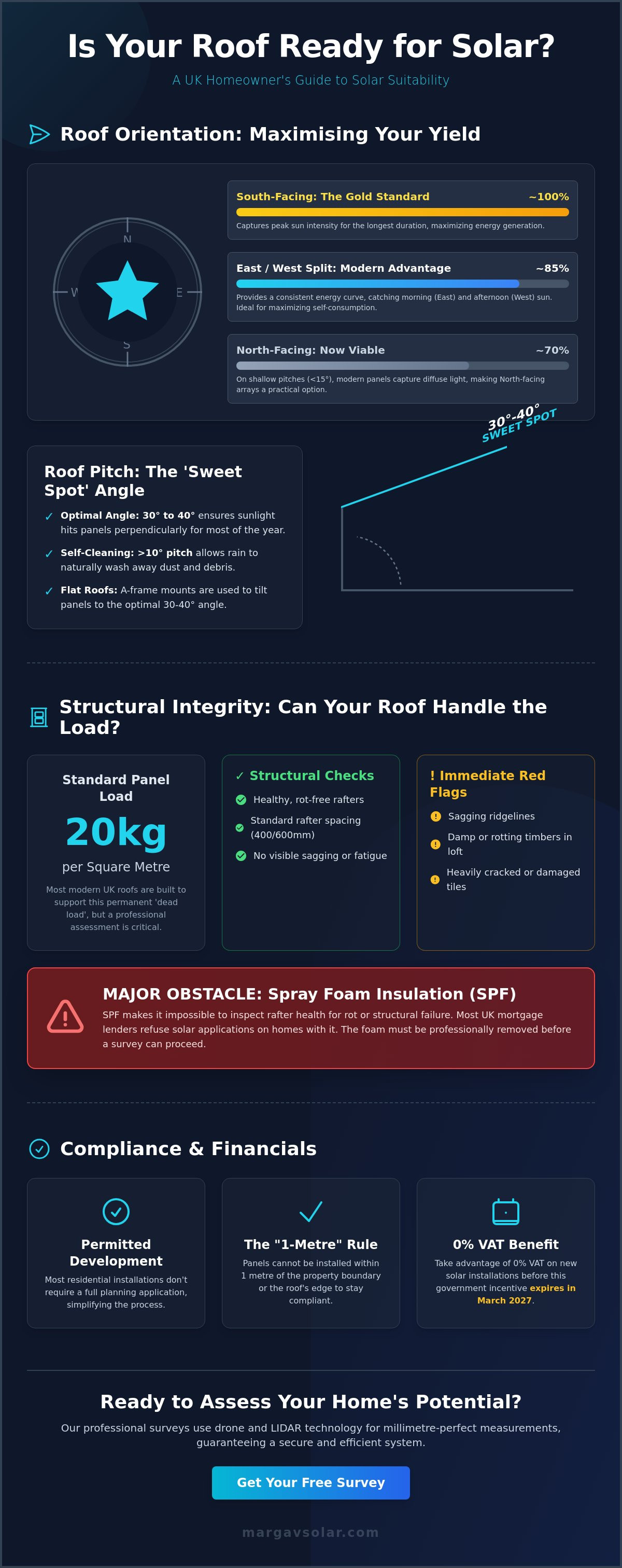
Roof orientation refers to the compass direction your roof slopes face, and it's the most significant factor in determining your system's potential energy yield. For decades, South-facing roofs have been the gold standard because they capture the sun at its highest intensity for the longest duration. When you ask is my roof suitable for solar panels UK, a South-facing pitch is usually the starting point for a high-yield assessment. However, the energy landscape in May 2026 has evolved, and modern high-efficiency panels mean you don't need a perfect South-facing home to see a return on investment.
Even North-facing roofs are no longer an automatic "no." If your roof has a shallow pitch of 15 degrees or less, a North-facing array can still generate roughly 70% of the energy a South-facing equivalent would produce. You can Learn about solar power and how modern photovoltaic cells are now designed to capture diffuse light, meaning they work even during the typical overcast weather seen across the UK. This technological leap ensures that almost any roof with clear sky access can contribute to your household's energy independence.
The East-West Advantage for Modern Homeowners
While South-facing panels produce a massive spike of energy at midday, East-West systems provide a flatter, more consistent energy curve. Panels on the East slope catch the morning sun, while West-facing panels power your home through the late afternoon and evening. This is often better for families who aren't home during the day to use that midday South-facing peak. A diurnal profile tracks the 24-hour cycle of your solar generation against your actual electricity consumption. By matching your generation to your morning and evening routines, you can maximize self-consumption and reduce your reliance on the grid during expensive peak hours.
Finding the 'Sweet Spot' Angle (Pitch)
The ideal pitch for UK latitudes generally falls between 30 and 40 degrees. This angle ensures that the sun's rays hit the panels as perpendicularly as possible throughout the year. Pitch also plays a vital role in maintenance; a slope of at least 10 degrees allows rainwater to naturally wash away dust and bird droppings. If your roof is steeper than 50 degrees, you might see a 10% to 15% reduction in annual yield, but these panels often perform better during the winter months when the sun sits lower on the horizon. For flat roofs, we install A-frame mounting systems that tilt the panels to the optimal 30-degree angle, ensuring your system doesn't lose efficiency due to architectural constraints.
Structural Integrity: Can Your Roof Support the Weight?
Most UK roofs are designed to withstand heavy snow loads, but adding a solar array introduces a permanent "dead load" that stays for 25 years or more. A typical residential solar array weighs approximately 20kg per square metre. While this is well within the tolerance of most modern builds, it's a significant addition that requires a stable foundation. When asking is my roof suitable for solar panels UK, the internal health of your rafters is just as important as the tiles on top. A professional surveyor will check that your rafters are spaced correctly, usually at 400mm or 600mm intervals, to ensure the weight is distributed evenly across the load-bearing walls.
Before proceeding, you should look for visible warning signs of structural fatigue. Sagging ridgelines, damp or rotting timber in the loft, and heavily cracked tiles are immediate red flags. These issues don't necessarily mean you can't have solar, but they do mean repairs are needed first. Compliance with UK planning and building regulations requires your installer to verify that the roof can support both the panels and the additional "wind load" caused by uplift during storms. For older Staffordshire properties, especially those built before the 1950s, this structural verification is a non-negotiable safety step.
The Spray Foam Insulation Red Flag
Spray foam insulation (SPF) has become a major obstacle for solar installations in 2026. Because the foam adheres directly to the underside of the roof, it hides the timber rafters from view, making it impossible to inspect for rot or structural failure. Most UK mortgage lenders now refuse to approve solar applications or equity releases on homes with SPF because of the risk of "sealed-in" moisture. If your loft has spray foam, you'll likely need to have it professionally removed from the installation area before a surveyor can declare the roof safe for a PV system.
Common UK Roof Materials and Compatibility
Standard slate and clay tiles are the most common materials we work with. We use stainless steel mounting hooks that tuck under the existing tiles to grip the rafters, ensuring the installation remains completely watertight. Metal and standing seam roofs are also excellent; they often allow for "clamping" systems that don't require any roof penetrations at all. However, some materials are unsuitable. We don't install on thatch due to the extreme fire risk, and asbestos roofs require a specialist abatement team to replace the surface before we can begin work. If you're worried about your specific tile type, booking a professional site survey is the most reliable way to confirm compatibility.
Evaluating Shading and Obstructions
Shading is often the most misunderstood factor when homeowners ask is my roof suitable for solar panels UK. We categorize shade into two distinct types: 'hard' and 'soft'. Hard shade is caused by solid, unmoving structures like a neighbour's gable end, a tall brick chimney, or a dormer window. Soft shade comes from objects that allow some light through or change density, such as tree branches, foliage, or even a layer of dust. While soft shade might seem less intrusive, it can be just as damaging to your system's efficiency if not managed correctly.
The reason shading is so critical lies in the 'Christmas Tree Light' effect. In a traditional solar setup, panels are wired together in a series called a string. If a single panel's output drops because of a shadow from a vent pipe, every other panel in that string is forced down to that same low level. This can turn a high-performing array into an underachiever in seconds. Keeping your panels clear of environmental 'soft' shade is vital, which is why we recommend regular solar panel maintenance in Staffordshire to prevent debris and bird droppings from creating permanent hot spots on your cells.
Modern Solutions for Shaded Roofs
If your roof suffers from partial shading, you don't have to abandon your solar ambitions. We use modern power electronics like micro-inverters or DC optimisers from industry leaders such as SolarEdge and Enphase. These devices allow each solar panel to operate independently. If one panel is shaded by a chimney, the others continue to produce electricity at their full potential. Specifically, optimisers 'bypass' shaded cells within a panel to maintain the string voltage, preventing a total system shutdown. This technology has made many previously "unsuitable" UK roofs viable energy generators in 2026.
Companies like Lumos Solar are at the forefront of implementing these shading solutions, providing domestic and commercial clients across the South West with the technical expertise needed to overcome environmental obstructions.
Seasonal Shading: The Winter Sun Challenge
A common mistake is evaluating a roof only during the bright summer months. In June, the sun sits high in the sky, and shadows are short. By December, the sun's arc is much lower, meaning a distant tree or building that caused no issues in summer could blanket your entire roof in shadow by 2:00 PM. A summer visual check simply isn't enough to guarantee a 25 year return on investment. To get an accurate picture, you should Find a certified solar installer who uses digital shading analysis tools. These systems use LIDAR data to simulate the sun's path across all 365 days of the year, providing a 99% accurate yield forecast before you sign a contract.
Planning Permission and Local Regulations in Staffordshire
Even if your roof is physically perfect, the legal answer to is my roof suitable for solar panels UK depends on local planning rules. Most residential solar installations in England fall under "Permitted Development" rights. This means you don't usually need a full planning application to go green. However, these rights come with strict conditions. For example, panels must not protrude more than 200mm from the roof slope, and they cannot be higher than the highest part of the roof, excluding the chimney. Following these rules ensures your project stays on the right side of the law without unnecessary paperwork.
The "1-metre rule" is another critical factor for any installation. To comply with Permitted Development, panels should be kept at least one metre away from the external edges of the roof and the ridgeline. This reduces the visual impact and minimizes wind lift risks. While these rules are national, Staffordshire homeowners in historic areas like the Lichfield City Conservation Area or the Stafford Borough conservation zones may face Article 4 directions. These local directives can remove Permitted Development rights, requiring a formal planning application even for standard roof-mounted arrays. Ensuring your electrical work meets the highest standards is vital for both safety and legal compliance, which is why we emphasize the importance of NICEIC certification for all domestic energy projects.
Solar for Listed Buildings and Conservation Areas
If you live in a Grade I or Grade II listed property, standard Permitted Development doesn't apply. You'll need to apply for 'Listed Building Consent' before any work begins. Local planning authorities in Staffordshire are increasingly supportive of renewable energy, but they often require aesthetic compromises. This might involve placing panels on a less visible rear roof slope or considering a ground-mounted system if you have the space. We work closely with homeowners to find solutions that respect the heritage of the property while still delivering modern energy efficiency.
Building Regulations and G98/G99 Notifications
Beyond planning permission, every installation must comply with Building Regulations. This covers the structural calculations we discussed earlier and the electrical safety of the system. Your installer is legally required to notify the District Network Operator (DNO), such as National Grid Electricity Distribution in the Midlands, about your new system. Smaller systems typically fall under G98 notification rules, while larger arrays with battery storage might require a G99 application before installation. We handle all MCS and building control certifications to ensure your system is fully registered for the Smart Export Guarantee (SEG). If you're unsure about your local council's specific requirements, we can help you request a planning feasibility check as part of your initial consultation.
The Professional Roof Survey: What Happens Next?
Once you've self-assessed your orientation and structural health, the final step in answering is my roof suitable for solar panels UK involves a technical site survey. At MarGav Solar, we've moved past the days of simple tape measures and ladders. We use drone technology and high-resolution LIDAR to create a millimetre-perfect digital twin of your roof. This allows us to map every tile, vent, and chimney stack without ever setting foot on your shingles. It's not just about whether the panels will fit; it's about optimizing the layout to avoid the shading issues we discussed in previous sections.
In May 2026, the question of suitability has shifted from "can I fit panels?" to "how much energy can I capture and keep?". A surveyor’s priority is no longer just answering is my roof suitable for solar panels UK, but rather determining how to maximize your specific property's potential. Even if you have a small or awkwardly shaped roof, integrating solar battery storage in Staffordshire can make your system highly effective. By storing excess generation during the day, a smaller, well-placed array can often cover a significant portion of your evening energy needs, providing a much faster return on investment than a larger, un-optimised system.
Integrating GivEnergy and Smart Monitoring
A technical survey leads directly to a bespoke GivEnergy Cloud setup. This smart monitoring platform allows you to visualise your future energy yield through advanced 3D modelling before the first panel is even delivered. If your roof is sub-optimal, perhaps due to a North-West pitch or partial shading from a neighbour’s gable, we might suggest "over-sizing" the array. Installing a few extra high-efficiency panels to compensate for lower light levels is a smart ROI move when paired with an intelligent battery system that catches every single kilowatt produced during the day.
Your Pre-Survey Checklist
To ensure your professional survey is as accurate as possible, it helps to have a few things ready before the engineer arrives. A thorough inspection usually takes between 45 and 90 minutes. Please prepare by following these steps:
- Provide clear access to the loft hatch so we can perform the internal timber and rafter inspection essential for structural safety.
- Locate your latest electricity bill or have access to your smart meter data; we need this to match the system size to your actual 12-month consumption profile.
- Check for any active roof warranties from recent repairs or new-build guarantees, as we'll ensure our mounting system maintains your existing protection.
- Identify the location of your current consumer unit (fuse box) and any potential space for a battery storage unit or EV charging point.
Unlock Your Home's Solar Potential
Determining is my roof suitable for solar panels UK doesn't require guesswork or outdated assumptions about South-facing pitches. We've explored how modern high-efficiency panels and DC optimisers turn even shaded or East-West roofs into powerful energy generators. By ensuring your rafters are structurally sound and navigating local Staffordshire planning rules, you can secure a system that provides reliable returns for 25 years or more. Integrating battery storage ensures you keep the power you generate; this protects your household from the electricity price volatility seen throughout 2026.
Ready to move from theory to reality? With 20+ years of solar expertise and a team of NICEIC and MCS Certified installers, we're here to help. As Staffordshire's leading GivEnergy specialists, we provide the technical precision needed for a high-performing installation. Book Your Free Staffordshire Roof Survey with MarGav Solar today to receive a millimetre-perfect LIDAR assessment of your property. It's the most reliable way to confirm your home's viability and start your journey toward energy independence before the 0% VAT rate expires in March 2027. Your roof is more than just a shelter; it's your personal power station waiting to be activated.
Frequently Asked Questions
Can I have solar panels on a North-facing roof in the UK?
Yes, you can install panels on a North-facing roof, though generation is lower than other orientations. While a South-facing pitch is ideal, a North-facing roof with a shallow pitch of 15 degrees still achieves roughly 70% of peak output. With UK electricity prices remaining high in 2026, many homeowners find that the 0% VAT incentive makes this a viable way to answer is my roof suitable for solar panels UK while offsetting base-load consumption.
Do I need a new roof before installing solar panels?
You don't necessarily need a new roof unless yours is nearing the end of its natural life. Solar panels last 25 years or more, so if your current tiles only have 10 years left, we recommend replacing them first. Removing and reinstalling a full array to fix a leak later is an avoidable expense. A survey will confirm if your existing structure is safe for the 20kg per square metre load.
How much space do I actually need on my roof for a 4kW system?
A standard 4kWp system typically requires 20 to 25 square metres of clear roof space. This allows for approximately 10 modern panels, each measuring roughly 1.7m by 1.1m. You must also account for the mandatory 1-metre safety border required under Permitted Development rights. When asking is my roof suitable for solar panels UK, measuring your total usable area minus these borders is the first step.
Are solar panels too heavy for an old terraced house roof?
Most historic UK terraced homes are structurally capable of supporting solar weight. These buildings were often constructed with substantial timber rafters that can easily handle the additional 20kg per square metre. However, a surveyor must check for "roof spread" or past water damage. If your rafters are thin or spaced wider than 600mm, we may suggest simple timber reinforcements before the installation begins.
What happens if my roof is shaded by a neighbour's tree?
If a neighbour's tree shades your roof, we use DC optimisers to prevent a total system drop-off. These devices allow each panel to work independently, so the shaded section doesn't affect the performance of the rest of the array. It's important to remember that you have no legal right to light for solar panels; therefore, a professional shading analysis is vital to predict how that tree's growth will impact your 25-year yield.
Can I install solar panels on a flat roof or conservatory?
You can install solar on flat roofs using tilted A-frame mounting systems to reach the optimal 30-degree angle. Conservatories are more complex; most standard glass or polycarbonate conservatory roofs aren't strong enough to support heavy solar glass. While a standard PV array is usually too heavy, Madison May Consulting Ltd can help you explore other energy-saving retrofit options, such as upgrading your conservatory to create a more thermally efficient, year-round space.
Is planning permission required for solar panels in a conservation area?
Planning permission is often required in conservation areas if the panels are visible from a public highway. While Permitted Development applies to most UK homes, local authorities in historic districts often restrict panels on the "principal elevation" or front of the house. In these cases, placing the array on a rear-facing roof or a ground-mount system is usually the most successful path to securing approval from the local council.
How do installers fix panels to the roof without causing leaks?
We use specialized stainless steel roof hooks that bypass the tiles to bolt directly into the rafters. The hook is shaped to curve around the tile, allowing it to sit back in its original position without being lifted or cracked. For slate roofs, we use high-quality flashing kits that create a permanent, weather-tight seal. This method ensures your roof remains completely waterproof while securely anchoring the mounting rails against high winds.


