

A national solar quote isn’t automatically more expensive, and a local quote isn’t automatically the better value. When comparing quotes from national vs local solar companies, match the proposed system, equipment, design and aftercare before judging the total. Getting quotes from three installers gives you a useful basis for comparison, while national companies may benefit from larger teams and streamlined processes.
It’s understandable to focus on the bottom line, but the right choice also depends on how well the system is designed for your home and who will support it after installation. This guide explains how quotes from national and local solar companies can differ in price, design, reviews and aftercare. You’ll also find a practical way to compare proposals on equal terms, so you can assess the full offer rather than choosing by company size or headline cost alone.
Key Takeaways
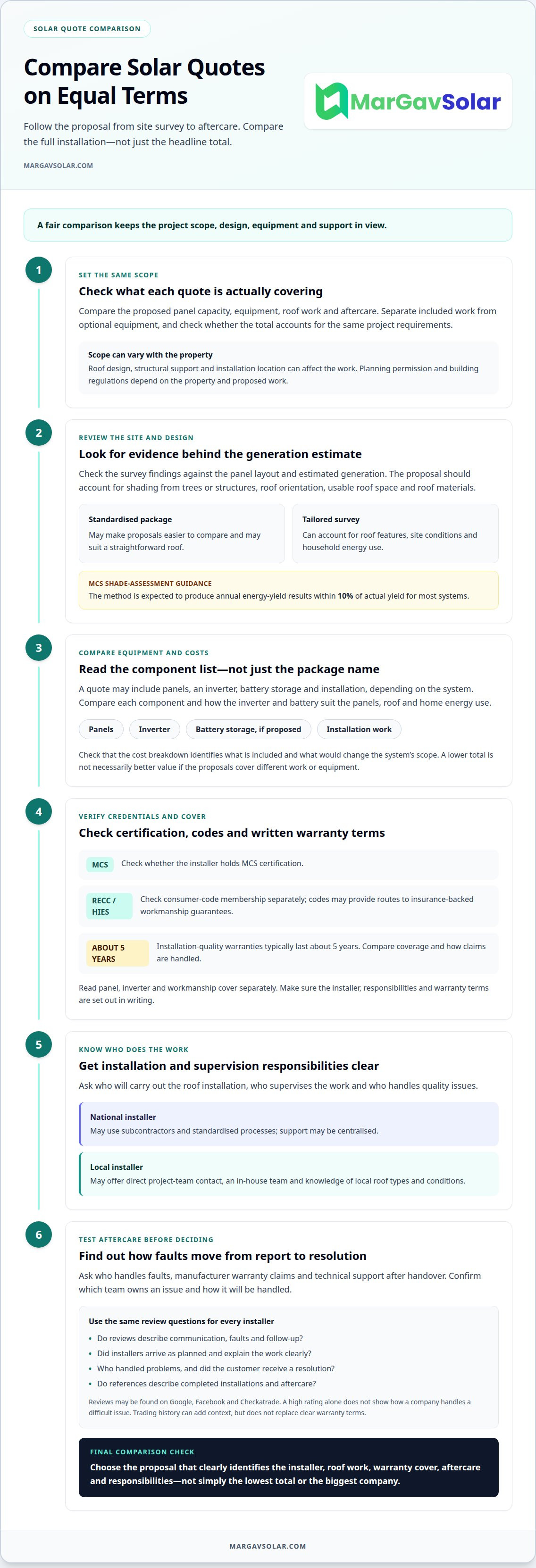
- Compare quotes on a like-for-like basis, including system design, equipment and what the price covers, rather than relying on the headline total.
- Consider installer accreditation and consumer-code membership alongside the proposed design to understand how each quote is supported.
- Look beyond star ratings: reviews and references about aftercare can help you understand how an installer responds when issues arise.
- National companies may offer the advantages of larger teams and streamlined processes, while the best fit depends on the details of your project and the support you value.
Comparing costs: are local solar installers cheaper than national companies?
For UK homes, planning permission and building regulations depend on the property and the proposed work. Roof design, structural support and the installation’s location can affect the project scope. Compare how each quote accounts for these factors rather than assuming the requirements are identical.
A lower total doesn’t always mean better value. National installers may benefit from scale and standardised sales processes, while local companies may tailor designs and communicate directly with the project team. Compare the same panel capacity, equipment, roof work and aftercare before deciding whether one quote costs less for an equivalent installation.
Accreditation can help you assess expertise and workmanship. Check whether the installer holds MCS certification and whether it belongs to a consumer code such as RECC or HIES. These are separate checks: MCS relates to certification, while consumer codes may provide routes to insurance-backed workmanship guarantees. Read the warranty terms to understand what installation defects are covered and how claims are handled.
Ask who will carry out the roof installation. A national installer may use subcontractors, so find out who supervises the work and handles quality issues. A local installer may have an in-house team and knowledge of common roof structures in the area. Community reputation can add context, but focus on reviews of completed installations and aftercare, not just general praise.
| Option | Accreditation and warranty | Installation and service | Local knowledge |
|---|---|---|---|
| National installer | Check MCS and consumer-code membership | Standardised processes; teams may be subcontracted | May use centralised support |
| Local installer | Check MCS and consumer-code membership | May offer direct project-team contact | May know local roof types and conditions |
Choose a quote that identifies the installer, roof work, warranty cover and aftercare, with accreditation and responsibilities set out in writing.
Homeowners’ confidence in assessing solar quotes and designs
Standard packages can make proposals easier to compare, while a tailored survey can account for your roof and energy use. Focus on the design evidence, equipment and warranty details behind each quoted system.
Design, Warranties and Cost Breakdown
A national installer may offer standardised packages, while a local specialist may propose a bespoke design based on a survey. Compare how each quote explains expected generation, equipment choices and the relationship between system size and household use. Check warranty terms separately, as panel, inverter and workmanship cover may differ. A clear cost breakdown should show which installation work and equipment are included in the total.
Quote Components
A UK solar quote may include panels, an inverter, battery storage and installation, depending on the proposed system. Compare each component across proposals rather than judging by the package name or panel count alone. The design should explain how the inverter and battery suit the panels and the home’s energy use. A tailored proposal should also separate included work from optional equipment, so you can see what changes the system’s scope.
Local Conditions and Solar Quotes
Shading, roof type and regional weather affect the generation estimate, system layout and potential savings. A survey should identify nearby trees or structures, roof orientation and usable roof space; slate or other roof materials can also affect installation details. MCS shade-assessment guidance says its method is expected to produce annual energy-yield results within 10% of actual yield for most systems. Local knowledge can help explain site-specific design choices.
To assess design quality, compare each quote’s survey findings with its panel layout and generation estimate. Ask how shading assumptions shaped the design and whether the proposed equipment suits the roof. Certification and a written explanation of the design give you concrete points to assess. A standard package may suit a straightforward roof, while a bespoke proposal may better account for complex shading or roof features.
Checking references, reviews and aftercare
Reviews and references can show how an installer delivers work and responds after handover. Look for evidence of aftercare, not just feedback about installation day.
References and Reviews
Read reviews on Google, Facebook and Checkatrade, focusing on communication, faults and follow-up. A high rating alone won’t show how a company handles a difficult issue. Look for consistent details, such as whether installers arrived as planned and explained the work clearly. References can add context, especially for smaller local firms whose reputation may be closely tied to their community.
Check how long each installer has been trading, then consider that alongside recent customer experiences. A longer trading history may help you assess its ability to support long-term warranties, but it doesn’t replace clear warranty terms. Compare national and local companies using the same questions: who handled a fault, how communication worked and whether the customer received a resolution.
Problem Resolution and Long-Term Support
Ask who handles faults, manufacturer warranty claims and technical support after installation. A national installer may route requests through a central service team, while a local company may offer direct contact with its project team. The key is to know which team owns the issue and how it moves from your report to resolution.
Installation-quality warranties typically last about 5 years. Compare their coverage and claims process, and check whether workmanship protection is insurance-backed through a consumer code such as RECC or HIES. An insurance-backed guarantee can protect homeowners if an installer ceases trading, but it is distinct from a manufacturer’s product warranty. Read each document to understand who responds and what the guarantee covers.
Think beyond the first year. If a solar system develops a problem in 5-10 years, support may involve the original installer, the equipment manufacturer, or both. A clear route for escalating faults matters as much as the warranty term. During high demand, smaller local teams may have longer installation lead times, while national firms can have larger service networks. Compare the stated support arrangements, not assumptions about company size.
Advantages of national solar companies
National installers can bring scale to residential renewable energy projects. Larger teams and streamlined processes mean they can often complete installations faster, which may suit homeowners working to a planned schedule. A 4 kW residential system represents a small fraction of a large national company’s work, so a straightforward household installation may fit readily into its operating model.
Scale can affect pricing: national companies may benefit from economies of scale, but that doesn’t mean every quote will be cheaper. Standardised processes can make the route from sales to installation more consistent. Check whether the process still accounts for your roof, equipment choices and household needs, rather than treating every home the same.
When reviewing the practical details, consider the value of an established process. Does the proposal explain the installation stages, identify who carries out the work and describe how the company handles questions after handover? Clear answers help you understand the written terms, including the workmanship warranty and any separate manufacturer cover. A familiar national brand alone doesn’t explain those responsibilities.
National scale may be useful when a defined process matters more than a close relationship with a local team. However, local knowledge can be valuable for homes with unusual roof structures or site-specific constraints. Compare the design and responsibilities in the proposal, not just the company’s size. A national installer may suit your project if its standard process fits the property and its written scope covers the details.
For a balanced decision, weigh installation timing, design fit, pricing transparency and how problems are resolved. This keeps a national company’s potential efficiency in view without treating size as proof of quality. Using the same criteria also makes differences between national and local quotes easier to explain to everyone involved.
Explore residential solar options to consider a system designed around your home.
MarGav Solar
MarGav Solar can help you turn quote comparisons into a practical decision about solar for your home. Its residential solar PV systems and battery storage solutions can be considered alongside your property’s energy needs. EV charging points may also be relevant if you plan to charge an electric vehicle at home, while solar panel maintenance and cleaning can support an existing system. When weighing proposals, focus on the design, equipment and support that matter to your household, rather than company size alone. Contact MarGav Solar to discuss your solar options.
Take the next step with confidence
Choosing solar can shape how your home uses energy for years, so make your next step a considered one. Look beyond the headline appeal of a proposal and focus on what you need the system to do, how it fits your plans and what would make you comfortable moving forward. Clear priorities help you compare quotes from national and local solar companies based on your home, not just the installer’s profile.
You don’t need to resolve every technical detail alone. A conversation about your property and priorities can clarify which questions matter most and what a suitable next step looks like. Bring the points you’re weighing, whether they concern your roof, energy use or future plans, and use the discussion to shape a decision that feels right for your household.
Discuss your solar options with MarGav Solar, and take the next step at your own pace.
Frequently Asked Questions
Are These Quotes Really Like-for-Like?
Quotes are like-for-like only when the proposed systems and work have the same scope. A quote that includes battery storage, for example, can’t be directly compared with one covering panels alone. Check whether each proposal makes the same assumptions about equipment, installation work, monitoring and export arrangements. Note exclusions separately, so a lower total doesn’t hide work or components you’ll need to arrange later.
Can a local solar installer offer faster support?
A local installer may give you a direct route to the team familiar with your project, but location alone doesn’t guarantee a faster response. Compare the support process: how to report a fault, who receives it and how technical issues are escalated. For a Staffordshire home, clear local contact arrangements can be valuable, particularly if your system needs attention after installation.
Do the Generation Estimates Use the Same Assumptions?
Not necessarily. Estimates can differ because proposals use different assumptions about roof orientation, shading, system losses and household electricity use. Compare the annual generation figure and the assumptions behind it rather than treating the headline estimate as guaranteed. For example, a proposal that accounts for shade from a chimney may give a different forecast from one based on a clearer roof area.
How Are the Savings Figures Presented?
Savings estimates depend on how much generated electricity the household uses, how much it exports and the assumptions used for energy consumption. Check whether a proposal separates bill reductions from export income and explains the period covered. A household that uses more solar electricity during daylight may benefit differently from one that exports more generation.
How do quotes from national and local solar companies in the UK typically differ?
National companies may use standardised sales and installation processes, while local companies may tailor proposals more closely to individual properties. These are tendencies, not a reliable verdict on a particular quote. When comparing quotes from national and local solar companies, focus on the design, responsibilities and support offered for your home. In Staffordshire, local familiarity can inform site-specific discussions, while national scale may support a streamlined process.
How can I compare solar panel specifications and system output across quotes?
Compare the panel model, rated wattage, total array capacity and estimated annual generation in each proposal. Note the inverter and any battery separately, since they affect the system design. To calculate total array capacity, multiply panel wattage by the number of panels, then compare the result with each installer’s output estimate. Differences in estimates may reflect roof conditions or modelling assumptions, not just panel specifications.


