
Most businesses fixate on the payback period when evaluating commercial solar panel ROI UK, and that's understandable. But here's the sharper question: what happens to your profitability in years seven, fifteen, or twenty-five? The payback period is just the starting line, not the finish.
If you're a finance director or business owner wrestling with volatile energy tariffs, a significant upfront capital commitment, or boardroom scepticism about whether the UK gets enough sun to make solar worthwhile, you're not alone. These are legitimate concerns, and they deserve straight answers, not sales pitches.
This guide cuts through the noise. You'll learn how to calculate a realistic payback period for a UK commercial solar installation in 2026, how to build a compelling financial case for your stakeholders, and how to structure your project so it keeps generating profit well beyond that initial break-even point. From Smart Export Guarantee income and Capital Allowances to the often-overlooked role of ongoing maintenance in protecting your returns, we cover the full picture of what it actually takes to make commercial solar a 25-year performance asset for your business.
Key Takeaways
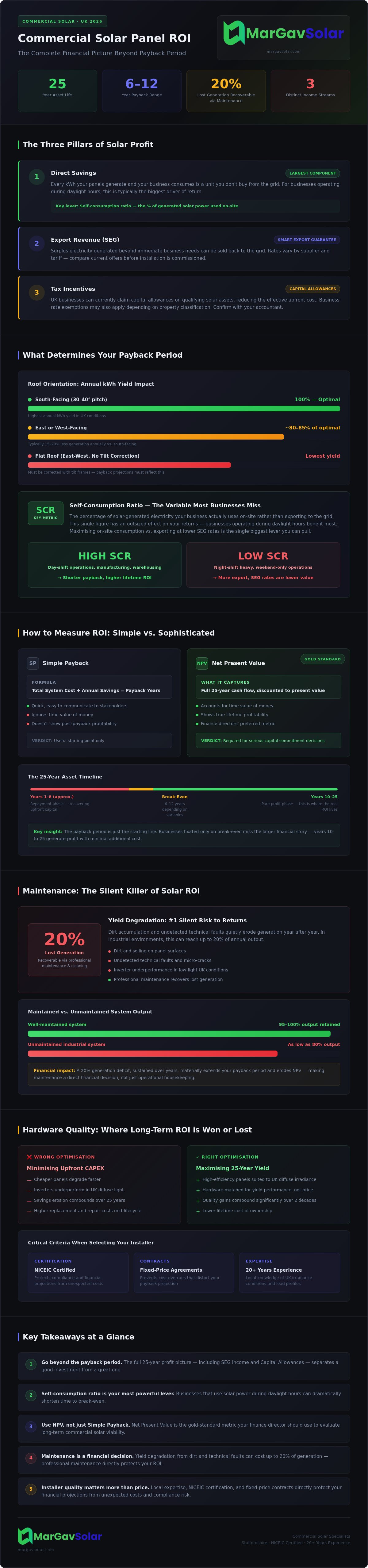
- Commercial solar panel ROI UK goes far beyond the payback period — understanding the full 25-year profit picture, including Smart Export Guarantee income and Capital Allowances, is what separates a good investment from a great one.
- Your self-consumption ratio is one of the most powerful levers in your payback calculation — businesses that use solar power during daylight hours can dramatically shorten the time to break-even.
- Simple payback is a useful starting point, but Net Present Value (NPV) is the gold-standard metric your finance director should be using to evaluate long-term commercial solar viability.
- Yield degradation from dirt and technical faults is the number one silent killer of solar ROI — professional maintenance and cleaning can recover up to 20% of lost generation in industrial environments.
- Local expertise, NICEIC certification, and fixed-price contracts matter more than most buyers realise — they directly protect your financial projections from unexpected costs and compliance risk.
Understanding Commercial Solar ROI in 2026: The Financial Fundamentals
Commercial solar panel ROI UK isn't a single number. It's a layered financial story that unfolds across decades, and most businesses only read the first chapter. The payback period tells you when you break even. It doesn't tell you what you earn in the years that follow, or how much worse your energy bill would have been without solar as grid prices continue to shift.
2026 is a particularly significant moment for UK businesses to act. Electricity tariffs have remained volatile following years of energy market disruption, and forward pricing offers limited certainty. For finance directors building three to five-year cost models, that unpredictability is a material risk. Solar doesn't eliminate energy costs, but it does convert a variable operational expense into a largely fixed capital investment, which is a fundamentally different financial proposition.
The Three Pillars of Solar Profit
A rigorous ROI calculation needs to account for three distinct income streams, not just one:
- Direct savings: Every kilowatt-hour your panels generate and your business consumes is a unit you don't buy from the grid. For businesses operating during daylight hours, this is typically the largest component of return.
- Export revenue: Surplus electricity generated beyond your immediate needs can be sold back to the grid through the Smart Export Guarantee (SEG). Rates vary by supplier and tariff, so it's worth comparing current offers before your installation is commissioned.
- Tax incentives: UK businesses can currently claim capital allowances on qualifying solar assets, reducing the effective upfront cost. Business rate exemptions on solar installations may also apply depending on your property classification. Both should be confirmed with your accountant, as thresholds and rules are subject to change.
Why CAPEX is Only the Starting Point
The instinct to minimise upfront capital is understandable, but it's often the wrong optimisation. A cheaper panel that degrades faster, or an inverter that underperforms in low-light UK conditions, quietly erodes your returns across a 25-year asset life. The real question isn't what the system costs on day one; it's what it generates across its lifetime.
High-efficiency panels convert a greater proportion of available irradiance into usable electricity, which matters considerably in the UK's diffuse light conditions. Selecting durable, well-matched hardware is where long-term ROI is genuinely won or lost. With over 20 years of experience in the sector, MarGav Solar's approach prioritises equipment selection for yield performance rather than headline price, a distinction that compounds significantly when you model returns across two decades.
Simple payback is a useful shorthand. But when you're committing capital at this scale, annualised return on investment and Net Present Value give your stakeholders a far more honest picture of what the asset will actually deliver.
Key Factors Influencing Your Payback Period in the UK
Not all commercial solar installations perform equally, and the gap between a system that pays back in six years and one that takes twelve often comes down to decisions made before a single panel is fitted. Roof orientation, how well the system matches your operational load profile, and the quality of the hardware you choose are all variables that compound across a 25-year asset life.
South-facing roofs at a pitch between 30 and 40 degrees deliver the highest annual kWh yield in the UK. East or west-facing orientations typically produce around 15 to 20% less generation annually. That's not a dealbreaker, but it does need to factor into your modelling. A system designed for a south-facing Staffordshire warehouse roof will produce meaningfully more electricity than the same system installed on a flat east-west orientation without tilt correction, and your payback projection should reflect that difference honestly.
The Self-Consumption Ratio: The Variable Most Businesses Miss
Your self-consumption ratio is the percentage of solar-generated electricity your business actually uses on-site, rather than exporting to the grid. This single figure has an outsized effect on commercial solar panel ROI UK because the value of electricity you consume directly is typically far greater than what you'd receive from grid export under the Smart Export Guarantee.
A business operating five days a week during daylight hours, such as a manufacturer, logistics facility, or food production site, is naturally positioned to self-consume a high proportion of what its panels generate. That alignment between generation peak and operational demand is where the strongest returns are built. Businesses with low daytime consumption, such as retail units or offices with low weekday occupancy, will find their self-consumption ratio lower and their payback period longer unless battery storage is introduced to shift that energy.
The Role of System Sizing and Load Profiling
Bigger isn't always better without the right context. Systems of 50kW and above typically benefit from improved economies of scale on hardware and installation, but oversizing relative to your daytime base load without battery storage means excess generation gets exported at lower rates rather than displacing expensive grid imports. The optimal approach is to model your half-hourly consumption data against expected solar generation profiles and size the system to maximise self-consumption first.
Staffordshire manufacturing sites are a practical example of where this alignment works well. Consistent daytime energy demand from production equipment means solar generation is absorbed efficiently, with little wasted export. Load profiling before installation is the difference between a system that performs as projected and one that quietly underdelivers.
Equipment quality matters beyond the spec sheet. Panels with lower degradation rates retain more of their rated output in years fifteen and twenty-five, which is where a significant portion of lifetime return is generated. Choosing hardware purely on upfront cost is a false economy when you're modelling a multi-decade asset. If you'd like guidance on sizing a system to your specific load profile, speaking with an experienced commercial solar installer before committing to a specification is time well spent.
UK Tax Benefits and Capital Allowances
The Annual Investment Allowance (AIA) allows UK businesses to deduct the full cost of qualifying plant and machinery, including solar PV hardware, against taxable profits in the year of purchase, up to the current AIA threshold. For a business paying corporation tax, this can materially reduce the effective net cost of the installation. Your accountant should confirm the current threshold and whether your specific installation qualifies, as the rules can change between fiscal years.
Business rate exemptions may also apply to certain renewable energy installations, depending on your property classification and local authority. These aren't guaranteed, but where they do apply, they add a further layer of financial benefit that strengthens the overall investment case for commercial solar panel ROI UK calculations.
Calculating the Numbers: Simple Payback vs. Lifetime Profit
Numbers don't lie, but incomplete numbers mislead. Most commercial solar conversations start and end with payback period, which is a useful metric but a dangerously narrow one when you're committing capital to a 25-year asset. Here's how to build a calculation that actually serves your finance director.
Simple Payback Formula for Businesses
The payback period is the time required for your cumulative energy savings to equal the initial investment. The formula is straightforward:
(Total System Cost - Incentives) / Annual Energy Savings = Payback Period (Years)
In practice, "incentives" includes any Capital Allowances claimed in year one, which reduce your effective net cost once the tax benefit is realised. "Annual energy savings" combines direct consumption savings and any Smart Export Guarantee income from surplus generation.
For UK commercial sites in 2026, payback periods are trending toward the five to seven year range for well-sized installations with strong daytime self-consumption. That figure is sensitive to your electricity tariff, system size, and how closely your operational hours align with solar generation, which is why the variables covered in the previous section matter so directly to this calculation.
Where competitors present headline savings figures without showing the underlying arithmetic, that's a red flag. An SME with a 100kW rooftop system needs to understand the specific inputs driving their projection, not a corporate case study from a business ten times their size.
The 25-Year Profit Outlook
Once you've cleared the payback period, the financial character of the asset changes entirely. Generation continues, but the cost has already been recovered. What follows is effectively zero-cost electricity for the remainder of the system's life, alongside continued SEG export income on any surplus.
Two factors deserve honest attention in any long-range model. First, energy price inflation. Modelling at a conservative two to three percent annual increase in grid electricity costs is a reasonable planning assumption, and it significantly improves the cumulative value of avoided grid purchases in years ten through twenty-five. The further you project, the more powerful that compounding effect becomes.
Second, inverter replacement. Inverters typically reach end of useful life between years twelve and fifteen, and this cost needs to appear in your financial model rather than arriving as a surprise. Factoring it in upfront keeps your NPV calculation honest. If you're planning ahead for this, it's worth reading the detailed guidance on inverter upgrades in Staffordshire to understand what replacement involves and how to protect your long-term commercial solar panel ROI UK projections.
Net Present Value is the metric that ties this all together. Unlike simple payback, NPV discounts future cash flows to their present-day value, giving you a single figure that reflects the true worth of the investment over its lifetime. For any capital commitment of this scale, it's the number your board should be approving against. Fixed-price installation contracts add a further layer of certainty here: when your upfront cost is locked, your NPV model isn't vulnerable to scope creep or post-contract cost surprises.
Maximising ROI: The Critical Role of Maintenance and Integration
There's a persistent myth in commercial solar that once the panels are fitted, the work is done. It isn't. A poorly maintained array quietly loses generation year after year, and that lost yield never shows up on anyone's dashboard until the underperformance becomes impossible to ignore. For businesses that have made a significant capital commitment, that's a preventable financial leak.
Maintenance: Protecting Your Asset
Dirt, bird fouling, industrial particulates, and moss accumulation don't just look bad; they actively block irradiance from reaching the cells. In industrial areas, this effect is compounded by airborne emissions and dust that settle on panel surfaces and resist natural rainfall. Professional cleaning can recover up to 20% of lost generation in high-contamination environments, which is a material improvement to your annual yield figures and, by extension, your commercial solar panel ROI UK calculation.
Technical faults add another layer of risk. Micro-inverter failures, hotspots, and degraded connections can go undetected for months in a large commercial array without systematic inspection. Each fault is silently eroding the return your finance director signed off on. Recurring technical inspections identify these issues before they compound, keeping your system performing close to its modelled output across the full asset life. You can find detailed guidance on what professional servicing involves in this resource on solar panel maintenance in Staffordshire.
MarGav Solar's maintenance offering is built around this principle: protecting the investment already made, not just the hardware. NICEIC-certified inspections, combined with professional cleaning scheduled around your operational calendar, keep your asset performing as projected rather than drifting below it.
The Battery and EV Charging Synergy
Battery storage directly addresses the self-consumption problem introduced earlier in this guide. Businesses that can't absorb all their solar generation during peak daylight hours export the surplus at lower SEG rates. A battery system captures that energy instead, making it available during evening peak tariff periods when grid electricity costs the most. That shift from export income to avoided peak-rate imports is where battery storage earns its place in the financial model.
GivEnergy systems are one practical example of smart commercial energy management, offering monitoring and control that optimises when stored energy is used and when grid draw occurs. The result is a higher effective self-consumption ratio and a stronger overall return.
Integrating EV charging points in Staffordshire adds a further dimension. Solar-powered charging reduces the operational cost of a company fleet, creates a genuine employee benefit that supports recruitment and retention, and can attract customers to commercial premises where public charging is a draw. Each of these outcomes strengthens the business case beyond pure energy savings.
Taken together, maintenance, battery storage, and EV integration aren't optional extras. They're the difference between a system that performs at projection and one that quietly underdelivers. Talk to MarGav Solar about building a fully integrated commercial energy strategy that protects your returns across the full 25-year asset life.
Partnering with MarGav Solar: Commercial Expertise in Staffordshire
Choosing an installer is where many businesses make a costly mistake. They compare headline prices without accounting for the variables that actually determine whether a commercial solar investment performs as projected: local planning knowledge, equipment specification, certification status, and the quality of support once the system is running. For Staffordshire businesses, those variables point clearly toward working with a specialist who knows the region, not a national operator managing your site from a head office three counties away.
MarGav Solar brings over 20 years of energy consultancy experience to every commercial project. That depth of knowledge shapes every stage of a project, from load profiling and system sizing through to long-term maintenance planning. It's the difference between a system designed to perform on paper and one that delivers against your financial model in practice.
Fixed-price installation contracts add a further layer of certainty here: when your upfront cost is locked before work begins, your NPV calculation isn't vulnerable to scope creep or post-contract cost surprises. For any business building a rigorous commercial solar panel ROI UK case for board approval, that certainty has genuine financial value, especially when the agreement is reviewed by a commercial law firm Manchester to ensure all legal protections are in place.
Why NICEIC Certification Matters for Your Business
NICEIC certification isn't a formality. For commercial properties, it directly affects insurance validity, grid connection compliance, and the legal standing of your installation. An uncertified installation can invalidate commercial property insurance policies and create liability exposure that far outweighs any saving made on installation cost. MarGav Solar's NICEIC-certified installers ensure your system meets the standards your insurer, your landlord, and the Distribution Network Operator require. If you want to understand exactly what that certification covers and why it matters for your specific situation, the detailed NICEIC certification guide is a practical starting point.
Next Steps for Your Staffordshire Business
The right starting point is a commercial energy audit and ROI feasibility study. This isn't a sales presentation; it's a structured review of your half-hourly consumption data, roof or ground-mount suitability, grid connection capacity, and projected returns across the asset's lifetime. You leave with numbers your finance team can interrogate, not estimates built on assumptions.
During a MarGav Solar consultation, you can expect honest system sizing recommendations, a clear explanation of the Capital Allowances and SEG income applicable to your project, and a maintenance plan that protects your commercial solar panel ROI UK projections from day one through year twenty-five. For a full overview of what professional installation involves in this region, the guide to solar panel installation in Staffordshire covers the process in detail.
The businesses that get the most from commercial solar are the ones that treat it as a managed asset from the outset. That starts with the right partner.
Turn Your Energy Costs Into a Long-Term Business Asset
Commercial solar panel ROI UK isn't just about breaking even faster. It's about converting an unpredictable operational expense into a fixed capital asset that keeps generating value for decades. The businesses that get this right treat solar as a managed investment from day one: right-sized for their load profile, maintained to protect yield, and integrated with battery storage or EV charging where it strengthens the financial case.
Three things matter most when you're ready to move forward. First, the numbers in your model need to reflect your actual consumption data, not industry averages. Second, your installer's certification status directly protects your insurance position and grid compliance. Third, ongoing maintenance is what keeps projected returns from quietly drifting below what your board approved.
MarGav Solar brings over 20 years of renewable energy expertise, NICEIC-certified commercial installers, and a specialist Staffordshire-based maintenance team to every project. Fixed-price contracts mean your financial projections stay intact from approval through to commissioning.
Request a professional commercial solar ROI audit from MarGav Solar and get the specific numbers your finance team needs to make a confident decision.
Frequently Asked Questions About Commercial Solar Panel ROI UK
What is the average payback period for commercial solar panels in the UK?
For well-sized commercial installations in 2026, payback periods are broadly trending toward five to seven years, though this figure is sensitive to your electricity tariff, system size, and how closely your operational hours align with daylight generation. A manufacturing site running five days a week will typically achieve a shorter payback than a low-occupancy retail unit, simply because more solar electricity is consumed directly rather than exported at lower rates.
How do capital allowances affect the ROI of a commercial solar system?
Capital allowances can materially reduce the effective net cost of your installation by allowing you to deduct qualifying solar hardware against taxable profits in the year of purchase, up to the current Annual Investment Allowance threshold. For a business paying corporation tax, this brings the real cost of the system down considerably, which shortens your payback period and improves your Net Present Value. Your accountant should confirm current thresholds and eligibility before you finalise your financial model.
Can commercial solar panels increase the property value of my business premises?
Evidence from the commercial property sector suggests that energy-efficient buildings with lower operational costs attract stronger buyer and tenant interest, and solar installations contribute to that profile. An EPC rating improvement resulting from on-site generation can be a relevant factor in valuations. If you own rather than lease your premises, it's worth discussing the potential impact with a commercial surveyor or an investment advisory firm like MaddisonV Properties, as outcomes vary by property type, location, and the size of the system installed.
How much does maintenance impact the long-term ROI of solar panels?
Maintenance is one of the most underestimated variables in commercial solar panel ROI UK calculations. Professional cleaning alone can recover up to 20% of lost generation in high-contamination industrial environments, and that recovered yield compounds across years and decades. Technical faults such as hotspots or degraded connections can go undetected for months without systematic inspection, silently eroding the return your board approved. Treating maintenance as ROI protection rather than an optional overhead is the more accurate framing.
Is my business roof suitable for a high-ROI solar installation?
South-facing roofs pitched between 30 and 40 degrees deliver the strongest annual yields in UK conditions. East or west-facing orientations typically produce around 15 to 20% less generation annually, which doesn't rule them out but does need to be reflected honestly in your projections. Flat roofs can perform well with tilt-frame mounting. The most reliable way to assess suitability is a professional site survey that reviews your roof's structural load capacity, shading profile, and orientation before any specification is agreed.
What happens to the ROI if energy prices drop in the future?
A sustained fall in grid electricity prices would reduce the value of avoided grid imports, which is typically the largest component of commercial solar returns. That's a legitimate planning risk, and it's why conservative modelling uses cautious energy price assumptions rather than peak tariff figures. It's also worth noting that the cost of your solar installation is fixed regardless of what the grid does, so a price drop affects the margin of return rather than eliminating it entirely. Diversifying your return across savings, export income, and tax benefits reduces dependence on any single variable.
Does NICEIC certification affect the ROI or insurance of my solar system?
NICEIC certification has a direct bearing on both. For commercial properties, an uncertified installation can invalidate commercial property insurance policies and create compliance issues with your Distribution Network Operator, both of which carry financial consequences that can far outweigh any saving made on installation cost. Certified installations also provide the documentation your insurer and landlord may require, which protects your position if a claim or dispute arises. It's a factor that belongs in your risk assessment, not just your technical checklist.
How does battery storage change the payback period for a business?
Battery storage doesn't automatically shorten the payback period because it adds upfront capital cost. What it does is improve the quality of your returns by shifting surplus solar generation from low-rate grid export into avoided peak-tariff imports, which are worth considerably more per unit. For businesses with low daytime self-consumption, that shift can meaningfully strengthen the overall financial case. Whether battery storage improves your specific payback period depends on your tariff structure, your consumption profile, and current battery system pricing, all of which should be modelled against your actual half-hourly data.


