

Chasing the highest efficiency rating on a spec sheet is often the quickest way to overpay for technology that underperforms in the British drizzle. While peak power looks great in a laboratory, the best solar panels for UK homes are those designed to thrive in low-light conditions and variable weather. It's completely understandable if you feel overwhelmed by technical jargon or worried about whether solar is a viable investment when the clouds roll in. You deserve clarity and a system that delivers genuine energy independence without the fear of poor aftercare from national sub-contractors.
This 2026 comparison guide cuts through the confusion to reveal which systems actually deliver the best yield for our unique climate. We'll help you navigate the current 0% VAT incentives before they change in 2027, explain how to integrate battery storage for maximum savings, and show you what to look for in a certified installer. Drawing on over 20 years of industry expertise, we'll provide the facts you need to choose a system that powers your home reliably for decades to come.
Key Takeaways
- Learn why the best solar panels for UK homes in 2026 feature efficiency ratings between 20% and 24% to maximize energy production in limited roof spaces.
- Understand how modern panels harvest energy from diffuse light, ensuring your system remains productive even during cloudy British weather.
- Discover why degradation rates matter and how to identify panels that are guaranteed to maintain at least 85% of their original output after 25 years.
- Explore how pairing high-quality panels with professional inverter upgrades and battery storage creates a complete energy ecosystem for true independence.
- See how local Staffordshire expertise ensures your system is designed specifically for regional weather patterns and optimal roof orientations.
Understanding Solar Panel Performance in the UK Climate
Energy efficiency in 2026 isn't just about how a panel performs under a laboratory lamp; it's about how much power it squeezes from a grey Tuesday in November. The best solar panels for UK homes are those engineered for consistency across our four seasons. While peak output is important, the real value lies in a system's ability to mitigate the impact of volatile grid prices. High-quality panels also feature superior temperature coefficients. This ensures that when the UK experiences summer heatwaves, your energy production doesn't drop off as the cells get hot.
Direct vs. Diffuse Light: Why UK Clouds Don’t Stop Solar
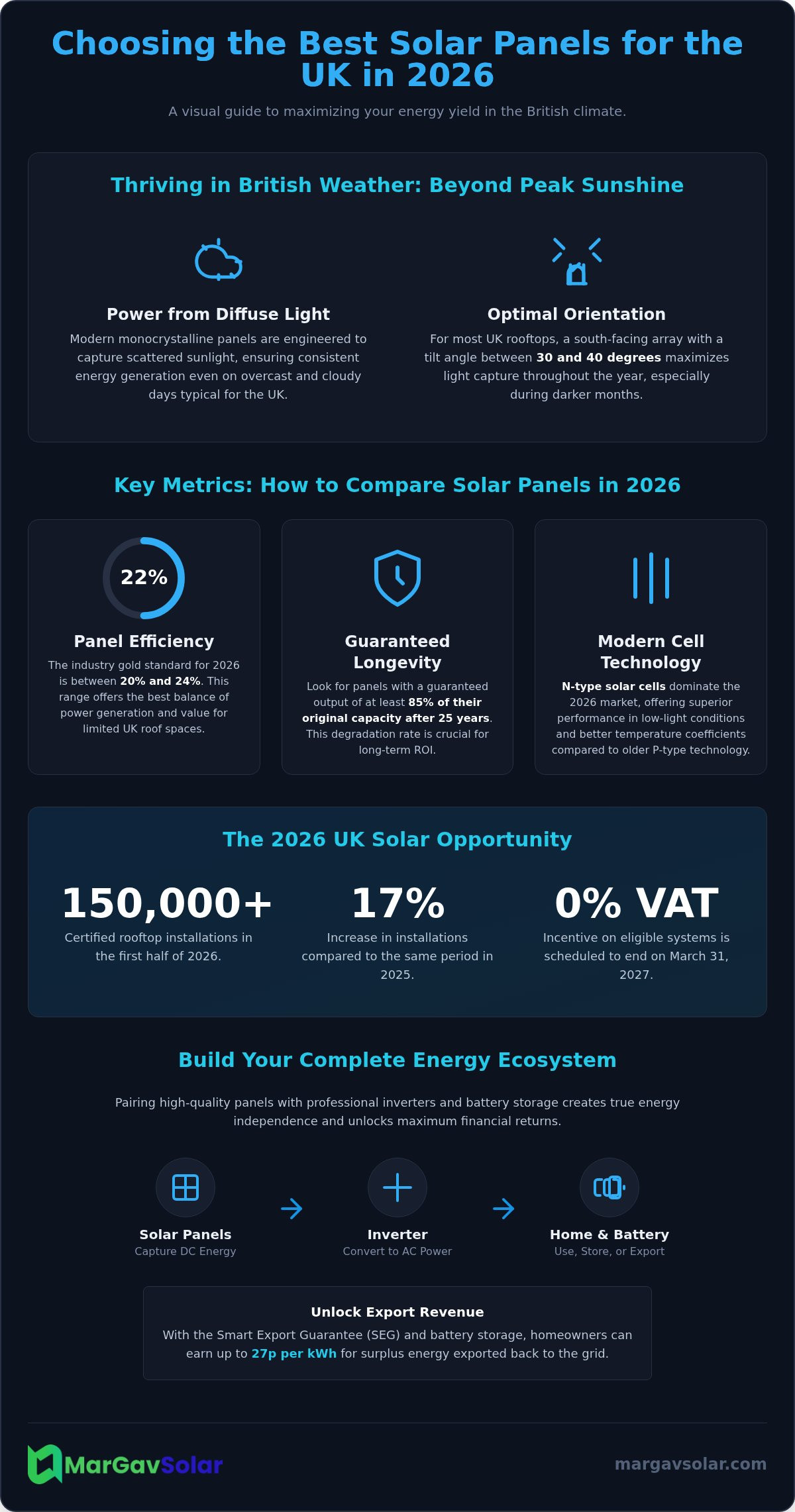
Modern monocrystalline silicon cells don't need a cloudless sky to generate electricity. They're designed to capture diffuse light, which is sunlight that's been scattered by clouds or haze. Even on a typical overcast afternoon in Staffordshire, these cells are actively harvesting photons. Because of the UK's northern latitude, the orientation of your array is vital for maximizing this light capture. Most rooftops see the best results with a south-facing tilt between 30 and 40 degrees. Low-light performance is the most critical metric for UK homeowners because it determines your actual energy yield during the darker half of the year.
The 2026 UK Solar Boom: Why Now is the Time
The state of Solar power in the United Kingdom has reached a turning point. During the first six months of 2026, the country saw nearly 150,000 certified rooftop installations, marking a 17% increase over the same period in 2025. This momentum is fueled by several factors. Professional solar panel installation has become more efficient, and the 0% VAT incentive on eligible systems is currently scheduled to end on March 31, 2027.
We've also seen a major shift from the old feed-in tariffs to a focus on self-consumption. By using the Smart Export Guarantee (SEG), homeowners can now earn significant returns on the energy they don't use. Some providers, such as Octopus Energy, offer SEG rates as high as 27p per kWh for customers who integrate battery storage. This makes the financial case for solar stronger than ever, provided you choose technology that can handle the specific light spectrum of the British Isles.
Key Metrics: How to Compare Solar Panels in 2026
Choosing the best solar panels for UK homes requires looking past the glossy marketing brochures. In 2026, the industry gold standard for panel efficiency has settled between 20% and 24%. While higher efficiency means more power from a smaller area, it's the degradation rate that determines your long-term return on investment. High-quality panels should still produce at least 85% of their original capacity after 25 years of service. If a manufacturer can't guarantee this, the initial savings on the purchase price will likely be erased by dwindling energy production over time.
Power output, measured in Watts, must be balanced against your specific roof constraints. A 450W panel might seem superior to a 400W model, but if its larger physical dimensions mean you can fit fewer units on your roof, your total system yield could actually be lower. It's about maximizing the total kilowatt-peak (kWp) of the entire installation rather than chasing the highest number on a single component.
Efficiency vs. Value: Finding the Sweet Spot
The 2026 market is dominated by N-type solar cells, which offer better performance in low light compared to older P-type technology. However, the most expensive premium panels aren't always the right choice for every UK rooftop. If you have ample roof space, a slightly less efficient Tier 1 panel might offer a better payback period than a high-priced boutique brand. Reliability is key. Tier 1 manufacturers are those with the financial stability to honour their 25-year promises.
Recent regulatory shifts have also changed the landscape. For example, the UK government announcement on plug-in solar has introduced 800W kits to the market. While these are great for renters, they don't offer the same long-term energy independence or grid-export revenue as a full residential PV system. For homeowners, a professionally designed system remains the superior financial move. If you're unsure which setup fits your property, you can request a professional assessment to compare your options.
Warranty Protection: What Homeowners Must Look For
Warranties are often misunderstood. You'll typically see a 12 to 15-year product warranty alongside a 25-year performance warranty. The performance warranty only covers the power output, while the product warranty covers physical defects. Ideally, you want a manufacturer that offers 25 years for both. Even more critical is the labour warranty. If a panel fails, the manufacturer might send a replacement, but they won't always pay for the scaffolding and technician to install it.
This is where local expertise becomes invaluable. Working with an installer who holds niceic certification ensures that your system isn't just high-performing, but also safe and compliant with the latest UK regulations. A local Staffordshire provider with two decades of experience can offer the kind of ongoing support that national sub-contractors often fail to provide.
Top-Rated Solar Panel Brands for UK Residential Systems
Not all manufacturers are equal when it comes to the best solar panels for UK homes. SunPower (Maxeon) remains the premium benchmark, boasting efficiency ratings up to 24% and an industry-leading 40-year warranty on some models. REC Group is another top contender, specifically praised for its durability in harsh weather and excellent temperature resistance. For those seeking a balance between cost and performance, LONGi Solar provides high-efficiency monocrystalline panels at a more accessible price point. Finally, Viridian Solar has carved a niche as a UK-based specialist in "in-roof" systems. MarGav Solar works with these leading manufacturers to design bespoke residential solar PV systems that suit the specific architectural needs of Staffordshire properties.
Best for Small Roofs: High-Density Panels
When you have limited south-facing roof space, every centimetre counts. High-density panels from brands like SunPower allow you to generate more power from fewer modules. For instance, a typical Staffordshire terrace might only have space for eight to ten panels. By choosing high-wattage modules, you can achieve a 4kWp system on a roof that would only support 3kWp with standard panels. This increased density directly impacts your ability to reach energy independence. While the UK government announces support for plug-in solar kits for smaller applications, a high-density roof installation remains the most effective way to power a full household.
Best for Aesthetics: All-Black and Integrated Options
Curb appeal is a major factor for many UK homeowners. "All-Black" panels, which feature black cells, backsheets, and frames, have become the standard for modern residential designs. They blend seamlessly with dark slate or tile roofs, avoiding the "grid" look of traditional silver-framed panels. If you live in one of Staffordshire's many conservation areas, aesthetics aren't just a preference; they're often a planning requirement. Integrated "in-roof" systems from Viridian Solar sit flush with the roofline rather than being mounted on top of it. This low-profile approach is frequently favoured by local planning authorities. While integrated panels can run slightly warmer than on-roof systems, their visual appeal and ease of maintenance make them a top choice for premium renovations.
Beyond the Panel: Why Installation Quality Matters
Selecting the best solar panels for UK homes is a significant first step, but even the highest-rated cells will fail to deliver if the surrounding infrastructure is poor. A solar PV system is a complex electrical circuit. Every component, from the mounting brackets to the wiring, must withstand decades of British rain and wind. Perhaps the most critical component often overlooked is the inverter. While panels grab the headlines, inverter upgrades are often what bridge the gap between a mediocre system and a high-yielding one. We ensure your inverter is perfectly matched to your array's peak output to prevent energy bottlenecks.
With over 20 years of industry experience, we understand that technical specs only tell half the story. The UK electrical grid has strict standards. Navigating these requires more than just a toolkit; it requires deep expertise. This is why we provide fixed-price contracts. You shouldn't have to worry about hidden fees or "unexpected" wiring issues discovered mid-install. A fixed price gives you peace of mind that the quote you receive is the final amount you pay, regardless of any small hurdles encountered during the process.
The Importance of NICEIC and Professional Accreditation
Professional accreditation is non-negotiable. Our NICEIC-certified status isn't just a badge; it's your guarantee of safety. Many homeowners don't realize that a professional, certified installation is a mandatory requirement to access the Smart Export Guarantee (SEG). Without it, you cannot sell your excess energy back to the grid. Quality installation also sets the stage for long-term solar panel maintenance. A system that's installed correctly from day one is far less likely to suffer from moisture ingress or loose connections five years down the line.
Local Staffordshire Support vs. National Call Centres
Choosing a local Staffordshire installer offers advantages that national call centres simply cannot match. We know the local landscape. Whether you're dealing with the specific planning nuances of the Staffordshire Moorlands or the exposed conditions of Cannock Chase, local knowledge matters. We understand the regional weather patterns and how they affect roof loading and wind uplift.
If you need support or cleaning, we're just down the road. You aren't just a ticket number in a database; you're a neighbour. This trust is built through face-to-face consultancy rather than a scripted sales pitch from a remote office. To get started with a team that knows your area, request a local solar consultation today.
Designing Your Complete Energy Ecosystem with MarGav Solar
While selecting the best solar panels for UK homes is a vital first step, the panel is only the engine of a much larger vehicle. To truly decouple your home from rising energy costs, you need a holistic ecosystem that manages energy as well as it generates it. This involves more than just mounting hardware on a roof; it requires a smart integration of storage, monitoring, and future-ready infrastructure. MarGav Solar provides this end-to-end consultancy to ensure every component works in harmony.
Monitoring your system has evolved significantly. By using the givenergy cloud, you can track your energy production and household consumption in real-time from your smartphone. This visibility allows you to adjust your habits to use power when it's cheapest or most abundant. Additionally, as the UK moves toward electric transport, integrating ev charging points into your initial design prevents the need for costly electrical upgrades later. Your roof can effectively become your own private petrol station.
Maximising ROI with Battery Storage
In 2026, the majority of homeowners are pairing their arrays with solar battery storage. Without a battery, you're often forced to export your surplus energy during the day for a few pence, only to buy it back at a higher rate once the sun goes down. By choosing the right battery size for your daily consumption, you can achieve up to 80% energy independence. Smart inverters act as the brain of this operation, automatically deciding whether to power your appliances, charge your battery, or sell excess to the grid based on live tariff data.
Your Next Steps: From Consultation to Commissioning
Our process begins with a professional site survey at your property. We don't believe in generic estimates based solely on satellite imagery. A local expert will visit your Staffordshire home to check roof orientation, potential shading from trees or chimneys, and the state of your current consumer unit. This attention to detail is why we can offer fixed-price installation contracts. You'll know exactly what you're paying before a single panel arrives on site.
With over 20 years of industry expertise and NICEIC certification, MarGav Solar handles the entire journey. From the initial design to long-term maintenance and cleaning, we stay with you for the life of the system. If you're ready to see how the best solar panels for UK homes can transform your energy bills, you can book your Staffordshire solar assessment today. We'll provide a clear, jargon-free breakdown of the best technology for your specific roof and budget.
Take Control of Your Energy Future in 2026
Choosing the best solar panels for UK homes is the first step toward genuine energy independence. You've seen how modern N-type cells thrive in overcast conditions and why technical metrics like degradation rates determine your long-term return on investment. By pairing high-efficiency panels with smart battery storage and professional inverter upgrades, you create an ecosystem that works around the clock. This integrated approach ensures you're not just generating power, but using it in the most cost-effective way possible.
Don't leave your investment to chance with national sub-contractors. MarGav Solar brings over 20 years of renewable energy expertise directly to your doorstep. Our local Staffordshire-based installation team provides the personalized support you need, backed by NICEIC certification and a fixed-price guarantee. We handle everything from the initial site survey to long-term maintenance, ensuring your system performs at its peak for decades.
Ready to start your journey? Book Your Free Staffordshire Solar Consultation with MarGav Solar and discover how we can tailor a high-performing system to your home. Taking control of your electricity bills has never been more accessible.
Frequently Asked Questions
Which solar panel is most efficient for UK homes in 2026?
SunPower (Maxeon) is currently the most efficient choice for UK homes in 2026, with ratings reaching up to 24%. While peak efficiency is impressive, the best solar panels for UK homes also prioritize N-type cell technology. These cells offer superior performance in the diffuse light conditions common across Staffordshire. Choosing a high-efficiency panel allows you to maximize electricity generation from a smaller roof area, ensuring your system remains productive even on overcast days.
Do solar panels work in the winter in the UK?
Yes, solar panels work effectively throughout the UK winter by harvesting daylight rather than heat. While the shorter days and lower sun position mean overall production is less than in summer, modern panels are specifically designed to capture the light spectrum available during grey winter months. You'll still generate enough power to offset your standing charges and contribute to your household energy needs, especially when paired with a smart battery storage system.
How long do solar panels take to pay for themselves in 2026?
Most UK homeowners see their investment in the best solar panels for UK homes pay for itself within 6 to 10 years as of 2026. This timeframe has shortened due to the Smart Export Guarantee (SEG), where suppliers pay up to 27p per kWh for exported power. The launch of the £15 billion Warm Homes Plan also provides 0% interest loans, making the transition more affordable. Your specific payback period depends on your self-consumption levels.
Do I need planning permission for solar panels in Staffordshire?
Most residential solar installations in Staffordshire fall under Permitted Development, meaning you don't usually need formal planning permission. However, specific rules apply if your property is a listed building or located within a conservation area. This is common in parts of the Staffordshire Moorlands or near Cannock Chase. It's always best to check with your local authority. We provide expert guidance on these regional nuances during our initial site survey to ensure your system is fully compliant.
What is the difference between monocrystalline and polycrystalline panels?
Monocrystalline panels are made from a single, high-purity silicon crystal, making them more efficient and space-saving than polycrystalline alternatives. In 2026, monocrystalline technology is the standard for residential systems because it performs significantly better in the UK's variable light. Polycrystalline panels, recognizable by their blue hue and fragmented crystal structure, are cheaper but require much more roof space to produce the same amount of power, making them less suitable for most homes.
Can I add battery storage to my existing solar panels later?
You can certainly add battery storage to your existing solar array at a later date. This is typically done using an AC-coupled system, which allows the battery to sit alongside your current inverter. Many Staffordshire homeowners start with panels and then add storage once they understand their energy usage patterns. Retrospectively adding a battery is a great way to increase your energy independence and take full advantage of high-paying export tariffs.
How often do solar panels need cleaning or maintenance?
We recommend a professional cleaning and technical inspection every 1 to 2 years to maintain optimal efficiency. While rain washes away some surface dust, a buildup of bird droppings or traffic pollution can reduce your system's yield by up to 20%. Professional maintenance ensures your electrical connections remain secure and your inverter is functioning correctly. MarGav Solar provides dedicated maintenance and cleaning services across Staffordshire to help protect your long-term investment.
Is my roof suitable for solar panels if it faces East or West?
An East-West roof orientation is often an excellent choice for modern households. While a South-facing roof produces the most total energy, an East-West split provides power earlier in the morning and later in the evening. This often aligns better with typical family routines, allowing you to use your own solar energy for breakfast and dinner. This setup can increase your self-consumption rates and reduce your reliance on expensive peak-time grid electricity.


