

Almost 150,000 UK households installed solar panels in just the first half of 2026, a 17% jump from the previous year. You're likely asking how much can solar panels save you UK wide when energy bills remain a primary concern. With the Ofgem electricity price cap set at 26.32p per kWh through the end of 2026, the financial incentive to generate your own power has shifted from a luxury to a logical investment.
It's natural to feel hesitant about upfront costs or worry that the Staffordshire clouds might limit your returns. You want to know if the Smart Export Guarantee (SEG) rates actually add up or if you'll be waiting decades to see a profit. This guide promises to reveal the realistic annual savings and payback periods for modern installations. We'll preview how "Smart Self-Consumption" through battery storage changes the math and explain why Staffordshire's 1,420 annual sunshine hours make Residential Solar PV Systems a high-performing asset for your home.
Key Takeaways
- Learn exactly how much can solar panels save you UK wide by balancing direct bill reductions with the latest 2026 Smart Export Guarantee (SEG) rates.
- Discover why adding Battery Storage Solutions is now essential for maximizing your return on investment and avoiding high peak-time grid costs.
- Understand how local Staffordshire weather patterns and specific roof orientations impact the annual energy yield of your Residential Solar PV Systems.
- Identify the critical role of smart tariffs and professional maintenance in shortening your system's payback period.
- Evaluate the long-term financial benefits of solar, including property value increases and protection against future energy price cap rises.
Calculating Your 2026 Solar Savings: Bill Reductions vs. Export Earnings
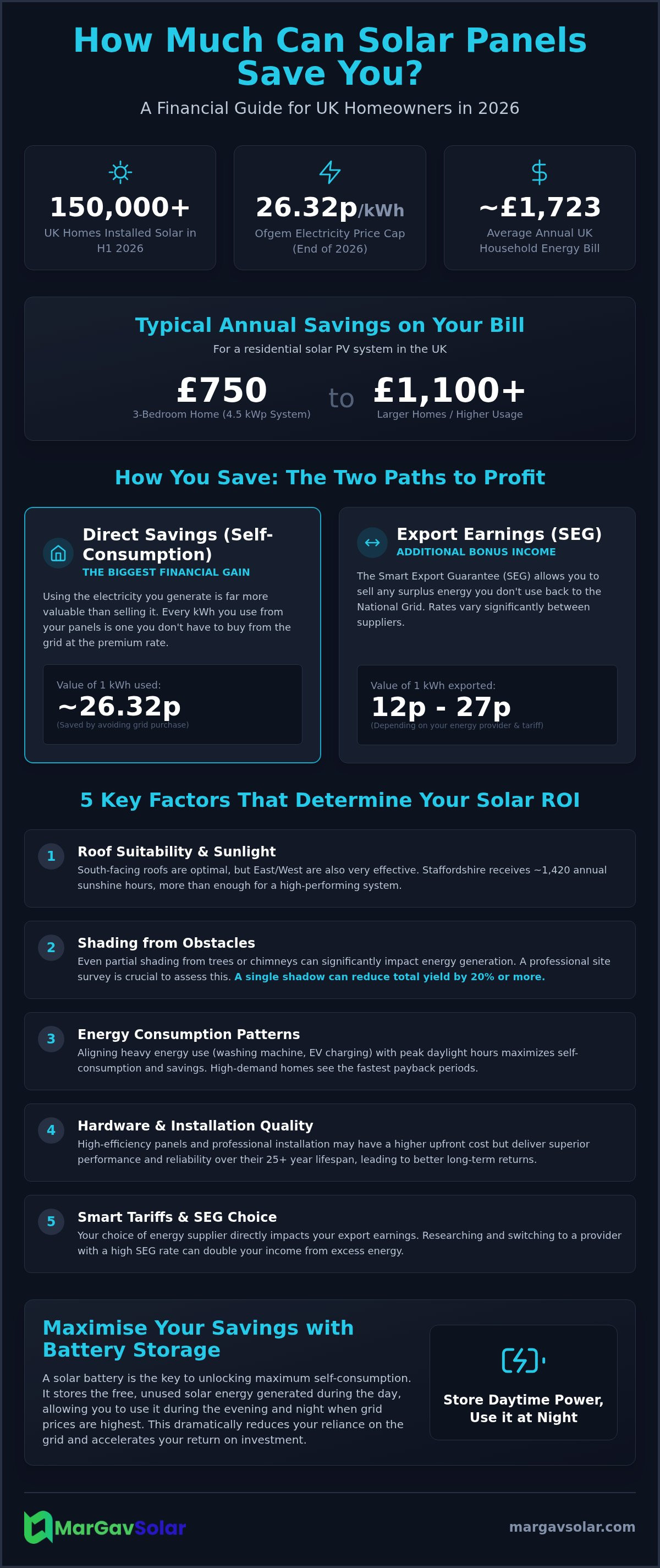
The financial landscape of Solar power in the United Kingdom has shifted significantly in recent years. As of late 2026, the Ofgem electricity price cap is set at 26.32p per kWh, with the average household facing annual energy costs of approximately £1,723. While high energy prices are generally a burden, they actually improve the math for homeowners asking how much can solar panels save you UK wide. Every kilowatt-hour your roof generates is a unit you don't have to purchase from the grid at that 26p premium. For a typical three-bedroom semi-detached home, a 4.5 kWp system can generate annual savings of roughly £750; larger systems often see these figures rise to £1,100 or more.
The Impact of the Smart Export Guarantee (SEG)
The Smart Export Guarantee (SEG) is the modern successor to the old Feed-in Tariffs. It allows you to earn money by funnelling excess energy back into the National Grid. Unlike the old fixed government rates, SEG is market-driven, meaning your choice of energy supplier directly dictates your earnings. In 2026, rates vary dramatically between providers. You might find a "no switch" rate of 12p per kWh from Scottish Power, while top-tier rates reach up to 27p per kWh for customers with specific hardware like a solar battery. Choosing the right supplier can effectively double your export income. This makes it vital to look beyond your current provider to find a tariff that rewards your generation fairly.
Direct Savings: The Power of Self-Consumption
While exporting energy provides a welcome cheque, the most substantial financial gains come from using your power at the point of generation. Since importing electricity costs about 26p per unit and exporting it typically earns you between 12p and 16p, you're financially better off using that energy to run your own home. Your daily habits dictate these savings. If you're home during the day to run the dishwasher, washing machine, or charge an electric vehicle, your "free" energy usage peaks. Maximising self-consumption is the primary driver of UK solar ROI in 2026. By aligning your heaviest energy tasks with peak daylight hours, you ensure your Residential Solar PV Systems provide the highest possible bill reduction. This strategy turns your home into a self-sustaining unit that is less vulnerable to the fluctuations of the global energy market.
The 5 Key Factors That Determine Your Solar ROI
Understanding how much can solar panels save you UK requires looking beyond the initial price tag of the hardware. Several variables dictate how quickly your Residential Solar PV Systems pay for themselves. First, your roof's orientation and pitch are fundamental. While south-facing roofs remain the gold standard for peak generation, east and west-facing roofs are increasingly popular for capturing energy during the morning and evening. Shading is another critical factor. A single chimney or an overhanging tree can slash your total yield by 20% or more. This is why professional site surveys are essential for a realistic ROI projection. Hardware quality also plays a role; high-efficiency panels might cost more upfront, but their ability to convert more light into electricity over 25 years often outweighs the savings of budget alternatives.
Roof Suitability and Sunlight Hours
UK solar panels rely on solar irradiance, which includes diffuse light filtered through clouds. Even on an overcast day in Staffordshire, your system generates power. According to government estimates on savings for smaller plug-in units, even modest setups provide measurable relief, but full-scale rooftop systems offer significantly higher returns. Staffordshire receives roughly 1,420 sunshine hours annually, which is more than enough to drive a high-performing system.
Energy Consumption Patterns
Households with high energy demands, such as those with EV charging points or heat pumps, often see the fastest payback periods. The goal is to match your peak generation with your peak usage. If you are planning a solar panel installation, consider how your future needs might grow. When calculating how much can solar panels save you UK wide, remember that every unit of self-generated power used for an EV is a unit saved at full market price. To get the most accurate picture for your property, it helps to consult with a local Staffordshire expert who understands regional irradiance levels.
Maximising Savings with Battery Storage and Smart Tariffs
Combining Residential Solar PV Systems with Battery Storage Solutions is the most effective way to answer how much can solar panels save you UK in 2026. Without a battery, most households export about 50 percent to 70 percent of their generated energy because they aren't home during peak sun hours. By storing this energy, you avoid buying from the grid during expensive evening peaks. This "battery multiplier" effect can effectively double your annual savings. Many households now report reducing their grid reliance to below 20 percent, achieving a level of energy independence that was previously impossible. This shift is why 94 percent of new solar installations in 2026 now include a battery.
Modern "time-of-use" tariffs have revolutionised the financial case for solar. These dynamic tariffs allow you to charge your battery from the grid during the night when prices are lowest, sometimes at a fraction of the standard rate. You can then use that cheap power during the day or even export it back to the grid when demand is high and SEG rates are at their peak. When calculating how long it takes to break even, these smart strategies can shave years off the payback period compared to standard fixed-rate export deals. It turns your home from a passive consumer into an active participant in the energy market.
The Role of Battery Storage Solutions
Families often find that their highest energy demand occurs between 5 PM and 9 PM, exactly when solar generation drops. Solar battery storage bridges this gap, allowing you to use your own "free" energy long after sunset. This is particularly valuable for households with EV Charging Points, as it allows for solar-powered commuting. Beyond the financial ROI, many systems now offer essential backup functionality, keeping your lights and internet running during local power cuts. It provides peace of mind alongside profit.
Smart Energy Management Systems
Efficiency isn't just about hardware; it's about intelligent software management. Using platforms like the GivEnergy Cloud, Staffordshire homeowners can monitor their generation and consumption in real-time. These systems often use AI-driven algorithms to check weather forecasts and energy price fluctuations. The software automatically decides when to charge from the grid and when to discharge for the maximum financial yield. This automated management ensures your system is always working at its peak potential without requiring you to check the weather or price apps every hour. It makes high-level energy saving effortless.
Local Considerations: Solar Performance in Staffordshire
While national averages provide a baseline for how much can solar panels save you UK wide, your actual return depends heavily on regional conditions. Staffordshire sits in a geographic "sweet spot" for solar energy. It avoids the coastal salt spray of the south while benefiting from higher irradiance levels than the far north. Successfully installing Residential Solar PV Systems here requires more than just mounting hardware; it involves navigating local grid constraints. In our area, the Distribution Network Operator (DNO) often has specific requirements for how systems connect to the grid. Working with a local expert who has over 20 years of experience ensures these technical applications are handled correctly, preventing delays in your ability to export energy and earn SEG payments.
Regional Yield Expectations
Staffordshire receives approximately 1,420 hours of sunshine annually, which is more than sufficient to make solar a high-yielding investment. A standard 4kWp system in Staffordshire typically generates approximately 3,400 kWh of clean electricity annually, providing a robust foundation for household energy independence. While the Midlands might see slightly fewer peak sun hours than Cornwall, the cooler average temperatures actually help panels operate more efficiently, as excessive heat can sometimes reduce solar cell performance. This regional balance makes Staffordshire an ideal location for long-term energy savings that often outperform generic national projections.
Protecting Your ROI with Maintenance
Many homeowners overlook how environmental factors like dust, bird droppings, and local agricultural debris impact their financial returns. In Staffordshire, these accumulations can reduce your system's efficiency by 15% to 25% if left unaddressed. Regular solar panel maintenance is not just about aesthetics; it's a critical strategy for protecting your ROI. Professional cleaning and technical inspections ensure that every component, from the panels to the inverter, is operating at peak capacity. MarGav Solar provides comprehensive support and fixed-price contracts to keep your system performing exactly as promised on day one. To ensure your home is achieving its maximum potential, you can request a professional Staffordshire site assessment from our NICEIC-certified team.
Is Solar Worth It in 2026? Final Verdict and Next Steps
The financial case for installing how much can solar panels save you UK wide has reached a tipping point. With the electricity price cap at 26.32p per kWh and 0% VAT still applicable to installations, the window for high returns is wide open. Beyond the immediate reduction in monthly outgoings, a well designed system adds long term value to your property. Every month you delay is an opportunity cost; you're essentially choosing to pay high grid prices instead of investing that same money into an asset that generates free power. MarGav Solar’s 20 years of experience ensures that your Residential Solar PV Systems are built to last, avoiding the common pitfalls of budget setups that fail to deliver on their ROI promises.
Choosing a provider that offers fixed-price installation contracts is vital in 2026. This protects you from the hidden fees and "project creep" that can often erode your projected savings. By securing a transparent, upfront cost, you can calculate your break-even point with total confidence. Staffordshire homeowners benefit from our local expertise, as we understand exactly how to navigate regional grid constraints and DNO applications to get your system live and earning as quickly as possible.
Calculating Your Personal Payback Period
The math behind your payback period is straightforward. You take the total cost of your system and divide it by your projected annual savings from bill reductions and SEG earnings. While some generic calculators suggest a decade-long wait, the integration of modern Battery Storage Solutions and smart tariffs has significantly shortened this window. High-efficiency inverters and AI-driven management software ensure you capture and use more of your own power than ever before. Remember that the "break-even" point is just the beginning. Once your system has paid for itself, you have roughly 15 to 20 years of pure profit based on the typical lifespan of modern hardware.
Taking the Next Step with MarGav Solar
Online calculators are a helpful starting point, but they can't account for the specifics of your roof's pitch, local shading, or your family's unique energy habits. A professional consultancy provides a granular look at your potential ROI. Before your first meeting, it's helpful to have your recent energy bills ready and a clear idea of your future goals, such as adding EV Charging Points or heat pumps. This allows our team to design a bespoke system that matches your consumption perfectly. Our end-to-end support means we handle everything from the initial technical site survey to long-term maintenance. When you're ready to stop guessing and start saving, you can Request a professional solar consultancy from MarGav Solar.
Secure Your Energy Independence in Staffordshire
Transitioning to clean energy in 2026 is a strategic move to lock in long-term financial stability. By combining Residential Solar PV Systems with Battery Storage Solutions, you can bypass high grid rates and take control of your energy future. We've explored how the current electricity price cap and Staffordshire’s specific irradiance levels create a perfect environment for high returns. The most successful homeowners are those who shift from passive consumption to smart, AI-driven energy management.
Understanding how much can solar panels save you UK wide is the first step toward decades of bill reductions. MarGav Solar brings over 20 years of renewable energy expertise to every project. As specialists in Staffordshire residential solar, our NICEIC-certified professional installers ensure your system is optimized for the local Midlands climate. We provide fixed-price contracts to give you total certainty over your investment from day one.
Get a Fixed-Price Solar Installation Quote from MarGav Solar and start your journey toward a more sustainable, cost-effective home today. It's time to turn your roof into your most valuable financial asset.
Frequently Asked Questions
How much can I realistically save on my energy bills with solar panels in 2026?
A typical 4.5 kWp system in the UK can save a household roughly £750 annually, though this figure can rise to £1,100 for larger setups. These savings are driven by the 2026 electricity price cap of 26.32p per kWh. By generating your own power, you avoid buying expensive grid energy. Your actual total depends on how much electricity you use during daylight hours and whether you've integrated Battery Storage Solutions to capture excess power.
Is the Smart Export Guarantee (SEG) enough to make solar worth it?
The Smart Export Guarantee is a valuable secondary income stream, but it shouldn't be your only focus. While top 2026 SEG rates reach up to 27p per kWh for specific setups, the real value lies in self-consumption. Since importing electricity costs about 26p and exporting often pays less, using your own energy is more profitable. However, SEG ensures that every extra kilowatt your Staffordshire home produces still contributes to your overall ROI.
Do solar panels work on cloudy days in the UK?
Yes, Residential Solar PV Systems generate electricity using diffuse light, meaning they work even when it's overcast. While direct sunlight is most efficient, the UK's weather is perfectly suitable for solar generation. Staffordshire receives approximately 1,420 sunshine hours annually, providing ample light to power your home. Modern panels are designed to be highly sensitive, ensuring that your system remains productive throughout the varying light levels of a typical Midlands winter.
How much does a typical residential solar PV system cost to install in Staffordshire?
Industry data for 2026 suggests that a typical 4kW system in the UK costs between £6,000 and £8,000, while a slightly larger 4.5kW setup averages around £7,600. These figures usually cover the panels and installation but don't include optional Battery Storage Solutions. At MarGav Solar, we provide fixed-price installation contracts to ensure Staffordshire homeowners have total clarity. This approach eliminates hidden fees and helps you calculate your exact payback period with confidence.
Will solar panels increase the value of my UK home?
Solar panels are widely considered a value-adding asset for UK properties in 2026. As energy efficiency becomes a top priority for buyers, a home with a pre-installed Residential Solar PV System often stands out in the Staffordshire market. Prospective owners appreciate the prospect of lower running costs and a reduced carbon footprint. Having a professional installation with full maintenance records provides the technical assurance that buyers and surveyors look for during the sale process.
Do I need a battery to see significant savings from my solar panels?
You don't strictly need a battery, but it significantly changes the math of how much can solar panels save you UK wide. Without storage, you might only use 30% of the energy you generate. Adding a battery allows you to store that power for evening use, often increasing self-consumption to over 80%. This helps you avoid the most expensive peak-time grid charges, making a battery one of the most effective ways to maximize your ROI.
How long do solar panels take to pay for themselves in the UK?
Payback periods typically range between 6 and 10 years, depending on your system size and energy habits. Households that use a lot of power during the day or utilize smart "time-of-use" tariffs often see the fastest returns. The 0% VAT rate on solar and batteries in 2026 has also helped shorten this window. Once you reach the break-even point, your system effectively provides free electricity for the remainder of its 25-year lifespan.
What maintenance is required to keep my solar savings high?
To keep your savings high, you should invest in professional Solar Panel Maintenance & Cleaning. In Staffordshire, local agricultural dust and debris can settle on your panels, potentially reducing efficiency by up to 25%. We recommend a technical inspection and cleaning at least once a year. This ensures that your inverter is functioning correctly and that your panels are receiving maximum light exposure, protecting your long-term financial returns from environmental degradation.


