

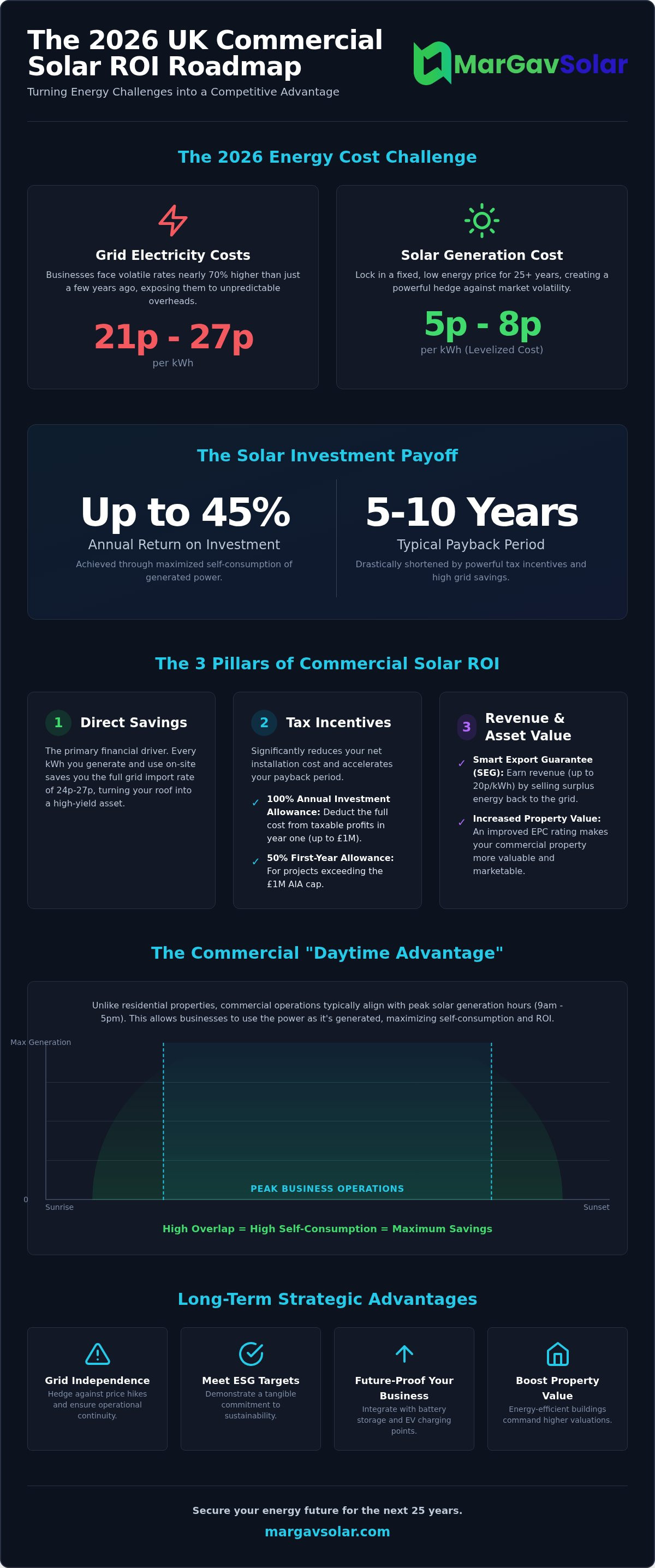
With commercial electricity rates in 2026 averaging between 21p and 27p per kWh, businesses are facing costs nearly 70% higher than they did just a few years ago. It's a frustrating reality for companies trying to balance tight margins with the urgent pressure to meet ESG targets. You've likely realized that relying solely on the national grid is no longer a sustainable financial strategy, especially when high upfront costs make every capital investment feel like a significant risk.
This article provides a definitive roadmap for your commercial solar panel ROI UK, showing you how to turn these energy challenges into a competitive advantage. You'll discover how the 100% Annual Investment Allowance and 0% VAT on energy-saving materials can drastically shorten your payback period, which now typically ranges from five to ten years. We will explore the specific financial drivers for 2026, including why grid-avoidance is the key to achieving an annual ROI of up to 45%. By viewing solar as a long-term technical partnership rather than a simple hardware purchase, you can secure your energy future while protecting your bottom line for the next 25 years.
Key Takeaways
- Learn how to leverage the Annual Investment Allowance and First-Year Allowance to significantly offset your initial capital expenditure in 2026.
- Discover how to accurately calculate your commercial solar panel ROI UK by factoring in "behind-the-meter" savings and potential revenue from the Smart Export Guarantee.
- Understand the importance of accounting for mid-life costs, such as inverter upgrades, to ensure your financial roadmap remains accurate over 25 years.
- Explore how integrating battery storage and EV charging points can further reduce grid reliance and help your business meet strict ESG targets.
- Find out why partnering with local Staffordshire specialists ensures smoother grid applications and provides the maintenance support needed to protect your long-term efficiency.
The 2026 Commercial Solar Landscape: Why ROI is Shifting
Calculating a commercial solar panel ROI UK used to be a simple exercise in comparing installation costs against annual bill savings. In 2026, the calculation has evolved into a strategic financial pillar. It now encompasses immediate tax relief through capital allowances, the appreciation of the commercial property as a green asset, and a massive reduction in operational expenditure. Businesses are no longer just buying hardware; they're securing a predictable energy price for the next quarter-century.
The year 2026 represents a pivotal moment for UK business energy strategy. Current UK solar power statistics show a projected capacity growth of over 5 GW this year alone, driven by the widening gap between grid costs and the levelized cost of solar. While grid electricity for small businesses sits around 24-27p per kWh, solar-generated power typically costs between 5-8p per kWh over the system's life. This disparity makes the financial case for solar stronger than it has ever been.
Grid Volatility vs. Solar Stability
Businesses that rely entirely on the national grid are exposed to a market with no price cap. In 2026, we've seen how global gas volatility directly impacts UK commercial tariffs, leaving companies vulnerable to sudden overhead spikes. Solar PV acts as a fixed-cost hedge. By locking in your energy costs at today's installation prices, you remove the uncertainty of annual contract renewals. Energy independence is the strategic capacity for a business to produce its own electricity on-site, ensuring that critical operations remain profitable regardless of fluctuations in the global energy market.
Commercial Load Profiles and Self-Consumption
Residential solar often struggles with ROI because homeowners are frequently away during peak generation hours. Businesses have the opposite profile. Most commercial operations run a schedule that aligns perfectly with peak solar output. This "daytime advantage" allows companies to achieve a much higher self-consumption rate than domestic users, which is the primary driver of a commercial solar panel ROI UK.
Consuming your own power is financially superior to exporting it. While the Smart Export Guarantee (SEG) might offer up to 20p per kWh, every unit you use yourself saves you the full 27p import rate. Maximizing this internal consumption is what drives the annual ROI toward that 45% upper limit. It turns your roof into a high-yield revenue generator that feeds your machinery, lighting, and servers directly, without the added costs of grid transmission or supplier margins.
The Financial Pillars: Savings, Tax Incentives, and Revenue
While energy bill reductions are the most visible benefit, a truly robust commercial solar panel ROI UK is built on a foundation of tax efficiency and asset appreciation. Business owners often overlook the fact that solar PV isn't just a utility; it's a high-yield financial instrument. By generating power "behind-the-meter," you avoid the 24p to 27p per kWh grid rates currently seen in 2026. When you compare this to a levelized generation cost of roughly 5p to 8p per kWh, the margin becomes a direct contribution to your EBITDA.
Beyond daily operational savings, solar installations provide a measurable boost to property value. Improving a commercial unit's EPC rating is no longer optional for many landlords; it's a requirement for maintaining leasehold yield and marketability. According to the UK's solar roadmap, the integration of renewable tech is a core component of the nation's strategy to decarbonize the commercial sector. This shift ensures that buildings with existing solar infrastructure command higher valuations and lower vacancy rates compared to energy-inefficient alternatives.
UK Tax Breaks for Commercial Solar
The UK tax regime in 2026 offers significant "front-loaded" benefits that accelerate your return. The Annual Investment Allowance (AIA) remains a powerful tool, allowing businesses to deduct 100% of the cost of solar panels from their taxable profits in the year of purchase, up to a limit of £1,000,000. This relief is confirmed to be in place until March 31, 2026. For larger projects exceeding this cap, a 50% First-Year Allowance provides a secondary layer of relief. Because these incentives reduce the net cost of the system immediately, they effectively slash the time it takes to reach your break-even point. Consulting with a specialist at MarGav Solar can help you align these technical specifications with your company's specific tax strategy.
SEG and Export Revenue Streams
While self-consumption is the primary goal, the Smart Export Guarantee (SEG) provides a vital secondary revenue stream. In 2026, export tariffs have become increasingly competitive, with some suppliers offering up to 25p per kWh for customers who meet specific installation criteria. This is particularly beneficial for businesses with large roof spaces that remain idle on weekends. Instead of letting that potential energy go to waste, you can export it back to the grid, turning your facility into a weekend revenue generator. While exporting should always be your "plan B" after powering your own machinery, it ensures that every photon captured by your array contributes to your commercial solar panel ROI UK.
Calculating the Payback Period: A Framework for UK Businesses
A standard commercial solar panel ROI UK calculation often starts with a simple payback formula: total system cost divided by annual energy savings. While this provides a quick snapshot, it doesn't tell the full financial story. To build a case that satisfies a CFO, you need to look at the Internal Rate of Return (IRR) over a 25-year lifecycle. This model accounts for the time value of money, the 0.5% annual degradation in panel efficiency, and the rising cost of grid electricity, which makes every unit of self-generated power more valuable each year.
One critical factor many calculators miss is the mid-life cost of technology. Most commercial solar panels are warrantied for 25 years, but the inverters, which convert the power for use in your building, typically have a lifespan of 12 to 15 years. Budgeting for inverter upgrades around the decade mark is essential for maintaining a realistic financial roadmap. By planning for these operational expenditures (OPEX) upfront, you ensure that your long-term projections remain accurate and transparent.
The "Hidden" ROI of Maintenance
Your ROI isn't static; it depends entirely on the system's ongoing performance. Environmental factors like soot, dust, and bird droppings can lead to a 20% drop in energy yield if left unaddressed. This makes professional solar panel maintenance & cleaning a high-return activity rather than just an overhead cost. Regular cleaning ensures your panels operate at peak efficiency, while sophisticated monitoring software can detect underperformance in specific strings before it noticeably impacts your bottom line. Investing in maintenance effectively protects your initial capital expenditure by extending the system's high-yield years.
Payback Variations by System Size
The speed of your return is heavily influenced by the scale of the installation. In 2026, we see clear variations across different commercial sectors:
- SMEs (20kW-50kW): These systems often see a payback period of 7 to 10 years. While they don't have the massive scale of industrial sites, they benefit significantly from high self-consumption rates during standard office hours.
- Industrial (100kW+): Larger arrays benefit from significant economies of scale during procurement and installation. For energy-intensive businesses like cold storage or manufacturing, the payback period can be as short as 3 to 7 years.
Regardless of size, the goal is to maximize the "behind-the-meter" usage. Every kilowatt-hour you generate and use on-site is a kilowatt-hour you don't have to buy from the grid at 2026's volatile commercial rates, which is the single biggest driver of your commercial solar panel ROI UK.
Strategic Advantages: ESG, Grid Independence, and EV Integration
A high commercial solar panel ROI UK isn't just measured in pounds saved on a utility bill; it's also reflected in your company's balance sheet through enhanced asset value and brand reputation. As we move through 2026, Environmental, Social, and Governance (ESG) reporting has shifted from a "nice-to-have" feature to a mandatory requirement for many supply chain tenders. Demonstrating a commitment to on-site renewable generation provides a transparent, data-driven metric for your annual sustainability reports. This transition often leads to the creation of "Green Leases," where landlords can command higher premiums for units that offer lower operational costs and a smaller carbon footprint.
Grid independence also offers a tactical shield against the Distribution Network Operator (DNO). During peak demand periods, many businesses face additional "peak shaving" charges or capacity constraints that limit their ability to expand operations. By generating your own power, you reduce your reliance on the DNO when the grid is most stressed. This ensures your facility remains operational and cost-effective even during high-tariff windows, effectively decoupling your production capacity from the limitations of local infrastructure.
The Synergy of Solar and Battery Storage
While solar panels generate the most power during the day, many industrial processes or security requirements continue around the clock. Integrating solar battery storage allows you to capture excess generation from the afternoon and deploy it during expensive evening peak periods. In 2026, the ROI of a combined system is increasingly attractive because it allows for "load shifting." You can avoid the highest grid price points entirely by running your facility on stored solar energy. This setup provides a dual benefit: it maximizes your self-consumption rate while providing an essential backup during grid outages, protecting your machinery from unscheduled downtime.
EV Charging as a Revenue Stream
The upcoming transition away from petrol and diesel vehicles makes the installation of EV charging points a strategic necessity for future-proofing your site. Beyond simply providing a perk for employees, solar-powered chargers can be turned into a distinct profit center. You can offer paid charging to clients or visitors, utilizing the "free fuel" generated by your roof. This infrastructure is a powerful tool for attracting top talent who prioritize sustainable workplaces. For businesses managing their own company fleets, the savings are even more dramatic. Replacing diesel fuel costs with solar-generated electricity provides a massive boost to your commercial solar panel ROI UK by slashing transport overheads.
To see how these strategic integrations can work for your specific site, contact the experts at MarGav Solar for a technical consultation.
Maximizing Your ROI with MarGav Solar’s Expertise
Protecting your commercial solar panel ROI UK requires more than just high-quality hardware. It demands a technical partner who understands the specific grid challenges and regulatory landscape of 2026. MarGav Solar brings over 20 years of industry expertise to every project, moving beyond simple installation to provide comprehensive technical consultancy. We don't just fit panels; we design energy systems that integrate with your existing infrastructure to ensure maximum financial performance over a 25-year lifespan.
Local expertise is particularly vital when dealing with the Distribution Network Operator (DNO). In Staffordshire and across the Midlands, grid capacity can be a significant hurdle for large-scale commercial arrays. Our deep understanding of local network constraints allows us to manage the DNO application process efficiently, securing the necessary approvals without the delays that often plague less experienced installers. By handling these complexities early, we ensure your project moves from feasibility to generation as quickly as possible.
The MarGav Consultation Process
We begin every commercial partnership with a detailed site survey. This isn't a generic assessment. We use advanced mapping to identify the highest-yielding roof areas, accounting for shading, orientation, and structural integrity. Our team then builds a bespoke financial model tailored to your specific energy bills and load profile. This model provides a transparent view of your projected savings, factoring in the 2026 tax incentives and export opportunities discussed earlier. We take the guesswork out of the investment by showing you exactly how the system will perform under real-world Midlands weather conditions.
Long-term Asset Management
A solar array is a long-term asset that requires proactive management to maintain its peak Internal Rate of Return. MarGav Solar provides end-to-end support that extends far beyond the initial commissioning. This includes comprehensive maintenance, repair services, and planned inverter upgrades to ensure your system never suffers from avoidable downtime. Our NICEIC-certified installers adhere to the highest industry standards, which is essential for maintaining manufacturer warranties and ensuring the safety of your commercial property.
Getting started is straightforward. We offer a comprehensive commercial solar feasibility study that outlines the technical requirements and financial potential of your site. This study serves as your roadmap, providing the data your board needs to make an informed decision about securing your energy future. By partnering with a local specialist, you ensure that your commercial solar panel ROI UK is protected by decades of technical knowledge and a commitment to ongoing system health.
Take Command of Your Operational Costs and Energy Future
The business case for solar in 2026 is no longer just about environmental optics; it's a fundamental shift in financial strategy. By moving away from volatile grid tariffs and leveraging current UK tax incentives like the Annual Investment Allowance, you can lock in a predictable energy price for decades. This approach transforms your roof into a high-yield asset that supports EV infrastructure, meets mandatory ESG targets, and delivers a robust commercial solar panel ROI UK.
Achieving these results requires a technical partner who understands the local grid complexities of the Midlands. MarGav Solar combines 20+ years of industry experience with the precision of NICEIC-certified installers. As Staffordshire local specialists, we provide the end-to-end support needed to navigate DNO approvals and maximize your long-term efficiency. Don't leave your energy strategy to chance while grid prices remain unpredictable. Request a Commercial Solar Feasibility Study from MarGav Solar today to discover the exact financial potential of your site. It's time to turn your facility into a self-sustaining power plant.
Frequently Asked Questions
What is the average ROI for commercial solar panels in the UK in 2026?
In 2026, the average annual commercial solar panel ROI UK ranges between 14% and 45%. Most businesses see a full payback on their initial investment within five to ten years. For energy-intensive companies in sectors like manufacturing or cold storage, this period can drop to between three and seven years. These high returns are driven by current grid electricity rates and your ability to consume generated power on-site during peak daytime hours.
How do Capital Allowances affect the payback period for business solar?
Capital Allowances act as a powerful accelerator for your return on investment. Under the Annual Investment Allowance, UK businesses can deduct 100% of the cost of solar installations from taxable profits in the year of purchase, up to a £1,000,000 limit. This tax relief is confirmed until at least March 31, 2026. By reducing your immediate tax liability, these incentives effectively lower the net cost of the system and shorten the payback timeline significantly.
Can my business sell excess solar energy back to the grid?
Yes, your business can generate revenue from surplus energy through the Smart Export Guarantee. In 2026, some suppliers offer export rates as high as 25p per kWh, though these often require specific installation criteria. While selling power is a useful secondary income stream, you'll achieve a higher commercial solar panel ROI UK by maximizing self-consumption. Using your own electricity saves you the full 24p to 27p import rate, which is more valuable than any export tariff.
How long do commercial solar panels last before they need replacing?
Modern commercial solar panels are designed to last between 25 and 30 years. Most manufacturers provide performance warranties that guarantee at least 80% to 85% of the original output after 25 years. However, you should plan for an inverter upgrade around the 12 to 15-year mark. Replacing this component is a standard part of long-term asset management and ensures the system continues to convert energy efficiently for its full operational life without significant yield loss.
Do I need planning permission for a commercial solar installation in Staffordshire?
Most commercial solar installations fall under Permitted Development rights, meaning you won't need full planning permission. However, specific rules apply to listed buildings, conservation areas, or systems exceeding 1MW. In Staffordshire, local authorities have specific requirements regarding roof-mounted arrays on heritage sites. It's always best to consult with local specialists like MarGav Solar to confirm your site's status and ensure all DNO and local council notifications are handled correctly before any work begins.
Does solar energy affect the business rates or property value of my commercial unit?
Installing solar panels typically doesn't increase your business rates, as the UK government often provides exemptions for microgeneration and energy-saving plant machinery. From a property value perspective, solar PV is a significant asset. It improves your building's EPC rating, which is increasingly vital for commercial landlords. Units with lower operational costs and sustainable infrastructure are more attractive to high-quality tenants and often command better resale values in a green-focused 2026 property market.
What maintenance is required to ensure a high ROI on commercial solar?
Regular maintenance is essential for protecting your 25-year financial roadmap. Professional solar panel cleaning can increase your energy yield by up to 20% by removing dirt, soot, and bird droppings that block sunlight. Beyond cleaning, we recommend annual technical inspections to check electrical connections and inverter health. MarGav Solar provides comprehensive maintenance and repair services in Staffordshire to ensure your system continues to operate at peak efficiency and remains within its manufacturer warranty.
Is my commercial roof suitable for solar panels?
Most commercial roofs in the UK are suitable for solar, provided they are structurally sound and have sufficient space. South-facing roofs offer the highest peak generation, but East-West configurations are excellent for businesses that need a consistent power supply throughout the working day. We conduct detailed site surveys in Staffordshire to assess roof condition and shading. If your roof is older, we can advise on whether repairs are needed before the installation begins to ensure long-term stability.


