
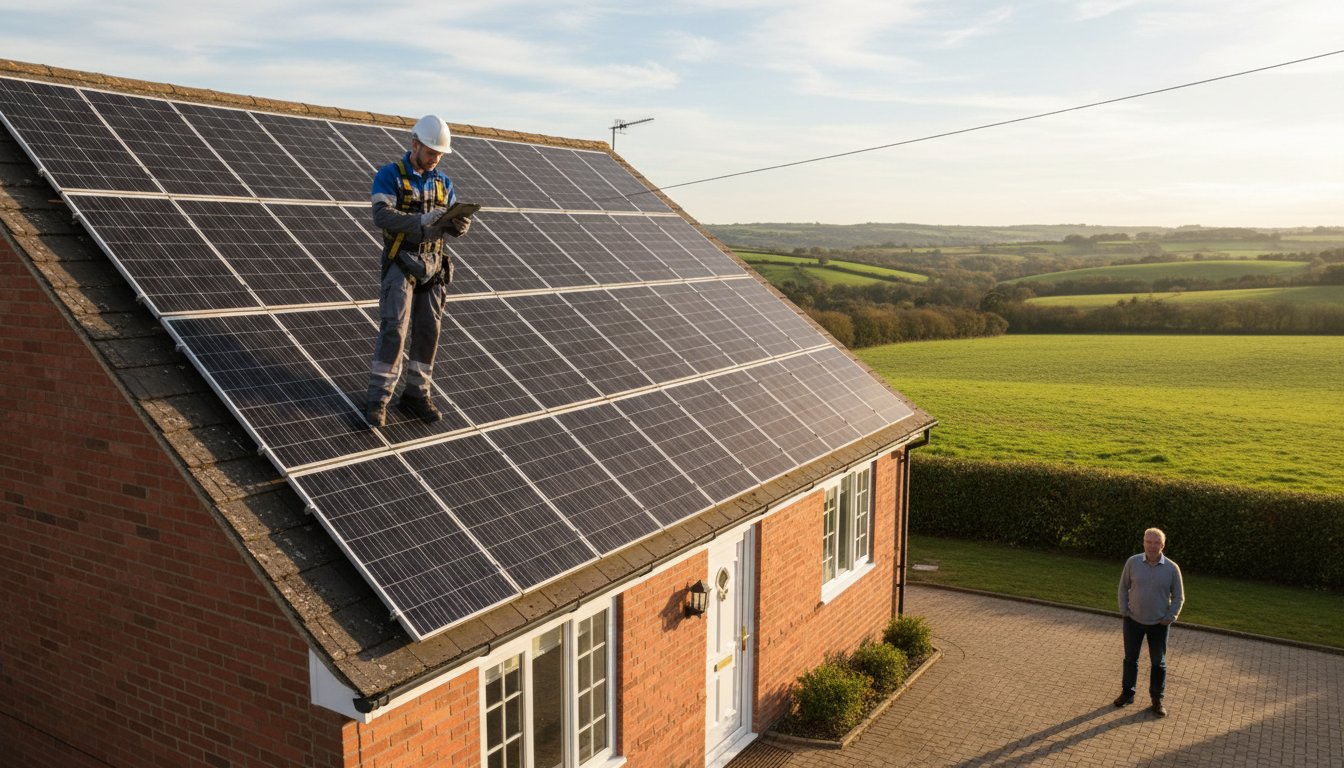
Could a single choice determine whether your solar panels are a lifelong asset or a costly liability for your roof? In 2026, searching for "accredited solar installers near me" is about more than just finding a local tradesman. It's about ensuring your system meets the strict new MCS Redeveloped Installer Scheme standards. These updated regulations shift the focus from paperwork to actual on-site quality, providing mandatory financial protection for every Staffordshire homeowner.
It's understandable if you feel overwhelmed by shifting certifications or worry about missing out on government incentives. You want a safe, high-yield system that pays for itself, not a botched installation that leads to leaks or voids your warranty. We've created this guide to help you cut through the confusion. You'll learn how to secure the 0% VAT relief available until March 2027, maximize your SEG earnings with battery storage, and verify which grants, like ECO4 or the Warm Homes: Local Grant, still apply to your property in Staffordshire.
Key Takeaways
- Learn how the 2026 MCS Redeveloped Installer Scheme protects your investment and secures your eligibility for lucrative Smart Export Guarantee (SEG) payments.
- Identify the critical safety risks of hiring unaccredited contractors, including potential fire hazards and the risk of voiding your Staffordshire home insurance.
- Follow our step-by-step guide to vetting accredited solar installers near me by verifying national database status and checking local project references.
- Discover why advanced system components like battery storage and EV charging points demand specific professional certifications to operate safely.
- Understand the value of fixed-price contracts and local maintenance support in maximizing your solar system's long-term return on investment.
What Does "Accredited" Really Mean for Solar Installers in 2026?
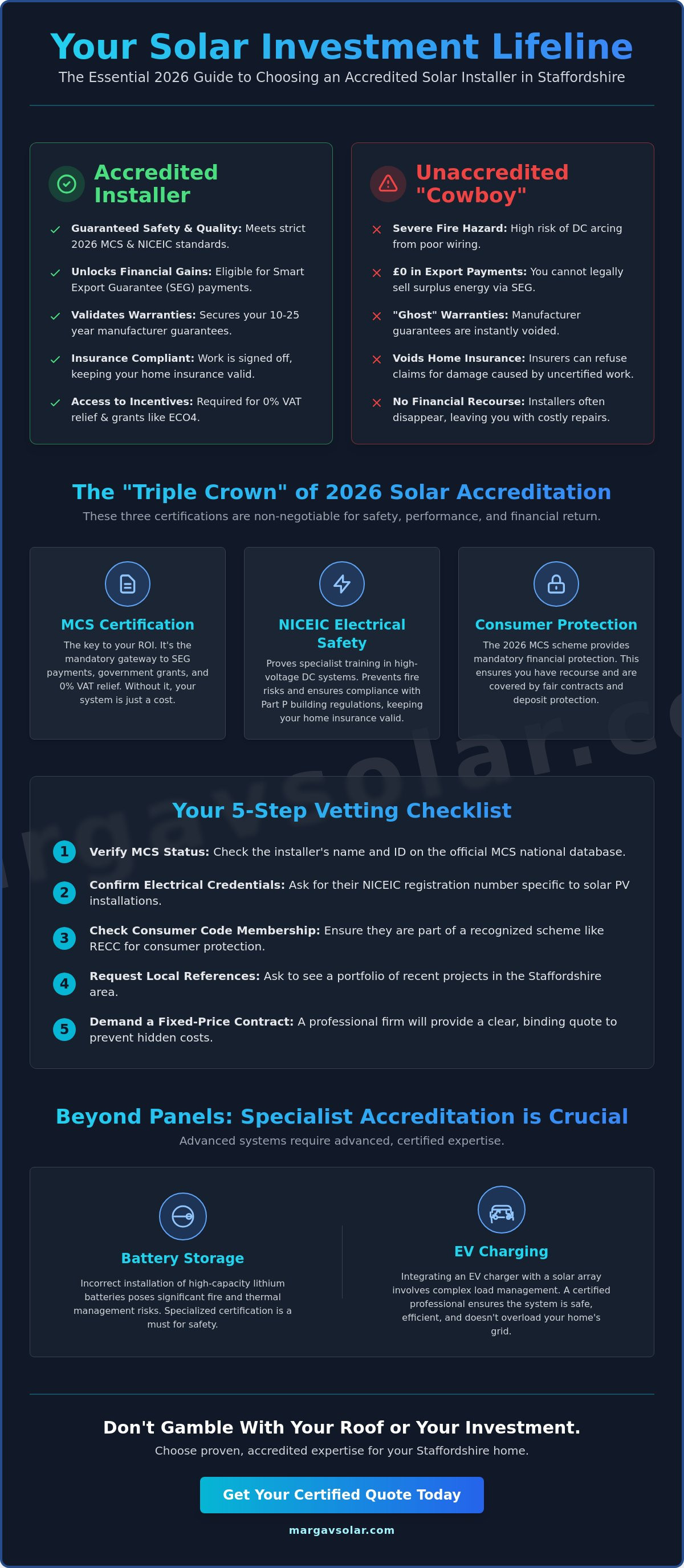
When you start searching for accredited solar installers near me, it's easy to assume any local contractor with a professional-looking website will do. In reality, the 2026 landscape requires a "Triple Crown" of certifications to ensure your home stays safe and your investment remains profitable. This includes the Microgeneration Certification Scheme (MCS), NICEIC for electrical safety, and consumer protection through the new centralized MCS scheme or traditional codes like RECC. While Renewable energy in the United Kingdom has become mainstream, regulations have tightened to filter out "cowboy" installers who lack specialized training.
True accreditation isn't just a badge on a van; it's your legal and financial safeguard. It guarantees that the professional working on your roof understands the complex relationship between high-voltage DC electricity and your home's existing AC grid. Without these specific credentials, you aren't just risking a poor installation; you're potentially locking yourself out of thousands of pounds in export payments and grants.
The Role of MCS in Financial ROI
MCS is the quality assurance scheme for low-carbon energy technologies. In 2026, it remains the most critical certification for your financial return on investment. You cannot sell surplus energy back to the grid through the Smart Export Guarantee (SEG) without a valid MCS certificate. If your installer isn't accredited, your energy supplier won't pay you a penny for the electricity you export.
Beyond export payments, MCS status is often a prerequisite for manufacturer warranties. Most premium panel and battery manufacturers tie their 10 to 25 year performance guarantees to the quality of the installation. If a non-accredited firm fits your system and a component fails, you'll likely find your warranty is void, leaving you to pay for expensive repairs out of pocket.
NICEIC: Why Electrical Safety Cannot Be Overlooked
A common mistake is hiring a general builder or a standard domestic electrician for a solar project. Solar PV systems, particularly those integrated with battery storage and EV charging points, involve intricate wiring that standard domestic training doesn't cover. NICEIC certification proves that an installer is specifically qualified to meet BS 7671 standards for high-voltage DC systems.
This is vital for Staffordshire homeowners because it ensures Part P building regulation compliance. When you add high-capacity lithium batteries to a garage or loft, the thermal management and circuit protection must be flawless. A specialist NICEIC contractor understands how to prevent DC arcing, a leading cause of solar fires. This expertise keeps your home insurance valid. If an incident occurs and the work wasn't signed off by a certified specialist, your insurance provider could legally refuse your claim. When looking for accredited solar installers near me, always verify they hold these specific electrical credentials alongside their solar-specific ones.
The Hidden Risks of Hiring Unaccredited "Cowboy" Installers
It starts with a tempting offer. A local general builder or a "handyman" friend claims they can install your panels for thousands less than the specialist firms. While saving money is important, the solar industry isn't like painting a fence or tiling a kitchen. When you bypass the search for accredited solar installers near me in favor of the lowest quote, you're often trading long-term safety for a short-term discount. The most severe technical risk is DC arcing. Unlike the AC electricity in your wall sockets, high-voltage DC electricity from solar panels doesn't self-extinguish easily if there's a gap in the circuit. Poor wiring or mismatched connectors, common hallmarks of unaccredited work, can create intense heat that leads to roof fires.
Beyond the physical danger, there's a significant legal trap. Most home insurance providers in Staffordshire require electrical work to be completed by a certified professional to maintain your policy's validity. If an unaccredited system causes damage, your insurer may legally refuse to pay out. You also face the "Ghost Warranty" problem. Cowboy firms frequently disappear or rebrand when issues arise, leaving you with no recourse when an inverter fails or a leak develops. Authentic protection only comes through the Microgeneration Certification Scheme (MCS), which ensures installers are held to rigorous safety and consumer standards.
Structural Risks to Your Roof
Staffordshire weather can be unpredictable, with high wind loads and heavy seasonal rainfall. Accredited professionals perform detailed structural calculations to ensure your roof can handle the "dead load" of the panels and the "wind uplift" that occurs during storms. Unaccredited installers often skip this step, using generic mounting brackets that can crack tiles or cause the roof to sag over time. These mounting errors are the primary cause of slow-developing leaks that rot your ceiling joists before you even notice a damp patch.
The Financial Loss of Non-Compliance
The math rarely favors the "cheap" option. Without an MCS certificate from an accredited installer, you're ineligible for the Smart Export Guarantee (SEG). With high-use tariffs paying over 30p/kWh as of May 2026, losing out on these payments can cost a typical household over £400 every year. Over the 25-year lifespan of a system, that's £10,000 in vanished earnings. Furthermore, the cost of hiring a qualified team to perform remedial work on a "cowboy" system is substantial. In most cases, the "cheaper" quote often costs 40% more after repairs and compliance upgrades are factored in. If you're concerned about the quality of an existing system, professional solar maintenance can help identify these hidden risks before they become expensive failures.
How to Vet Accredited Solar Installers in Staffordshire
Finding a list of names is the easy part. The real challenge is separating high-quality local experts from national franchises that prioritize volume over precision. When you search for accredited solar installers near me, you need a vetting framework that goes beyond a basic Google review. Start by cross-referencing any potential company with the official MCS website. This database is the only way to confirm a firm is currently compliant with the 2026 Redeveloped Installer Scheme. Digital verification is just the first step; it proves they are legal, but it doesn't prove they are the best fit for your specific roof.
A reputable installer should offer a local Staffordshire reference or even a site visit to a previous project. This allows you to see the quality of the "invisible" work, such as cable management and inverter mounting. You should also ask if the labor is end-to-end. Many national companies sub-contract the actual installation to whoever is cheapest that week. A dedicated local team with their own staff ensures accountability and consistency. If something goes wrong, you want to know exactly who is responsible for the repair.
The survey process is another red flag indicator. Avoid any company that provides a "firm" quote based solely on satellite imagery. A professional must visit your property to check the roof's structural integrity, identify potential shading from nearby trees or chimneys, and assess your current consumer unit. Without an on-site visit, you risk hidden costs appearing on installation day. Finally, ensure they provide consumer protection insurance through bodies like HIES or the centralized MCS scheme, which protects your deposit and provides a workmanship guarantee even if the company ceases trading.
Local Knowledge: Why a Staffordshire Specialist Wins
Staffordshire presents unique challenges that national installers often overlook. If you live in the Staffordshire Moorlands or parts of Cannock Chase, you may face stricter planning restrictions or conservation area rules. A local specialist will already know these local authority quirks. They also understand the specific requirements of the National Grid (formerly Western Power Distribution) for our region. They'll handle the G98 or G99 grid connection applications on your behalf, ensuring your system is legally allowed to export energy. Long-term, having a local team also makes solar panel maintenance much easier, as they are just a short drive away if you need a system health check or cleaning.
Questions to Ask During the Consultation
Use your initial meeting to gauge the installer's technical depth. If they can't answer these three questions clearly, they aren't the right fit:
- "Will you provide a physical MCS certificate and an NICEIC completion certificate?" These are your tickets to SEG payments and insurance validity.
- "Are you an approved installer for specific brands like GivEnergy?" Being an approved partner often grants you extended warranties on battery storage solutions.
- "Do you handle the full G98/G99 grid application?" You shouldn't be left to navigate complex utility paperwork alone.
Beyond Panels: Accreditation for Batteries and EV Charging
Modern solar systems in 2026 are rarely just panels on a roof. As energy prices fluctuate, most homeowners look for a complete ecosystem including storage and vehicle charging. This shift makes finding accredited solar installers near me even more vital. High-capacity lithium batteries and fast-charging EV units draw significant current. If the installation isn't handled by a certified professional, you risk overloading your home's electrical circuits or creating a fire hazard in your loft or garage. Proper thermal management and ventilation are non-negotiable when housing large-scale battery cells indoors.
Integrating these technologies often requires inverter upgrades. A standard older inverter might not be capable of managing the bidirectional flow of energy between your panels, the battery, and the grid. An accredited installer understands these technical nuances, ensuring your system remains efficient and safe. Choosing a single partner for the entire "Smart Home" ecosystem simplifies maintenance and ensures all components communicate perfectly. It also means you have one point of contact for warranties and technical support.
The GivEnergy Ecosystem in Staffordshire
We specialize in the GivEnergy Cloud system because it offers unparalleled control over your energy usage. Proper accreditation for software setup is just as important as the physical wiring. When your battery is configured correctly, it can automatically charge from the grid during low-cost overnight periods and discharge when rates are highest. This smart management is the key to maximizing your ROI. Without expert setup, solar battery storage becomes an expensive backup rather than a proactive money-saving tool. Our team ensures your software settings match your household's specific consumption patterns.
Integrating EV Charging Points Safely
Adding an EV charging point to your home requires careful load balancing. A standard domestic fuse box isn't always built to handle a 7kW charger alongside an electric shower and oven. Accredited installers use smart hardware to ensure your car charges quickly without tripping your main fuses. OZEV accreditation is a hallmark of a high-quality installer, as it proves they meet the specific safety standards required for government-funded installations. We're also looking ahead to V2H (Vehicle-to-Home) technology, ensuring your current array is ready for the day your car can power your house during a blackout. This future-proofing saves you from having to pay for a second installation down the line.
Ready to upgrade your home's energy efficiency? Contact our accredited team for a technical survey to see how these systems can work for you.
MarGav Solar: 20 Years of Accredited Excellence in Staffordshire
Choosing a partner for your home's energy transition is a 25-year commitment. When you search for accredited solar installers near me, you aren't just looking for someone to bolt panels to a roof; you're looking for long-term accountability. MarGav Solar provides this through a strict "no sub-contractors" policy. Every member of our team is a direct employee, ensuring that the high standards of our NICEIC and MCS certifications are met on every single project. This localized approach allows us to manage every detail, from the initial DNO application to the final commissioning of your Smart Export Guarantee (SEG) meter.
While our company was incorporated in April 2020, our team brings decades of collective industry expertise to the Staffordshire region. We've focused on bridging the gap between high-efficiency hardware and professional electrical certification. We don't just sell components; we provide a fixed-price contract that covers the entire lifecycle of the installation. This ensures your system isn't just functional but is fully optimized for the specific climate and grid conditions of our local area.
Our Local Staffordshire Heritage
We've built our reputation on successful solar panel installations in Staffordshire, ranging from urban terraces to rural barn conversions. By remaining a local specialist rather than a national "volume" installer, we maintain close relationships with Staffordshire local authorities and grid operators. This local presence means we're never more than a short drive away if you need maintenance or a system upgrade. We know the local planning nuances of the Moorlands and the specific grid constraints of the National Grid in this region, saving you weeks of potential paperwork delays.
Start Your Accredited Solar Journey Today
Your journey begins with a technical consultancy, not a sales pitch. We perform a full on-site audit to check your roof's health and your consumer unit's capacity. Our fixed-price contracts mean the price we quote is the price you pay; there are no hidden "extras" on installation day. We handle all the technical hurdles, ensuring your system is safe, efficient, and fully eligible for all financial incentives available in 2026.
Ready to secure your energy future with a team you can trust? Book your Staffordshire site survey today and take the first step toward a safer, higher-yield solar system. Contact us now to get started.
Secure Your Staffordshire Energy Future Today
Investing in solar power is a smart move for your wallet and the planet, but only if the installation is handled with technical precision. You've seen how the 2026 MCS standards and NICEIC certifications are the only way to guarantee both your home's safety and your long-term financial returns. From securing 0% VAT relief to maximizing your SEG earnings through smart battery storage, every step requires a professional hand. Searching for accredited solar installers near me shouldn't be a gamble; it should be the start of a reliable partnership.
MarGav Solar combines over 20 years of renewable energy expertise with full MCS and NICEIC certification. We provide the dedicated local support and long-term maintenance you need for total peace of mind. By choosing a specialist who understands the specific grid requirements and planning rules unique to Staffordshire, you ensure your system performs at its peak for decades to come. It's time to take control of your energy bills with a system built to last. Book Your Accredited Solar Survey in Staffordshire with MarGav Solar and start your journey toward true energy independence.
Frequently Asked Questions
Do I legally need an MCS accredited installer for solar panels?
No, there is no law preventing an unaccredited person from fitting panels, but it's a poor financial decision. Without an MCS certificate, you won't be eligible for the Smart Export Guarantee (SEG) or the 0% VAT relief available until March 2027. Most insurance providers also require professional certification to maintain your home's coverage and protect against fire risks.
What is the difference between MCS and NICEIC for solar?
MCS is a product and installation quality scheme that ensures your system produces energy as promised. NICEIC is an electrical safety accreditation that proves the installer is qualified to handle high-voltage wiring and complex grid connections. You need both to ensure your system is safe, efficient, and fully compliant with UK building regulations and BS 7671 standards.
Can I still get the Smart Export Guarantee (SEG) if I install panels myself?
No, you cannot access SEG payments with a DIY installation. Energy suppliers require a certificate from the Microgeneration Certification Scheme to prove the system was installed to national standards. Since SEG rates can reach over 30p/kWh for some variable tariffs in 2026, the loss of this income often outweighs any initial savings from a self-installation.
How do I check if a solar company in Staffordshire is actually accredited?
You should always verify credentials through the official MCS and NICEIC databases online. When searching for accredited solar installers near me, enter your specific Staffordshire postcode into these search tools to confirm the firm's current status. This ensures the company is currently active and hasn't had their certification suspended for poor workmanship or safety violations.
What happens to my warranty if my solar installer goes out of business?
Your equipment warranties for panels and batteries are held by the manufacturer, so they remain valid regardless of the installer's status. For workmanship issues, you're only protected if your installer provided an Insurance Backed Guarantee (IBG). Accredited installers are required to provide these through approved schemes, ensuring you aren't left stranded if the firm closes its doors.
Does solar accreditation cover battery storage and EV chargers too?
Yes, but installers need additional specific qualifications for these technologies to ensure home safety. For battery storage, they must follow specific MCS standards for battery integration and thermal management. For EV chargers, they should be OZEV-approved to ensure the unit is safely balanced against your home's electrical load without tripping your main fuses during peak usage.
Are there any specific planning permissions for solar in Staffordshire?
Most domestic solar installations are considered Permitted Development and don't require formal planning permission. Exceptions exist for listed buildings and homes within conservation areas, such as parts of the Staffordshire Moorlands or Cannock Chase. In these sensitive areas, you'll need to consult your local planning authority to ensure the array meets specific aesthetic or structural guidelines.
How long does an accredited solar installation typically take?
A typical residential installation is completed within one to two days for most Staffordshire properties. The first day usually focuses on roof mounting and panel placement, while the second day covers the internal electrical work, including battery setup and inverter commissioning. Larger systems or those requiring significant consumer unit upgrades may take slightly longer to ensure full safety compliance.


