
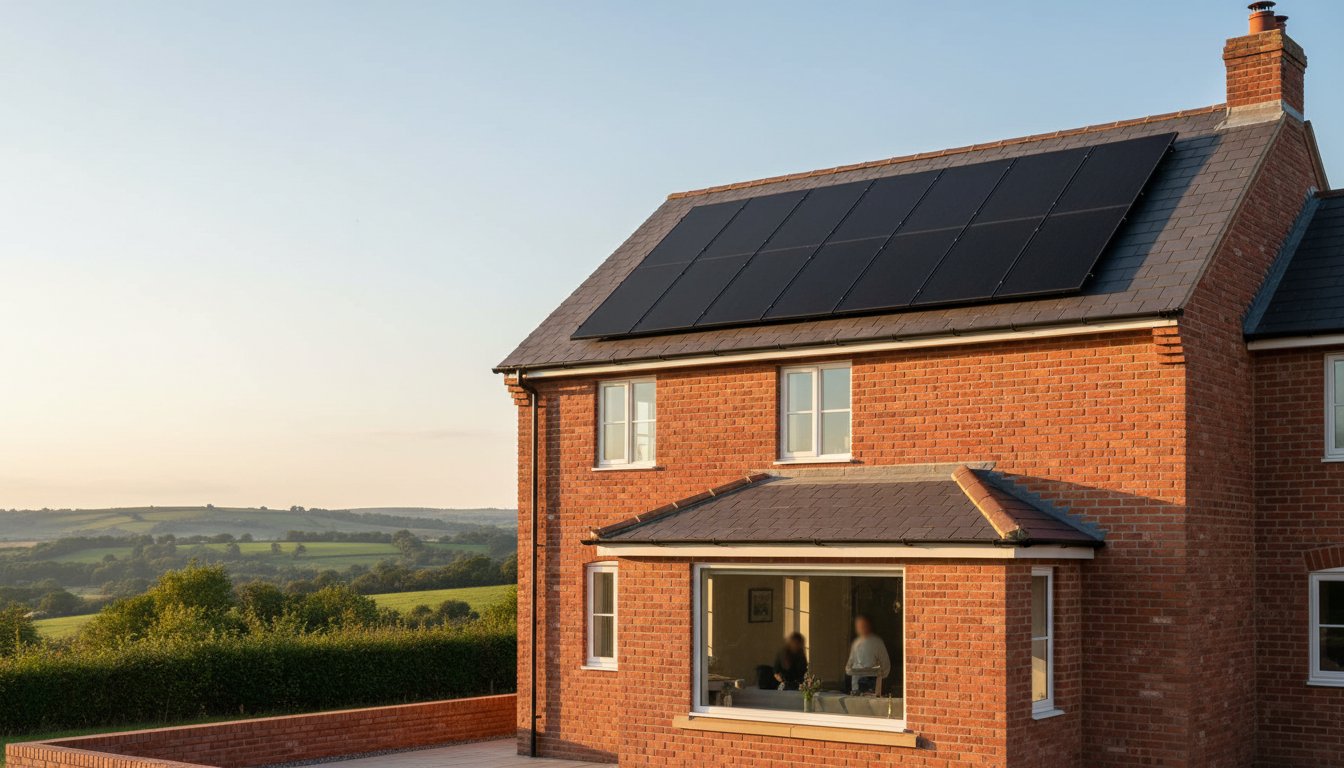
Your roof in Staffordshire is likely already pre-approved for solar power, even if local headlines about controversial solar farms suggest otherwise. You've probably felt the frustration of trying to distinguish between massive commercial projects and your own search for solar panel planning permission Staffordshire guidelines. It's natural to worry about council fines or the complex restrictions found in historic areas like Lichfield and Stafford. You don't want your investment stalled by a surprise Article 4 Direction or a conservation area rule you didn't know existed.
This guide makes the regulations simple, giving you the confidence to start your transition to clean energy. You'll discover exactly which homes qualify for Permitted Development under the latest 2026 rules, including the new 600mm height allowance for flat roofs. We'll also cover the specific exceptions in Stone and Eccleshall, explain why residential solar currently enjoys 0% VAT, and show you how to choose an MCS-certified installer who handles the technical paperwork so you don't have to. Whether you want to save £800 on your annual bills or add battery storage to your setup, we'll ensure your project stays on the right side of the law.
Key Takeaways
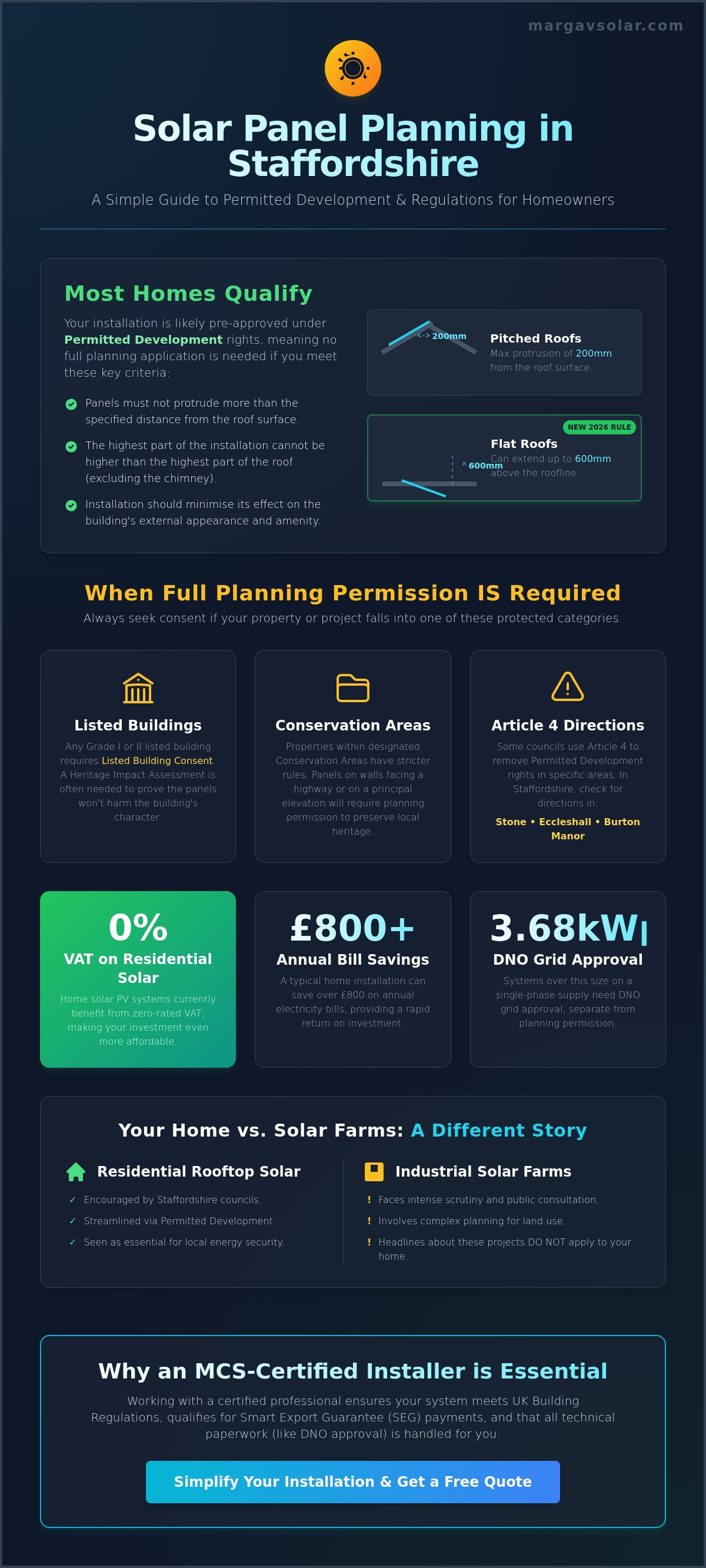
- Most residential projects in Staffordshire fall under Permitted Development, provided panels don't protrude more than 200mm from a pitched roof or 600mm from a flat roof.
- Local councils in Stone, Eccleshall, and Burton Manor have Article 4 Directions that can change your solar panel planning permission Staffordshire requirements.
- Properties with Listed Building status or those located in specific Conservation Areas always require additional consent to ensure the installation preserves local heritage.
- Planning permission is separate from DNO grid approval, which is mandatory for any solar PV system exceeding 3.68 kWp on a single-phase supply.
- Working with an MCS-certified installer ensures your system meets UK Building Regulations and qualifies for the Smart Export Guarantee (SEG) payments.
Understanding Permitted Development for Solar in Staffordshire
Installing solar panels on your home is rarely the bureaucratic headache that many homeowners fear. Most residential installations in the UK fall under Permitted Development rights. This means you can often proceed without a full planning application, provided your project meets specific national criteria established in The Town and Country Planning (General Permitted Development) (England) Order 2015. For your house to qualify for solar panel planning permission Staffordshire exemptions, the installation must follow a few straightforward rules. Panels on a pitched roof shouldn't protrude more than 200mm from the roof surface, and they must never sit higher than the highest part of the roof itself, excluding the chimney.
Local authorities also require you to install the system in a way that minimises its effect on the building's external appearance. This doesn't mean you need hidden panels, but it does mean installers should aim for a neat, symmetrical layout. When researching UK solar power planning considerations, you'll find that the national framework is designed to support the UK's net-zero targets by making small-scale green energy as accessible as possible. If you follow these standard limits, your project is usually a "green light" from day one.
Residential vs. Industrial Solar Rules
Don't let the local headlines about "solar land grabs" or controversial solar farms on Staffordshire's agricultural land worry you. There's a massive difference between a multi-acre industrial array and a set of panels on a residential roof. While large-scale developments face intense scrutiny and public consultation, Staffordshire councils actively encourage rooftop solar. They view residential PV systems as essential for local energy security. You aren't competing with the "land grab" controversies; you're simply upgrading your home's efficiency. Residential solar panel planning permission Staffordshire is streamlined specifically to separate your small-scale project from the complex planning hurdles faced by commercial energy developers.
The 2026 Solar Regulation Update
The rules became even more homeowner-friendly as of May 2026. One of the most significant shifts involves flat roof installations. Previously, these were often a grey area, but current regulations now allow panels on flat roofs to extend up to 600mm above the roofline under Permitted Development. This change allows for better angling of panels to maximise energy capture without needing a full planning application. Additionally, councils in Stafford and Stoke-on-Trent have further prioritised residential solar to protect the local Green Belt. This policy shift means that if you're installing on an existing structure, the path to approval is clearer than it's ever been.
When Planning Permission IS Required: The Exceptions
While Permitted Development covers the majority of residential projects, specific scenarios still trigger a full application. If you live in a property with historical significance or want to install panels in a large garden rather than on your roof, you'll need to look closer at the solar panel planning permission Staffordshire requirements. The latest government planning rules have expanded freedoms for many, but they haven't removed the protections for our county's heritage and rural landscape. Understanding where these boundaries lie prevents costly council fines and project delays.
Listed Buildings and Heritage Assets
Living in a Grade I or Grade II listed building means your property is protected by law. Any alteration that affects the character of the building, including solar PV, requires Listed Building Consent. Homeowners in the Staffordshire Moorlands or under the jurisdiction of Lichfield District Council should consult with heritage officers early in the process. They often require a Heritage Impact Assessment to prove the panels won't damage the building's fabric or visual history. In some cases, solar slates that mimic traditional materials might be the only approved option. If you're unsure about your home's status, getting a professional solar feasibility assessment can help clarify your next steps.
Ground-Mounted Systems in Staffordshire
Staffordshire's rural gardens offer plenty of space, but ground-mounted systems have stricter limits than roof-mounted ones. To stay within Permitted Development, your array must not exceed 9 square metres. It also needs to be at least 5 metres from your property boundary and no taller than 4 metres. If your project exceeds these dimensions, which is common for larger 6kW or 8kW systems, you'll need to submit a full planning application. Rural councils are particularly sensitive to ground-mounts that might impact the open character of the countryside. You should also check for any underground utility easements that might restrict where you can dig for the mounting structure.
Flat roofs provide another common exception. While rules now allow for a 600mm protrusion, this includes the height of the mounting frames. If your installer uses a high-tilt frame to capture more winter sun and it pushes the total height beyond that 600mm limit, solar panel planning permission Staffordshire will be required. Similarly, business owners in areas like Tamworth or Burton-upon-Trent face different thresholds. While commercial PD rights were expanded to allow for larger systems, any installation on a non-domestic property that fails to meet specific height or boundary criteria still requires a formal nod from the local planning office.
Local Staffordshire Considerations: Conservation Areas and AONBs
Staffordshire's rich history and protected landscapes mean that national rules often come with local footnotes. While the UK government's permitted development rights offer a broad green light for most, specific pockets of the county operate under tighter controls. If your home sits within a Conservation Area or an Area of Outstanding Natural Beauty (AONB), the standard "anything goes" approach to solar panel planning permission Staffordshire is replaced by a need for careful placement and aesthetic consideration.
One of the most critical tools local councils use is the "Article 4 Direction". This is a legal mechanism that removes certain permitted development rights in a specific area to protect its character. For instance, Stafford Borough Council has active Article 4 Directions in Stone, Eccleshall, and Burton Manor Village. South Staffordshire Council has implemented similar restrictions across 15 distinct areas. In these locations, you'll likely need a full planning application even for a standard roof-mounted system that would be exempt elsewhere. Beyond council-wide rules, local Neighbourhood Plans, such as those in Gnosall or Penkridge, can also introduce specific design preferences that planners consider during your application.
Installing in Conservation Areas
In conservation zones like Tamworth’s historic core or the village of Eccleshall, the primary rule is visibility. Planning permission is generally required if you want to fit panels on a wall or roof slope that forms the "principal elevation" and is visible from a highway. This often means homeowners must prioritise rear-facing roof slopes to stay within the rules. Success stories in Lichfield’s historic centre show that councils are increasingly pragmatic; they often approve street-facing panels if the homeowner uses high-quality black-frame modules that sit flush with the tiles. These "all-black" systems reduce the industrial look of the array, helping it blend into the streetscape while still providing significant clean power for the home.
AONB and Rural Landscape Restrictions
The Cannock Chase AONB is subject to a specific Design Guide that influences any external property changes. While the AONB doesn't ban solar, it prioritises the "conservation and enhancement" of the landscape. Natural England and local planning officers prefer installations that aren't visible from major viewpoints or popular walking trails. If your home overlooks the Chase or the southern fringes of the Peak District, you might be asked for a basic visual impact assessment. This isn't as daunting as it sounds; it usually involves providing photos of the roof from various angles to prove the panels won't create a glare nuisance or disrupt the rural skyline. Choosing non-reflective glass and matte-finish mounting brackets can significantly improve your chances of a smooth approval process.
Beyond Planning: Grid Connection and NICEIC Standards
Securing solar panel planning permission Staffordshire from your local council handles the visual aspect of your project, but you also need technical permission to link your system to the local power lines. This is known as DNO (Distribution Network Operator) approval. In Staffordshire, the network is managed by National Grid Electricity Distribution. While planning permission focuses on how your home looks, DNO approval ensures your installation won't destabilise the local grid or cause voltage issues for your neighbours. It's a separate legal requirement that must be handled before or immediately after your system goes live.
The application process depends entirely on the size of your system. If your solar array is rated at 3.68kWp or less on a single-phase supply, your installer typically follows a "connect and notify" process. This allows the system to be commissioned first, with the DNO being informed within 28 days. However, if you're installing a larger system or adding high-capacity Solar Battery Storage in Staffordshire, you must apply for permission before the work begins. This pre-approval ensures the local infrastructure in areas like Cannock or Stafford can handle the potential export of surplus energy during peak sunlight hours.
The DNO Connection Process
National Grid Electricity Distribution reviews these applications to check if the local substation has enough capacity. For most residential streets, this is a formality, but in more remote parts of the Staffordshire Moorlands, the grid might require minor upgrades. If you're also planning to install an EV charging point, your installer will factor in the "diversified load" of your home to ensure you don't exceed your main fuse's limit. Handling these technicalities is a standard part of a professional installation service, removing the stress of dealing with utility companies directly.
Certifications and Building Regulations
Once the grid is satisfied, your installation must meet strict UK Building Regulations. Part P covers electrical safety, ensuring all wiring is protected and grounded correctly. Using an NICEIC-certified installer is essential because they can self-certify their work, providing you with a Building Regulations Compliance Certificate without needing a separate council inspection. This document is vital when you eventually come to sell your home.
Structural integrity, or Part A of the Building Regulations, is equally important. A standard 4kW system adds roughly 300kg of weight to your roof. An expert installer will assess your rafters to ensure they can handle this load, especially during heavy snow or high winds on the Staffordshire heights. Finally, your system must be MCS-certified. This isn't just about quality; it's a legal prerequisite for accessing the Smart Export Guarantee (SEG). Without an MCS certificate, you won't be able to sell your excess electricity back to the grid for the current 2026 rates of up to 17p per kWh.
If you want to ensure your system meets every local and national standard, you can book a professional solar survey to assess your home's readiness.
How MarGav Solar Simplifies Your Staffordshire Installation
Securing your home's energy future shouldn't mean spending weeks deciphering council documents or worrying about legal red tape. We provide a comprehensive end-to-end consultancy that removes the guesswork from solar panel planning permission Staffordshire. Our team takes full responsibility for the technical and administrative hurdles, from the initial site survey to the final commissioning of your system. You don't need to be an expert in local planning law because we've spent over 20 years mastering the nuances of the Staffordshire landscape.
Our service goes far beyond just mounting panels on a roof. We handle the vital DNO applications with National Grid Electricity Distribution and manage any specific queries from local planning departments on your behalf. Whether you're interested in a standard PV array or a full system including battery storage and EV charging points, we ensure every component meets both national standards and local expectations. By choosing a specialist in Solar Panel Installation in Staffordshire, you're gaining a partner who understands the specific challenges of our county's varied geography and heritage.
Our Local Expertise
Working across Stafford, Stoke-on-Trent, and Lichfield has given us unique insights into how different local planning departments operate. We're particularly adept at managing projects in "Article 4" areas like Stone and Eccleshall, where standard Permitted Development rights are restricted. A local installer is better equipped to handle these zones because we already know which designs are likely to be approved. We offer fixed-price contracts that include the management of all necessary paperwork, ensuring there are no hidden costs or surprise fees if your project requires a more detailed planning submission. Our long-standing relationships with local building control officers help speed up the certification process, getting your system live sooner.
Start Your Solar Journey
Your transition to clean energy begins with a detailed initial consultation. We don't believe in one-size-fits-all solutions; instead, we design a bespoke system that balances maximum energy efficiency with strict planning compliance. During our survey, we assess your roof's structural integrity, orientation, and any potential shading issues while checking for conservation area restrictions. We'll provide a clear roadmap for your installation, explaining exactly how we'll manage the solar panel planning permission Staffordshire requirements for your specific property. Once the design is finalised, we handle the grid connection and all safety certifications, leaving you to enjoy the savings on your energy bills.
Ready to see if your home is suitable for a high-efficiency PV system? Book your Staffordshire solar assessment with MarGav Solar today and let our experts handle the paperwork for you.
Secure Your Staffordshire Energy Future Today
Confirming your home's status for solar panel planning permission Staffordshire is the final hurdle before you start generating your own clean electricity. While the 2026 updates to Permitted Development have made it easier than ever to install solar on flat and pitched roofs, the local nuances of Article 4 Directions and Conservation Area restrictions remain. You've seen how critical it is to balance aesthetic standards with technical requirements like DNO grid approval and MCS certification. Getting these details right ensures your system is legal, safe, and eligible for the Smart Export Guarantee.
MarGav Solar provides over 20 years of local expertise to help you navigate these regulations without the stress. Our NICEIC and MCS certified installers handle everything from initial council checks to final system maintenance. We're proud to support Staffordshire homeowners with bespoke energy solutions that respect our county's heritage while delivering maximum efficiency. You don't have to guess whether your project meets the latest standards when you have a dedicated local partner by your side.
The path to lower energy bills and a smaller carbon footprint is clear. Get a Free, No-Obligation Solar Quote for Your Staffordshire Home and let our experts design a system that works for you. Your transition to sustainable power is just one professional assessment away.
Frequently Asked Questions
Do I need planning permission for solar panels on a flat roof in Staffordshire?
You don't usually need planning permission for flat roof solar if the panels protrude less than 600mm. This 2026 standard allows for most mounting frames to be installed under Permitted Development. However, if your property is in a conservation area or has an Article 4 Direction, you'll need to check with your local council before starting. Professional installers can confirm if your specific roof height meets these national criteria.
How much does planning permission cost if I actually need it?
A standard householder planning application in England currently costs £258. This fee applies if your project falls outside Permitted Development rules. You should also budget for professional drawings or a Heritage Impact Assessment if your property is listed, as these documents are required for a valid submission. These costs are separate from the installation price and are paid directly to your local district or borough council.
Can I put solar panels on a listed building in Lichfield?
You can install solar panels on a listed building, but you must obtain Listed Building Consent from Lichfield District Council first. The council prioritises the preservation of historical features, so they may request that panels are placed on outbuildings or hidden roof slopes. In some cases, specialized solar tiles are the only approved option for Grade II listed properties to ensure the building's character remains unchanged.
What is an Article 4 Direction and does it affect my solar installation?
An Article 4 Direction is a local rule that removes your right to carry out certain developments without a full planning application. It directly impacts solar panel planning permission Staffordshire requirements in specific historic villages like Stone and Eccleshall. If your street is covered by this direction, you must submit a formal application even for standard roof-mounted systems that would be exempt in other parts of the county.
Do I need my neighbours permission to install solar panels?
You don't need your neighbour's legal permission to install solar panels on your own property. However, if your project requires a full planning application, the council will notify immediate neighbours and allow them 21 days to submit comments. It's usually best to discuss your plans early to address any concerns about glare or aesthetics before the official process begins to maintain good local relations.
How long does it take for Staffordshire councils to approve a planning application?
Most Staffordshire councils aim to decide on householder planning applications within 8 weeks. This statutory timeframe includes a period for public consultation and site visits by planning officers. If your project is complex or involves a listed building, the process can occasionally extend to 13 weeks, so it's vital to submit high-quality, accurate documents at the start to avoid unnecessary delays in your project timeline.
Are there specific rules for solar panels in the Cannock Chase AONB?
Solar installations within the Cannock Chase AONB must follow the specific AONB Design Guide to protect the landscape's natural beauty. While the area isn't a "no-go" zone, planners prefer panels that aren't visible from public viewpoints. Using non-reflective glass and black-frame modules helps your application meet the requirement to conserve the character of the Chase, ensuring your green energy transition respects the local environment.
What happens if I install solar panels without planning permission?
Installing panels without the necessary solar panel planning permission Staffordshire can result in the council issuing an enforcement notice. This legal order may require you to remove the panels at your own expense and restore the building to its original state. You could also face a fine and encounter significant difficulties when trying to sell your property without the correct compliance certificates, as solicitors will check for planning legality.


