

What if the "free" solar panels promised by that persistent caller are actually a debt trap designed to strip equity from your home? While the UK solar market is booming, with over 369,000 systems certified in 2025 alone, the rise of sophisticated "solar cowboys" has left many homeowners feeling vulnerable. You are likely feeling the pressure of high energy costs and want to do the right thing for the planet, but the fear of losing thousands to a "phoenix" company or a high-pressure doorstep salesman is real. Avoiding solar panel scams UK requires more than just a gut feeling; it takes a clear understanding of the latest regulations and red flags.
We understand that conflicting technical jargon and aggressive sales pitches can make a simple home upgrade feel like a minefield. This guide will help you cut through the noise. You'll learn how to spot the latest "sweetened payback" scams, debunk unrealistic ROI claims, and verify that your installer meets the updated 2026 NICEIC and MCS standards. By the end of this article, you'll have a practical checklist to verify credentials and the peace of mind that your Staffordshire home is in safe hands.
Key Takeaways
- Recognise how rogue installers exploit the 2026 energy landscape by creating a false sense of urgency around limited-time government grants.
- Learn to spot manipulated ROI data and "Sweetened Payback" maths when avoiding solar panel scams UK.
- Understand the vital distinction between standard electrical work and the MCS certification required to access Smart Export Guarantee payments.
- Identify immediate red flags, including high-pressure sales tactics and requests for large cash deposits or personal bank transfers.
- Discover the long-term safety benefits of choosing a local Staffordshire partner with a physical office and a focus on ongoing maintenance.
The State of UK Solar Scams in 2026
The 2026 energy market is a double-edged sword for homeowners. While clean energy adoption is at an all-time high, rogue installers are becoming more sophisticated. They use the surge in legitimate interest to mask predatory behavior. Avoiding solar panel scams UK starts with recognizing that the technology itself is incredibly reliable. The state of solar power in the UK has never been more robust, with record-breaking installation numbers. The danger isn't in the silicon cells; it's in the deceptive sales process and substandard installation practices that can leave your investment and your home at risk.
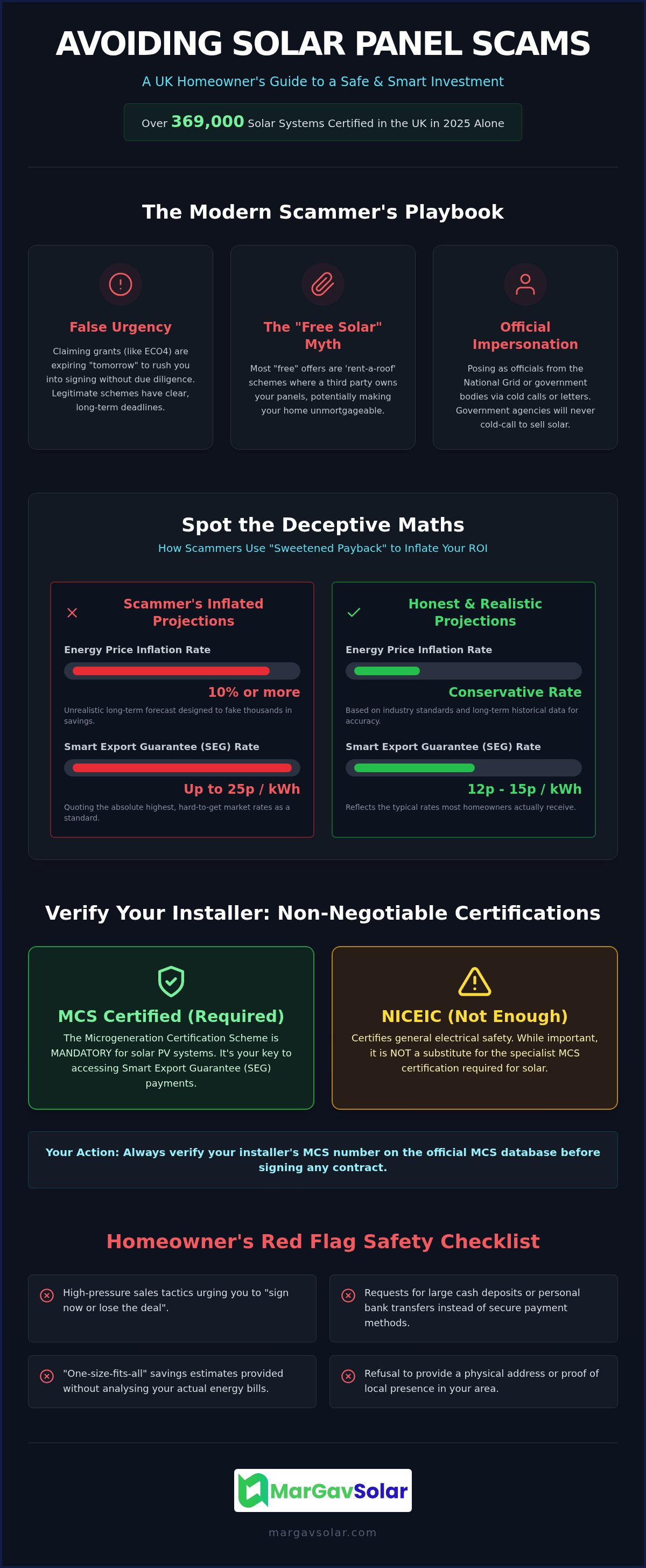
Modern scammers now use AI-generated social media ads to target specific regions like Staffordshire with surgical precision. These ads often feature deepfake news reports or generic free offers that look incredibly professional. They weaponise urgency by claiming government grants like ECO4 are expiring tomorrow, even though the scheme is confirmed to run until December 2026. This artificial pressure is a psychological trick designed to stop you from performing due diligence. If a salesperson tells you that you'll lose out if you don't sign within the hour, it's almost certainly a trap.
The "Free Solar" Myth Debunked
Legitimate companies don't give away thousands of pounds in equipment for nothing. Most "free" offers are actually "rent-a-roof" schemes in disguise. In these arrangements, a third party owns the panels on your roof and collects the export payments for decades. This can create massive headaches if you try to sell your house. Many mortgage lenders are wary of these long-term leases, potentially making your property unmortgageable. Truly avoiding solar panel scams UK means looking for transparent, fixed-price contracts. Genuine zero-upfront financing exists, but it should always involve a clear credit agreement from a regulated lender, not a vague promise of free power.
Impersonation of Government and Utility Officials
A common 2026 tactic involves letters or phone calls from individuals claiming to be from the National Grid or a local Energy Audit department. They might tell you your current system is unsafe or that you're required to upgrade your inverter to meet new standards. It's vital to remember that the UK government never cold-calls individuals to sell or mandate solar installations. If someone contacts you out of the blue, hang up and verify their identity through the official MCS or NICEIC registers. Never provide your address or bank details to a cold-caller, regardless of how official their audit sounds.
Identifying the "Sweetened Payback" and Maths Scams
One of the most effective tools in a scammer’s arsenal isn’t a fake product, but a manipulated spreadsheet. Avoiding solar panel scams UK requires a sharp eye for what industry experts call "Sweetened Payback" maths. This tactic involves twisting variables to make a system appear far more profitable than reality allows. By inflating specific figures and ignoring others, rogue installers manufacture a return on investment (ROI) that looks like a financial miracle but falls apart under scrutiny.
A professional quote should always be grounded in your actual energy usage. Legitimate installers will ask for your annual consumption in kWh directly from your utility bills. If a salesperson provides a "one-size-fits-all" savings estimate without looking at your data, they're guessing at best and lying at worst. They rely on the complexity of energy markets to hide their tracks, assuming most homeowners won't double-check the arithmetic.
Cranking Up Energy Inflation Numbers
Scammers often assume an annual energy price inflation rate of 10% or more in their projections. While energy costs have been volatile, basing a 20-year forecast on such extreme numbers is deceptive. A mere 2% difference in assumed inflation can fake thousands of pounds in projected savings over the system's lifespan. We believe in transparency. This is why we use realistic, conservative projections for your solar panel installation. The Microgeneration Certification Scheme (MCS) provides clear guidelines on how these calculations should be presented. Any installer deviating from these standards to "boost" the numbers is a major red flag.
Exaggerated Export Rates and Self-Consumption
Another common trick involves the Smart Export Guarantee (SEG). As of August 2026, typical SEG rates sit between 12p and 15p per kWh. Scammers might quote the absolute highest market rates, sometimes up to 25p, without mentioning the strict criteria required to access them. They also frequently assume you'll export 100% of your generated energy at these high rates, which is physically impossible. In reality, solar battery storage is what actually changes the maths by allowing you to use more of your own power instead of selling it back cheaply. If a quote ignores your specific roof orientation, local shading, or your actual consumption patterns, it isn't a professional estimate. It's a sales pitch. If you want a clear, honest look at your home's potential, request a transparent consultation from a local expert.
Verifying Professional Standards: MCS vs. NICEIC
A common mistake when avoiding solar panel scams UK is assuming that any local electrician has the expertise to handle a solar PV installation. While standard electrical work is essential, solar involves high-voltage Direct Current (DC) systems that require specific training and specialist equipment. Trusting an uncertified installer doesn't just put your investment at risk; it threatens the safety of your property. You wouldn't hire a plumber to fix your car, so don't hire a generalist for a complex renewable energy project.
The distinction between electrical safety and renewable performance is where many homeowners get caught out. A scammer might show you a logo on their van, but unless you verify their credentials on official registers, that logo is just a sticker. Real safety is found in the combination of electrical mastery and microgeneration certification.
Why NICEIC Certification is Non-Negotiable
Solar systems operate at high voltages that can exceed 600V DC. This is significantly more hazardous than standard 230V AC home wiring. Proper sign-off from a certified professional is both a legal and a safety requirement. If a fire or electrical fault occurs and your system wasn't installed by a qualified professional, your home insurance provider may reject your claim entirely. Following expert advice on how to spot solar panel scams includes looking for companies that hold legitimate electrical credentials. MarGav Solar brings over 20 years of electrical expertise to every project in Staffordshire. We ensure every system meets the highest safety standards, providing a NICEIC certification that keeps your home and your insurance policy valid.
The MCS Register Check
While NICEIC covers general electrical safety, the Microgeneration Certification Scheme (MCS) is the quality standard for renewable energy performance. If your installer isn't MCS certified, you cannot access the Smart Export Guarantee (SEG). This means you'll lose out on payments for the excess energy you send back to the grid every single month, significantly damaging your return on investment. Scammers often use "phoenix companies" to hide their tracks. These are businesses that go bust to avoid liabilities and then restart under a new name, sometimes using expired or stolen MCS numbers to look legitimate.
To protect yourself, follow these verification steps:
- Visit the official MCS website and enter the company name or certification number.
- Check that the "Certified" status is active and matches the installer's current business address.
- Cross-reference this with the NICEIC register to ensure they're authorised for domestic electrical work.
- Ask to see the individual installer’s updated 2026 NICEIC qualifications.
Don't just trust a business card. Taking five minutes to verify these registers is the single most effective step in avoiding solar panel scams UK. Real professionals welcome this scrutiny because it proves they have nothing to hide.
The Homeowner’s "Red Flag" Safety Checklist
Identifying a scam often comes down to the "vibe" of the sales process, but successful criminals are experts at appearing professional. Avoiding solar panel scams UK requires you to look past the polish and identify specific operational red flags. The most immediate warning sign is high-pressure sales tactics. If a representative offers a "limited time" 30% discount that expires the moment they leave your house, walk away. Legitimate businesses provide fixed-price contracts and give you the time to review the technical details without artificial deadlines.
Financial transparency is another critical indicator of legitimacy. Never agree to pay a large cash deposit or transfer money into a personal bank account. Professional installers use corporate accounts and provide detailed, branded invoices. You should also verify that the company has a physical office address. Many national "cowboys" use local phone numbers that divert to anonymous call centres. If they can't tell you exactly where their Staffordshire office is located, they likely won't be around when you need warranty support in five years.
Spotting Predatory Maintenance Scams
A growing trend in 2026 involves scammers targeting households that already have solar installed. These criminals often pose as "health check" experts, claiming your system is a fire risk or that your equipment is now obsolete. They use fear to sell unnecessary solar panel cleaning services or overpriced hardware. While inverter upgrades are sometimes necessary to improve efficiency or add battery compatibility, a legitimate professional will never cold-call you with a "mandatory" safety warning. Never allow an unsolicited "surveyor" onto your roof or into your loft without prior verification.
The "Surveyor" who is actually a Salesman
Scammers often use the title of "Technical Surveyor" to gain entry to your home, but their only qualification is in high-pressure sales. You can tell the difference by asking a few pointed questions. Ask if they are a qualified electrician or if they carry a commission-based sales target. A real technical site survey involves measuring roof dimensions, checking your consumer unit, and assessing shading with specialized tools. It isn't a three-hour pitch about "saving the planet." At MarGav Solar, we insist on technical consultancy before any contract is signed, ensuring the system we design actually fits your home's needs.
Protect your home by choosing a partner that prioritises engineering over aggressive sales. Request a fixed-price quote from a local Staffordshire specialist today.
Why a Local Staffordshire Partner is the Safest Bet
Choosing a local installer is the most effective strategy for avoiding solar panel scams UK. While national companies often dominate search results with massive marketing budgets, they frequently lack the long-term accountability that a local business provides. Many large-scale operations perform what industry insiders call the "Vanishing Act." They complete a high volume of installations using subcontractors, only to disappear or restructure when warranty claims start to roll in. When you choose a partner with a physical presence in Staffordshire, you aren't just a number in a database. You know exactly where our office is, and you know we'll be here to support your system for the next two decades.
Local expertise also extends to technical precision. National call centres rarely understand the regional nuances that affect your system's performance. Staffordshire has specific weather patterns and unique planning rules, especially within our various conservation areas and heritage sites. A local consultant understands these factors and designs a system that actually works for your specific postcode. MarGav Solar’s 20 years of expertise is built on local trust, not 20 minutes of high-pressure sales. We've spent two decades building a reputation in this community, which is a far more reliable guarantee than any glossy brochure from a national firm.
Fixed-Price Contracts vs. Hidden Fees
One of the most common scams involves providing a low initial estimate, only to hit the homeowner with "unforeseen" electrical costs on the day of installation. These hidden fees can add hundreds or even thousands to your final bill. Our approach is different. We provide fixed-price installation contracts that cover everything from the initial design and procurement to the final NICEIC-certified sign-off. By conducting a thorough technical consultancy upfront, we eliminate the surprises that scammers use to inflate their profits. You get a transparent, all-in fee for your residential solar PV system, battery storage, or EV charging points, ensuring your investment remains protected from the start.
Next Steps: Securing Your Energy Future Safely
Taking the first step toward energy independence shouldn't feel like a gamble. To ensure you're making an informed decision, we recommend booking a no-pressure consultancy with a local expert. This isn't a sales pitch; it's a technical evaluation of your home's potential. To get the most out of your first session, it's helpful to have your recent energy bills and a few photos of your roof and consumer unit ready. This allows us to provide a realistic projection of your ROI based on your actual consumption patterns. When you're ready to move forward without the fear of "cowboy" tactics, we're here to help.
Get a transparent, fixed-price solar quote from MarGav Solar and ensure your home is in safe, local hands.
Secure Your Energy Investment with Confidence
Successfully avoiding solar panel scams UK requires a combination of technical vigilance and local accountability. By looking past high-pressure sales pitches and artificial discounts, you can protect your home from the "vanishing act" typical of national cowboys. Remember to always verify MCS and NICEIC credentials on official registers and scrutinize any ROI projections that seem too good to be true. Real energy independence is built on transparent data and professional installation standards, not empty promises of "free" equipment.
As a Staffordshire-based partner with over 20 years of industry expertise, we believe in engineering excellence over aggressive marketing. Our NICEIC-certified team provides fixed-price contracts with no hidden fees, ensuring your transition to clean energy is safe and predictable. Don't let the fear of rogue installers hold back your home's potential. You deserve a system that delivers exactly what it promises for decades to come.
Book a Professional Solar Consultation with MarGav Solar
Take the first step toward a greener future with a partner you can trust right here in Staffordshire.
Frequently Asked Questions
Is there really such a thing as "free" solar panels in the UK?
No legitimate company provides 100% free solar panels without a significant catch. These are typically "rent-a-roof" schemes where a third party owns the system and collects the export payments for 20 to 25 years. This can complicate your mortgage or property sale. While some government grants like ECO4 exist for low-income households, they have strict eligibility criteria and aren't advertised through cold calls. Always look for transparent, fixed-price contracts to ensure you own your investment.
What should I do if a solar company cold-calls me about a government grant?
You should hang up immediately and never provide personal information or your address. The UK government and official grant bodies never cold-call individuals to sell solar installations or mandate energy audits. If you're interested in a legitimate scheme like the Warm Homes Local Grant, research it yourself on official government websites. Avoiding solar panel scams UK involves proactive research rather than responding to unsolicited phone calls or high-pressure doorstep sales pitches.
How can I tell if a solar panel installer is MCS certified?
You can verify an installer's status by searching the official Microgeneration Certification Scheme (MCS) online register. Simply enter the company’s name or their certification number to check if their status is "Active." Don't rely on logos displayed on vans or websites, as these can be easily faked. A legitimate installer will also be listed on the NICEIC register for electrical safety. Checking these databases is the most reliable way to confirm professional standards before signing.
Can I get scammed on solar panel maintenance or cleaning?
Yes, maintenance scams are increasingly common, often targeting homeowners with older systems. Scammers may claim your inverter is a fire risk or that "obsolete" panels need specialized cleaning to remain legal. In reality, modern solar panels are very low-maintenance. If a company you didn't hire contacts you for a "free health check," it's usually a tactic to sell overpriced, unnecessary upgrades. Always use a trusted local partner for any genuine maintenance or cleaning needs.
What are the most common lies told by solar panel "cowboys"?
The most common lies include claiming that government grants are ending tomorrow or that you’ll never pay an electricity bill again. Cowboys often exaggerate energy price inflation to 10% or higher to make their ROI look better. They might also claim they are "official auditors" sent to inspect your system for safety. These tactics are designed to create a false sense of urgency or fear, pushing you to sign a contract without doing your due diligence.
Why do some solar quotes have such different payback periods?
Payback periods vary because rogue installers often manipulate the underlying maths to "sweeten" the deal. They might assume you'll export 100% of your energy at the highest possible SEG rate or ignore the impact of shading on your roof. A professional quote uses your actual annual consumption from your bills and realistic inflation figures. Avoiding solar panel scams UK means questioning any quote that promises a payback period significantly shorter than the industry average of 8 to 12 years.
Is it a scam if a company asks for a deposit upfront?
Asking for a deposit isn't always a scam, but how they ask for it matters. Legitimate companies may require a deposit to secure equipment, but they will provide a branded invoice and use a corporate bank account. Red flags include requests for large cash payments, bank transfers to a personal account, or deposits exceeding 25% of the total cost. Always ensure your deposit is protected by an insurance-backed guarantee, which is a standard requirement for MCS-certified installers.
How do I report a solar scam in the UK?
You should report suspected fraud to Action Fraud, the UK’s national reporting centre for fraud and cybercrime. Additionally, contact the Citizens Advice consumer helpline, as they can refer your case to Trading Standards for investigation. If the company claimed to be MCS certified but isn't, you should also report them directly to the Microgeneration Certification Scheme. Reporting these incidents helps protect other homeowners in Staffordshire and across the UK from falling victim to similar cowboy tactics.


