

The biggest name on the television advert might actually be the riskiest choice for your roof. You likely want the perceived security of a household brand, yet the anxiety surrounding "cowboy" installers or the local vs national solar installers UK debate is a valid concern in 2026. It's stressful to spend your hard-earned money only to discover your national provider has subcontracted the job to a third party you've never met. You deserve a point of contact that actually answers the phone after the panels are fitted.
This article promises to show you how to ensure your solar investment remains secure, efficient, and backed by local expertise. We'll examine the 2026 MCS transition and its impact on your mandatory financial protection, the reality of subcontracting practices, and why local accountability often beats national scale for long-term ROI. We will also preview how specialists like MarGav Solar provide the expertise of a national firm with the personal touch of a Staffordshire-based team. By the end, you'll know exactly how to secure a high-yield system while the 0% VAT rate remains in your favour.
Key Takeaways
- Identify the core operational differences between local vs national solar installers UK to avoid the common pitfalls of high-pressure sales and third-party subcontracting.
- Learn why local specialists often provide superior long-term ROI through bespoke system design and deep knowledge of regional DNO grid requirements.
- Discover how to vet any installer using a 5-point checklist that prioritises NICEIC certification and at least a decade of industry expertise.
- Understand the value of the 'safe middle ground' by choosing an established regional firm that offers the accountability of a local with the technical skill of a national.
- Ensure your solar investment remains efficient for its entire lifespan by partnering with a provider that offers ongoing maintenance and cleaning services.
The UK Solar Landscape: Defining Local vs National Installers
Understanding the local vs national solar installers UK dynamic is the first step toward a successful installation. As we move through 2026, the 0% VAT rate on residential solar and battery storage continues to drive massive demand. This has created two distinct types of providers. A national installer is typically a high-volume, marketing-led company that operates across the entire country. They use famous faces or heavy digital advertising to win your click. In contrast, a local specialist is a regional expert, like those focused on Staffordshire, who relies on a physical presence and a long-standing community reputation.
This distinction is vital because the UK solar power landscape is increasingly complex. With the grid becoming more congested, your installation needs more than just a standard setup. National giants often sell a "one-stop-shop" image, but the reality is frequently different. Many of these big brands act as marketing fronts; they sell the contract and then hire local subcontractors to actually perform the work. This creates a disconnect between what the salesperson promised in the showroom and what the installer delivers on your roof. When things go wrong, you don't want to be stuck in a loop between a sales office in London and a subcontractor in Birmingham.
The Rise of the National Solar Giant
National firms dominate search results because they have massive marketing budgets. When you call, you'll likely speak to a salesperson in a call centre rather than a technical consultant. Their business model relies on standardised system designs that can be rolled out quickly. While this efficiency can sometimes lower initial hardware costs, it often ignores the unique shading or structural quirks of your specific home. They want volume, not bespoke engineering. This "sales-first" culture can lead to systems that are over-promised and under-delivered, especially regarding seasonal performance expectations.
Why 'Near Me' is Trending for Solar in 2026
Homeowners are increasingly searching for local experts because accountability matters. After several high-profile national company collapses, the security of a local office provides peace of mind. Local installers build their business on word-of-mouth. You can often drive past a physical install they completed three streets away or see their vans at the local builders' merchant. This transparency is a powerful shield against the "cowboy" anxiety many feel. Choosing between local vs national solar installers UK often comes down to whether you want a call centre queue or a specialist who knows your local Distribution Network Operator (DNO) requirements inside out.
National Installers: Scale, Speed, and the Subcontractor Risk
National installers are the heavyweights of the industry. Their primary appeal lies in sheer scale. Because they purchase components by the container load, they often secure lower initial hardware costs for a standard 4kW system. This procurement power allows them to offer competitive pricing that smaller firms might struggle to match on equipment alone. If you are in a hurry, these giants often have the logistics to book your installation within days. This speed is a major factor for homeowners navigating the local vs national solar installers UK choice.
However, this efficiency comes with a trade-off. National firms frequently operate a "Sales First" culture. The person sitting on your sofa is often a commission-based salesperson, not an engineer. They are trained to close the deal quickly, sometimes using high-pressure tactics or offering "today-only" discounts. While the Energy Saving Trust installation guide emphasises the importance of a technical survey, many large companies rely on remote desktop surveys that miss the structural nuances of your specific roof.
The Efficiency of Scale
Standardised components are the backbone of the national model. You'll likely be offered a limited range of "all-black" panels or specific inverters that the company stocks in bulk. While this simplifies the process, it can lead to a "cookie-cutter" aesthetic that doesn't always suit traditional UK architecture. These firms also excel at providing diverse financing options, including solar subscription models or long-term credit agreements. These financial products make solar accessible, but they often tie you into 10 or 15-year commitments that stay with the property.
The Quality Control Challenge
The most significant risk with national brands is the "Subcontractor Lottery." The brand on the van might not be the employer of the people on your roof. National companies often outsource the physical work to local gangs who are paid a flat rate per installation. This creates a dangerous disconnect between the designer and the installer. Subcontractors paid per job rather than per hour may rush through complex wiring, occasionally leading to skipped electrical certifications or missed safety checks. If you want to avoid this lottery, it's worth considering a specialist installer who keeps their entire team in-house.
Finally, consider the warranty. A 25-year guarantee is only as strong as the company providing it. The UK solar market has seen numerous national brands rebrand or close their doors, leaving customers with "zombie warranties" that are impossible to claim against. In 2026, the redeveloped MCS standards offer better protection, but a local company with 20 years of history often provides more tangible security than a national giant with a glossy brochure.
Local Specialists: Expertise, DNO Knowledge, and Long-Term Value
While national firms prioritise volume, local specialists focus on precision. Choosing between local vs national solar installers UK often means deciding between a generic kit and a system designed for your specific roof. Local experts take the time to create bespoke residential solar PV systems that account for chimney shading, varying roof pitches, and the exact orientation of your property. This attention to detail ensures your system actually meets the performance estimates provided during the quote.
One of the most overlooked advantages of a regional firm is their deep understanding of the local electrical infrastructure. In Staffordshire, for instance, installers must deal with National Grid Electricity Distribution. Navigating G98 and G99 applications requires a nuanced understanding of local grid capacity. A specialist who works with these officers daily can often secure export permissions that a national call centre might struggle to process. This expertise ensures your system is fully compliant with MCS certified installer standards from day one.
Quality assurance is also significantly higher with in-house teams. When the same engineers handle everything from the initial survey to the final commissioning, nothing gets lost in translation. This consistency eliminates the "Subcontractor Lottery" mentioned previously. Long after the scaffolding is down, having a team based just 10 miles away makes booking solar panel maintenance & cleaning simple. You aren't just a number in a database; you're a neighbour whose system performance matters to the installer's local reputation.
Mastering the Local Grid Requirements
Staffordshire has its own unique planning landscape. Local installers are well-versed in regional conservation area rules and specific building regulations that might trip up a national provider. They also understand the regional weather patterns and how Staffordshire's specific light levels affect battery discharge rates. When installing larger battery storage units, their existing relationship with the DNO is crucial for managing export limitations and ensuring you can actually sell your surplus energy back to the grid without delay.
Accountability Beyond the Handover
The relationship doesn't end when the panels are switched on. A local specialist provides a personalised handover, teaching you how to monitor your energy production through the GivEnergy cloud in person. They use fixed-price contracts to ensure the price you're quoted is the price you pay, avoiding the "hidden extras" that often plague national contracts. Ultimately, a local reputation acts as a de facto performance guarantee because a regional business cannot simply disappear behind a corporate rebrand if a customer is unhappy. This level of accountability is the cornerstone of the local vs national solar installers UK debate in 2026.
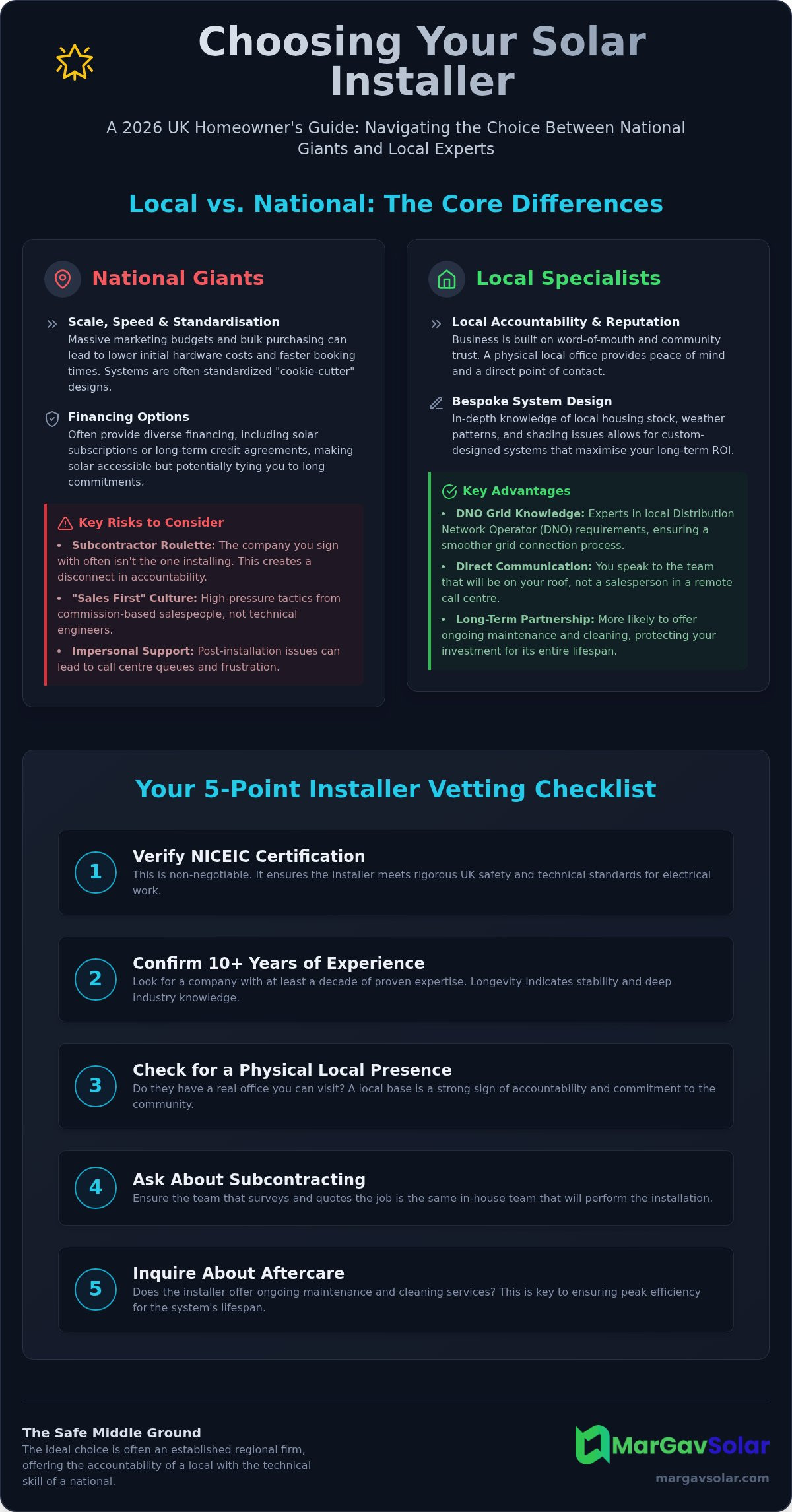
How to Choose: The 5-Point Solar Installer Checklist
Deciding between local vs national solar installers UK requires more than a simple price comparison. In 2026, with the market evolving rapidly, you need a structured way to filter out the marketing noise. Use this five-point checklist to ensure your chosen firm has the technical depth to back up their sales pitch.
- Step 1: Verify Accreditations. Every installer must be MCS certified for you to access the Smart Export Guarantee (SEG). However, the gold standard for electrical safety is NICEIC certification; this ensures the complex high-voltage wiring in your loft meets current UK building regulations.
- Step 2: Check Longevity. The solar industry is famous for companies that disappear overnight. Look for a firm with 10 to 20 years of industry experience. This history proves they can weather economic shifts and will likely be around to honour their warranties.
- Step 3: Review the Quote. Avoid any document labelled as an "estimate." Insist on a fixed-price contract that includes scaffolding, grid application fees, and all components. National firms often add "hidden extras" once the team arrives on-site.
- Step 4: Ask About Labour. Ask point-blank if the people on your roof are in-house employees or subcontractors. In-house teams have a personal stake in the company's local reputation, leading to higher installation standards.
- Step 5: Test the Support. Call the office with a technical question before you sign anything. If you are stuck in a call centre queue or can't speak to a qualified engineer, consider it a preview of their post-installation service.
Spotting the Red Flags
The most common trap in the local vs national solar installers UK market is the "limited time only" discount. These high-pressure tactics are designed to stop you from seeking a second opinion. You should also be wary of "Phoenix companies." These are businesses that go bust and immediately reopen under a slightly different name to dodge their previous warranty obligations. Always check Companies House to see how long the current directors have been active. Finally, never pay 100% of the cost upfront; a reputable installer will only require a deposit, with the balance paid once the system is commissioned.
Comparing Warranties and Maintenance
Don't confuse a product warranty with a workmanship warranty. A product warranty covers the hardware, like the panels or battery, while the workmanship warranty covers the actual installation. If a roof leak occurs because of a poor mounting bracket, you need a local team that can respond quickly. As your system ages, you may also need inverter upgrades to maintain efficiency. Regular cleaning and maintenance can improve your 25-year ROI by up to 15%, so choosing an installer with a dedicated local service department is a smart long-term move.
If you want a solar investment backed by two decades of local expertise and a fixed-price guarantee, contact the specialists at MarGav Solar today.
MarGav Solar: The Staffordshire Specialist with 20 Years of Trust
Choosing between local vs national solar installers UK doesn't have to be a compromise between scale and service. MarGav Solar occupies the "safe middle ground," providing the technical expertise you expect from a national giant with the personal accountability only a local specialist can offer. With over 20 years of industry experience, we've seen national brands come and go, while our Staffordshire-based team has remained a constant for homeowners across the county. We don't just fit panels; we build long-term relationships based on transparency and NICEIC-certified quality.
One of the biggest frustrations with national providers is the lack of price certainty. We address this directly by offering fixed-price installation contracts. This means the price you see on your quote is exactly what you pay, with no hidden fees for scaffolding or grid applications added later. Our two-decade history is your guarantee that we'll be here to support your system for its entire lifespan. Whether you need an inverter replacement in ten years or help understanding your export payments, you'll always have a local point of contact who knows your installation personally.
Our commitment to your home's energy future is end-to-end. We specialise in high-performance residential solar PV systems, but we also integrate advanced solar battery storage and EV charging points into a single, cohesive energy hub. By keeping every stage of the process in-house, we ensure that your battery and car charger work in perfect harmony with your solar panels, maximising your self-consumption and reducing your reliance on the grid.
Our Staffordshire Roots
We're proud to support Staffordshire homes and businesses with sustainable energy solutions. Our engineers have an intimate knowledge of the local power grid, which is essential for successful DNO applications with National Grid Electricity Distribution. Unlike national firms that rely on the "Subcontractor Lottery," our professional installation teams are entirely in-house. This allows us to maintain strict quality control and ensure every wire and bracket meets our high standards, a level of dedication also found at GES Greenera for residential and commercial fit-outs. We live and work in the same communities as our customers, so our local reputation is our most valuable asset.
Ready to Start Your Solar Journey?
A MarGav Solar consultation is a technical deep dive, not a high-pressure sales pitch. We'll assess your roof's orientation, shading, and structural integrity to design a system that delivers genuine ROI. Our support continues long after the final panel is fixed. We provide comprehensive solar panel maintenance and cleaning services to keep your system performing at peak efficiency for decades. If you're ready to secure your energy future with a team that combines national-level skill with local care, book your local Staffordshire solar consultation with MarGav Solar today.
Secure Your Energy Future with Confidence
Your choice in the local vs national solar installers UK debate ultimately determines the long-term health of your investment. While national giants offer speed, they often lack the regional grid knowledge and personal accountability required for a truly efficient system. By prioritising local experts who use in-house teams, you avoid the risks of the subcontractor lottery and ensure your system is backed by someone who actually answers the phone. Remember to verify NICEIC certification and look for firms that have successfully navigated the industry for over a decade.
MarGav Solar provides that essential peace of mind. With over 20 years of local expertise, we're NICEIC Certified and MCS Compliant, ensuring every installation meets the highest safety standards. We believe in transparency, which is why we offer a Fixed-Price Installation Guarantee to protect you from unexpected costs. It's time to take control of your energy bills with a partner you can trust. Get a Fixed-Price Solar Quote from MarGav Solar and start your journey toward sustainable, locally supported energy today.
Frequently Asked Questions
Are local solar installers cheaper than national companies?
Local installers aren't always cheaper upfront, but they often provide better long-term value. National companies use bulk buying power to lower hardware costs, yet they frequently pass on huge marketing and sales commission expenses to the customer. A local firm with lower overheads can offer a more competitive total price. Their fixed-price contracts also eliminate the hidden extras that often appear in estimated national quotes. For homeowners in other regions like Switzerland looking to compare professional installation rates, PV Pro offers a comparable platform for finding vetted experts.
What happens to my warranty if a local solar installer goes bust?
Hardware warranties are held with the manufacturers, while workmanship is protected by mandatory Insurance Backed Guarantees (IBGs). Under the 2026 MCS standards, all certified installers must provide a financial protection product covering remediation for at least six years. Whether you choose local vs national solar installers UK, these protections ensure you aren't left stranded if the original installation company ceases trading.
Do national solar installers use their own staff for the work?
Many national brands function primarily as sales and marketing hubs rather than installation companies. They often outsource the physical work to third-party subcontractors who are paid a flat rate per job. This "subcontractor lottery" is a key factor when weighing up local vs national solar installers UK. Local specialists typically use their own in-house engineers, ensuring the same team that surveyed your roof is responsible for the final commissioning.
How do I know if a solar installer is reputable in Staffordshire?
Look for a physical presence in the county and at least a decade of trading history. A reputable Staffordshire installer will hold NICEIC certification and be an MCS-certified member. You should ask to see local installs they've completed in towns like Stafford or Stoke-on-Trent. Checking their status on the MCS register ensures they comply with the redeveloped 2026 scheme requirements for consumer protection.
Can a local installer help with DNO applications and G99 forms?
Local specialists are often more adept at navigating grid applications because they deal with regional operators daily. They understand the specific capacity limits of the Staffordshire grid and can handle all G98 or G99 paperwork on your behalf. This technical support is vital for ensuring your system can legally export surplus energy and that you can access Smart Export Guarantee (SEG) payments without delays.
Is it better to have a national company for EV charging points?
Local specialists often provide a more cohesive service for EV charging points. They can integrate the charger with your solar PV and battery storage to prioritise charging your car with free surplus energy. National firms often treat EV chargers as standalone electrical jobs, which might miss the opportunity to optimise your home's total energy efficiency and ROI.
How long does a typical solar installation take with a local firm?
A standard residential solar installation typically takes one to two days on-site. While national companies might offer slightly faster booking dates due to their volume, local firms often spend more time on the initial technical survey. This careful planning prevents on-site errors and ensures the scaffolding and electrical work are coordinated perfectly. The result is a smoother, safer process that respects your property.
Why is NICEIC certification important for solar installers?
NICEIC certification is the industry's gold standard for electrical safety and competence. It ensures that the installer is qualified to handle the complex AC and DC wiring involved in modern solar and battery systems. While MCS focuses on the renewable technology, NICEIC guarantees that the underlying electrical work meets the UK's BS 7671 safety standards. It's a critical mark of professionalism for any reputable installer.


