

What if the most effective way to protect your 2026 profit margins wasn't through traditional cost-cutting, but through the untapped space on your warehouse roof? With commercial electricity rates currently 70% higher than pre-2020 levels, often reaching 27p/kWh, energy price volatility has moved from a simple line item to a genuine strategic threat. You aren't alone in feeling the pressure to meet Net Zero targets while facing board-level skepticism regarding immediate ROI. The secret to getting buy-in for commercial solar project approval lies in moving beyond "green" sentiment and presenting a hard-hitting financial hedge.
This guide provides a strategic framework to help UK business leaders secure stakeholder approval by aligning solar technology with tangible financial growth and risk mitigation. You'll learn how to leverage the £1 million Annual Investment Allowance before the March 2026 deadline and use the Smart Export Guarantee to turn surplus energy into a revenue stream. From navigating Building Regulations Part L to choosing a NICEIC-certified partner in Staffordshire, this article provides the data-backed roadmap you need to turn a proposal into a board-approved rollout.
Key Takeaways
- Discover how to leverage Full Expensing and Capital Allowances to create a high-impact financial case that prioritizes long-term ROI over initial capital outlay.
- Learn the specific strategies for getting buy-in for commercial solar project approval by addressing the unique priorities of CFOs, CEOs, and operational managers.
- Identify how to mitigate common board-level fears regarding roof integrity and operational downtime through professional structural surveys and fixed-price contracts.
- Understand the critical role of NICEIC certification in ensuring your solar installation remains compliant with corporate insurance policies and UK building regulations.
- Gain insights into the 2026 regulatory landscape, including how updated Building Regulations Part L makes on-site renewable energy a necessity for business continuity.
The 2026 Energy Landscape: Why 'Business as Usual' is a Risk
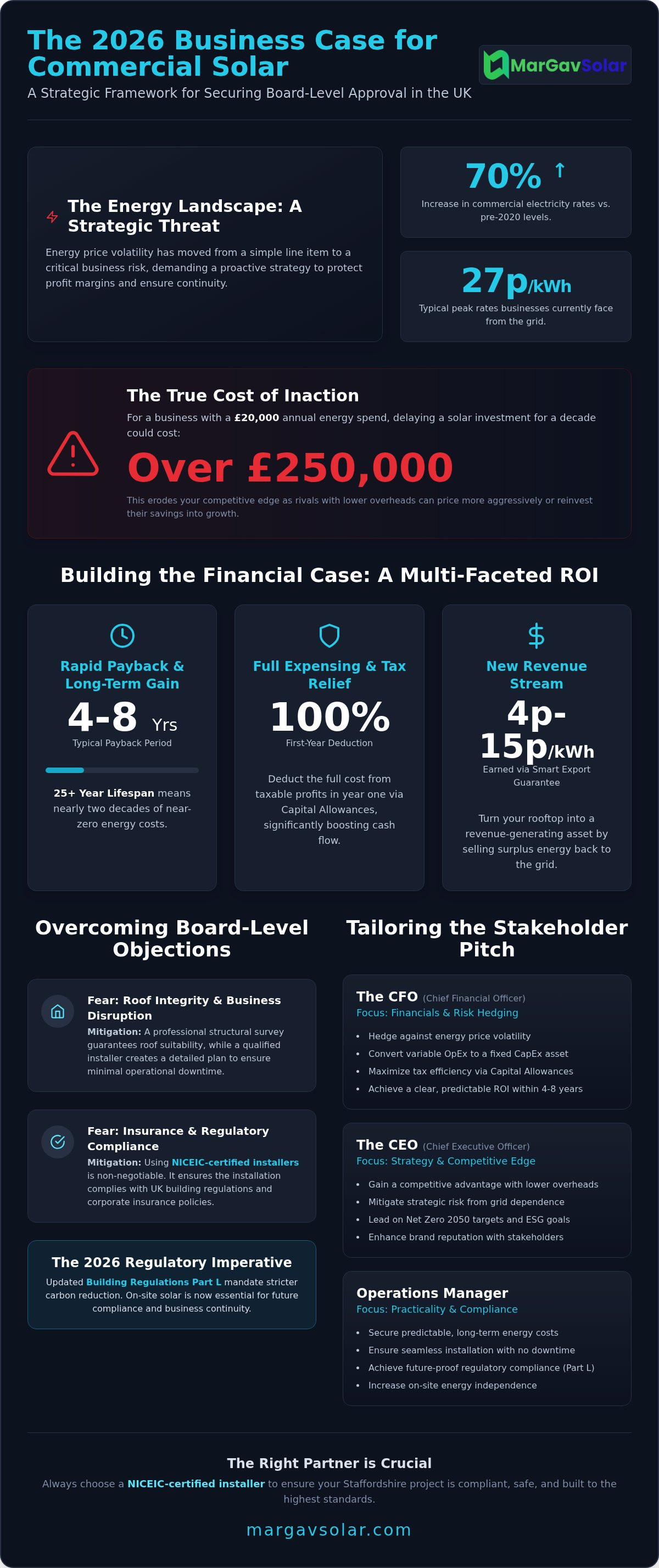
The corporate world has reached a tipping point where ignoring on-site generation is no longer the "safe" option. For years, many boards viewed solar as a sustainability badge or an optional extra. In 2026, that perspective has shifted toward business continuity. With commercial electricity rates for small businesses currently sitting between 24p and 27p/kWh, energy costs aren't just an expense; they're a volatile risk. Transitioning to commercial solar technology allows a firm to lock in energy costs for 25 years or more. This creates a fixed-cost hedge that protects your bottom line from the next global energy crisis. Energy independence in a commercial context means your production schedules and operational costs are dictated by your own roof, not by international gas markets.
The True Cost of Inaction
Aligning with UK Net Zero 2050 Targets
The 2026 update to Building Regulations Part L has set stricter carbon reduction targets for non-dwelling buildings, mandating low-carbon technology from the design phase. By adopting solar now, you simplify future regulatory compliance rather than scrambling to meet mandatory deadlines later. Solar is the most direct way to slash Scope 2 emissions, which are the indirect emissions from the generation of purchased electricity. Grid reliance is a strategic business vulnerability that leaves your operational budget at the mercy of external infrastructure and market fluctuations. Securing internal support and getting buy-in for commercial solar project rollouts ensures your business isn't just reacting to policy, but leading it.
Building the Financial Case: ROI, Tax, and Revenue
The strongest argument for getting buy-in for commercial solar project initiatives is a transparent financial model. Most UK businesses see a full payback on their investment within 4 to 8 years. When you consider that modern PV systems have a functional lifespan exceeding 25 years, you're essentially looking at nearly two decades of near-zero energy costs. By integrating battery storage, you can significantly increase your self-consumption ratio, ensuring that the power generated during peak daylight hours isn't wasted but used to offset expensive evening grid rates. This transition transforms a variable utility bill into a predictable, depreciating asset that adds clear value to the company balance sheet.
Beyond internal savings, your system can generate direct revenue through the Smart Export Guarantee (SEG). As of August 2026, businesses can receive between 4p and 15p/kWh for surplus electricity sent back to the grid. While self-consumption remains the most profitable route, the SEG provides a secondary safety net for weekends or periods of low operational activity. If you're concerned about site constraints or addressing land use concerns for larger arrays, rooftop installations offer the most efficient use of existing space without requiring additional property acquisition.
Tax Incentives and Capital Allowances in 2026
The UK tax regime remains highly favourable for renewable energy. Under current rules, the Annual Investment Allowance (AIA) allows businesses to deduct 100% of the cost of qualifying plant and machinery, including solar panels, from taxable profits in the first year. With the main corporation tax rate at 25%, this provides a significant immediate cash flow benefit. To ensure your project meets all technical requirements for these claims, it's vital to work with NICEIC-certified installers who understand the rigorous compliance standards required by HMRC and corporate insurers alike.
Operating Expenditure (OpEx) vs. Capital Expenditure (CapEx)
Choosing how to fund your project is a critical step in getting buy-in for commercial solar project approval. While using internal capital (CapEx) offers the highest long-term ROI, many firms prefer asset finance or Power Purchase Agreements (PPAs) to keep the project off the balance sheet. Regardless of the funding route, reducing your monthly OpEx through solar self-generation frees up vital cash flow for core business activities. Utilizing fixed-price installation contracts is essential here; it prevents budget creep and allows your finance team to forecast long-term savings with absolute precision. A detailed feasibility study can pinpoint exactly where these savings hit your balance sheet.
Overcoming Board-Level Objections: Risk Mitigation
Securing board approval often hinges on your ability to dismantle perceived risks. While the financial benefits are clear, directors frequently worry about roof integrity, operational downtime, and technology becoming obsolete. Professional structural surveys are the first line of defense; they ensure your building can safely support the 500W to 600W panels common in 2026. Modern monitoring software further mitigates risk by providing real-time data, which prevents hidden system failures from eroding your ROI. Following a structured framework like the EPA's project development pathway helps align these technical safeguards with corporate governance standards. This systematic approach is vital for getting buy-in for commercial solar project initiatives that require multi-departmental consensus.
Ensuring Business Continuity During Install
Disrupting daily operations is a deal-breaker for most logistics or manufacturing firms. We solve this through phased installation strategies that keep your facility running while the array is commissioned. In Staffordshire, adhering to strict Health and Safety standards is essential for maintaining site insurance and protecting staff. Beyond the install, regular solar maintenance is a non-negotiable component of any commercial proposal. Utilizing fixed-price installation contracts removes the fear of budget creep, ensuring that the project remains a predictable financial asset rather than a variable liability.
Future-Proofing with Battery Storage and EV Charging
A smart business case looks beyond today's energy bills. Positioning solar as the foundation for a commercial EV charging hub prepares your site for the inevitable transition to electric fleets. When paired with solar battery storage, your business can avoid expensive peak-time grid charges by drawing from stored reserves. Modular hardware allows for seamless future expansion, enabling your business to scale its energy production as operational demands grow. This flexibility is a powerful tool for getting buy-in for commercial solar project approval, as it demonstrates a long-term vision that adapts to market changes.
The Stakeholder Pitch: Tailoring Your Message
The most significant hurdle in getting buy-in for commercial solar project approval isn't the technology; it's the internal communication. Each member of your board views the project through a different lens. To secure a "yes", you must speak their specific financial and operational language. A CFO doesn't need to know how a silicon cell works, but they do need to see the Internal Rate of Return (IRR) and Net Present Value (NPV). Presenting the project as a tax-efficient investment that utilizes the 25% corporation tax offset via the Annual Investment Allowance turns a "green project" into a savvy fiscal move.
The CEO and Operations Manager require different reassurances. For the CEO, focus on ESG leadership and the competitive edge gained by lowering fixed overheads. With the 2026 Building Regulations Part L mandating stricter carbon targets, solar is a tool for future-proofing the brand's reputation. Meanwhile, the Operations Manager needs to know that the system is reliable and requires minimal intervention. Highlighting that MarGav Solar uses NICEIC-certified professional installations provides the necessary peace of mind regarding insurance compliance and site safety. Creating a concise "one-pager" executive summary that addresses these three distinct perspectives is the most effective way to streamline the decision-making process.
Translating Kilowatts into Business Value
Stop talking about "panels" and start talking about "yield" and "savings." Technical jargon often creates a barrier to understanding. Instead, use visual data to show projected versus actual energy cost curves. When you frame the conversation around how much capital is being "leaked" to the grid every month, the project becomes a priority. Leveraging the 20 years of industry expertise provided by MarGav Solar acts as a powerful risk-reducer, demonstrating that the project is backed by two decades of proven regional success.
Handling the 'Not Now' Rebuff
The most common objection is "let's wait until next year." You must counter this by framing the "Cost of Delay." With commercial electricity rates for small businesses currently at 24-27p/kWh, every month of inaction is a direct hit to your profit and loss statement. Waiting 12 months could mean thousands of pounds in lost savings that can never be recovered. If the board is still hesitant, offer a low-risk first step. You can request a commercial feasibility study to provide the site-specific data needed to move the conversation from theory to a concrete business case.
Selecting the Right Partner for Your Staffordshire Project
Choosing an installation partner is the final, most critical step in getting buy-in for commercial solar project approval. While national firms might offer high-volume promises, a local Staffordshire partner provides the regional insight and rapid response times necessary for long-term operational success. Local expertise means your installer understands the specific grid constraints and planning nuances of the West Midlands. Beyond proximity, you must prioritise technical accreditation. NICEIC certification isn't just a badge of quality; it's often a mandatory requirement for your corporate insurance validity and electrical compliance. An end-to-end consultancy will handle everything from the initial G99 grid application to the final commissioning, ensuring no technical detail stalls your board's decision.
The MarGav Solar Advantage
With over 20 years of industry expertise, MarGav Solar has built a reputation for delivering high-efficiency PV systems that stand the test of time. We don't just install panels; we design comprehensive energy ecosystems. This includes integrating battery storage to maximise self-consumption and performing technical inverter upgrades to breathe new life into older systems. Our focus on fixed-price installation contracts is specifically designed to prevent the budget creep that often kills commercial projects during the approval phase. You get a clear, transparent cost from day one, which makes the financial forecasting for your board pitch considerably more robust.
Your Buy-In Checklist
Before you head into the boardroom, ensure your proposal includes the following "must-have" documents to streamline getting buy-in for commercial solar project initiatives:
- Structural Survey: A professional report confirming your roof can handle the 2026 standard of 500W+ panels.
- Financial Forecast: A 10-year projection including AIA tax relief, SEG revenue, and avoided grid costs.
- Compliance Pack: Proof of NICEIC certification and health and safety protocols for your specific site.
- Maintenance Plan: A clear schedule for cleaning and monitoring to protect the system's IRR.
The transition to on-site generation is a significant milestone for any business. It requires a partner who treats your energy security as their primary objective. Ready to move from a proposal to a live project? Book a Commercial Solar Consultation with MarGav Solar today to secure a site-specific feasibility study for your Staffordshire facility.
Securing Your Company’s Energy Future in 2026
The transition to on-site generation has evolved from a sustainability goal into a fundamental requirement for business continuity. By presenting solar as a strategic financial hedge against volatile grid rates, you transform a technical proposal into a compelling fiscal asset. You've seen how tax incentives like the Annual Investment Allowance accelerate ROI and how addressing board-level fears with structural data removes the final barriers to approval. The secret to getting buy-in for commercial solar project success is demonstrating that the cost of delay far outweighs the initial investment.
Partnering with a local expert ensures your system remains a high-performing asset for decades. With over 20 years of industry experience and a team of NICEIC-certified professional installers, MarGav Solar provides the Staffordshire-based support and maintenance your business needs to stay compliant. Don't let energy volatility dictate your 2026 margins. Take the first step toward energy independence today and Request a Bespoke Commercial Solar Feasibility Study for Your Business. Your board is waiting for a plan that protects the bottom line; it's time to deliver it.
Frequently Asked Questions
How long is the typical payback period for a commercial solar project in 2026?
Most UK businesses see a full return on investment within 4 to 8 years. High commercial electricity rates, currently around 24p to 27p/kWh, have significantly accelerated this timeline compared to previous years. Since modern systems last 25 years or more, you'll enjoy nearly two decades of near-zero energy costs after the initial payback. This clear financial timeline is a vital component when getting buy-in for commercial solar project approval from your finance department.
Can we install solar panels if we don't own our business premises?
What are the tax benefits for UK businesses investing in solar energy?
UK businesses can deduct 100% of the installation cost from taxable profits in the first year through the Annual Investment Allowance (AIA), up to a £1 million limit. With the main corporation tax rate at 25%, this provides an immediate cash flow benefit that effectively reduces the net cost of the system. These incentives are currently in place through March 2026, making it a highly tax-efficient time for capital investment in renewables.
How much maintenance do commercial solar panels actually require?
Commercial solar panels are relatively low-maintenance but require professional cleaning and system health checks at least once a year. Dust, bird droppings, and industrial debris can reduce energy output by over 10% if left unmanaged. You should also budget for an inverter upgrade after approximately 10 to 15 years. Regular maintenance contracts ensure the system continues to perform at the high efficiency levels required to meet your projected ROI.
Will installing solar panels disrupt our daily business operations?
Installation typically causes very little disruption to your daily workflow. Most of the work is concentrated on the roof, and any necessary electrical shutdowns for grid connection are scheduled during off-peak hours or weekends. A professional installer will coordinate a phased delivery to ensure your facility remains operational throughout the process. Discussing these logistics early helps alleviate board-level concerns regarding potential downtime or lost productivity.
What happens to the excess energy our business doesn't use?
Surplus energy can be sold back to the National Grid through the Smart Export Guarantee (SEG). As of August 2026, businesses can receive between 4p and 15p/kWh for exported power. While this provides a secondary revenue stream, it's usually more profitable to store that energy in an on-site battery. Using your own stored power during peak evening hours offers a much higher saving than the export tariff provides.
Is my business roof suitable for a large-scale solar installation?
Most commercial roofs are suitable, but a professional structural survey is essential to confirm the building can support the weight of modern 500W+ panels. We evaluate roof orientation, potential shading from nearby structures, and the current condition of the roof covering. In England, most rooftop installations are considered Permitted Development, meaning you won't usually need a full planning application unless the building is listed or in a conservation area.
How does battery storage improve the business case for solar?
Battery storage strengthens the business case by allowing you to use your solar energy during expensive peak-time hours rather than just when the sun is shining. It increases your self-consumption ratio and provides a hedge against price spikes from the grid. For businesses with high evening energy demands or those looking to avoid "red zone" DUoS charges, adding storage can significantly shorten the overall project payback period.


