

Why are you still paying 26.11p per kWh for grid electricity when your Staffordshire roof could be generating that power for free? It's understandable if you feel hesitant. Between the noise of competing battery brands and the valid fear of cowboy installers, many homeowners worry about whether the residential solar panel ROI UK residents expect is actually achievable in our climate. You want lower bills and a smaller carbon footprint, but you don't want to get caught out by shifting regulations or poor advice.
We've designed this 2026 guide to cut through the confusion and show you exactly how to transform your home into a self-sustaining power plant. By combining high-efficiency panels with GivEnergy battery storage and smart EV charging, you can protect your household from volatile energy price hikes. We will explore the critical 0% VAT deadline ending in March 2027, the latest Smart Export Guarantee rates, and how local Staffordshire expertise ensures your system delivers maximum financial returns for decades to come.
Key Takeaways
- Learn why modern energy independence in 2026 relies on prioritising self-consumption through integrated battery storage rather than just exporting to the grid.
- Understand the financial impact of the upcoming 0% VAT deadline and how smart technology significantly improves the residential solar panel ROI UK homeowners can expect.
- Discover why Staffordshire's climate and varied roof orientations are still highly effective for generating significant power and reducing energy bills.
- Explore how combining solar PV with home EV charging points and smart tech creates a future-proof energy ecosystem for your property.
- Gain insights into why professional maintenance and local Staffordshire expertise are essential for protecting your investment and ensuring long-term system performance.
What is Solar Power for Your Home in 2026?
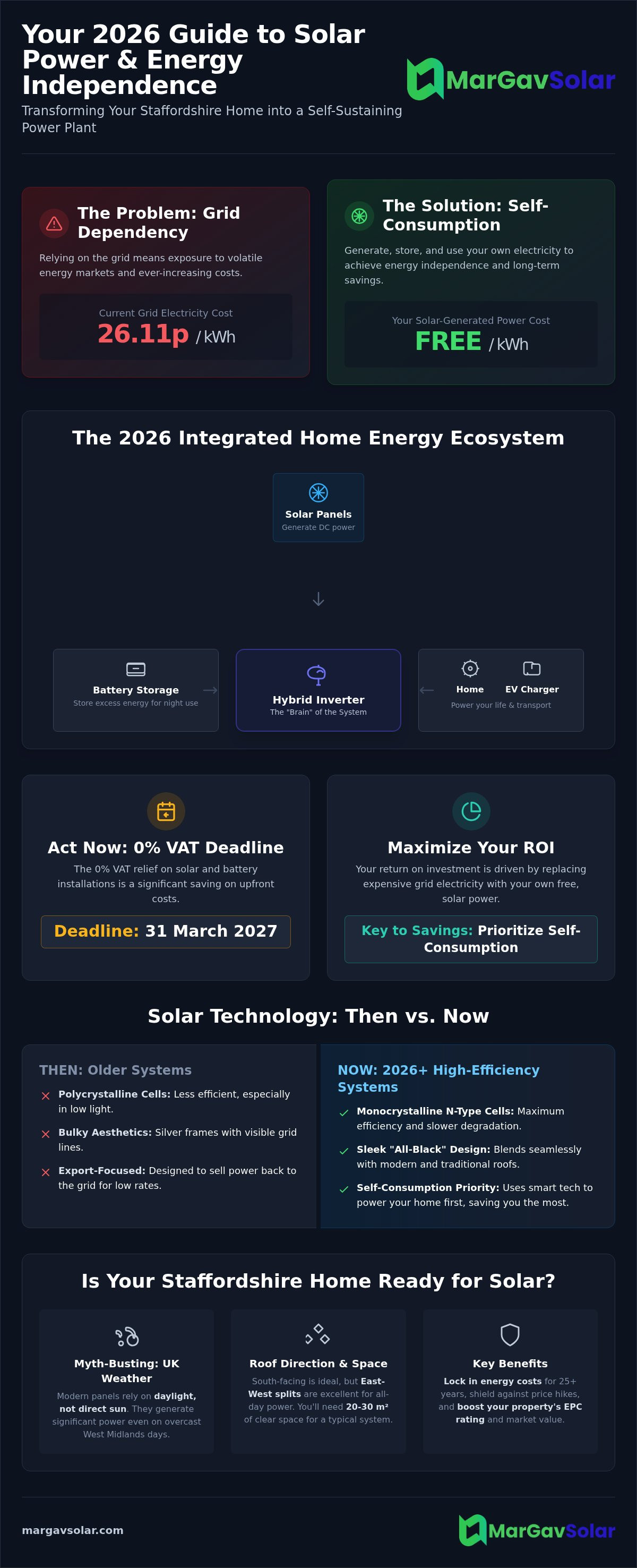
Solar power has evolved from a niche environmental choice into a strategic financial tool. In 2026, residential solar PV systems are the cornerstone of home energy independence. The UK solar power landscape has shifted dramatically. While early adopters focused on selling electricity back to the National Grid, today's homeowners prioritise maximising self-consumption. By using high-efficiency panels coupled with a hybrid inverter and battery storage, you can use the energy you generate during the day to power your home at night. It remains the leading renewable choice because it is scalable, requires minimal space compared to wind, and offers the most predictable returns for a standard household.
A modern system consists of more than just glass on the roof. A typical setup includes:
- High-efficiency panels: These capture maximum sunlight even on overcast days.
- Hybrid inverters: This is the "brain" of the system that manages power flow between your home, your battery, and the grid.
- Mounting kits: These ensure a secure, weather-proof fit for UK rooftops.
This integrated approach is the most effective way to improve your residential solar panel ROI UK metrics. Every unit of self-generated electricity you use replaces a unit bought at the current Ofgem price cap rate of 26.11p per kWh.
The Evolution of Solar Efficiency
The technology under the glass has changed. We've seen a decisive industry move from older polycrystalline cells to monocrystalline N-type cells. These N-type cells are more efficient and degrade slower over time. For Staffordshire residents, this means panels perform significantly better in low-light conditions or during shorter winter days. Sleek "All-Black" designs have also replaced the bulky silver-framed panels of the past. These allow solar arrays to blend seamlessly into modern and traditional rooflines alike without compromising on aesthetics; for a similar focus on modern aesthetics and glass innovation within your home, you can check out Fågg AS for privacy solutions that transform glass at the click of a button.
Why UK Homeowners are Switching Now
The motivation for installing solar hasn't ever been clearer. With the 0% VAT relief on solar and battery installations scheduled to end on 31 March 2027, there's a finite window to save on upfront costs. Beyond the immediate tax saving, solar allows you to lock in your energy costs for 25 years or more. It's a powerful shield against volatile global energy markets. As the UK moves toward Net Zero, a high-performing solar system also boosts your property's EPC rating. This is increasingly vital for maintaining property value in the 2026 housing market.
Suitability: Is Your Staffordshire Home Ready for Solar?
Many homeowners in Stafford, Stoke-on-Trent, and the surrounding villages worry that our local weather isn't "sunny enough" for solar. This is a common myth. Modern solar technology relies on daylight, not just direct heat. Even on a standard overcast afternoon in the West Midlands, high-efficiency panels continue to generate power. When you are looking at the residential solar panel ROI UK homeowners can expect, the total annual daylight hours are the metric that truly matters. Your roof doesn't need to be in the South of France to be a highly effective power plant.
Before installation, the structural integrity of your roof is the first priority. Staffordshire's diverse architecture, from Victorian terraces with traditional clay tiles to modern detached homes, requires a tailored approach. We assess whether your rafters can support the additional weight and ensure the tiles are in good condition. A quick professional assessment can confirm if your roof is structurally sound before you commit to a full installation plan.
Roof Direction and Shading Factors
While a South-facing roof is often called the "gold standard," it isn't the only profitable option. East-West splits are becoming increasingly popular for families who are at home during the morning and evening. An East-facing array captures the early sun, while West-facing panels power your home through the evening peak. If your roof has shading from a chimney or nearby trees, we use power optimisers. These clever devices ensure that if one panel is in the shade, the rest of the system continues to perform at maximum capacity. For a typical 4kW to 6kW system, you will generally need between 20 and 30 square metres of clear roof space.
Planning Permission in Staffordshire
Most residential solar projects fall under "Permitted Development" rights, meaning you won't need formal planning permission. However, Staffordshire has several conservation areas and beautiful listed buildings in places like Lichfield or Cannock Chase where stricter rules apply. In these cases, you might need to choose low-profile panels or seek specific council approval. Regardless of where you live, your system must meet building regulations. This is why NICEIC certification is vital. It proves your installation is safe and compliant, which is also a requirement if you want to sign up for the Official Smart Export Guarantee (SEG) scheme to get paid for your excess energy.
The Integrated Ecosystem: Batteries, EV Charging, and Smart Tech
In 2026, solar energy has moved far beyond just putting glass on your roof. It's now a sophisticated energy ecosystem where every component works in harmony. While panels are the engine, the real financial gains happen when you integrate battery storage and EV charging. Over 90% of new residential installations now include a battery. This shift is intentional. Homeowners have realised that sending power back to the grid for a few pence is less efficient than keeping it to offset the 26.11p per kWh grid price. A unified system ensures you aren't just a passive producer; you're an active energy manager. This holistic approach is the most effective way to secure the residential solar panel ROI UK families need to combat rising living costs.
Instead of buying piecemeal components that might not communicate, a smart energy management system acts as the brain of your home. It automatically decides when to power your appliances, when to fill the battery, and when to charge your car. This level of sophisticated connectivity is part of a broader trend in private infrastructure; to see how similar tech drives efficiency in other sectors, you can discover Virtuser and their specialist IoT and private network solutions. It removes the guesswork, ensuring that not a single watt of generated power goes to waste.
Maximising ROI with Battery Storage
A battery storage system acts as your home's personal reservoir. It captures the surplus electricity your panels produce during the day so you can use it during expensive evening peaks. Through GivEnergy Cloud monitoring, you can track these energy flows in real-time from your phone. This technology enables "Peak Shaving," a strategy where your system discharges the battery specifically when grid prices are highest. While the Energy Saving Trust guide to the SEG provides excellent context on selling power back, the biggest savings always come from avoiding grid purchases altogether.
Solar-Powered EV Charging
If you've made the switch to an electric vehicle, your solar array becomes your private petrol station. The financial benefit of "driving on sunshine" is immense compared to the high costs of public rapid chargers. Modern smart chargers are designed to prioritise solar excess. They can be programmed to wait until your battery is full before directing any remaining surplus into your car's battery. This synergy ensures your transport is as green as your home. For a detailed look at local installation requirements, see our 2026 Staffordshire EV charging guide. Integrating these technologies doesn't just lower your bills; it creates a future-proof property that is shielded from the unpredictability of the national energy market.
Calculating Residential Solar Panel ROI UK: Costs and Savings
Understanding the true residential solar panel ROI UK homeowners can expect involves looking beyond the initial installation. It's a balance between immediate tax savings and the ongoing efficiency of your system. While the 26.11p per kWh you save by using your own power is the main driver, the Smart Export Guarantee (SEG) adds another layer of income. Major energy suppliers must pay you for the surplus electricity you export. In 2026, some of the best SEG rates hover around 20p per kWh, though you'll often get the best deals by staying with your import provider. However, the most significant financial gains come from solar battery storage. By storing your own energy, you avoid the need to buy power from the grid during expensive peak times.
Financial Incentives and Payback Periods
A major factor in your ROI calculation is the 0% VAT status on solar and battery installations. This government relief is confirmed to end on 31 March 2027, after which the rate will revert to 5%. Taking advantage of this now significantly reduces the upfront cost of your system. Most integrated setups in 2026 now have an estimated payback period of 6 to 9 years, depending on your household's energy usage patterns. With energy prices remaining high, the ROI on a residential solar system is currently one of the most stable financial investments available for UK property owners.
Professional Maintenance and Bird Proofing
Believing solar is a "set and forget" technology is a myth that can cost you hundreds of pounds in lost yield. Pigeons are the number one threat to solar efficiency in Staffordshire. They love the warmth under the panels, but their nesting habits lead to debris build-up and even damage to your roof's structural integrity. Professional bird proofing is a small investment that protects your long-term returns. Likewise, professional cleaning is essential. Over time, a layer of grime can reduce your panels' output by up to 20%.
Professional maintenance typically includes several key checks:
- Inverter health: Checking for error codes and ensuring the "brain" of the system is efficient.
- Panel cleaning: Removing biofilm and traffic film that rain alone cannot wash away.
- Bird proofing inspection: Ensuring mesh or spikes are intact to keep pests out.
Following a Staffordshire solar maintenance guide ensures your system stays in top condition. If you want to protect your investment, you can schedule a professional maintenance check to ensure your panels are performing at their absolute peak.
Choosing the Right Partner for Your Solar Journey
Selecting an installer isn't just about the lowest quote. It's about finding a partner who will be there for the next 25 years. In a market where new companies appear and vanish overnight, MarGav Solar's 20 years of experience in Staffordshire provides a level of security that national providers can't match. This local accountability is vital for protecting your residential solar panel ROI UK investment. If a problem arises five years from now, you need to know your installer is just a short drive away in Stoke or Stafford, ready to honour their workmanship and keep your system running.
Quality installations require more than just technical skill; they require specific certifications. Always verify that your partner is NICEIC-certified. This isn't just a badge of safety. It's often a prerequisite for accessing the best export tariffs and ensuring your building insurance remains valid. We also recommend looking for installers who offer fixed-price contracts. This protects you from the hidden extras that often plague complex energy projects, ensuring the price you're quoted is the price you actually pay.
The MarGav Solar Difference
We don't sell DIY components because we believe in the safety and longevity of professional-only installations. Our process is end-to-end. We handle everything from the initial roof survey to your 10-year maintenance checks. By focusing on high-efficiency residential PV and GivEnergy battery systems, we ensure every part of your energy ecosystem is designed to work together. This bespoke approach is what allows us to deliver the performance levels we promise during your initial consultation.
Questions to Ask Your Solar Installer
Before signing any contract, ask your installer for a bespoke performance estimate. A generic calculation won't account for the specific pitch of your roof or the shading from your neighbour's trees. You should also clarify the difference between your inverter warranty and your panel warranty. Panels often carry 25-year performance guarantees, but inverters might need an upgrade or replacement sooner. Finally, confirm how they handle bird proofing. As we discussed, pigeons are a major risk to efficiency in Staffordshire, so this should be part of the initial plan rather than a costly afterthought.
Your journey toward energy independence starts with an accurate assessment of your property's potential. Booking a Staffordshire home energy assessment is the most reliable way to move from confusion to confidence. We'll help you map out a system that fits your budget, your roof, and your long-term financial goals.
Secure Your Energy Independence in Staffordshire
The shift toward integrated solar systems represents the most significant change in home energy management for decades. By combining high-efficiency panels with battery storage and smart EV charging, you aren't just saving money; you're building a personal power plant. Remember that the 0% VAT relief ends in March 2027, making this the ideal window to maximise your residential solar panel ROI UK potential. Whether you're in Stoke, Stafford, or Lichfield, the combination of local expertise and modern technology ensures your home remains resilient against future price hikes.
Don't leave your energy future to chance or confusing grid tariffs. With over 20 years of Staffordshire expertise and NICEIC-certified installers, we provide the technical precision and fixed-price installation guarantee you need for total peace of mind. Take the first step toward lower bills and a smaller carbon footprint today. Book Your Free Staffordshire Solar Assessment with MarGav Solar and discover how much your roof could be working for you. It's time to take control of your energy costs for good.
Frequently Asked Questions
Are solar panels worth it in the UK with our weather?
Yes, solar panels are highly effective in the UK because they generate electricity from daylight rather than direct heat. Modern monocrystalline N-type cells are specifically designed to capture energy even on overcast Staffordshire days. By replacing grid electricity capped at 26.11p per kWh with your own free generation, you can achieve significant savings regardless of the occasional grey sky.
How much do solar panels cost for a 3-bedroom house in 2026?
A typical 4kW solar system for a 3-bedroom home in the UK costs approximately £7,000 as of August 2026. This market average generally covers the panels and professional installation but does not include optional extras like battery storage or EV chargers. Homeowners should take advantage of the 0% VAT relief on these systems, which remains in place until 31 March 2027.
Do I need a battery with my solar panels?
While a battery isn't strictly mandatory, it's recommended for most new installations to maximise your residential solar panel ROI UK potential. Without storage, any energy you don't use during the day is sent back to the grid for a lower rate. A battery allows you to store that surplus for the evening, ensuring you don't have to buy expensive power from the grid when the sun goes down.
What is the Smart Export Guarantee (SEG) and how do I join?
The Smart Export Guarantee (SEG) is a government-backed initiative that requires energy suppliers to pay you for the surplus electricity you export to the grid. To join, you need a smart meter and an MCS-certified installation. In 2026, some suppliers offer rates as high as 20p per kWh, though you should compare different providers to find the best deal for your specific export volume.
How long do solar panels actually last?
Most high-quality solar panels are built to last between 25 and 30 years. Manufacturers typically provide a performance guarantee ensuring the panels still produce at least 80% of their original output after two and a half decades. It's important to plan for an inverter replacement around the 10 to 12-year mark, as this component manages the power flow and experiences more wear than the panels themselves.
Do solar panels need planning permission in Staffordshire?
Most residential solar projects in Staffordshire are classed as "Permitted Development" and don't require formal planning permission. However, if your home is a listed building or located within a conservation area in places like Lichfield or Stafford, you may need to seek council approval. It's always best to verify your property's status with local planning authorities before beginning any structural work on your roof.
Can I charge my electric car with solar panels?
You can definitely charge your electric vehicle using solar power by integrating a smart EV charging point into your system. This is a powerful way to boost your residential solar panel ROI UK because it allows you to "drive on sunshine" instead of paying for public charging or grid power. Smart chargers can be programmed to use only the surplus energy your panels produce, making your transport virtually free.
What maintenance do solar panels require?
Solar panels require minimal but regular maintenance to ensure they operate at peak efficiency. You should arrange for professional cleaning every year or two to remove traffic film and bird droppings, which can reduce your energy yield by up to 20%. Additionally, installing bird proofing is a smart move in rural Staffordshire to prevent pigeons from nesting under the panels and causing debris build-up or wiring issues.


