

What if you could freeze your energy bills while the rest of the West Midlands watches the 2026 price caps climb? With local electricity rates currently at 26.99p per kWh, calculating the solar panel payback period Staffordshire homeowners can expect is the most important step toward financial independence. It's understandable to feel cautious about changing regulations or the risk of unreliable installers, especially when trying to make sense of Smart Export Guarantee (SEG) rates that vary from 5p to 20p per kWh.
We know you want a transparent, fixed-price solution that actually delivers on its promises. This guide will show you exactly how long it takes for a system to pay for itself in our local climate, factoring in the current 0% VAT incentive and the latest battery storage trends. You'll get a clear breakdown of the 2026 ROI factors, from West Midlands weather data to intelligent export tariffs. We'll also explain how 20+ years of local expertise can help you bypass the grid and secure your home's energy future.
Key Takeaways
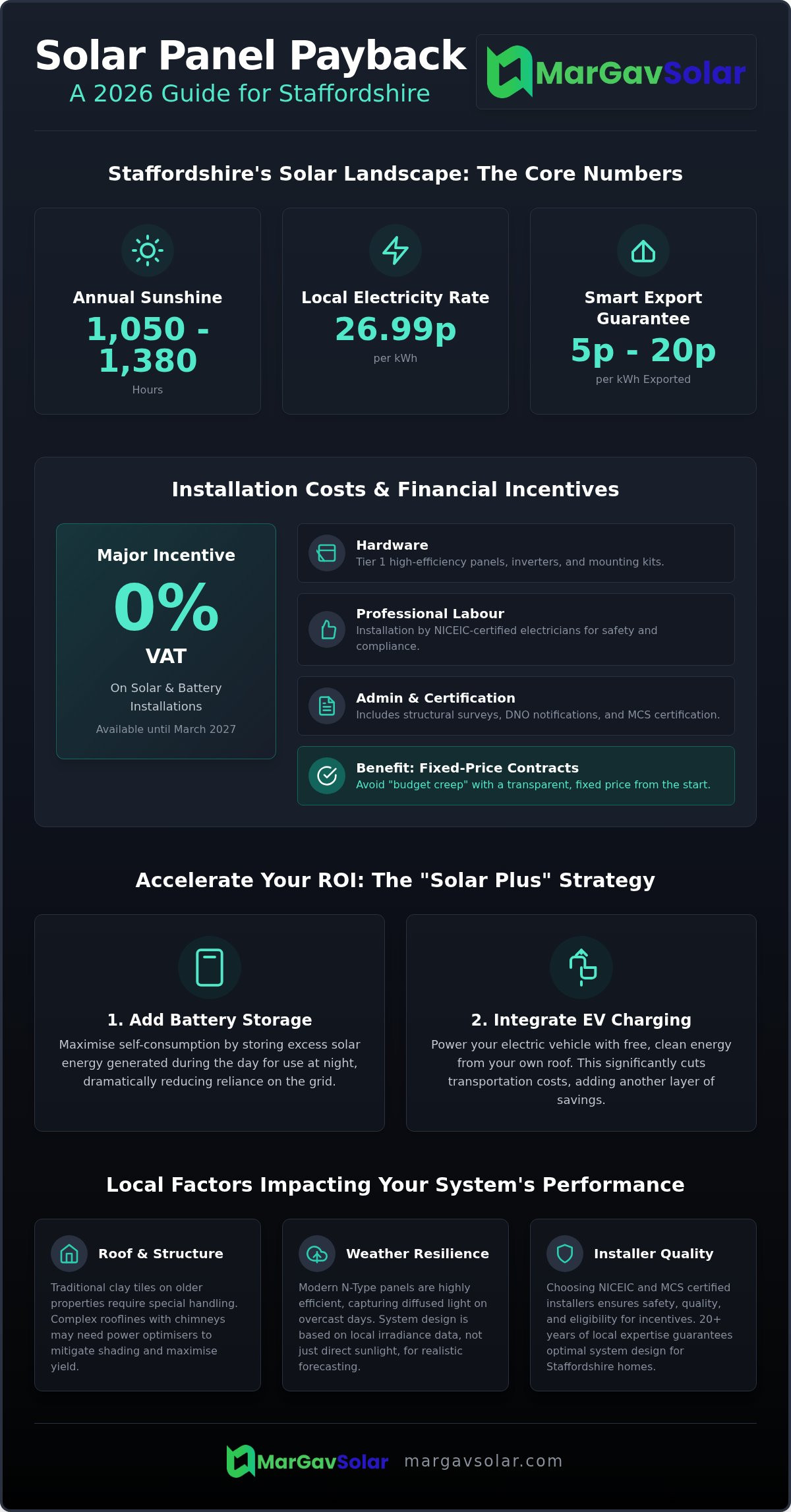
- Understand how Staffordshire's 1,050 to 1,380 annual sunshine hours directly influence your system's energy yield and financial return.
- Learn how the solar panel payback period Staffordshire residents face is reduced through strategic use of the 0% VAT incentive available until March 2027.
- Discover why pairing your solar PV system with battery storage and EV charging points is the most effective way to maximise self-consumption in 2026.
- Identify the critical role of NICEIC-certified installers and fixed-price contracts in avoiding unexpected costs and ensuring long-term system safety.
- Gain clarity on how current Smart Export Guarantee (SEG) rates in the West Midlands can turn your surplus energy into a consistent monthly income.
What Influences Solar Panel Payback in Staffordshire for 2026?
Calculating the solar panel payback period Staffordshire homeowners can expect depends on more than just the price of hardware. In 2026, several local variables dictate whether your system pays for itself in six years or ten. Staffordshire receives between 1,050 and 1,380 hours of sunshine annually. While we aren't the South Coast, this yield is more than sufficient to generate substantial savings, especially with West Midlands electricity rates currently capped at 26.99p per kWh. Every unit you generate and use is a unit you don't buy from the grid at those peak prices. By leveraging 20+ years of local expertise, you can ensure your system is designed to capture every available ray of light.
Roof Materials and Structural Complexity
Staffordshire's diverse housing stock presents unique challenges that directly influence installation costs. Older properties in Stafford or Leek often feature traditional blue clay tiles. These require careful handling and specific mounting brackets compared to the modern concrete tiles found on new builds in Branston. Victorian and Georgian homes frequently have complex rooflines with chimneys that cast significant shadows. To maintain a healthy ROI, these systems often require power optimisers to ensure one shaded panel doesn't drag down the performance of the entire string. Scaffolding logistics also play a role; a town-centre terrace in Stoke requires different access planning than a sprawling rural farmhouse in the Moorlands. Choosing an installer who offers fixed-price contracts is vital to avoid budget creep when dealing with these structural nuances.
Staffordshire Weather vs. Solar Yield
It's a common misconception that our local weather is too grey for renewable energy. Modern N-Type high-efficiency panels are specifically designed to capture energy from diffused light on overcast days. Understanding how solar photovoltaic technology works helps clarify that panels rely on light intensity, not just direct heat or clear blue skies. When calculating your specific solar panel payback period Staffordshire data becomes the foundation of your ROI quote. This local irradiance data accounts for regional cloud patterns, ensuring your generation estimates are realistic rather than optimistic. By selecting hardware tailored for the UK's specific light spectrum, you ensure consistent generation even during a damp afternoon in Cannock. High-quality components paired with long-term maintenance will protect this yield for decades to come.
Breaking Down the Cost of Solar Installation in Staffordshire
Understanding the upfront investment is vital when calculating the solar panel payback period Staffordshire residents can expect. While it's tempting to focus solely on the price of the panels, the total cost involves hardware, professional labour, and mandatory administrative fees. Hardware choices play a massive role in long-term ROI. Choosing Tier 1 high-efficiency panels often provides a better return than budget alternatives. These premium modules maintain higher output levels over 25 years, meaning they continue to generate significant savings long after the initial system has paid for itself.
Professional labour from NICEIC-certified electricians is another critical component. Beyond simple installation, these experts handle the technical complexities required for a safe, legal system:
- DNO (Distribution Network Operator) notifications: Ensuring the local grid can handle your system's output.
- Structural surveys: Verifying that older Staffordshire housing stock can safely support the additional weight.
- MCS Certification: Necessary for proving system quality and accessing financial incentives.
Inverter Technology: String vs. Micro-inverters
The choice of inverter significantly impacts your system's efficiency and future-proofing. String inverters are the standard choice for simple roofs, but hybrid models are increasingly popular for those planning to add battery storage later. If your home has a complex layout or suffers from partial shading, micro-inverters allow each panel to operate independently. This technology is particularly useful for Inverter Upgrades in Staffordshire, ensuring that one shaded chimney doesn't compromise your entire array's output.
Why Certification Matters for Your Investment
Certification isn't just a formality; it's a financial necessity. You must use an MCS-certified installer to qualify for the Smart Export Guarantee (SEG), which allows you to sell excess energy back to the grid. Without this, your solar panel payback period Staffordshire timeline could stretch significantly longer as you'd lose out on export income. Additionally, NICEIC Certification in Staffordshire protects your property insurance and ensures the system meets the highest safety standards. Ensuring your installer has these credentials is the best way to safeguard your long-term investment. If you're ready to see how these factors apply to your home, you can request a detailed assessment from a local expert.
The "Solar Plus" Factor: Accelerating ROI with Batteries and EV Charging
In 2026, the strategy for achieving a shorter solar panel payback period Staffordshire homeowners desire has shifted. It's no longer just about generating power; it's about how much of that power you keep for yourself. Without storage, a typical household might only use 25% of the energy their panels produce, with the rest spilling back to the grid for a lower export rate. By adding battery storage, you can push that self-consumption rate significantly higher, often reaching 80%. This means you're using your own free electricity during the evening when grid prices are at their highest. The UK government solar drive highlights how integrated systems are central to saving hundreds on annual energy bills through these smart configurations.
Smart energy management isn't just a gadget; it's a financial tool. By using intelligent software to track your home's energy habits, you can shift heavy appliance use to peak generation hours. This synergy between high-efficiency hardware and real-time data is what truly shortens the solar panel payback period Staffordshire families experience in 2026. It turns a passive set of panels into an active home power station that works harder while you're at work or asleep.
GivEnergy Battery Integration
We specialise in GivEnergy systems because their modular design fits the varied energy needs of Staffordshire homes perfectly. Whether you live in a town-centre terrace or a large detached property in the countryside, you can start with a single battery and expand as your needs grow. This flexibility is essential for managing the modern energy landscape. Using the GivEnergy Cloud, you can monitor your generation and storage in real-time, seeing exactly how much you've saved each day. For a deeper look at the technology, see our guide on Solar Battery Storage in Staffordshire.
EV Charging and Transport Savings
If you own an electric vehicle, your ROI calculations change dramatically. Charging an EV from the grid at 26.99p per kWh is already cheaper than petrol, but charging it with surplus solar power makes your "fuel" cost virtually nothing. This "one-visit" installation approach is a major advantage for West Midlands homeowners. By installing EV Charging Points in Staffordshire at the same time as your solar PV and battery, you save significantly on labour and scaffolding costs. This integrated approach doesn't just lower your home's carbon footprint; it slashes your transport costs and accelerates your total system payback by months or even years.
Calculating Your Payback Period: Staffordshire ROI in 2026
The 2026 financial landscape has shifted the math for local homeowners. While earlier estimates often suggested a decade-long wait, the current solar panel payback period Staffordshire residents experience has been squeezed by rising export rates and high utility costs. With the highest Smart Export Guarantee (SEG) rates now reaching 20p to 25p per kWh, your surplus energy is no longer just a minor credit; it's a genuine revenue stream. When you combine this with the current electricity import price of 26.99p per kWh, every unit your system generates represents a significant saving or earning that directly accelerates your return on investment.
Timing is critical because of the 0% VAT incentive on solar and battery installations. This scheme is set to expire on March 31, 2027, after which the rate reverts to 5%. Installing now effectively provides a 5% discount on the total system cost compared to waiting just a year longer. Beyond the direct energy savings, solar panels are increasingly viewed as a capital improvement in the Staffordshire property market. Homes with high-efficiency PV systems often command a premium, as buyers prioritise properties with lower running costs. This acts as a hedge against future global energy market shocks, providing financial security that goes beyond simple monthly bill reductions.
Grants and Funding in the West Midlands
While specific regional grants are rare, the national ECO4 scheme remains a vital resource for low-income or vulnerable households in Staffordshire until its scheduled end on March 31, 2026. For most homeowners, the primary "grant" is the 0% VAT on supply and installation. To qualify for this and the lucrative SEG payments, your system must be installed by an MCS-certified professional. This certification is the gatekeeper to your ROI, as energy suppliers won't pay for exported power from uncertified arrays. Ensuring your installer has these credentials is the only way to lock in these financial benefits.
Maintenance and Efficiency Protection
To maintain the projected solar panel payback period Staffordshire data suggests, you must protect your system's yield. Local factors, such as bird fouling from Staffordshire's rural and suburban wildlife, can cause a 15% to 20% drop in efficiency if left untreated. Professional Solar Panel Maintenance in Staffordshire ensures that your 25-year investment continues to perform at its peak. Regular cleaning and inverter health checks prevent minor issues from becoming costly repairs that eat into your savings. If you want to lock in these 2026 benefits before the VAT deadline, you can get a fixed-price ROI projection today.
Choosing a Staffordshire Installer: The MarGav Solar Difference
Selecting the right partner is the final piece of the puzzle. While hardware quality and weather patterns set the baseline, the precision of your installation determines whether you actually hit those ROI targets. A poorly configured system can leak efficiency, stretching the solar panel payback period Staffordshire families expect. With 20+ years of local expertise, we've seen every roof type from historic clay tiles to modern eco-developments. This experience allows us to design systems that account for the specific nuances of our county's landscape and housing stock.
We provide fixed-price installation contracts to eliminate the fear of budget creep that often plagues home improvements. Before signing anything, you should verify your installer's NICEIC and MCS credentials. These certifications aren't just badges; they're your guarantee of safety and your ticket to receiving SEG payments. Our NICEIC-certified team handles everything from the initial energy audit to long-term maintenance. This end-to-end consultancy ensures your investment remains protected for its entire 25-year lifespan.
Our Local Commitment
Our goal is to transform Staffordshire properties into high-performing, sustainable hubs. We don't believe in the generic "one-size-fits-all" approach favoured by national call centres. Instead, we focus on high-efficiency hardware, such as GivEnergy battery integration, to squeeze every possible watt out of the West Midlands sun. This bespoke consultancy ensures that your system is sized perfectly for your household's 2026 consumption needs, rather than being an off-the-shelf kit that doesn't quite fit your lifestyle.
Getting Your Staffordshire Solar Quote
Starting your transition to renewable energy is straightforward. We follow a clear, three-step process to ensure you have total clarity on your potential savings and the solar panel payback period Staffordshire data supports for your specific home:
- Step 1: A comprehensive initial energy audit and roof suitability assessment to check structural integrity and potential shading issues.
- Step 2: A detailed technical design tailored to your current and future energy consumption, including potential EV charging needs.
- Step 3: A fixed-price proposal that includes clear ROI projections, so you know exactly when your system will pay for itself.
Get Your Fixed-Price Solar Quote from MarGav Solar
Take Control of Your Energy Costs in 2026
Navigating the transition to renewable energy requires a clear understanding of your long-term returns. By combining current 0% VAT incentives with high-yield battery storage and intelligent export tariffs, the solar panel payback period Staffordshire homeowners face has never been more attractive. You've seen how local weather patterns and specific housing stock influence your yield, but the most important factor remains the quality of your installation and ongoing maintenance.
Choosing a partner with over 20 years of renewable energy expertise ensures your system is designed for maximum efficiency. With our NICEIC and MCS certified local installers and fixed-price installation guarantees, you can invest with total confidence. We're here to help you bypass the grid and protect your household from future price hikes while contributing to a greener West Midlands.
Ready to start your journey? Book Your Free Staffordshire Solar Consultation with MarGav Solar and discover exactly how much you could save this year. It's time to turn your roof into a powerful financial asset.
Frequently Asked Questions
How much do solar panels cost for a 3-bedroom house in Staffordshire?
A typical 4kW solar system for a 3-bedroom house usually costs between £6,000 and £8,000 in 2026. If you decide to include battery storage to increase your energy independence, the price range moves to approximately £8,500 to £15,500. These figures benefit from the current 0% VAT scheme on installations. Prices vary based on panel efficiency and roof complexity; therefore, obtaining a fixed-price quote from a certified local installer is the best way to determine your exact investment.
What is the typical solar payback period in the West Midlands in 2026?
The average solar panel payback period Staffordshire homeowners can expect is currently estimated between 6 and 10 years. This timeline is heavily influenced by your household's energy consumption and the current electricity import rate of 26.99p per kWh. By maximising self-consumption through battery storage and utilising the 0% VAT incentive before March 2027, many residents find they reach their break-even point much faster than in previous years. High export rates also help shorten this window.
Are there any Staffordshire-specific solar grants available this year?
There aren't specific local grants exclusively for Staffordshire, but residents can access national schemes. The ECO4 scheme provides funding for energy-efficient improvements for low-income households until March 31, 2026. Most homeowners benefit primarily from the 0% VAT incentive on solar and battery installations, which runs until March 2027. It's also worth checking with local councils like Stafford or Stoke-on-Trent for any temporary "Green Home" initiatives they might launch to support renewable energy adoption.
Do I need planning permission for solar panels in Staffordshire conservation areas?
Most solar installations fall under "permitted development," but conservation areas like those in Lichfield or Stafford town centres have stricter rules. You usually don't need permission if panels don't protrude more than 200mm from the roof. However, if your property is a listed building or subject to an Article 4 Direction, you'll need to consult the local planning authority. Always check with your council before starting work to avoid legal complications and ensure your installation remains compliant.
Is Staffordshire sunny enough for solar panels to be effective?
Yes, Staffordshire receives between 1,050 and 1,380 hours of sunshine per year, which is more than enough for efficient generation. Even on overcast days, modern N-Type panels capture diffused light to produce electricity. A typical 3.5kWp system in the West Midlands can generate around 1,500 kWh annually. While we aren't as sunny as the South Coast, our irradiance levels are perfectly suited for a strong return on investment. Local systems consistently perform well throughout the year.
How much can I earn from the Smart Export Guarantee (SEG) in 2026?
Earnings from the SEG depend on your supplier, with some 2026 rates reaching as high as 20p or 25p per kWh for specific customers. A typical 3.5kWp system might earn around £225 annually if you export a significant portion of your generation at a 15p rate. To qualify, your system must be installed by an MCS-certified professional. These payments act as a consistent monthly income that helps shorten your overall payback timeline while supporting the UK's renewable energy grid.
Can I add a battery to my solar system later to improve ROI?
You can certainly add battery storage to an existing system, though it's often more cost-effective to install it simultaneously. Adding a battery allows you to store excess energy for evening use rather than exporting it at lower SEG rates. This significantly increases your self-consumption, which is the fastest way to improve your ROI. Ensure your current inverter is "hybrid-ready" or be prepared for an upgrade when you integrate the storage solution. It's a great way to future-proof your home.
How often do solar panels need cleaning in Staffordshire to maintain efficiency?
We recommend professional cleaning at least once a year to prevent a 15% to 20% drop in yield. Staffordshire's mix of agricultural dust and bird fouling can create a layer of grime that blocks sunlight. While rain washes away some loose debris, it doesn't remove stubborn deposits. Regular maintenance ensures your panels operate at peak performance, protecting the 25-year lifespan of your investment. Keeping them clean is essential for maintaining the solar panel payback period Staffordshire data suggests for your home.


